Products Category
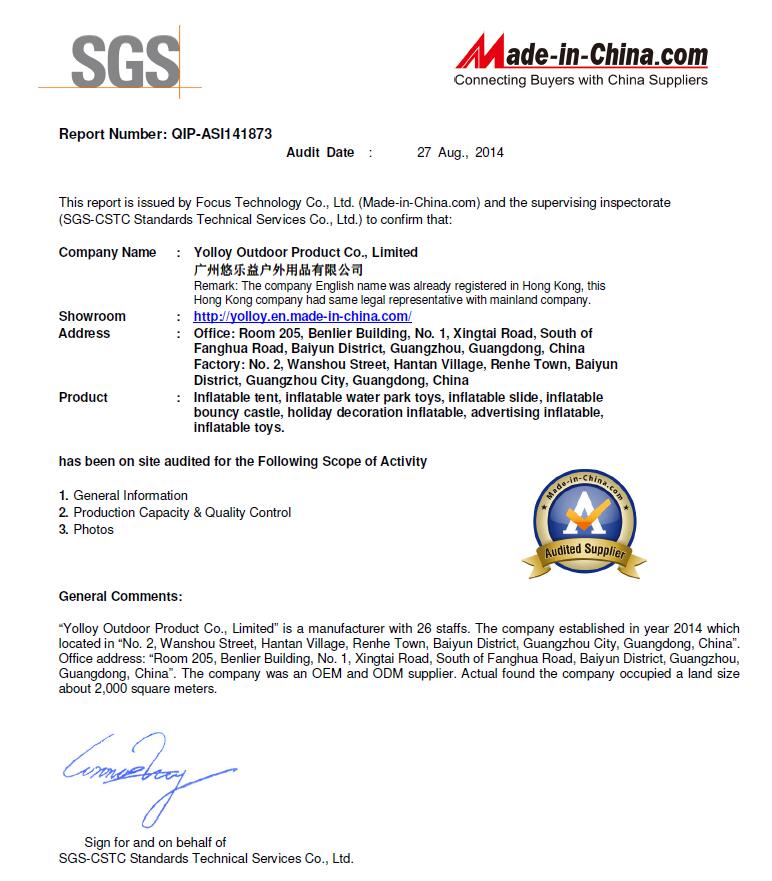
Certification

News

• New Order Successfully Finished for Long-Time Cooperated Japanese Client | YOLLOY Wins Full Client Recognition

• YOLLOY Custom Inflatable Pool Tent for Danish Client: Professional Pool Repair Shelter & Debris Protection

• Trusted Once Again! Greek Captain Re-orders Our Products After 4 Years

• Revolutionize Your Outdoors: The All-Terrain Inflatable Floating Tent for Land & Water

• Elevate Your Summer Fun: The Ultimate Inflatable Water Floating Volleyball Court Trampoline

• Innovative Inflatable Nightclub Tents & Pop-Up Bars: The Ultimate Solution for Portable Party Venues

Contact Us

Name: Sunny Yang
Tel: +86-20-8370 0771
Fax: +86-20-8370 0771
Mobile: 13570587575
E-mail: sales@yolloy.com
Add: No 5,Xiong wei Bo Nan Road,ZhongLuoTan Town,Baiyun district,Guangzhou,China
Friend me on Facebook Follow me on Twitter Add me to your circles Follow me on Pinterest Watch my channel on YouTube
News

Why Outdoor Inflatable Tents Are the Smart Choice for Events, Business, and Outdoor Activities

Author:yolloy Date:2026/7/15 15:32:04
When you think about hosting an outdoor event or expanding a commercial space, the first thing that probably comes to mind is a traditional pole tent or a permanent structure. Both options come with serious drawbacks: pole tents take hours to set up and require a large crew, while permanent buildings involve construction permits, high costs, and zero flexibility. There is a third option that more and more event planners, rental businesses, and commercial operators are turning to — the outdoor inflatable tent.
Unlike a standard tent that relies on rigid poles and heavy fabric, an inflatable tent uses air-filled beams to create a sturdy, weather-resistant shelter that can be set up in minutes by just a couple of people. The concept has been around for years, but recent advances in materials and manufacturing have turned the inflatable tent from a novelty item into a serious commercial solution. Today, businesses use them for trade show booths, pop-up dining spaces, outdoor classrooms, emergency shelters, and everything in between.
What Sets an Inflatable Tent Apart
The most obvious advantage of an inflatable tent is setup speed. A large event tent that would take a team of four an hour to assemble with poles can be inflated and anchored within ten to fifteen minutes. This time saving translates directly into lower labor costs and less stress on event day. But speed is only part of the story.
A well-made inflatable tent is surprisingly durable. The structural beams, once inflated, create a continuous curve that naturally sheds wind and rain. There are no sharp metal edges, no pinch points, and no rigid components that can bend or snap under pressure. When the wind picks up, the tent flexes rather than fights — a design principle borrowed from modern air-supported sports domes and military field shelters.
Portability is another key factor. A deflated tent rolls into a compact package that fits in the trunk of a car, while the same-sized pole tent would require a van or trailer just for the frame components. For businesses that do frequent setups — event rental companies, market vendors, mobile promotional teams — this difference alone often justifies switching to an inflatable model.
Different Designs for Different Needs
Not all inflatable tents look the same, and that is by design. Manufacturers who specialize in custom inflatable products offer a variety of shapes to suit different applications:
Tent Type Best For Key Feature
Cube Tent Trade shows, product displays, ticket booths Maximizes interior floor space with vertical walls
Tunnel Tent Walk-through exhibits, covered walkways, dining halls Long, continuous interior perfect for guiding foot traffic
Dome Tent Projection theaters, planetariums, yoga studios 360-degree interior surface ideal for immersive projections
Party Tent Weddings, birthdays, corporate celebrations Open-plan layout with customizable sidewalls and decor options
Sport Tent Indoor sports, golf simulators, fitness events High ceilings and wide spans to accommodate active movement
Each shape serves a purpose. A cube tent is the go-to for exhibitors who need clean, usable wall space. A tunnel tent works beautifully for guided exhibition routes or outdoor dining corridors. A dome tent, with its curved interior, is unmatched for projection-based experiences like outdoor cinema nights or immersive brand activations. The best part is that all of these configurations can be produced as a custom inflatable tent with your choice of size, color, and printed branding.
Why Event Planners Are Making the Switch
If you have ever organized an outdoor event, you know that weather is the biggest variable. A sudden gust of wind or an unexpected drizzle can ruin hours of preparation. Traditional frame tents with sidewalls offer some protection, but they are bulky, slow to deploy, and limited in shape. An inflatable tent for events solves all of these problems in one package.
Imagine a wedding reception set inside a sleek white dome tent, with fairy lights tracing the arched ceiling and clear side panels letting guests enjoy the sunset. Or a corporate product launch where a branded cube tent serves as a pop-up showroom, complete with printed logos on every exterior panel. These are not hypothetical scenarios — event companies around the world are already using inflatable tents to create memorable spaces that traditional tents simply cannot match.
Another practical benefit for event businesses is the reduction in storage and transportation costs. A commercial inflatable tent, when deflated, occupies a fraction of the space required by a pole tent of the same footprint. You can stack multiple units on a single pallet, ship them economically, and store them in a compact warehouse corner during the off-season.
Materials and Build Quality That Matter
The durability of an inflatable tent comes down to two things: the fabric and the construction. Commercial-grade PVC tarpaulin is the standard for most outdoor inflatable tents because it is waterproof, UV-resistant, and tough enough to handle repeated setup and takedown cycles. For applications where weight is a concern — such as backpack-carried camping tents — Oxford fabric or TPU-coated nylon may be used instead.
Key material facts: Quality inflatable tents use PVC tarpaulin that passes EN71 and EN14960 safety standards. Seams are reinforced with waterproof nylon thread, and high-stress areas like anchor points and zipper openings receive extra layers of fabric. A repair kit is typically included with every unit, and with proper care, the tent can last three years or more in commercial use.
The blower system is just as important as the fabric. A properly matched blower keeps the tent at the right pressure — firm enough to maintain structural integrity, but with enough give to absorb wind loads. Blowers can be supplied for 110V, 220V, or 380V power systems, and many models run continuously at low power once the tent reaches full inflation.
Beyond Events: Practical Commercial Uses
While events and parties are the most visible applications, outdoor inflatable tents serve a wide range of commercial and industrial purposes. Automotive detailers use inflatable spray booths as portable, dust-free work environments that can be set up at a client's location and taken down when the job is done. Golf facilities use inflatable sim bay tents to create year-round practice spaces without building permanent structures.
Emergency response teams have adopted inflatable shelters for field hospitals, command centers, and temporary housing because they can be airlifted into remote areas and deployed by a two-person crew. Farmers' market vendors use compact inflatable tents as branded stalls that stand out from the sea of generic white canopies. The common thread is that each of these users needed a shelter that was fast to deploy, easy to transport, and tough enough for real-world conditions.
Customization Is the Real Game-Changer
One of the biggest advantages of working with a specialized China inflatable manufacturer is the level of customization available. You are not limited to picking a size from a catalog. You can specify the exact dimensions you need, choose your fabric colors, add printed logos and graphics, and even request functional modifications like extra doors, ventilation windows, or cable entry points.
The design process typically starts with a conversation about your requirements. The manufacturer creates a digital rendering of the proposed tent so you can see exactly what it will look like before production begins. You can request revisions until you are happy with the design. Once approved, the tent goes into production — and because the minimum order quantity can be as low as one piece, you do not need to commit to a bulk purchase just to get a custom product.
This level of customization makes inflatable tents particularly attractive for brand marketing. A tent shaped like your product, printed with your company colors, and designed with your event workflow in mind becomes more than just a shelter — it becomes a mobile brand experience that customers remember long after the event ends.
What to Look for When Choosing a Supplier
Not all inflatable tents are created equal, and choosing the right supplier makes all the difference. Look for a manufacturer that offers detailed product information, transparent pricing, and a clear quality control process. Ask about the materials they use and whether they meet recognized safety standards. Inquire about warranty terms and after-sales support — a reputable supplier will provide repair kits and respond to inquiries within a reasonable timeframe.
Shipping is another consideration. If you are importing from overseas, check whether the supplier offers both air and sea freight options and what the typical transit times are. Air freight can deliver a tent within a week, while sea freight is more economical for bulk orders but takes longer. A good supplier will help you navigate these logistics rather than leaving you to figure it out on your own.
Making the Right Investment for Your Business
An outdoor inflatable tent is not a disposable purchase — it is a business asset that should serve you for years. When you factor in the time savings on setup, the reduction in labor costs, the portability, and the branding opportunities, the value proposition becomes clear. Event rental companies can expand their inventory without taking up more warehouse space. Brands can create pop-up experiences without the overhead of permanent venues. And outdoor enthusiasts can enjoy camping without wrestling with pole assemblies in the dark.
The inflatable tent market continues to grow because the technology genuinely solves problems that traditional tents cannot address. As materials improve and manufacturing techniques advance, these products are only going to get lighter, stronger, and more versatile.
Ready to explore inflatable tent solutions for your next event or business venture? Yolloy Outdoor Product Co., Limited specializes in custom inflatable products — from outdoor event tents and clear dome tents to water parks and interactive sports games. Every product is built with commercial-grade materials and backed by a commitment to quality and responsive service. Reach out today to discuss your requirements and receive a tailored solution that fits your needs and budget.


Why Outdoor Inflatable Tents Are the Smart Choice for Events, Business, and Outdoor Activities

Author:yolloy Date:2026/7/15 15:32:04

When you think about hosting an outdoor event or expanding a commercial space, the first thing that probably comes to mind is a traditional pole tent or a permanent structure. Both options come with serious drawbacks: pole tents take hours to set up and require a large crew, while permanent buildings involve construction permits, high costs, and zero flexibility. There is a third option that more and more event planners, rental businesses, and commercial operators are turning to — the outdoor inflatable tent.
Unlike a standard tent that relies on rigid poles and heavy fabric, an inflatable tent uses air-filled beams to create a sturdy, weather-resistant shelter that can be set up in minutes by just a couple of people. The concept has been around for years, but recent advances in materials and manufacturing have turned the inflatable tent from a novelty item into a serious commercial solution. Today, businesses use them for trade show booths, pop-up dining spaces, outdoor classrooms, emergency shelters, and everything in between.
What Sets an Inflatable Tent Apart
The most obvious advantage of an inflatable tent is setup speed. A large event tent that would take a team of four an hour to assemble with poles can be inflated and anchored within ten to fifteen minutes. This time saving translates directly into lower labor costs and less stress on event day. But speed is only part of the story.
A well-made inflatable tent is surprisingly durable. The structural beams, once inflated, create a continuous curve that naturally sheds wind and rain. There are no sharp metal edges, no pinch points, and no rigid components that can bend or snap under pressure. When the wind picks up, the tent flexes rather than fights — a design principle borrowed from modern air-supported sports domes and military field shelters.
Portability is another key factor. A deflated tent rolls into a compact package that fits in the trunk of a car, while the same-sized pole tent would require a van or trailer just for the frame components. For businesses that do frequent setups — event rental companies, market vendors, mobile promotional teams — this difference alone often justifies switching to an inflatable model.
Different Designs for Different Needs
Not all inflatable tents look the same, and that is by design. Manufacturers who specialize in custom inflatable products offer a variety of shapes to suit different applications:
Tent Type Best For Key Feature
Cube Tent Trade shows, product displays, ticket booths Maximizes interior floor space with vertical walls
Tunnel Tent Walk-through exhibits, covered walkways, dining halls Long, continuous interior perfect for guiding foot traffic
Dome Tent Projection theaters, planetariums, yoga studios 360-degree interior surface ideal for immersive projections
Party Tent Weddings, birthdays, corporate celebrations Open-plan layout with customizable sidewalls and decor options
Sport Tent Indoor sports, golf simulators, fitness events High ceilings and wide spans to accommodate active movement
Each shape serves a purpose. A cube tent is the go-to for exhibitors who need clean, usable wall space. A tunnel tent works beautifully for guided exhibition routes or outdoor dining corridors. A dome tent, with its curved interior, is unmatched for projection-based experiences like outdoor cinema nights or immersive brand activations. The best part is that all of these configurations can be produced as a custom inflatable tent with your choice of size, color, and printed branding.
Why Event Planners Are Making the Switch
If you have ever organized an outdoor event, you know that weather is the biggest variable. A sudden gust of wind or an unexpected drizzle can ruin hours of preparation. Traditional frame tents with sidewalls offer some protection, but they are bulky, slow to deploy, and limited in shape. An inflatable tent for events solves all of these problems in one package.
Imagine a wedding reception set inside a sleek white dome tent, with fairy lights tracing the arched ceiling and clear side panels letting guests enjoy the sunset. Or a corporate product launch where a branded cube tent serves as a pop-up showroom, complete with printed logos on every exterior panel. These are not hypothetical scenarios — event companies around the world are already using inflatable tents to create memorable spaces that traditional tents simply cannot match.
Another practical benefit for event businesses is the reduction in storage and transportation costs. A commercial inflatable tent, when deflated, occupies a fraction of the space required by a pole tent of the same footprint. You can stack multiple units on a single pallet, ship them economically, and store them in a compact warehouse corner during the off-season.
Materials and Build Quality That Matter
The durability of an inflatable tent comes down to two things: the fabric and the construction. Commercial-grade PVC tarpaulin is the standard for most outdoor inflatable tents because it is waterproof, UV-resistant, and tough enough to handle repeated setup and takedown cycles. For applications where weight is a concern — such as backpack-carried camping tents — Oxford fabric or TPU-coated nylon may be used instead.
Key material facts: Quality inflatable tents use PVC tarpaulin that passes EN71 and EN14960 safety standards. Seams are reinforced with waterproof nylon thread, and high-stress areas like anchor points and zipper openings receive extra layers of fabric. A repair kit is typically included with every unit, and with proper care, the tent can last three years or more in commercial use.
The blower system is just as important as the fabric. A properly matched blower keeps the tent at the right pressure — firm enough to maintain structural integrity, but with enough give to absorb wind loads. Blowers can be supplied for 110V, 220V, or 380V power systems, and many models run continuously at low power once the tent reaches full inflation.
Beyond Events: Practical Commercial Uses
While events and parties are the most visible applications, outdoor inflatable tents serve a wide range of commercial and industrial purposes. Automotive detailers use inflatable spray booths as portable, dust-free work environments that can be set up at a client's location and taken down when the job is done. Golf facilities use inflatable sim bay tents to create year-round practice spaces without building permanent structures.
Emergency response teams have adopted inflatable shelters for field hospitals, command centers, and temporary housing because they can be airlifted into remote areas and deployed by a two-person crew. Farmers' market vendors use compact inflatable tents as branded stalls that stand out from the sea of generic white canopies. The common thread is that each of these users needed a shelter that was fast to deploy, easy to transport, and tough enough for real-world conditions.
Customization Is the Real Game-Changer
One of the biggest advantages of working with a specialized China inflatable manufacturer is the level of customization available. You are not limited to picking a size from a catalog. You can specify the exact dimensions you need, choose your fabric colors, add printed logos and graphics, and even request functional modifications like extra doors, ventilation windows, or cable entry points.
The design process typically starts with a conversation about your requirements. The manufacturer creates a digital rendering of the proposed tent so you can see exactly what it will look like before production begins. You can request revisions until you are happy with the design. Once approved, the tent goes into production — and because the minimum order quantity can be as low as one piece, you do not need to commit to a bulk purchase just to get a custom product.
This level of customization makes inflatable tents particularly attractive for brand marketing. A tent shaped like your product, printed with your company colors, and designed with your event workflow in mind becomes more than just a shelter — it becomes a mobile brand experience that customers remember long after the event ends.
What to Look for When Choosing a Supplier
Not all inflatable tents are created equal, and choosing the right supplier makes all the difference. Look for a manufacturer that offers detailed product information, transparent pricing, and a clear quality control process. Ask about the materials they use and whether they meet recognized safety standards. Inquire about warranty terms and after-sales support — a reputable supplier will provide repair kits and respond to inquiries within a reasonable timeframe.
Shipping is another consideration. If you are importing from overseas, check whether the supplier offers both air and sea freight options and what the typical transit times are. Air freight can deliver a tent within a week, while sea freight is more economical for bulk orders but takes longer. A good supplier will help you navigate these logistics rather than leaving you to figure it out on your own.
Making the Right Investment for Your Business
An outdoor inflatable tent is not a disposable purchase — it is a business asset that should serve you for years. When you factor in the time savings on setup, the reduction in labor costs, the portability, and the branding opportunities, the value proposition becomes clear. Event rental companies can expand their inventory without taking up more warehouse space. Brands can create pop-up experiences without the overhead of permanent venues. And outdoor enthusiasts can enjoy camping without wrestling with pole assemblies in the dark.
The inflatable tent market continues to grow because the technology genuinely solves problems that traditional tents cannot address. As materials improve and manufacturing techniques advance, these products are only going to get lighter, stronger, and more versatile.
Ready to explore inflatable tent solutions for your next event or business venture? Yolloy Outdoor Product Co., Limited specializes in custom inflatable products — from outdoor event tents and clear dome tents to water parks and interactive sports games. Every product is built with commercial-grade materials and backed by a commitment to quality and responsive service. Reach out today to discuss your requirements and receive a tailored solution that fits your needs and budget.