Why Inflatable Tents Are Revolutionizing Outdoor Events and Camping
August 11, 2026
Picture this: you arrive at a festival ground, a corporate event venue, or a scenic campsite. Instead of wrestling with tangled tent poles, snapping connectors, and deciphering cryptic instruction manuals, you simply unroll a compact bundle, connect a blower, and watch a fully functional shelter rise in minutes. That is the reality of inflatable tent technology — a category that has quietly transformed how businesses, event organizers, and outdoor enthusiasts think about temporary shelter.
Once considered a niche novelty, inflatable tents have matured into a serious alternative to traditional pole-based structures. The global shift is unmistakable: from glamping resorts in Europe to emergency response deployments in South America, inflatable structures are proving their value across a remarkably diverse range of applications. Whether you need a inflatable party tent for a weekend celebration or a fleet of durable shelters for commercial operations, the technology has evolved far beyond its early limitations.
The Core Advantage: Speed Without Sacrifice
The most immediate difference between a traditional tent and an inflatable model is setup time. A standard pole tent requires threading poles through sleeves, coordinating multiple people, and spending 20 to 60 minutes on assembly — often longer in wind or rain. An inflatable tent, by contrast, deploys in minutes. Once the integrated air beams are pressurized via an electric or manual pump, the structure stands on its own. This alone explains why event rental companies, military units, and festival organizers are increasingly turning to inflatable tent manufacturers for their shelter needs.
But speed is only part of the story. The structural integrity of a properly designed inflatable tent comes from large-diameter air beams that distribute stress evenly across the frame. When inflated to the correct pressure, these beams create a rigid, self-supporting skeleton that actually handles gusty conditions better than many thin aluminum or fiberglass pole systems. In extreme weather, a pole may bend or snap; an air beam flexes and recovers. Coupled with D-ring or round metal anchor systems, a well-made inflatable tent can stand firm in conditions that would compromise traditional structures.
Beyond Camping: The Commercial and Industrial Landscape
While weekend campers were among the early adopters, the real growth in inflatable tent technology is happening in the commercial sector. Event planners use them for outdoor weddings, product launches, and VIP lounges. Sports teams deploy them as sideline shelters and changing rooms. Automotive detailers rely on inflatable spray booths with ventilation systems. Golf simulators are housed in portable inflatable enclosures that can be set up anywhere. Even emergency services have adopted inflatable shelters for field hospitals, command posts, and temporary housing.
One particularly eye-catching category is the clear inflatable bubble tent, which has become a staple of luxury camping and outdoor dining. Made from transparent PVC material, these spherical structures offer a 360-degree view of the surrounding landscape while keeping occupants comfortable and protected. They have been used for stargazing dinners, winter garden parties, and hotel pop-up suites — creating memorable experiences that a standard canvas tent simply cannot deliver.
Did You Know? The inflatable dome tent category now includes cube, tunnel, shelter, car, party, sports, emergency, and workshop configurations — each designed for specific use cases with tailored materials, anchoring systems, and ventilation options.
What to Look for in a Quality Inflatable Tent
Not all inflatable tents are created equal. When evaluating options, several factors separate professional-grade products from budget alternatives:
Materials matter. Commercial-grade PVC tarpaulin is the gold standard for durability and weather resistance. For lightweight applications, Oxford fabric, nylon, or TPU may be specified. The best manufacturers offer material choices based on the intended use case rather than applying a one-size-fits-all approach.
Seam construction is critical. Precision sewing equipment, reinforced seams, waterproof nylon thread, and additional reinforcement at high-load areas extend the life of the product significantly. For airtight structures, high-temperature fusion welding equipment ensures consistent, leak-free seals.
Certifications provide peace of mind. Look for products that meet recognized standards. Materials should pass EN71, EN14960, and RoHS testing. Water park products should reference EN 15649. Blowers should carry CE or UL certification to ensure safe, reliable operation across different voltage requirements (110V, 220V, or 380V).
Customization capability. The ability to customize sizes, colors, logos, and artwork is essential for businesses. A capable manufacturer can work from a description, drawing, sketch, photograph, site plan, and budget to deliver exactly what you need — even with a minimum order quantity of just one piece.
After-sales support. Every inflatable product should come with a repair kit. A manufacturer that responds within 24 hours and maintains a 95% on-time delivery rate is a partner worth keeping.
Inflatable Tents vs. Traditional Tents: A Quick Comparison
| Feature |
Inflatable Tent |
Traditional Pole Tent |
| Setup Time |
2–10 minutes with electric pump |
20–60+ minutes, often needs 2+ people |
| Wind Performance |
Flexes and recovers; large-diameter air beams absorb gusts |
Poles can bend or snap; relies heavily on guy ropes |
| Repairability |
Patch kit fixes punctures quickly; tubes can be replaced |
Broken poles usually require replacement parts |
| Portability |
Deflates into a compact, single-unit bundle |
Multiple components; poles set the minimum pack length |
| Customization |
Highly customizable — size, shape, color, printing, branding |
Limited to off-the-shelf designs |
| Commercial Use |
Extensively used in events, sports, hospitality, emergency |
Primarily recreational camping |
The Supply Chain Advantage: Why Direct from Factory Matters
For businesses purchasing inflatable tents at scale — whether for rental fleets, event operations, or resale — the supply chain makes a measurable difference. Working directly with a factory-based manufacturer eliminates intermediary markups, provides access to custom design services, and ensures consistent quality control. A manufacturer that handles everything from design simulation to final inspection under one roof can deliver shorter lead times (typically 6–15 days for regular products) and more responsive communication.
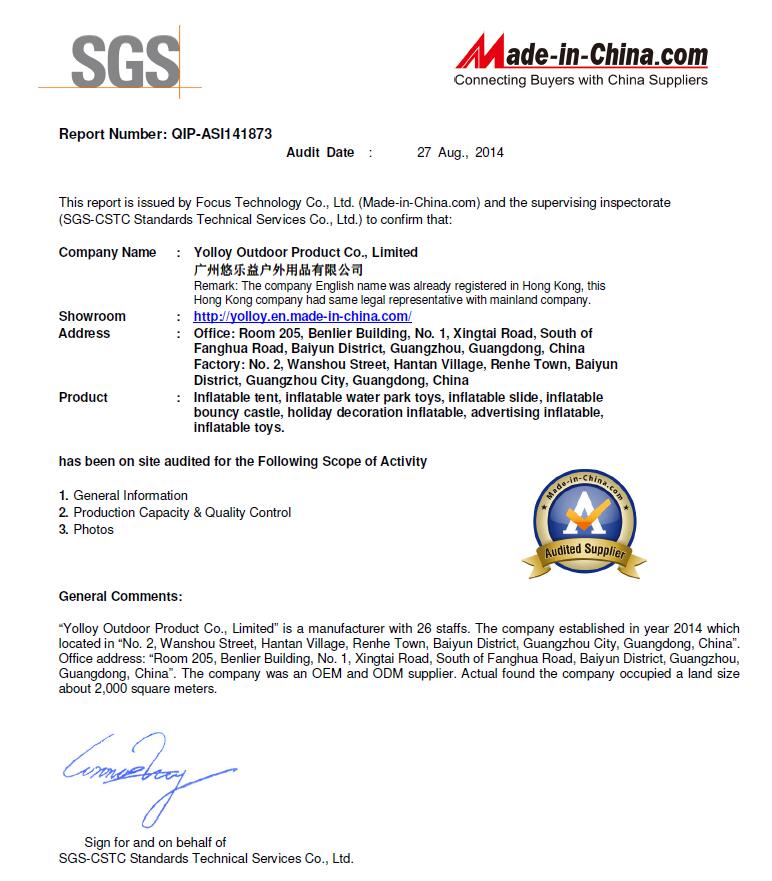
YOLLOY Outdoor Product Co., Limited, based in Guangzhou, China, exemplifies this factory-direct model. With a full design-to-production workflow, the company creates 3D simulation renderings from customer proposals, revises designs until approval, and then releases them for production. Products are inspected and tested before shipment, packed with soft carpet protection, waterproof PVC bags, and outer PE film. Each product ships with a repair kit, and blowers are matched to the customer's voltage requirements. The company reports a 95% on-time delivery rate and responds to inquiries within 24 hours, with air and sea shipping options available to markets across Europe, Asia, South America, Africa, the Middle East, and Latin America.
Practical Considerations Before You Buy
When planning an inflatable tent purchase, keep these practical points in mind:
Space and anchoring. Measure your site and confirm that the tent footprint fits with adequate clearance. Check that the ground can accommodate D-ring or metal anchor systems. For hard surfaces, weighted anchors may be needed.
Power supply. Most inflatable tents require a continuous blower to maintain pressure. Ensure you have reliable power access. Blowers are available in 110V, 220V, and 380V configurations to match local electrical standards.
Weather expectations. While inflatable tents perform well in wind, snow loading should be considered for winter deployments. Discuss your climate conditions with the manufacturer so the right materials and reinforcements can be specified.
Maintenance routine. Clean the tent after use, dry it thoroughly before storage, and periodically inspect seams and air beams. The included repair kit handles minor punctures, and the manufacturer can provide guidance for more significant repairs.
Ready to Explore Inflatable Tent Solutions?
Whether you are outfitting a glamping resort, launching an event rental business, equipping a sports facility, or preparing for emergency response operations, the right inflatable tent can transform how you approach temporary shelter. YOLLOY offers a comprehensive range of inflatable tent products — from clear bubble domes and cube tents to tunnel shelters and custom-designed structures — all built to international safety standards with a three-year service life expectation under proper use and maintenance. To discuss your project, reach out to the team at [email protected] or call +86-20-8370 0771. Custom designs, logos, and branding are all available — and the minimum order starts at just one piece.
|