Products Category
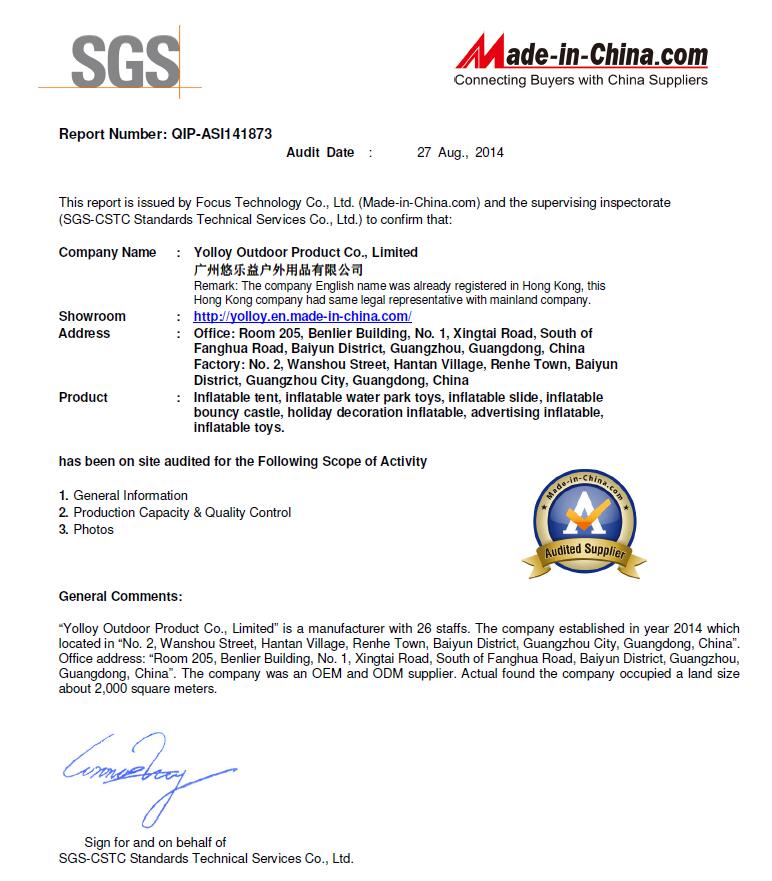
Certification

News

• New Order Successfully Finished for Long-Time Cooperated Japanese Client | YOLLOY Wins Full Client Recognition

• YOLLOY Custom Inflatable Pool Tent for Danish Client: Professional Pool Repair Shelter & Debris Protection

• Trusted Once Again! Greek Captain Re-orders Our Products After 4 Years

• Revolutionize Your Outdoors: The All-Terrain Inflatable Floating Tent for Land & Water

• Elevate Your Summer Fun: The Ultimate Inflatable Water Floating Volleyball Court Trampoline

• Innovative Inflatable Nightclub Tents & Pop-Up Bars: The Ultimate Solution for Portable Party Venues

Contact Us

Name: Sunny Yang
Tel: +86-20-8370 0771
Fax: +86-20-8370 0771
Mobile: 13570587575
E-mail: [email protected]
Add: No 5,Xiong wei Bo Nan Road,ZhongLuoTan Town,Baiyun district,Guangzhou,China
Friend me on Facebook Follow me on Twitter Add me to your circles Follow me on Pinterest Watch my channel on YouTube
News

The Rise of Inflatable Event Tents: Why Party Planners and Venue Owners Are Making the Switch

Author:yolloy Date:2026/8/11 7:49:58

The Rise of Inflatable Event Tents: Why Party Planners and Venue Owners Are Making the Switch

From weddings to corporate galas, discover how inflatable structures are transforming the event industry and how to source them directly from the manufacturer.

Walk into any major outdoor event this year, and you will notice something different. The traditional pole-and-canvas marquees that once dominated weddings, music festivals, and corporate gatherings are being replaced by something far more striking: sleek, modern inflatable party tent structures that seem to float above the ground. These are not the bouncy castles of childhood birthday parties — they are engineered commercial spaces that combine architectural ambition with practical flexibility. For event planners, venue owners, and rental businesses, the shift toward inflatable event solutions represents one of the most significant changes in the industry in decades.

What Makes an Inflatable Event Tent Different?

An inflatable event tent is fundamentally different from a traditional pole tent. Instead of relying on a rigid metal or wooden frame, it uses air-filled beams and columns to create its structure. A continuous-flow blower keeps the beams inflated, and the tent stands firm as long as the blower is running. This design eliminates the need for dozens of separate poles, connectors, and tension cables — the tent is essentially a single, integrated unit.

The materials used in commercial-grade inflatable tents are also a step above what you might expect. Reputable manufacturers use commercial-grade PVC tarpaulin, Oxford fabric, nylon, or TPU depending on the application. These materials are tested to meet international safety standards, including EN71, EN14960, and RoHS requirements. The seams are precision-sewn with waterproof nylon thread, and high-load areas receive additional reinforcement. For airtight products, high-temperature fusion welding equipment ensures leak-free performance.

Why Event Professionals Are Choosing Inflatable Tents

Faster Setup, Fewer Crew Members

A traditional large pole tent can take a crew of four to six people several hours to erect. An inflatable tent of the same size can be fully deployed by two people in a fraction of the time. This difference in labor cost alone can justify the investment for rental companies that set up and tear down multiple events each week. The setup process is straightforward: unroll the tent, stake down the anchor points, connect the blower, and wait for the structure to rise. No ladders, no heavy lifting, no complex assembly diagrams.

More Design Freedom

Pole tents are limited by the geometry of their frames. You can have a rectangle, a square, or perhaps a peaked center. An inflatable dome tent, by contrast, can be a perfect sphere, a tunnel, a cube, or a custom shape designed to match a brand logo or event theme. The curved, organic forms of inflatable structures create a visual impact that standard marquees simply cannot match. This is why inflatable domes have become the go-to choice for immersive brand activations, VIP lounges at music festivals, and high-end wedding receptions.

Better Weather Resistance

When properly secured with D-ring or round metal anchor systems, an inflatable tent can handle wind loads that would bend traditional tent poles. The air beams flex under pressure rather than resisting it rigidly, which means they distribute stress more evenly across the structure. This flexibility makes inflatable tents surprisingly resilient in storms and high-wind conditions. The continuous blower also maintains positive internal pressure, which helps the tent shed rain and snow rather than letting it pool on the roof.

Lower Total Cost of Ownership

The upfront cost of an inflatable tent is often higher than a comparable pole tent, but the total cost of ownership tells a different story. Fewer crew members needed for setup, reduced transport volume (a deflated tent packs into a surprisingly compact bundle), and lower maintenance requirements all contribute to a faster return on investment. Pole tents require regular replacement of worn poles, connectors, and tension hardware. Inflatable tents, when maintained properly, primarily need the blower serviced and occasional patch repairs — and every unit ships with a repair kit included.

What Types of Inflatable Tents Are Available?

The range of inflatable tents available today extends far beyond the basic camping models. Here are the main categories that event professionals should know about:

Cube and Tunnel Tents: Ideal for trade show booths, product launches, and pop-up retail spaces. The straight walls maximize usable interior floor area, while the modular design allows multiple units to be connected into larger complexes.

Dome Tents: The spherical shape provides exceptional structural strength and a dramatic visual presence. Popular for planetarium shows, immersive projection experiences, VIP lounges, and luxury glamping setups.

Clear Bubble Tents: Made from transparent PVC, these tents offer 360-degree views and are enormously popular for outdoor dining, stargazing events, wedding receptions, and holiday markets. The see-through walls create a magical connection between the indoor event space and the surrounding environment.

Party and Event Tents: Available in a wide range of sizes and shapes, these are the workhorses of the rental industry. They can be customized with printed logos, brand colors, and themed artwork to match any event concept.

Specialty Tents: This category includes inflatable nightclub tents with integrated LED lighting, golf simulator enclosures, spray painting booths, car detailing tents, and inflatable shelters for emergency response — demonstrating the versatility of air-beam technology.

What to Look for When Sourcing Inflatable Event Tents

Material Quality

The durability and safety of an inflatable tent depend on the materials used. Look for suppliers that use commercial-grade PVC tarpaulin with reinforced seams. The stitching should use waterproof nylon thread, and high-stress points should have additional layers of reinforcement. If the tent is intended for night use or outdoor dining, ask about fire-retardant treatments and UV resistance. Certifications like EN71, EN14960, and RoHS compliance are indicators that the manufacturer follows internationally recognized quality standards.

Blower Specifications

The blower is the heart of any inflatable tent. A quality blower should be rated for continuous operation and should meet CE or UL electrical safety requirements. Make sure the supplier can provide blowers configured for your local voltage — 110V, 220V, or 380V. The blower should be powerful enough to maintain full inflation even with normal air leakage through seams and zippers, but quiet enough not to disturb the event.

Customization Capabilities

One of the biggest advantages of working directly with a manufacturer is the ability to customize. A good supplier should be able to produce tents in custom sizes and colors, print your logo or artwork on the fabric, and even design entirely new shapes based on your description, drawing, or photograph. The best manufacturers employ in-house designers who can prepare simulation renderings from your proposal before production begins, allowing you to approve the design before any fabric is cut.

Minimum Order Quantity and Lead Time

For event rental businesses testing a new product category, minimum order quantities are a critical consideration. Some manufacturers offer a minimum order quantity of just one piece, which allows you to sample a product before committing to a larger order. Typical production time for a regular inflatable product ranges from 6 to 15 days, excluding transit time. Complex or large custom products may take longer. Air shipping typically takes 5 to 7 days, while sea freight ranges from 15 to 30 days or more.

Frequently Asked Questions

How long does an inflatable event tent last?

When used and maintained correctly, a commercial-grade inflatable tent can have a service life of approximately three years or more, depending on frequency of use and environmental conditions. Each unit is supplied with a repair kit for minor puncture repairs, and the modular design means individual components can be replaced if needed.

Can inflatable tents be used in winter or cold weather?

Yes, inflatable tents can be used year-round. The materials remain flexible in cold temperatures, and the continuous blower actually helps maintain a warmer interior environment by creating positive pressure that reduces drafts. For extreme cold conditions, the manufacturer can recommend appropriate material specifications.

How are inflatable tents anchored?

Commercial inflatable tents use D-ring or round metal anchor systems that are incorporated into the design at multiple points around the perimeter. On soft ground, heavy-duty stakes are driven through the anchor rings. On hard surfaces like concrete or asphalt, weighted ballast systems or bolt-down plates can be used.

What happens if the blower fails during an event?

A properly constructed inflatable tent does not collapse instantly when the blower stops. The air beams are designed to hold pressure for a period of time, giving you ample opportunity to address the issue. For critical applications, a backup blower can be kept on site. Many event professionals also invest in a small generator to ensure uninterrupted power.

Can I get a tent in a custom color or with my logo printed on it?

Yes. Customization is one of the core services offered by professional inflatable tent manufacturers. You can specify custom sizes, colors, and have your logo or artwork printed directly on the tent fabric. The design team typically prepares a digital rendering for your approval before production begins.

Making the Right Choice for Your Business

The inflatable tent market has matured significantly in recent years. What was once a niche product has become a mainstream choice for event professionals who value speed, visual impact, and operational efficiency. Whether you are a rental company looking to expand your inventory, a venue owner seeking a signature structure, or an event planner who wants to offer clients something truly memorable, inflatable tents deserve serious consideration.

The key to a successful investment is choosing the right manufacturing partner. Look for a supplier with a proven track record, transparent quality control processes, and the willingness to customize products to your exact specifications. The best manufacturers will guide you through the entire process — from initial concept and design rendering to production, quality inspection, packaging, and shipping.

Ready to explore inflatable event tents for your next project? YOLLOY Outdoor Product Co., Limited is a Guangzhou-based inflatable product manufacturer specializing in custom inflatable tents, clear domes, party tents, and event structures. With a minimum order quantity of just one piece, materials certified to EN71, EN14960, and RoHS standards, and a stated 95% on-time delivery rate, YOLLOY provides end-to-end service from design to delivery. Contact their team at [email protected] or visit www.yolloy.net to discuss your requirements.

The Rise of Inflatable Event Tents: Why Party Planners and Venue Owners Are Making the Switch

Author:yolloy Date:2026/8/11 7:49:58

The Rise of Inflatable Event Tents: Why Party Planners and Venue Owners Are Making the Switch

From weddings to corporate galas, discover how inflatable structures are transforming the event industry and how to source them directly from the manufacturer.

Walk into any major outdoor event this year, and you will notice something different. The traditional pole-and-canvas marquees that once dominated weddings, music festivals, and corporate gatherings are being replaced by something far more striking: sleek, modern inflatable party tent structures that seem to float above the ground. These are not the bouncy castles of childhood birthday parties — they are engineered commercial spaces that combine architectural ambition with practical flexibility. For event planners, venue owners, and rental businesses, the shift toward inflatable event solutions represents one of the most significant changes in the industry in decades.

What Makes an Inflatable Event Tent Different?

An inflatable event tent is fundamentally different from a traditional pole tent. Instead of relying on a rigid metal or wooden frame, it uses air-filled beams and columns to create its structure. A continuous-flow blower keeps the beams inflated, and the tent stands firm as long as the blower is running. This design eliminates the need for dozens of separate poles, connectors, and tension cables — the tent is essentially a single, integrated unit.

The materials used in commercial-grade inflatable tents are also a step above what you might expect. Reputable manufacturers use commercial-grade PVC tarpaulin, Oxford fabric, nylon, or TPU depending on the application. These materials are tested to meet international safety standards, including EN71, EN14960, and RoHS requirements. The seams are precision-sewn with waterproof nylon thread, and high-load areas receive additional reinforcement. For airtight products, high-temperature fusion welding equipment ensures leak-free performance.

Why Event Professionals Are Choosing Inflatable Tents

Faster Setup, Fewer Crew Members

A traditional large pole tent can take a crew of four to six people several hours to erect. An inflatable tent of the same size can be fully deployed by two people in a fraction of the time. This difference in labor cost alone can justify the investment for rental companies that set up and tear down multiple events each week. The setup process is straightforward: unroll the tent, stake down the anchor points, connect the blower, and wait for the structure to rise. No ladders, no heavy lifting, no complex assembly diagrams.

More Design Freedom

Pole tents are limited by the geometry of their frames. You can have a rectangle, a square, or perhaps a peaked center. An inflatable dome tent, by contrast, can be a perfect sphere, a tunnel, a cube, or a custom shape designed to match a brand logo or event theme. The curved, organic forms of inflatable structures create a visual impact that standard marquees simply cannot match. This is why inflatable domes have become the go-to choice for immersive brand activations, VIP lounges at music festivals, and high-end wedding receptions.

Better Weather Resistance

When properly secured with D-ring or round metal anchor systems, an inflatable tent can handle wind loads that would bend traditional tent poles. The air beams flex under pressure rather than resisting it rigidly, which means they distribute stress more evenly across the structure. This flexibility makes inflatable tents surprisingly resilient in storms and high-wind conditions. The continuous blower also maintains positive internal pressure, which helps the tent shed rain and snow rather than letting it pool on the roof.

Lower Total Cost of Ownership

The upfront cost of an inflatable tent is often higher than a comparable pole tent, but the total cost of ownership tells a different story. Fewer crew members needed for setup, reduced transport volume (a deflated tent packs into a surprisingly compact bundle), and lower maintenance requirements all contribute to a faster return on investment. Pole tents require regular replacement of worn poles, connectors, and tension hardware. Inflatable tents, when maintained properly, primarily need the blower serviced and occasional patch repairs — and every unit ships with a repair kit included.

What Types of Inflatable Tents Are Available?

The range of inflatable tents available today extends far beyond the basic camping models. Here are the main categories that event professionals should know about:

Cube and Tunnel Tents: Ideal for trade show booths, product launches, and pop-up retail spaces. The straight walls maximize usable interior floor area, while the modular design allows multiple units to be connected into larger complexes.

Dome Tents: The spherical shape provides exceptional structural strength and a dramatic visual presence. Popular for planetarium shows, immersive projection experiences, VIP lounges, and luxury glamping setups.

Clear Bubble Tents: Made from transparent PVC, these tents offer 360-degree views and are enormously popular for outdoor dining, stargazing events, wedding receptions, and holiday markets. The see-through walls create a magical connection between the indoor event space and the surrounding environment.

Party and Event Tents: Available in a wide range of sizes and shapes, these are the workhorses of the rental industry. They can be customized with printed logos, brand colors, and themed artwork to match any event concept.

Specialty Tents: This category includes inflatable nightclub tents with integrated LED lighting, golf simulator enclosures, spray painting booths, car detailing tents, and inflatable shelters for emergency response — demonstrating the versatility of air-beam technology.

What to Look for When Sourcing Inflatable Event Tents

Material Quality

The durability and safety of an inflatable tent depend on the materials used. Look for suppliers that use commercial-grade PVC tarpaulin with reinforced seams. The stitching should use waterproof nylon thread, and high-stress points should have additional layers of reinforcement. If the tent is intended for night use or outdoor dining, ask about fire-retardant treatments and UV resistance. Certifications like EN71, EN14960, and RoHS compliance are indicators that the manufacturer follows internationally recognized quality standards.

Blower Specifications

The blower is the heart of any inflatable tent. A quality blower should be rated for continuous operation and should meet CE or UL electrical safety requirements. Make sure the supplier can provide blowers configured for your local voltage — 110V, 220V, or 380V. The blower should be powerful enough to maintain full inflation even with normal air leakage through seams and zippers, but quiet enough not to disturb the event.

Customization Capabilities

One of the biggest advantages of working directly with a manufacturer is the ability to customize. A good supplier should be able to produce tents in custom sizes and colors, print your logo or artwork on the fabric, and even design entirely new shapes based on your description, drawing, or photograph. The best manufacturers employ in-house designers who can prepare simulation renderings from your proposal before production begins, allowing you to approve the design before any fabric is cut.

Minimum Order Quantity and Lead Time

For event rental businesses testing a new product category, minimum order quantities are a critical consideration. Some manufacturers offer a minimum order quantity of just one piece, which allows you to sample a product before committing to a larger order. Typical production time for a regular inflatable product ranges from 6 to 15 days, excluding transit time. Complex or large custom products may take longer. Air shipping typically takes 5 to 7 days, while sea freight ranges from 15 to 30 days or more.

Frequently Asked Questions

How long does an inflatable event tent last?

When used and maintained correctly, a commercial-grade inflatable tent can have a service life of approximately three years or more, depending on frequency of use and environmental conditions. Each unit is supplied with a repair kit for minor puncture repairs, and the modular design means individual components can be replaced if needed.

Can inflatable tents be used in winter or cold weather?

Yes, inflatable tents can be used year-round. The materials remain flexible in cold temperatures, and the continuous blower actually helps maintain a warmer interior environment by creating positive pressure that reduces drafts. For extreme cold conditions, the manufacturer can recommend appropriate material specifications.

How are inflatable tents anchored?

Commercial inflatable tents use D-ring or round metal anchor systems that are incorporated into the design at multiple points around the perimeter. On soft ground, heavy-duty stakes are driven through the anchor rings. On hard surfaces like concrete or asphalt, weighted ballast systems or bolt-down plates can be used.

What happens if the blower fails during an event?

A properly constructed inflatable tent does not collapse instantly when the blower stops. The air beams are designed to hold pressure for a period of time, giving you ample opportunity to address the issue. For critical applications, a backup blower can be kept on site. Many event professionals also invest in a small generator to ensure uninterrupted power.

Can I get a tent in a custom color or with my logo printed on it?

Yes. Customization is one of the core services offered by professional inflatable tent manufacturers. You can specify custom sizes, colors, and have your logo or artwork printed directly on the tent fabric. The design team typically prepares a digital rendering for your approval before production begins.

Making the Right Choice for Your Business

The inflatable tent market has matured significantly in recent years. What was once a niche product has become a mainstream choice for event professionals who value speed, visual impact, and operational efficiency. Whether you are a rental company looking to expand your inventory, a venue owner seeking a signature structure, or an event planner who wants to offer clients something truly memorable, inflatable tents deserve serious consideration.

The key to a successful investment is choosing the right manufacturing partner. Look for a supplier with a proven track record, transparent quality control processes, and the willingness to customize products to your exact specifications. The best manufacturers will guide you through the entire process — from initial concept and design rendering to production, quality inspection, packaging, and shipping.

Ready to explore inflatable event tents for your next project? YOLLOY Outdoor Product Co., Limited is a Guangzhou-based inflatable product manufacturer specializing in custom inflatable tents, clear domes, party tents, and event structures. With a minimum order quantity of just one piece, materials certified to EN71, EN14960, and RoHS standards, and a stated 95% on-time delivery rate, YOLLOY provides end-to-end service from design to delivery. Contact their team at [email protected] or visit www.yolloy.net to discuss your requirements.