Products Category
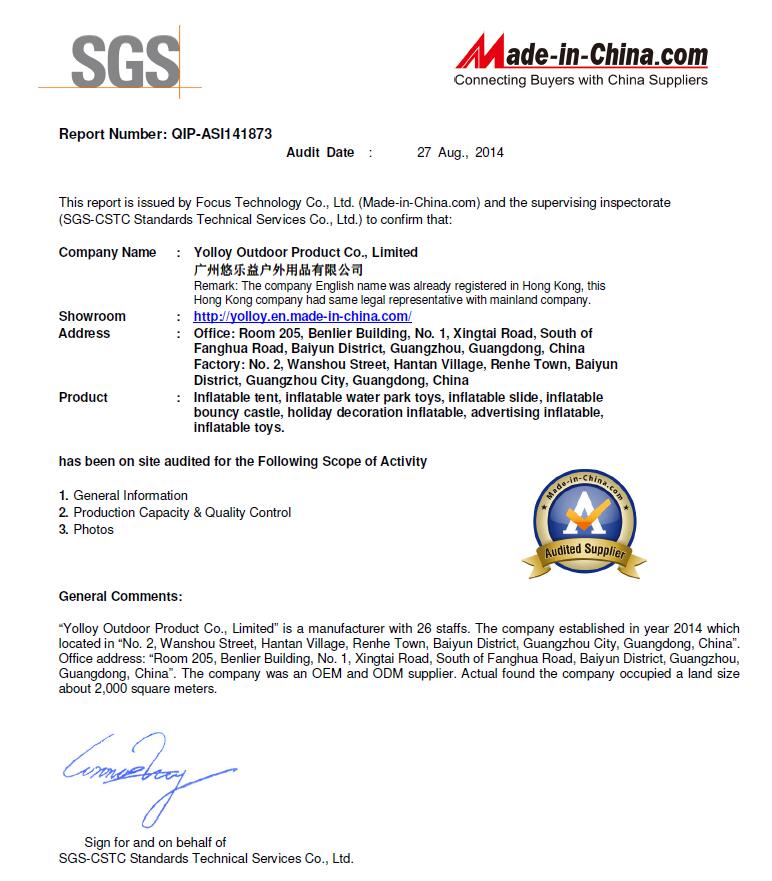
Certification

News

• New Order Successfully Finished for Long-Time Cooperated Japanese Client | YOLLOY Wins Full Client Recognition

• YOLLOY Custom Inflatable Pool Tent for Danish Client: Professional Pool Repair Shelter & Debris Protection

• Trusted Once Again! Greek Captain Re-orders Our Products After 4 Years

• Revolutionize Your Outdoors: The All-Terrain Inflatable Floating Tent for Land & Water

• Elevate Your Summer Fun: The Ultimate Inflatable Water Floating Volleyball Court Trampoline

• Innovative Inflatable Nightclub Tents & Pop-Up Bars: The Ultimate Solution for Portable Party Venues

Contact Us

Name: Sunny Yang
Tel: +86-20-8370 0771
Fax: +86-20-8370 0771
Mobile: 13570587575
E-mail: sales@yolloy.com
Add: No 5,Xiong wei Bo Nan Road,ZhongLuoTan Town,Baiyun district,Guangzhou,China
Friend me on Facebook Follow me on Twitter Add me to your circles Follow me on Pinterest Watch my channel on YouTube
News

Why an Inflatable Camping Tent Could Be the Smartest Outdoor Investment You Make This Year

Author:yolloy Date:2026/8/1 11:52:11
From weekend getaways to commercial events, inflatable tents are reshaping how people think about portable shelter and for good reason.
Setting up a traditional tent has never been anyone's favorite part of camping. Wrestling with poles, deciphering cryptic instructions, and hoping the wind doesn't pick up mid-assembly it's a familiar frustration. That's why more outdoor enthusiasts, event planners, and business owners are switching to the inflatable camping tent. With a design that trades pole-based frameworks for air-beam technology, these tents go from packed to pitched in minutes often with nothing more than an electric pump.
But speed is only part of the story. Modern inflatable tents are engineered for durability, built with commercial-grade materials, and available in configurations that traditional pole tents simply cannot match. Whether you're looking for a cozy two-person bubble for stargazing or a large-scale event shelter for hundreds of guests, the inflatable tent category has matured into a legitimate, high-performance alternative.
What Sets Inflatable Tents Apart from Traditional Pole Tents
The core difference is structural. Instead of rigid aluminum or fiberglass poles, inflatable tents use pressurized air beams typically made from reinforced TPU or PVC tarpaulin to create a self-supporting frame. Once inflated, these beams distribute load evenly across the structure, which means fewer pressure points and less risk of frame failure in gusty conditions.
The practical advantages are immediate. A single person can set up a large family-sized inflatable tent in under five minutes. There are no poles to lose, no sleeves to thread, and no complicated tensioning systems to figure out. Deflation is just as quick open the valves and the tent collapses, ready to be folded into its carry bag. For rental businesses, event companies, and anyone who needs to move shelters frequently, this efficiency translates directly into saved labor hours and faster turnaround.
Key advantage: Inflatable tents eliminate the single most common point of failure in traditional tents broken or bent poles. An air beam flexes under wind load rather than resisting it, which means the structure absorbs stress instead of transferring it to a rigid joint.
Beyond Camping: The Expanding World of Inflatable Shelters
While the inflatable camping tent remains the most familiar application, the category now spans far more than recreational use. Today's inflatable shelters serve industries ranging from hospitality to emergency response. Here are some of the most common use cases:
Glamping and hospitality: Clear inflatable bubble tents have become iconic in the luxury camping sector. Fully transparent or semi-transparent dome designs let guests sleep under the stars with full weather protection, creating an experience that traditional canvas tents cannot replicate. Resorts and eco-lodges around the world now use these as premium accommodations.
Events and exhibitions: Inflatable party tents, tunnel tents, and large dome structures are increasingly common at outdoor festivals, trade shows, and corporate events. They offer branded, weatherproof spaces that pack down compactly for transport.
Sports and recreation: From inflatable golf simulator enclosures to portable football arenas and obstacle courses, air-supported structures bring athletic facilities to locations where permanent construction isn't feasible.
Emergency and field operations: Military units, disaster relief organizations, and field researchers use inflatable shelters for rapid-deployment medical stations, command centers, and temporary housing. Setup speed and transportability are critical here.
Commercial spray booths: Inflatable spray painting booths provide automotive detailers and manufacturers with a portable, ventilated workspace that can be deployed on-site no permanent building required.
What to Look for When Choosing an Inflatable Tent
Not all inflatable tents are built to the same standard. If you're sourcing for personal use, a rental fleet, or a commercial operation, here are the factors that matter most:
Factor Why It Matters
Material quality Commercial-grade PVC tarpaulin with reinforced seams and waterproof nylon thread ensures long-term durability. For tent applications, Oxford fabric, nylon, or TPU may also be used depending on requirements. Look for materials that have passed EN71, EN14960, and RoHS testing.
Seam construction High-temperature fusion welding for airtight sections and precision sewing with reinforcement at high-load areas are non-negotiable for a tent that will see regular use.
Blower compatibility The blower is the heart of any inflatable structure. Make sure the manufacturer can supply blowers rated for your local voltage 110V, 220V, or 380V and that they meet CE or UL requirements.
Anchoring system D-ring or round metal anchor points should be integrated into the design for wind resistance. For outdoor installations, proper anchoring is essential for safety.
Customization capability Can the manufacturer print your logo, match your brand colors, or build to your specific dimensions? A factory that offers full customization from design to production gives you far more flexibility than one selling off-the-shelf models.
Minimum order quantity Some factories require bulk orders, while others accept single-piece purchases. This is especially important if you're testing a new design or ordering a prototype.
Why Sourcing from the Right Manufacturer Matters
The difference between an inflatable tent that lasts three seasons and one that lasts three years comes down to manufacturing quality. When evaluating inflatable tent manufacturers, look beyond the product photos. Ask about their material sourcing, quality control procedures, and whether they test products before shipment.
Established manufacturers should be able to walk you through their entire production process from the initial design and simulation rendering to factory production and final inspection. They should also provide appropriate documentation, including material test reports and safety certifications. A repair kit included with each product is a sign that the manufacturer stands behind their work and expects the product to be used in the field.
Lead times and logistics are equally important. A typical production time for a standard inflatable product is 6 to 15 days. Shipping by air takes approximately 5 to 7 days, while sea freight can take 15 to 30 days or more. A manufacturer that maintains a 95% on-time delivery rate and responds to inquiries within 24 hours is one you can build a reliable supply relationship with.
Customization: Making the Tent Work for Your Specific Needs
One of the most underappreciated advantages of working directly with an inflatable tent factory is the level of customization available. Unlike retail products with fixed specs, a custom-manufactured tent can be built around your exact requirements whether that means fitting a specific site footprint, matching corporate branding, or engineering a product for a niche application.
The customization process typically starts with a proposal: you provide a description, drawing, photograph, site plan, or simply a set of dimensions and a budget. The manufacturer's design team prepares simulation renderings, which are revised until you approve the final design. Only then does the order go into production. This iterative approach means you get exactly what you need, not a close-enough compromise.
Logos, artwork, custom colors, and non-standard sizes are all within reach. For businesses, this means the tent itself becomes a branding asset a mobile billboard that also happens to provide shelter. For event organizers, it means structures that fit the venue rather than forcing the venue to accommodate the tent.
Maintenance and Longevity: Getting the Most from Your Investment
With proper care, a well-made inflatable tent can serve reliably for three years or more, depending on frequency of use and environmental conditions. The basics are straightforward: always set up on a level surface, use the included anchoring system, avoid over-inflation, and clean the tent thoroughly before storage. Every inflatable should come with a repair kit, and minor punctures can typically be patched in the field without professional assistance.
When the tent is not in use, store it in a dry, clean environment. The product should be packed using soft carpet protection, a waterproof PVC bag, and an outer PE film layer. For large products, steel pallets may be used to prevent damage during shipping and storage. Proper packaging is not just about presentation it's a critical factor in ensuring the product arrives in ready-to-use condition.
Ready to explore inflatable tent solutions for your next project? Whether you need a single custom-designed clear bubble tent for a glamping site, a fleet of inflatable party tents for an event rental business, or a large-scale inflatable shelter for commercial use, working with an experienced manufacturer makes all the difference. Contact Yolloy Outdoor Product Co., Limited at sales@yolloy.com or call +86-20-8370 0771 to discuss your requirements. Custom sizes, colors, and branding are available and the minimum order starts at just one piece.


Why an Inflatable Camping Tent Could Be the Smartest Outdoor Investment You Make This Year

Author:yolloy Date:2026/8/1 11:52:11

From weekend getaways to commercial events, inflatable tents are reshaping how people think about portable shelter and for good reason.
Setting up a traditional tent has never been anyone's favorite part of camping. Wrestling with poles, deciphering cryptic instructions, and hoping the wind doesn't pick up mid-assembly it's a familiar frustration. That's why more outdoor enthusiasts, event planners, and business owners are switching to the inflatable camping tent. With a design that trades pole-based frameworks for air-beam technology, these tents go from packed to pitched in minutes often with nothing more than an electric pump.
But speed is only part of the story. Modern inflatable tents are engineered for durability, built with commercial-grade materials, and available in configurations that traditional pole tents simply cannot match. Whether you're looking for a cozy two-person bubble for stargazing or a large-scale event shelter for hundreds of guests, the inflatable tent category has matured into a legitimate, high-performance alternative.
What Sets Inflatable Tents Apart from Traditional Pole Tents
The core difference is structural. Instead of rigid aluminum or fiberglass poles, inflatable tents use pressurized air beams typically made from reinforced TPU or PVC tarpaulin to create a self-supporting frame. Once inflated, these beams distribute load evenly across the structure, which means fewer pressure points and less risk of frame failure in gusty conditions.
The practical advantages are immediate. A single person can set up a large family-sized inflatable tent in under five minutes. There are no poles to lose, no sleeves to thread, and no complicated tensioning systems to figure out. Deflation is just as quick open the valves and the tent collapses, ready to be folded into its carry bag. For rental businesses, event companies, and anyone who needs to move shelters frequently, this efficiency translates directly into saved labor hours and faster turnaround.
Key advantage: Inflatable tents eliminate the single most common point of failure in traditional tents broken or bent poles. An air beam flexes under wind load rather than resisting it, which means the structure absorbs stress instead of transferring it to a rigid joint.
Beyond Camping: The Expanding World of Inflatable Shelters
While the inflatable camping tent remains the most familiar application, the category now spans far more than recreational use. Today's inflatable shelters serve industries ranging from hospitality to emergency response. Here are some of the most common use cases:
Glamping and hospitality: Clear inflatable bubble tents have become iconic in the luxury camping sector. Fully transparent or semi-transparent dome designs let guests sleep under the stars with full weather protection, creating an experience that traditional canvas tents cannot replicate. Resorts and eco-lodges around the world now use these as premium accommodations.
Events and exhibitions: Inflatable party tents, tunnel tents, and large dome structures are increasingly common at outdoor festivals, trade shows, and corporate events. They offer branded, weatherproof spaces that pack down compactly for transport.
Sports and recreation: From inflatable golf simulator enclosures to portable football arenas and obstacle courses, air-supported structures bring athletic facilities to locations where permanent construction isn't feasible.
Emergency and field operations: Military units, disaster relief organizations, and field researchers use inflatable shelters for rapid-deployment medical stations, command centers, and temporary housing. Setup speed and transportability are critical here.
Commercial spray booths: Inflatable spray painting booths provide automotive detailers and manufacturers with a portable, ventilated workspace that can be deployed on-site no permanent building required.
What to Look for When Choosing an Inflatable Tent
Not all inflatable tents are built to the same standard. If you're sourcing for personal use, a rental fleet, or a commercial operation, here are the factors that matter most:
Factor Why It Matters
Material quality Commercial-grade PVC tarpaulin with reinforced seams and waterproof nylon thread ensures long-term durability. For tent applications, Oxford fabric, nylon, or TPU may also be used depending on requirements. Look for materials that have passed EN71, EN14960, and RoHS testing.
Seam construction High-temperature fusion welding for airtight sections and precision sewing with reinforcement at high-load areas are non-negotiable for a tent that will see regular use.
Blower compatibility The blower is the heart of any inflatable structure. Make sure the manufacturer can supply blowers rated for your local voltage 110V, 220V, or 380V and that they meet CE or UL requirements.
Anchoring system D-ring or round metal anchor points should be integrated into the design for wind resistance. For outdoor installations, proper anchoring is essential for safety.
Customization capability Can the manufacturer print your logo, match your brand colors, or build to your specific dimensions? A factory that offers full customization from design to production gives you far more flexibility than one selling off-the-shelf models.
Minimum order quantity Some factories require bulk orders, while others accept single-piece purchases. This is especially important if you're testing a new design or ordering a prototype.
Why Sourcing from the Right Manufacturer Matters
The difference between an inflatable tent that lasts three seasons and one that lasts three years comes down to manufacturing quality. When evaluating inflatable tent manufacturers, look beyond the product photos. Ask about their material sourcing, quality control procedures, and whether they test products before shipment.
Established manufacturers should be able to walk you through their entire production process from the initial design and simulation rendering to factory production and final inspection. They should also provide appropriate documentation, including material test reports and safety certifications. A repair kit included with each product is a sign that the manufacturer stands behind their work and expects the product to be used in the field.
Lead times and logistics are equally important. A typical production time for a standard inflatable product is 6 to 15 days. Shipping by air takes approximately 5 to 7 days, while sea freight can take 15 to 30 days or more. A manufacturer that maintains a 95% on-time delivery rate and responds to inquiries within 24 hours is one you can build a reliable supply relationship with.
Customization: Making the Tent Work for Your Specific Needs
One of the most underappreciated advantages of working directly with an inflatable tent factory is the level of customization available. Unlike retail products with fixed specs, a custom-manufactured tent can be built around your exact requirements whether that means fitting a specific site footprint, matching corporate branding, or engineering a product for a niche application.
The customization process typically starts with a proposal: you provide a description, drawing, photograph, site plan, or simply a set of dimensions and a budget. The manufacturer's design team prepares simulation renderings, which are revised until you approve the final design. Only then does the order go into production. This iterative approach means you get exactly what you need, not a close-enough compromise.
Logos, artwork, custom colors, and non-standard sizes are all within reach. For businesses, this means the tent itself becomes a branding asset a mobile billboard that also happens to provide shelter. For event organizers, it means structures that fit the venue rather than forcing the venue to accommodate the tent.
Maintenance and Longevity: Getting the Most from Your Investment
With proper care, a well-made inflatable tent can serve reliably for three years or more, depending on frequency of use and environmental conditions. The basics are straightforward: always set up on a level surface, use the included anchoring system, avoid over-inflation, and clean the tent thoroughly before storage. Every inflatable should come with a repair kit, and minor punctures can typically be patched in the field without professional assistance.
When the tent is not in use, store it in a dry, clean environment. The product should be packed using soft carpet protection, a waterproof PVC bag, and an outer PE film layer. For large products, steel pallets may be used to prevent damage during shipping and storage. Proper packaging is not just about presentation it's a critical factor in ensuring the product arrives in ready-to-use condition.
Ready to explore inflatable tent solutions for your next project? Whether you need a single custom-designed clear bubble tent for a glamping site, a fleet of inflatable party tents for an event rental business, or a large-scale inflatable shelter for commercial use, working with an experienced manufacturer makes all the difference. Contact Yolloy Outdoor Product Co., Limited at sales@yolloy.com or call +86-20-8370 0771 to discuss your requirements. Custom sizes, colors, and branding are available and the minimum order starts at just one piece.