Every summer, the same question comes up in family group chats and neighborhood lanes: which inflatable water slide is best for a family? There is no single correct answer, because the right unit depends on your kids' ages, the space you have, and how many summers you expect it to survive. This guide walks through the factors that actually matter, so you can pick a slide that keeps everyone happy without wasting money.
Start with your kids and your yard before you start with the slide
Most backyard slides are designed for a fairly narrow age window. A tall, steep slide with a deep splash pool is thrilling for a ten-year-old but intimidating (and sometimes unsafe) for a four-year-old. So the first filter is honest: how old are the kids, and are there little siblings who will share it? Look for a unit whose climbing height and slide steepness suit the youngest child who is likely to use it.
The second filter is space. Inflatable slides need not just footprint for the base, but clearance in front for the run-out and beside for anchoring. Measure the flat area of your yard, check overhead branches and power access, and remember that a generous splash pool adds to both the fun and the safe landing zone. A unit that fits tightly in the store photo rarely fits comfortably in a real lawn.
Weight capacity and how many children it truly handles
A common mismatch is buying a slide that says it holds four kids when a family has six, or choosing one rated for small children when older cousins keep visiting. Check the published weight capacity against your own crowd, and remember that wet inflatables feel heavier and more slippery than dry ones. Models with stronger seams and sturdier fabric can absorb more lively use, which matters more than the number on the box if your house is the popular one on the street.
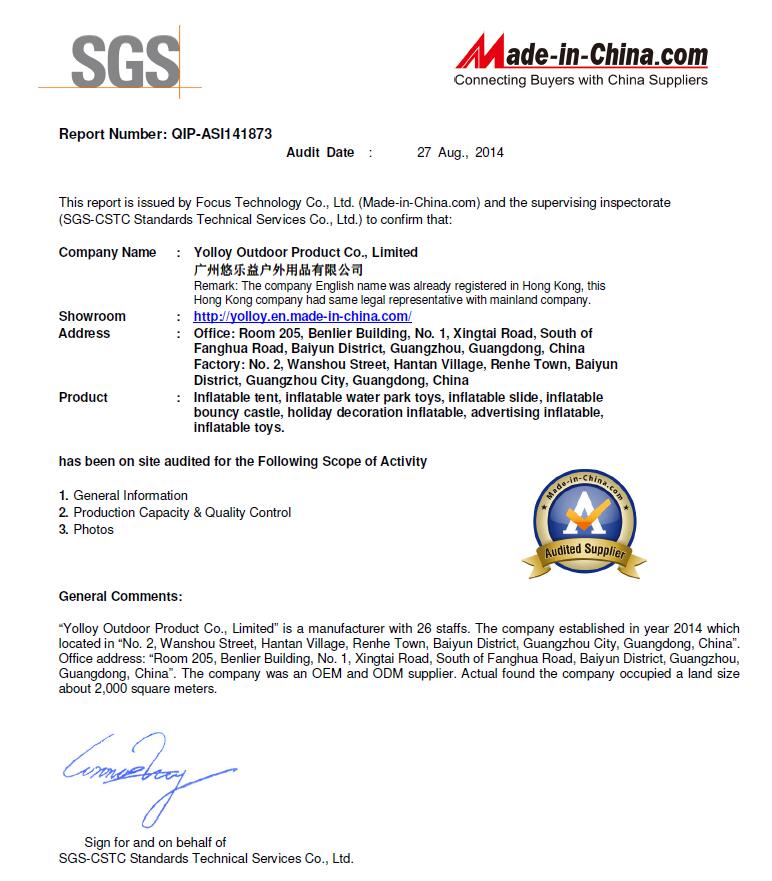
If you are shopping for an inflatable water slide for sale, treat the stated size and capacity as a starting point and ask how the base is reinforced at high-load areas. YOLLOY, an inflatable manufacturer in Guangzhou, adds extra reinforcement at pressure points and high-wear seams precisely because rough family use is where cheaper units fail first.
Material and build quality decide how many summers it lasts
The biggest gap between a cheap slide and one that stays family-friendly for years is the fabric and how it is joined. Commercial-grade PVC tarpaulin resists punctures far better than thin, glossy film. Look for precision-sewn seams using waterproof nylon thread, and airtight sections made by high-temperature fusion or welding rather than simple glue lines. These details are invisible in a product photo but are the difference between a repair project and a dependable slide.
Materials matter for safety too. Reliable suppliers confirm their materials against recognised standards, with inflatable toys often linked to EN 14960 and water-park products referenced against EN 15649, alongside tests such as EN71 and RoHS. If a seller cannot say how the fabric and seams are built, it is worth meeting a manufacturer who can. YOLLOY's commercial inflatable water slides are produced with this kind of material selection and are supplied with appropriately powered blowers for the unit's size.
Safety, anchoring, and setup you cannot skip
Inflation time and anchoring are the two practical parts people underestimate. A slide that takes an hour and several people to inflate will sit in storage. Check how the unit is staked down (D-rings or round metal anchors built into the base) and how firmly it stays put on a windy afternoon. Also confirm the blower's voltage matches your outlet and whether it needs a particular plug type before the package arrives.
Do not leave the surface wet between uses. Drain, wipe, and let the unit dry before folding, since trapped moisture is the fastest way to shorten an inflatable's life. Most suppliers ship a repair kit with each slide; keep it in the box rather than the garage so the inevitable pinhole patch happens in minutes, not days.
When customising makes sense for a family
Most families buy a ready-made slide, but there are two situations where going custom is worth it. First, if your yard has an unusual shape or a specific theme for a birthday, a giant water slide inflatable can be produced to a chosen size, colour scheme, and even with a logo printed on the side. Second, if the kids are wide in age range and no standard model fits everyone, a maker can adjust dimensions to suit both the youngest and the tallest.
Working directly with a factory also changes what you pay attention to. YOLLOY designs products from a description, sketch, photo, or site plan, produces simulation renderings for approval before manufacturing, and has a stated minimum order of one piece, with typical production of a regular product around 6–15 days plus transit. It ships air or sea and reports a 95% on-time delivery rate, so a custom family slide can match a party deadline instead of giving you a vague promise.
Budget realistically, not just by price tag
The cheapest slide is rarely the cheapest over five summers, and the priciest is not automatically the best. Allocate cost across three things: durable materials and build, a properly matched blower, and design that fits your actual yard and ages. With good care, YOLLOY describes a three-year service-life expectation for inflatables used and maintained correctly, which is a more useful yardstick than a single-season price.
Finally, buy from a source that answers questions honestly. A real manufacturer can tell you the material, the seam method, the anchor points, and the blower power, and will respond within a day or two. For a family investment that has to work every summer, that transparency is worth at least as much as the photo on the listing.
The best inflatable water slide for a family is the one matched to your youngest child, your available space, and the kind of materials that survive real use. Match those first, and the actual brand takes care of itself. If you want help choosing or sizing one for your own backyard, YOLLOY's team can discuss options and show you how it will be built before anything goes into production.