If you have ever searched for a
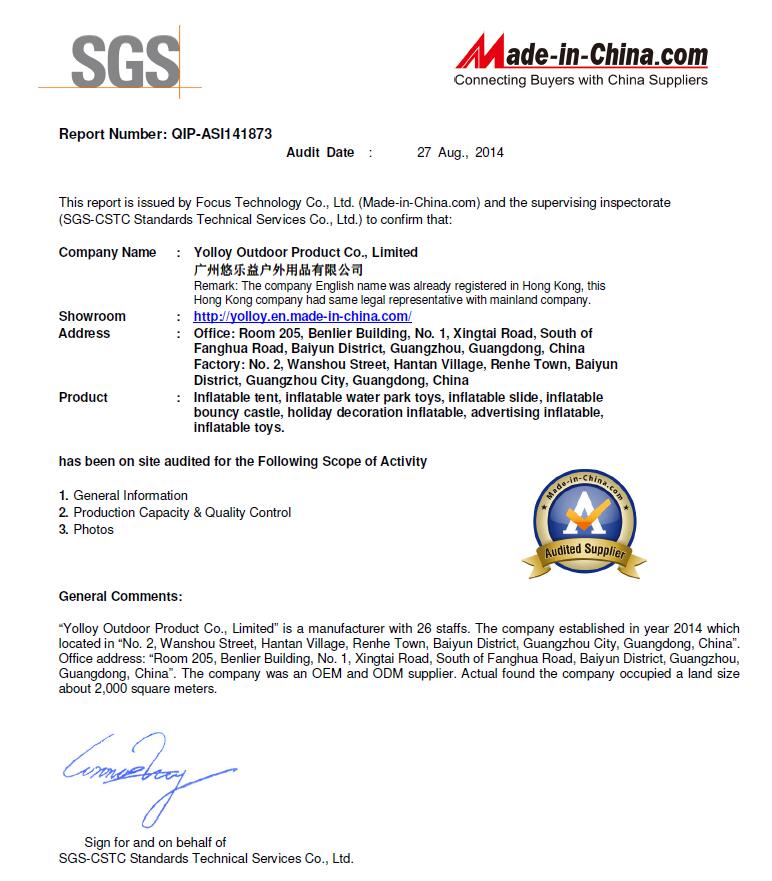
custom inflatable tent, you have probably noticed that most suppliers sell standard models off the shelf. Made-to-order changes that. It means the tent is designed and produced around your size, shape, material, and branding, rather than the other way around. YOLLOY is an inflatable-product manufacturer in Guangzhou, China, that works this way, and this article explains what made-to-order really involves, from the first conversation to the packed box on its way to you.
What does "made-to-order" mean for an inflatable tent?
Made-to-order means every tent is produced for a specific buyer and a specific purpose. Instead of choosing from a fixed catalogue, you describe what you need, and the supplier turns that description into a product. For YOLLOY, the starting point can be a written description, a drawing, a sketch, a photograph, a site plan, or simply a budget. Custom sizes and colors are available, and customer logos and artwork can be printed directly onto the fabric.
This is different from a standard purchase in two practical ways. First, the product matches the job you actually have, whether that is an event shelter, a spray booth, a golf simulator enclosure, or a water recreation facility. Second, because the design is confirmed before production, there are fewer surprises at delivery. Every YOLLOY project is treated as a custom job, and the stated minimum order quantity is one piece, which means even a single unique tent can be built to your specification.
How the made-to-order process works
Strong inflatable tent manufacturers follow a clear sequence so that both sides stay on the same page. YOLLOY describes its workflow as a custom design-to-production service, and it generally runs like this.
Share your requirement. Tell the team how the tent will be used and where it will stand. Weather, floor space, guest or equipment capacity, access points, and anchoring all matter at this stage. The more you describe the environment, the better the design team can match the structure to it.
Receive a design rendering. The design team prepares a simulation rendering from your proposal. This is where size, shape, and layout become visible before anything is cut. If a detail is wrong, the design is revised and a new rendering is prepared until you approve it.
Confirm materials and details. Materials depend on the project. Commercial-grade PVC tarpaulin is used for many products, while tent projects can also be made with Oxford fabric, nylon, TPU, or other materials according to requirements. Colors, door and window placement, printing, and any functional zones are confirmed before the job is released.
Production. Once the design is approved, it is released for factory production. Sewn products use precision sewing equipment and reinforced seams with waterproof nylon thread, with extra reinforcement at high-load areas. Airtight products are manufactured with high-temperature fusion or welding equipment so the structure holds pressure reliably. Products are inspected and tested before shipment.
Blowers and anchoring. Products are supplied with appropriately powered blowers. Because destinations differ, blowers can be provided for 110V, 220V, or 380V requirements. Where installation and wind resistance call for it, D-ring or round metal anchor systems are incorporated.
Packaging and delivery. Products are packed using soft carpet protection, waterproof PVC bags, and outer PE film, with steel pallets for larger items. Once packed, the tent is ready for air or sea shipping to your market.
Production time and minimum order
Lead time is usually a deciding factor. For one regular inflatable product, a typical production time is 6 to 15 days, excluding transit. Complex or large custom products may take longer because more design and fabrication work is involved. The minimum order is one piece, so a buyer testing a new design can order a single unit before scaling up. YOLLOY also reports a 95% on-time delivery rate, supported by both air and sea shipping options, with the FAQ citing 5 to 7 days by air and around 15 to 30 days or more by sea.
Quality and materials
Because an inflatable structure must hold air safely, material and workmanship matter as much as design. Relevant YOLLOY materials have passed EN71, EN14960, and RoHS-related testing. Inflatable toys are associated with EN 14960, while inflatable water parks reference EN 15649, and blowers are described as meeting CE or UL requirements. Seams are reinforced at high-load areas, and airtight sections are produced with high-temperature welding so they can keep pressure without leaks.
After production, every product is inspected and tested before it leaves the factory. When used and maintained correctly, products are expected to serve for around three years, subject to product type and actual terms, and a repair kit is supplied with each inflatable product. Emails and faxes are answered within 24 hours.
What to prepare before you order
A little preparation makes the whole process smoother. Useful information to have ready includes the intended use and location, the approximate size you need, any material or color preference, whether anything needs to be printed on the surface, and your target price range. You do not need a finished drawing; a description, sketch, or budget is enough for the design team to begin. The clearer you can be about the environment and how the tent will be used, the faster the design is confirmed and released for production.
Final thoughts
Made-to-order inflatable tents exist so that your structure fits your site and your purpose. YOLLOY manufactures custom inflatable tents, clear domes, water-park products, slides, bounce houses, paintball bunkers, advertising models, and more from Guangzhou, exporting to Europe, Asia, South America, Africa, the Middle East, and Latin America. To start a project, contact the sales team and describe what you need to build. You can reach YOLLOY at [email protected], or visit www.yolloy.net to see the range and get in touch.