Walk through any neighborhood on a summer weekend, and you will probably hear the sound before you see it—the whir of an electric blower and the unmistakable laughter of kids bouncing inside a colorful inflatable structure. Bounce houses have become a staple of birthday parties, school carnivals, and backyard gatherings. But despite their popularity, many people still wonder: what exactly is a bounce house, and how does it actually work?
For parents, the question is about safety and age appropriateness. For event planners and rental business owners, it is about durability, setup, and return on investment. And for anyone buying from a manufacturer, understanding the engineering behind a bounce house is the difference between a smart purchase and a disappointing one.
This article explains what a bounce house is, the science that keeps it inflated and safe, the materials that determine its lifespan, and what to look for when choosing one—whether you are buying for home use or sourcing from an inflatable bounce house manufacturer like YOLLOY.
What Is a Bounce House?
A bounce house is a portable inflatable play structure designed for children to jump, bounce, and play inside an enclosed, air-filled space. Unlike rigid playground equipment made of metal or hard plastic, a bounce house relies entirely on continuous airflow to create a soft, spring-like surface that absorbs impact and reduces the risk of injury.
The term itself tells the story. "Bounce" describes the elastic, cushioned motion created by compressed air. "House" describes the enclosed shape with walls that keep children safely contained. Together, they describe a product built around one core idea: safe bouncing inside a protected space.
In everyday language, people use many names for the same thing—bounce house, inflatable bouncer, moon bounce, jump house, jumping castle, or bouncy castle. They all refer to the same category of inflatable play structures, though some variations include slides, climbing walls, splash pools, or obstacle elements.
Quick definition: A bounce house is an air-supported inflatable structure that uses a constant-flow electric blower to maintain internal air pressure, creating a soft, impact-absorbing jumping surface enclosed by walls for safety.
How Does a Bounce House Work?
At first glance, a bounce house looks simple. But the way it stays inflated and creates a safe bouncing surface involves a carefully balanced system of airflow, air pressure, and structural design. Let us break down each component.
Constant Airflow, Not Sealed Air
The most important thing to understand is that a bounce house does not stay inflated the way a balloon or an air mattress does. A balloon holds sealed air. A bounce house uses constant airflow.
An electric blower pushes air continuously into the structure through an air inlet tube. At the same time, small gaps in the seams and fabric allow excess air to escape. This constant in-and-out movement keeps the internal pressure stable without overinflating the structure. If the blower stops, the bounce house deflates gradually—not suddenly—which is an intentional safety feature.
The Role of Air Pressure in Bouncing
The bouncing action does not come from springs or elastic bands. It comes from air compression and rebound. Here is what happens when a child jumps:
- The child's weight compresses the air inside the jumping surface
- The compressed air resists the downward force and pushes back upward
- As the pressure equalizes, the child is gently lifted
This creates a controlled, low-impact rebound that is softer than a trampoline and gentler on young joints. Unlike trampolines, which amplify vertical motion, bounce houses are designed to limit bounce height and lateral movement, making them safer for younger children.
Internal Air Chambers
A well-designed bounce house is not one big air bag. Quality units use multiple internal air chambers that separate different structural zones—the jumping floor, the walls, the pillars, and the slide if there is one. This chambered design means that if one section experiences a sudden pressure change, the rest of the structure stays stable. It is a principle similar to compartmentalization in boats: it prevents total failure from a single point.
Why the Blower Must Run Continuously
Because bounce houses are dynamic load structures, they experience repeated impacts, sudden pressure changes, and continuous air displacement. The blower must run at all times during use to maintain stable pressure, enable immediate pressure recovery after each jump, and keep the walls upright and the structure firm. Turning off the blower while children are inside is unsafe.
Common Types of Bounce Houses
Today's inflatable bounce house market offers far more variety than the simple square bouncers of the past. Modern designs include:
- Classic bounce houses: The standard square or rectangular inflatable with an enclosed jumping area. Simple, affordable, and easy to set up.
- Combo bounce houses: Units that combine a bouncing area with a slide, climbing wall, or splash pool. These are popular for rental businesses and larger backyards.
- Themed bounce houses: Designs shaped like castles, pirate ships, jungle animals, or cartoon characters. These are favorites for themed parties and children's events.
- Water slide bounce houses: Inflatables with built-in water slides, often used in summer for pool parties and outdoor events.
- Obstacle course bounce houses: Larger units that combine bouncing with tunnels, barriers, and climbing challenges for competitive play.
YOLLOY, as a bounce house inflatable manufacturer, produces all these types and offers full customization—buyers can specify size, color, theme, and even have their own logo or artwork printed on the product.
Materials and Construction
The material quality of a bounce house directly determines how long it lasts, how well it performs, and how safe it is. Here is what goes into a well-built unit.
PVC Tarpaulin and Reinforced Fabrics
Commercial-grade bounce houses are typically made from heavy-duty PVC tarpaulin, which offers excellent tear resistance, waterproofing, and UV stability. The weight of the PVC—measured in ounces per square yard—is a key indicator of durability. Heavier PVC means a thicker, more puncture-resistant surface that holds shape better under repeated use.
Some products also use Oxford fabric, nylon, or TPU for specific applications. For example, YOLLOY selects materials based on the product type and intended use—Oxford fabric for lightweight tent components, heavy PVC for high-wear bounce surfaces, and TPU where transparency is needed for dome tents.
Seam Construction
The seams are the most vulnerable part of any inflatable. Quality manufacturers use precision sewing equipment with reinforced, waterproof nylon thread, plus additional reinforcement at high-load areas like corners, anchor points, and blower connections. Double-stitching and heat-sealing at critical joints prevent air leaks and extend the life of the product.
Safety Certifications
A reputable manufacturer will have its materials tested against recognized safety standards. For inflatable toys and bounce houses, common certifications include EN71 (toy safety) and EN14960 (inflatable play equipment). Blowers should meet CE or UL requirements. These certifications are not just paperwork—they mean the materials have been tested for harmful substances, flammability, and structural integrity. YOLLOY states that its materials have passed EN71, EN14960, and RoHS testing, and blowers are supplied to meet CE or UL standards depending on the destination market.
Bounce House vs. Trampoline: What Is the Difference?
Many people assume a bounce house and a trampoline are similar, but they work in fundamentally different ways.
| Feature | Bounce House | Trampoline |
|---|
| Energy source | Air compression | Spring tension |
| Surface | Air-filled PVC chambers | Tensioned fabric mat |
| Impact absorption | High | Moderate |
| Bounce height | Limited and controlled | High and amplified |
| Enclosure | Built-in walls | Optional netting |
| Age suitability | Younger children | Older children and teens |
| Injury risk | Lower for kids | Higher |
Bounce houses are designed to contain movement and limit bounce height, while trampolines are designed to maximize vertical rebound. This is why many pediatric safety organizations consider bounce houses more appropriate for children under ten years old.
How to Choose a Quality Bounce House
Whether you are buying for home use or for a rental business, here are the factors that matter most.
Material Weight and Thickness
Ask about the PVC weight. Commercial-grade products typically use PVC tarpaulin in the range of 0.4 mm to 0.55 mm thickness. Thinner material may be cheaper upfront but will wear faster, especially under frequent use or sun exposure.
Blower Quality and CFM Rating
The blower is the engine of the bounce house. Look for blowers with clear CFM (cubic feet per minute) ratings that match the size of the inflatable. An undersized blower leads to poor inflation, sagging walls, and reduced bounce quality. YOLLOY supplies appropriately powered blowers with each product, available in 110V, 220V, or 380V configurations to match local electrical standards.
Stitching and Reinforcement
Inspect the seams if possible, or ask the manufacturer about their stitching process. Double-stitched seams, reinforced corners, and heat-welded joints are signs of careful construction. Products that use high-temperature fusion welding for airtight sections tend to last longer than those relying solely on stitching.
Customization Options
If you are buying for a business, the ability to customize colors, sizes, and branding can set your rental fleet apart. A manufacturer that offers custom design—from a simple sketch or photograph to a finished 3D rendering before production—gives you more control over the final product. YOLLOY's design-to-production workflow includes simulation renderings, client revision rounds, and factory production after design approval.
Anchoring and Wind Safety
Any outdoor bounce house must be properly anchored. Look for D-ring or round metal anchor points integrated into the structure. These should be reinforced and positioned to distribute wind load evenly. A quality manufacturer will include anchor stakes or tie-down systems with the product.
Warranty and After-Sales Support
A manufacturer that stands behind its products will offer a clear warranty and responsive support. Check whether a repair kit is included (it should be), what the expected service life is under normal use, and how quickly the company responds to inquiries. YOLLOY indicates a three-year expected service life with proper use and maintenance, and states that emails are answered within 24 hours.
Setting Up and Maintaining a Bounce House
Setup
Setting up a bounce house is straightforward but requires attention to a few key steps:
- Choose a flat, level surface free of sharp objects, rocks, and overhead obstacles
- Unfold the bounce house and spread it out completely
- Connect the blower to the air inlet tube and secure the connection
- Stake or anchor all tie-down points before turning on the blower
- Turn on the blower and let the structure fully inflate before allowing anyone inside
- Check that all walls are upright and the jumping surface is firm
Maintenance
Regular maintenance extends the life of a bounce house significantly:
- Clean the surface after each use with mild soap and water; avoid harsh chemicals that can degrade PVC
- Always dry the bounce house completely before storage to prevent mold and mildew
- Inspect seams, anchor points, and the blower connection before each use
- Use the included repair kit to patch small punctures promptly before they grow
- Store in a cool, dry place away from direct sunlight and rodents
Why Buy from a Manufacturer Like YOLLOY?
When you buy a bounce house, you are buying a product that must perform safely under repeated physical stress. The difference between a well-made bounce house and a poorly made one is not always visible in a product photo—it is in the material weight, the seam quality, the blower matching, and the quality control behind the scenes.
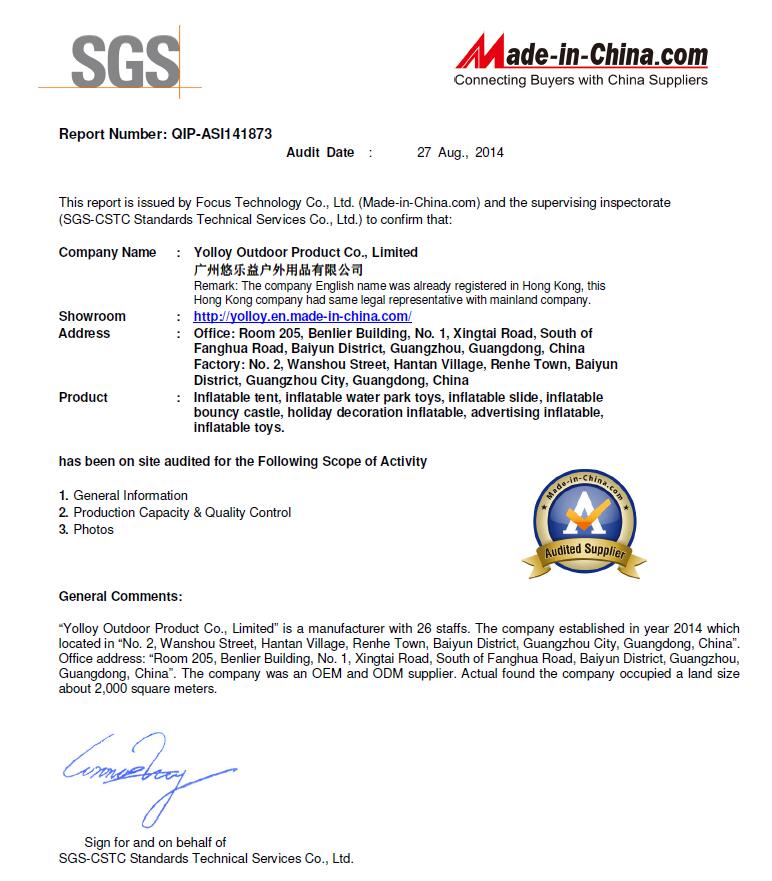
YOLLOY, based in Guangzhou, China, designs and manufactures inflatable products including bounce houses, inflatable tents, water park toys, commercial slides, and interactive sports games. The company uses precision sewing equipment, reinforced seams with waterproof nylon thread, and high-temperature fusion welding for airtight sections. Products are inspected and tested before shipment, and each inflatable ships with a repair kit.
Customization is a core part of YOLLOY's service. Buyers can request custom sizes, colors, and printed artwork. The design team prepares simulation renderings from a client's proposal, revises until approval, and only then releases the design for production. The minimum order quantity is one piece, making it accessible for both individual buyers and bulk purchasers.
With exports to Europe, Asia, South America, Africa, the Middle East, and Latin America, YOLLOY has experience meeting different regional safety standards and electrical requirements. Blowers can be supplied for 110V, 220V, or 380V, and materials have passed EN71, EN14960, and RoHS testing.
Conclusion
A bounce house is more than a colorful party decoration. It is an air-supported play structure that uses continuous airflow, internal air chambers, and reinforced materials to create a safe, impact-absorbing environment for children. Understanding how it works—the role of the blower, the importance of material quality, and the difference between a bounce house and a trampoline—helps buyers make informed decisions.
Whether you need a single themed bounce house for backyard birthdays or a fleet of commercial units for a rental business, choosing a manufacturer that prioritizes material quality, seam construction, safety certifications, and responsive service will save you money and headaches in the long run. For those looking to explore custom options, YOLLOY offers a full range of inflatable bounce houses designed and built to international standards from its factory in Guangzhou, China.