Products Category
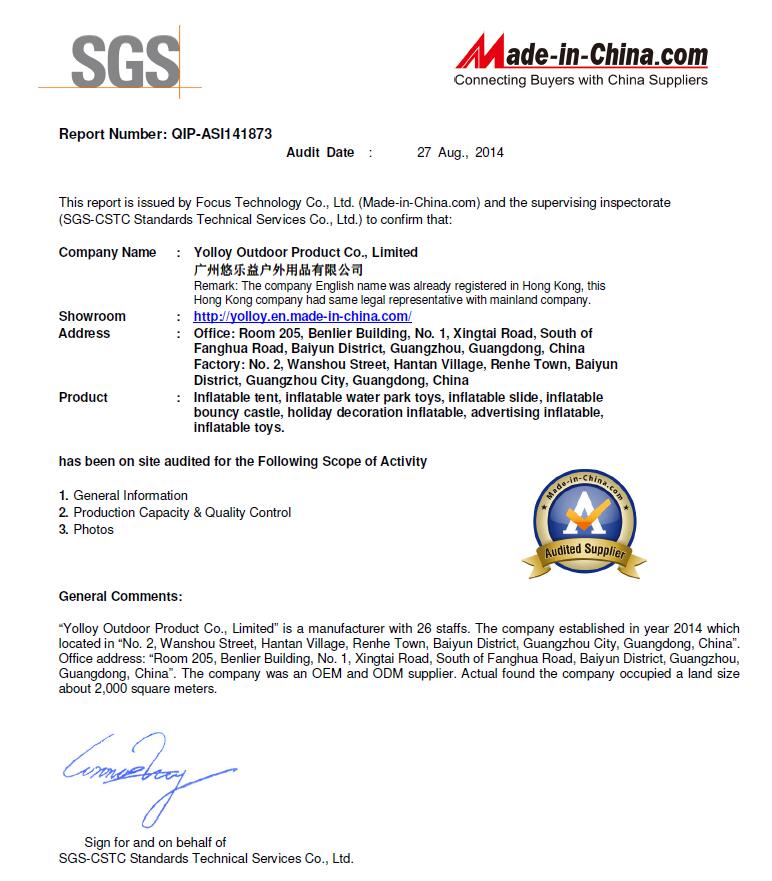
Certification

News

• New Order Successfully Finished for Long-Time Cooperated Japanese Client | YOLLOY Wins Full Client Recognition

• YOLLOY Custom Inflatable Pool Tent for Danish Client: Professional Pool Repair Shelter & Debris Protection

• Trusted Once Again! Greek Captain Re-orders Our Products After 4 Years

• Revolutionize Your Outdoors: The All-Terrain Inflatable Floating Tent for Land & Water

• Elevate Your Summer Fun: The Ultimate Inflatable Water Floating Volleyball Court Trampoline

• Innovative Inflatable Nightclub Tents & Pop-Up Bars: The Ultimate Solution for Portable Party Venues

Contact Us

Name: Sunny Yang
Tel: +86-20-8370 0771
Fax: +86-20-8370 0771
Mobile: 13570587575
E-mail: [email protected]
Add: No 5,Xiong wei Bo Nan Road,ZhongLuoTan Town,Baiyun district,Guangzhou,China
Friend me on Facebook Follow me on Twitter Add me to your circles Follow me on Pinterest Watch my channel on YouTube
News

What are the best paintball bunkers for your field?

Author:yolloy Date:2026/8/18 13:06:29

The bunkers you place on a paintball field decide more than how the field looks in photos. They set the pace of every game, the range of strategies players can use, and how willing a group is to come back for another session. Picking the right inflatable paintball bunkers is therefore one of the most important buying decisions a field owner makes, whether you run a competition arena, a scenario field, or a rental operation at parties and events.

Solid cover makes a field fun; flimsy, awkward cover makes it frustrating. This guide walks through how to choose inflatable bunkers for your specific setup, what to check for quality and safety, and how to buy them so they last.

Match the bunkers to the way your field is played

There is no single "best" bunker. The right choice depends on what kind of games run on your field most of the time.

Competition and speedball fields

Tournament-style speedball is played on a symmetrical field, usually with a centre snake beam, a series of bunkers that players can stand behind, and other pods spaced to give each team balanced sightlines. Here consistency matters more than novelty: bunkers that are easy to reposition quickly, deflate flat for storage between events, and hold a steady shape under pressure keep game flow smooth. Operators who run league nights typically want a matched set so every layout follows the same geometry.

Scenario and outdoor woodsball fields

Scenario and woodsball play rewards variation. Mixing tall bunkers that break long sightlines with low, wide barricades players can crouch behind creates more interesting exchanges. Products such as pallet-shaped barricades, barrels, and air-frame structures give field designers the building blocks to carve out lanes, flanking routes, and staging areas instead of a single open symmetry.

Rental and event operations

If your bunkers are set up and packed down every weekend for birthday parties, corporate days, or school events, portability and setup speed dominate the decision. Fields in this category benefit from sets that inflate and deflate in a few minutes, roll down to a compact bundle, and do not need a crane or heavy equipment to move. Because the same ground is used for different events, a modular set you can rearrange beats one fixed layout.

Check durability and materials before you buy

Inflatable bunkers take real punishment: repeated paintball impacts, players leaning and sliding against them, wind, and weather. The fabric is the single biggest factor in whether a bunker lasts one season or several. Commercial-grade PVC tarpaulin is the standard for equipment that sees frequent use, because it resists punctures far better than the thinner material found in household inflatables. Worth checking at the same time are the seams: high-load areas should be double-reinforced, and on quality units the seams are welded with hot-air machinery rather than simply glued.

Stability is just as important as the shell. A bunker that skids across the field or tips in a gust is a hazard. Look for units fitted with D-ring or round metal anchor loops, and plan to stake them down with appropriate anchors and wind ropes. Always confirm the anchor points line up with the surface you play on, grass and hard standing each need a slightly different approach.

Size and layout for your player numbers

A field that is crowded with too many bunkers slows the game to a crawl; one that is too open leaves players exposed with nowhere to move. A practical way to plan is to lay out enough cover that a group of players of the size you usually host always has a realistic option within a short run. Draft the field on paper or on the ground first, marking where each bunker will sit, then count how many players actually hide and shoot from each shape; if some bunkers are never used because they sit in open, exposed ground, move them before you spend money on repeat stock.

For most rental and small club fields, a mix of shapes gives better gameplay than many copies of one model: a couple of tall bunkers for standing cover, a couple of low barricades, and a long snake-style bunker players can crawl behind. That combination creates the varied sightlines that keep a layout interesting session after session.

Custom fit, logos, and buying from a manufacturer

A field owner who wants a distinctive look and a clear brand identity can go much further than buying off-the-shelf sets. The main advantage of working with an inflatable manufacturer rather than a retailer is that you can specify exact sizes and colours, and have your own logo or artwork printed directly on the bunkers. The whole field then works as branding space as well as cover.

When you order inflatable bunkers for sale through a factory such as YOLLOY, you describe the layout you need, the designers prepare a simulation rendering for your approval, and only then does production start. That design-to-production flow removes the guesswork: you see the bunkers on screen before a single panel is cut. Suppliers in this position can also match the blower to your site power, so the units run on 110V, 220V, or 380V as your location requires instead of forcing you to buy converters.

A useful rule when buying direct from a manufacturer: order enough spare panels and the repair kit along with the initial stock. Inflatable products ship with a repair kit from YOLLOY, and a field operator who can patch a minor tear between events avoids losing a lane on a busy weekend.
Security, safety, and sensible standards

Your players' safety is what keeps them coming back, so do not let price be the only factor. For commercial inflatable equipment, check that the materials used are compliant with the standards that apply in your market. A serious manufacturer will be open about the certifications its fabric and finished products meet rather than leaving you to puzzle them out. Details such as a fire-resistant or flame-retardant frame on the right unit, robust anchors, and clean pinch-free seam construction all reduce the risk of field problems in daily use.

Also factor in how the kit is packed. Quality inflatable bunkers are packed with protective carpeting and waterproof bags and then sealed so they reach you undamaged; large sets may arrive on pallets. Plan your storage so the units can be folded and kept dry between uses, because fabric stored wet or cramped degrades much faster than fabric that is aired and kept clean.

A realistic view of production and service

If you are fitting out a new field, build lead time into your schedule. For a regular inflatable product, manufacturing typically takes six to fifteen days once the design is approved, before shipping time. Complex or very large custom pieces take longer, so for a season opening, place the order early and confirm the sales team's delivery schedule in writing.

Reliable service matters as much as the product itself. A responsive supplier answers questions within a day so a design tweak does not stall the whole project. Many commercial inflatable manufacturers report an on-time delivery record they stand behind, which is worth checking because a late shipment can shut down a field you have already advertised. When you compare quotes, weigh durability, delivery reliability, and after-sales support against the sticker price rather than choosing purely on cost.

Getting a layout right the first time

The most cost-effective way to build a field is to decide the gameplay first and buy bunkers to match it. List the player numbers you expect, the game formats you run most often, and the ground you have available. Then pick a bunker range that covers those three factors rather than a big multi-pack that does not fit your space.

For a smooth start, work with an inflatable bunkers manufacturer that can guide the layout, provide renderings of your planned field, and keep the ordering process simple. A field built around the right cover plays better, looks professional in pictures, and keeps players returning. That combination is what turns a patch of ground into a venue people talk about.


What are the best paintball bunkers for your field?

Author:yolloy Date:2026/8/18 13:06:29

The bunkers you place on a paintball field decide more than how the field looks in photos. They set the pace of every game, the range of strategies players can use, and how willing a group is to come back for another session. Picking the right inflatable paintball bunkers is therefore one of the most important buying decisions a field owner makes, whether you run a competition arena, a scenario field, or a rental operation at parties and events.

Solid cover makes a field fun; flimsy, awkward cover makes it frustrating. This guide walks through how to choose inflatable bunkers for your specific setup, what to check for quality and safety, and how to buy them so they last.

Match the bunkers to the way your field is played

There is no single "best" bunker. The right choice depends on what kind of games run on your field most of the time.

Competition and speedball fields

Tournament-style speedball is played on a symmetrical field, usually with a centre snake beam, a series of bunkers that players can stand behind, and other pods spaced to give each team balanced sightlines. Here consistency matters more than novelty: bunkers that are easy to reposition quickly, deflate flat for storage between events, and hold a steady shape under pressure keep game flow smooth. Operators who run league nights typically want a matched set so every layout follows the same geometry.

Scenario and outdoor woodsball fields

Scenario and woodsball play rewards variation. Mixing tall bunkers that break long sightlines with low, wide barricades players can crouch behind creates more interesting exchanges. Products such as pallet-shaped barricades, barrels, and air-frame structures give field designers the building blocks to carve out lanes, flanking routes, and staging areas instead of a single open symmetry.

Rental and event operations

If your bunkers are set up and packed down every weekend for birthday parties, corporate days, or school events, portability and setup speed dominate the decision. Fields in this category benefit from sets that inflate and deflate in a few minutes, roll down to a compact bundle, and do not need a crane or heavy equipment to move. Because the same ground is used for different events, a modular set you can rearrange beats one fixed layout.

Check durability and materials before you buy

Inflatable bunkers take real punishment: repeated paintball impacts, players leaning and sliding against them, wind, and weather. The fabric is the single biggest factor in whether a bunker lasts one season or several. Commercial-grade PVC tarpaulin is the standard for equipment that sees frequent use, because it resists punctures far better than the thinner material found in household inflatables. Worth checking at the same time are the seams: high-load areas should be double-reinforced, and on quality units the seams are welded with hot-air machinery rather than simply glued.

Stability is just as important as the shell. A bunker that skids across the field or tips in a gust is a hazard. Look for units fitted with D-ring or round metal anchor loops, and plan to stake them down with appropriate anchors and wind ropes. Always confirm the anchor points line up with the surface you play on, grass and hard standing each need a slightly different approach.

Size and layout for your player numbers

A field that is crowded with too many bunkers slows the game to a crawl; one that is too open leaves players exposed with nowhere to move. A practical way to plan is to lay out enough cover that a group of players of the size you usually host always has a realistic option within a short run. Draft the field on paper or on the ground first, marking where each bunker will sit, then count how many players actually hide and shoot from each shape; if some bunkers are never used because they sit in open, exposed ground, move them before you spend money on repeat stock.

For most rental and small club fields, a mix of shapes gives better gameplay than many copies of one model: a couple of tall bunkers for standing cover, a couple of low barricades, and a long snake-style bunker players can crawl behind. That combination creates the varied sightlines that keep a layout interesting session after session.

Custom fit, logos, and buying from a manufacturer

A field owner who wants a distinctive look and a clear brand identity can go much further than buying off-the-shelf sets. The main advantage of working with an inflatable manufacturer rather than a retailer is that you can specify exact sizes and colours, and have your own logo or artwork printed directly on the bunkers. The whole field then works as branding space as well as cover.

When you order inflatable bunkers for sale through a factory such as YOLLOY, you describe the layout you need, the designers prepare a simulation rendering for your approval, and only then does production start. That design-to-production flow removes the guesswork: you see the bunkers on screen before a single panel is cut. Suppliers in this position can also match the blower to your site power, so the units run on 110V, 220V, or 380V as your location requires instead of forcing you to buy converters.

A useful rule when buying direct from a manufacturer: order enough spare panels and the repair kit along with the initial stock. Inflatable products ship with a repair kit from YOLLOY, and a field operator who can patch a minor tear between events avoids losing a lane on a busy weekend.
Security, safety, and sensible standards

Your players' safety is what keeps them coming back, so do not let price be the only factor. For commercial inflatable equipment, check that the materials used are compliant with the standards that apply in your market. A serious manufacturer will be open about the certifications its fabric and finished products meet rather than leaving you to puzzle them out. Details such as a fire-resistant or flame-retardant frame on the right unit, robust anchors, and clean pinch-free seam construction all reduce the risk of field problems in daily use.

Also factor in how the kit is packed. Quality inflatable bunkers are packed with protective carpeting and waterproof bags and then sealed so they reach you undamaged; large sets may arrive on pallets. Plan your storage so the units can be folded and kept dry between uses, because fabric stored wet or cramped degrades much faster than fabric that is aired and kept clean.

A realistic view of production and service

If you are fitting out a new field, build lead time into your schedule. For a regular inflatable product, manufacturing typically takes six to fifteen days once the design is approved, before shipping time. Complex or very large custom pieces take longer, so for a season opening, place the order early and confirm the sales team's delivery schedule in writing.

Reliable service matters as much as the product itself. A responsive supplier answers questions within a day so a design tweak does not stall the whole project. Many commercial inflatable manufacturers report an on-time delivery record they stand behind, which is worth checking because a late shipment can shut down a field you have already advertised. When you compare quotes, weigh durability, delivery reliability, and after-sales support against the sticker price rather than choosing purely on cost.

Getting a layout right the first time

The most cost-effective way to build a field is to decide the gameplay first and buy bunkers to match it. List the player numbers you expect, the game formats you run most often, and the ground you have available. Then pick a bunker range that covers those three factors rather than a big multi-pack that does not fit your space.

For a smooth start, work with an inflatable bunkers manufacturer that can guide the layout, provide renderings of your planned field, and keep the ordering process simple. A field built around the right cover plays better, looks professional in pictures, and keeps players returning. That combination is what turns a patch of ground into a venue people talk about.