If you have ever watched athletes sprint through tunnels, scramble over walls, balance across narrow beams and dive onto a slide at a festival, a corporate team-building day or a military challenge event, you have seen a commercial obstacle course in action. Built for constant use by large crowds, these inflatable courses are a favourite addition to amusement venues, water parks and entertainment centres around the world.
So what exactly is a commercial obstacle course? In simple terms, it is a large inflatable structure built from a series of connected challenges that participants move through from start to finish. Every element is engineered for high traffic, repeated use and quick setup, which sets it apart from the lightweight toys designed for occasional backyard play.
Commercial vs. residential obstacle courses
The most important difference lies in how the two are built. A residential unit is meant for a handful of children over a few weekends. A commercial inflatable obstacle course is designed to cope with hundreds of users every single day, outdoors on grass or concrete, being inflated and packed away again and again across a whole season.
Manufacturers such as YOLLOY achieve this with heavier commercial-grade PVC tarpaulin, reinforced seams and extra support at high-load areas such as climbing walls, tunnel exits and slide edges. Why does this matter? Because a thin, lightly stitched unit can tear at the seams after a season of rental rotation, whereas a properly reinforced course keeps delivering a consistent, reliable experience event after event.
What makes an obstacle course "commercial"?
The word "commercial" is used loosely by some sellers, so it helps to know what actually separates a serious product. Look for these qualities in an inflatable obstacle course:
- Thick, commercial-grade materials: durable PVC tarpaulin is standard, with reinforced seams that hold up under repeated impact.
- Precision construction: sewn units are made on precision sewing equipment with waterproof, high-strength nylon thread, and airtight parts are joined with high-temperature fusion or welding equipment.
- Anchoring systems: D-ring or round metal anchor points keep the course stable against wind and daily active use.
- Blower compatibility: a correctly powered blower keeps every chamber pressurised, and suppliers can offer units for 110V, 220V or 380V power supplies.
- Quality certification: materials and toys should meet recognised safety standards, so buyers can verify the product before committing.
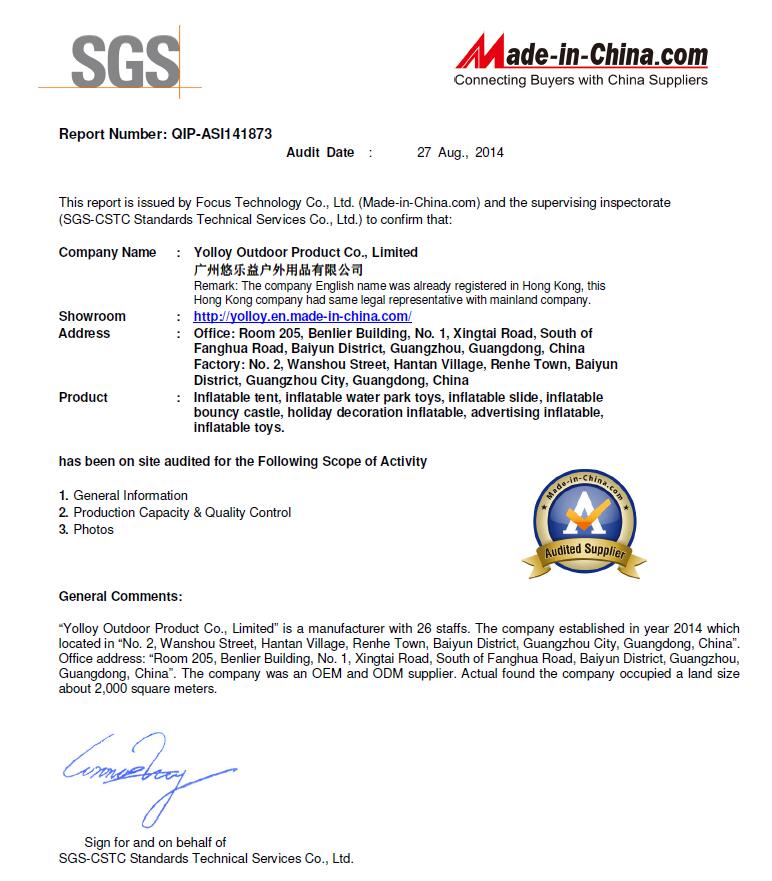
At YOLLOY, relevant materials have passed EN71, EN14960 and RoHS-related testing, giving operators confidence that the course is built and tested for routine commercial use before it is packed for shipment.
What is inside a typical course?
A well-designed course follows a rhythm that keeps the crowd moving. A common layout starts with a crawl tunnel or squeeze wall to break the group up, then moves through pop-up bumpers that test lateral movement, a balance section such as a log or beam, a tunnel to force a reset, and a slide finish to end on a high note. Longer courses may add climbing walls, jump platforms or wiggle bridges that are connected into one continuous circuit.
Because every element is inflatable, a course can be designed in any length, shape or lane count. Single-lane layouts move participants through one at a time and are ideal for smaller events, while wider, faster layouts let racers go head to head, which is perfect for competitive events and team-building days.
Where are commercial obstacle courses used?
These courses earn their keep everywhere people gather to play. Common settings include:
- Family entertainment centres and amusement parks, where they draw line-ups all day.
- Corporate and school team-building events, where racing adds energy and friendly competition.
- Festivals, community fairs and birthday parties run by rental operators.
- Military and fitness challenge events, where tougher versions test strength and endurance.
- Water parks and lakeside venues, where water-based courses offer a cooling spin on the idea.
Dry-land and water obstacle courses
There are two broad families of commercial obstacle course. Dry-land courses are the classic bouncy challenge sets used in fields, halls and arenas. Water-based courses sit on lakes, reservoirs or pools and are assembled from floating platforms, slides, climbing walls, balance beams and trampolines that participants navigate across the water.
Water courses demand extra attention to anchoring and materials, because they must shrug off wind, current and wave action while staying safe for swimmers. Operators who already run a water park or pool can add an obstacle course as a headline attraction during the summer season.
Custom design: make it yours
One advantage of working with a manufacturer such as YOLLOY is the option to build the course to your own specs. Custom sizes and colours are available, and your logo or artwork can be printed directly onto the product. The process is straightforward: you share a description, drawing, sketch, photograph, site plan or budget, and the YOLLOY design team prepares a simulation rendering.
The design is revised together until you are happy, and only then is it released for factory production. There is no need to order a large quantity to customise the design, so even a single bespoke course is possible, which is useful for a venue that wants something unique rather than an off-the-shelf unit.
Production time and shipping
Lead time is worth planning around. For a regular inflatable product, production typically takes around 6 to 15 days once the design is approved, not including transit, while complex or very large custom courses can take longer. When it comes to delivery, air freight usually takes about 5 to 7 days, while sea freight is more economical but takes about 15 to 30 days or more depending on the route.
YOLLOY exports to customers across Europe, Asia, South America, Africa, the Middle East and Latin America. Products are carefully packed with soft carpet protection, waterproof PVC bags and outer PE film to survive the journey, and large items may use steel pallets for extra support.
Keeping the course in good shape
A commercial course is only as good as the attention it receives. After each event, wipe the unit down, let it dry completely before packing to prevent mould, and inspect the seams, mesh and anchor points. A repair kit is supplied with each inflatable product, which lets you patch small punctures quickly on site and keep the unit in service.
With correct use and maintenance, a quality course is expected to deliver years of service, and every product is inspected and tested before it leaves the factory. That combination of durable materials, careful production and sensible upkeep is what turns an inflatable course into a reliable, money-making attraction.
Is a commercial obstacle course right for you?
A commercial obstacle course is a versatile investment if you run events, operate a family entertainment venue, manage a water park or build a rental fleet. It packs genuine crowd appeal, adapts to kids, teens and adults, and can be customised to match your brand.
If you would like to explore options and bring your own custom adult inflatable obstacle course to life, the team at YOLLOY can prepare a design for your site and budget, and guide you from rendering all the way to delivery.