Products Category
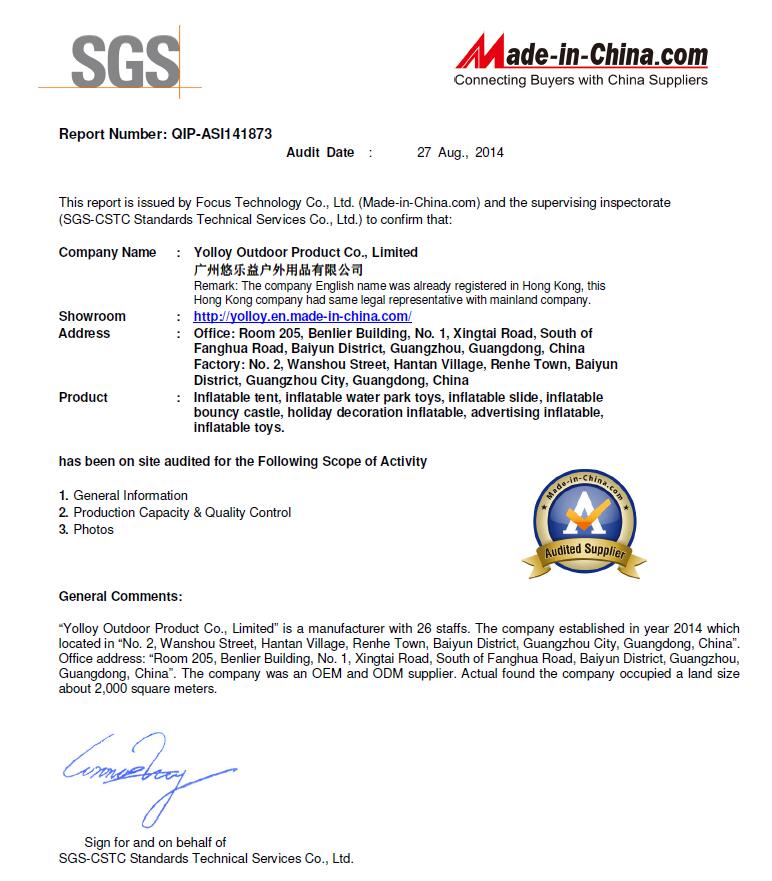
Certification

News

• New Order Successfully Finished for Long-Time Cooperated Japanese Client | YOLLOY Wins Full Client Recognition

• YOLLOY Custom Inflatable Pool Tent for Danish Client: Professional Pool Repair Shelter & Debris Protection

• Trusted Once Again! Greek Captain Re-orders Our Products After 4 Years

• Revolutionize Your Outdoors: The All-Terrain Inflatable Floating Tent for Land & Water

• Elevate Your Summer Fun: The Ultimate Inflatable Water Floating Volleyball Court Trampoline

• Innovative Inflatable Nightclub Tents & Pop-Up Bars: The Ultimate Solution for Portable Party Venues

Contact Us

Name: Sunny Yang
Tel: +86-20-8370 0771
Fax: +86-20-8370 0771
Mobile: 13570587575
E-mail: [email protected]
Add: No 5,Xiong wei Bo Nan Road,ZhongLuoTan Town,Baiyun district,Guangzhou,China
Friend me on Facebook Follow me on Twitter Add me to your circles Follow me on Pinterest Watch my channel on YouTube
News

The Ultimate Guide to Inflatable Tents: Why Commercial Buyers Are Making the Switch

Author:yolloy Date:2026/8/10 16:05:28

Inflatable tents have quietly transformed how businesses approach outdoor shelter. What started as a niche camping gadget has evolved into a serious commercial solution for events, exhibitions, emergency response, sports venues, and brand activations. If you're comparing traditional pole-supported tents against modern inflatable alternatives, this guide breaks down everything you need to know — from construction quality to sourcing strategy.

What Makes Inflatable Tents Different From Traditional Tents?

A traditional tent relies on rigid poles, a frame, or a truss system to hold its shape. An inflatable tent replaces those poles with air beams — sealed tubes of reinforced fabric that, when inflated, create a rigid, load-bearing structure. The result is a shelter that goes from a compact carry bag to a fully erected building in minutes, with far fewer parts to lose, bend, or replace.

For commercial and event buyers, the difference matters. Setting up a 10×10 m frame tent can take a team of three an hour or more. A comparable inflatable model can be fully inflated and ready for use in under 15 minutes with just one or two people. Labor savings alone often justify the investment for rental companies and event planners who manage multiple setups per week.

Key Advantages for Commercial Use

Fast Setup and Takedown

Time is money in the events business. Inflatable tents cut setup time dramatically because there are no poles to sort, no connectors to align, and no complex frame assembly. Attach the blower, zip the entry, and watch the structure rise. Takedown is equally straightforward — deflate, fold, and pack.

Portability and Storage

When deflated, most commercial inflatable tents pack into a duffel or wheeled bag that fits in a standard van or truck. There's no need for a dedicated trailer or large warehouse racking. For businesses with limited storage space, this is a meaningful advantage.

Design Flexibility

Because air beams can be shaped into almost any form, inflatable tents come in a wider variety of shapes than traditional frame tents — cubes, domes, tunnels, arches, bubbles, and custom silhouettes. Custom branding, logos, and full-color graphics can be printed directly onto the fabric, turning the shelter itself into a marketing asset.

Weather Resistance

High-quality commercial inflatable tents use heavy-duty PVC tarpaulin with welded or reinforced sewn seams, making them highly waterproof and wind-resistant when properly anchored. Many models are rated for sustained use in moderate wind and rain, matching or exceeding the performance of mid-range frame tents.

What to Look for in a Quality Inflatable Tent

Not all inflatable tents are built the same. If you're sourcing for commercial or rental use, pay attention to these critical factors:

Material Grade

Commercial-grade PVC tarpaulin is the standard for heavy-use inflatable tents. Look for specifications like 0.55 mm or 0.9 mm PVC thickness. Budget consumer models often use thinner Oxford fabric or nylon, which won't hold up to repeated setups and outdoor exposure.

Construction Quality

  • Seams: Sewn products should use precision sewing with waterproof nylon thread and reinforcement at high-load points. Airtight models require high-temperature fusion welding.
  • Anchoring system: D-rings or metal anchor points should be integrated into the base for secure staking or weighting.
  • Zippers and entries: Heavy-duty zippers with storm flaps indicate a quality build.

Blower Compatibility

The blower is the heart of a constant-pressure inflatable tent. Make sure the supplier provides blowers rated for your local voltage — 110V, 220V, or 380V — and that they meet safety certifications like CE or UL.

Safety Certifications

Reputable manufacturers test their products against recognized standards. For inflatable play structures, look for EN 14960 compliance. For water park products, EN 15649 is the relevant standard. General material certifications may include EN71 and RoHS.

Warranty and After-Sales Support

A three-year expected service life is typical for well-maintained commercial inflatables. Verify what the warranty covers and whether replacement parts — blowers, repair patches, zipper sliders — are readily available. A repair kit should be included with every unit.

Popular Commercial Applications

Events and Parties

From weddings to corporate galas, inflatable party tent solutions offer a clean, modern look that works for both formal and casual gatherings. Clear inflatable domes add a "wow" factor that traditional pole tents can't match.

Trade Shows and Exhibitions

Inflatable exhibition tents can be fully customized with branded graphics, internal lighting, and modular layouts. Their quick setup makes them popular for pop-up activations and touring roadshows.

Sports and Recreation

Sports teams and fitness facilities use inflatable tents for mobile golf simulators, spectator shelters, athlete lounges, and tournament registration areas. Inflatable paintball bunkers and obstacle courses are another fast-growing segment.

Emergency and Disaster Relief

Government agencies and NGOs use inflatable emergency shelters because they can be deployed quickly and transported efficiently. A single truck can carry enough inflatable shelters to house dozens of families.

Advertising and Brand Promotion

Inflatable arches, air dancers, and custom-shaped inflatables turn heads at grand openings, marathons, festivals, and storefront promotions. They are lightweight, reusable, and highly visible.

Sourcing Strategy: Working With Inflatable Tent Manufacturers

If you're buying in volume or need custom designs, partnering directly with inflatable tent manufacturers gives you the best pricing and the most control over product specifications. Here's how to approach it:

1. Define Your Requirements First

Before reaching out to a factory, clarify:

  • Intended use (rental, events, resale, personal use)
  • Size and capacity needed
  • Preferred material and color
  • Custom branding or printing requirements
  • Target budget and quantity
  • Local electrical standards for blowers

2. Ask for Design Renderings

A good manufacturer will provide simulation renderings based on your proposal so you can visualize the final product before production begins. This is especially important for custom shapes and branded designs.

3. Verify Certifications and Quality Control

Ask for copies of material test reports, product certifications, and details about their quality inspection process. Do they test each unit before shipment? What's their defect rate?

4. Understand Lead Times and Shipping

For a standard inflatable product, production typically takes 6–15 days. Large or complex custom projects may take longer. Air freight usually takes 5–7 days, while sea freight ranges from 15–30 days or more depending on the destination.

5. Consider Wholesale and OEM Options

If you're a reseller or rental business, commercial inflatable tent wholesale pricing can significantly improve your margins. Many Chinese manufacturers offer OEM/ODM services, allowing you to brand the products under your own company name.

Common Mistakes to Avoid

Buying on Price Alone

The cheapest inflatable tent rarely saves money in the long run. Thin fabric, weak seams, and low-quality blowers lead to early failures, repair costs, and disappointed customers.

Skipping the Anchoring Step

Even the sturdiest inflatable tent needs proper anchoring. Always use ground stakes, sandbags, or water weights — especially in windy conditions. Most structural failures happen because the tent wasn't secured correctly.

Overinflating the Air Beams

Follow the manufacturer's recommended pressure. Overinflation puts unnecessary stress on seams and can cause premature wear or blowouts.

Neglecting Maintenance

Clean your tent after each use, let it dry completely before packing, and store it in a cool, dry place. Small punctures should be repaired promptly with the included patch kit to prevent them from growing.

Is an Inflatable Tent Right for Your Business?

Inflatable tents aren't the answer for every scenario — for permanent installations or extremely high-wind environments, a steel-frame structure may still be preferable. But for most commercial use cases — events, rentals, exhibitions, sports, advertising, and emergency response — the benefits of speed, portability, design flexibility, and cost efficiency are hard to ignore.

If you've been on the fence about making the switch, consider starting with one unit to test in your operations. Many businesses find that after one event, they never go back to traditional pole tents.

Ready to Explore Your Options?

YOLLOY Outdoor Product Co., Limited is a Guangzhou-based inflatable product manufacturer with a full catalog of commercial inflatable tents, clear domes, water parks, interactive sports games, and advertising inflatables. They offer custom design services, OEM/ODM capabilities, and direct factory pricing — with a minimum order quantity of just one piece. Every product comes with a repair kit, CE or UL-certified blowers, and a 95% on-time delivery rate.

To discuss your project or request a custom quote, reach out to their team directly — they typically respond within 24 hours.


The Ultimate Guide to Inflatable Tents: Why Commercial Buyers Are Making the Switch

Author:yolloy Date:2026/8/10 16:05:28

Inflatable tents have quietly transformed how businesses approach outdoor shelter. What started as a niche camping gadget has evolved into a serious commercial solution for events, exhibitions, emergency response, sports venues, and brand activations. If you're comparing traditional pole-supported tents against modern inflatable alternatives, this guide breaks down everything you need to know — from construction quality to sourcing strategy.

What Makes Inflatable Tents Different From Traditional Tents?

A traditional tent relies on rigid poles, a frame, or a truss system to hold its shape. An inflatable tent replaces those poles with air beams — sealed tubes of reinforced fabric that, when inflated, create a rigid, load-bearing structure. The result is a shelter that goes from a compact carry bag to a fully erected building in minutes, with far fewer parts to lose, bend, or replace.

For commercial and event buyers, the difference matters. Setting up a 10×10 m frame tent can take a team of three an hour or more. A comparable inflatable model can be fully inflated and ready for use in under 15 minutes with just one or two people. Labor savings alone often justify the investment for rental companies and event planners who manage multiple setups per week.

Key Advantages for Commercial Use

Fast Setup and Takedown

Time is money in the events business. Inflatable tents cut setup time dramatically because there are no poles to sort, no connectors to align, and no complex frame assembly. Attach the blower, zip the entry, and watch the structure rise. Takedown is equally straightforward — deflate, fold, and pack.

Portability and Storage

When deflated, most commercial inflatable tents pack into a duffel or wheeled bag that fits in a standard van or truck. There's no need for a dedicated trailer or large warehouse racking. For businesses with limited storage space, this is a meaningful advantage.

Design Flexibility

Because air beams can be shaped into almost any form, inflatable tents come in a wider variety of shapes than traditional frame tents — cubes, domes, tunnels, arches, bubbles, and custom silhouettes. Custom branding, logos, and full-color graphics can be printed directly onto the fabric, turning the shelter itself into a marketing asset.

Weather Resistance

High-quality commercial inflatable tents use heavy-duty PVC tarpaulin with welded or reinforced sewn seams, making them highly waterproof and wind-resistant when properly anchored. Many models are rated for sustained use in moderate wind and rain, matching or exceeding the performance of mid-range frame tents.

What to Look for in a Quality Inflatable Tent

Not all inflatable tents are built the same. If you're sourcing for commercial or rental use, pay attention to these critical factors:

Material Grade

Commercial-grade PVC tarpaulin is the standard for heavy-use inflatable tents. Look for specifications like 0.55 mm or 0.9 mm PVC thickness. Budget consumer models often use thinner Oxford fabric or nylon, which won't hold up to repeated setups and outdoor exposure.

Construction Quality

  • Seams: Sewn products should use precision sewing with waterproof nylon thread and reinforcement at high-load points. Airtight models require high-temperature fusion welding.
  • Anchoring system: D-rings or metal anchor points should be integrated into the base for secure staking or weighting.
  • Zippers and entries: Heavy-duty zippers with storm flaps indicate a quality build.

Blower Compatibility

The blower is the heart of a constant-pressure inflatable tent. Make sure the supplier provides blowers rated for your local voltage — 110V, 220V, or 380V — and that they meet safety certifications like CE or UL.

Safety Certifications

Reputable manufacturers test their products against recognized standards. For inflatable play structures, look for EN 14960 compliance. For water park products, EN 15649 is the relevant standard. General material certifications may include EN71 and RoHS.

Warranty and After-Sales Support

A three-year expected service life is typical for well-maintained commercial inflatables. Verify what the warranty covers and whether replacement parts — blowers, repair patches, zipper sliders — are readily available. A repair kit should be included with every unit.

Popular Commercial Applications

Events and Parties

From weddings to corporate galas, inflatable party tent solutions offer a clean, modern look that works for both formal and casual gatherings. Clear inflatable domes add a "wow" factor that traditional pole tents can't match.

Trade Shows and Exhibitions

Inflatable exhibition tents can be fully customized with branded graphics, internal lighting, and modular layouts. Their quick setup makes them popular for pop-up activations and touring roadshows.

Sports and Recreation

Sports teams and fitness facilities use inflatable tents for mobile golf simulators, spectator shelters, athlete lounges, and tournament registration areas. Inflatable paintball bunkers and obstacle courses are another fast-growing segment.

Emergency and Disaster Relief

Government agencies and NGOs use inflatable emergency shelters because they can be deployed quickly and transported efficiently. A single truck can carry enough inflatable shelters to house dozens of families.

Advertising and Brand Promotion

Inflatable arches, air dancers, and custom-shaped inflatables turn heads at grand openings, marathons, festivals, and storefront promotions. They are lightweight, reusable, and highly visible.

Sourcing Strategy: Working With Inflatable Tent Manufacturers

If you're buying in volume or need custom designs, partnering directly with inflatable tent manufacturers gives you the best pricing and the most control over product specifications. Here's how to approach it:

1. Define Your Requirements First

Before reaching out to a factory, clarify:

  • Intended use (rental, events, resale, personal use)
  • Size and capacity needed
  • Preferred material and color
  • Custom branding or printing requirements
  • Target budget and quantity
  • Local electrical standards for blowers

2. Ask for Design Renderings

A good manufacturer will provide simulation renderings based on your proposal so you can visualize the final product before production begins. This is especially important for custom shapes and branded designs.

3. Verify Certifications and Quality Control

Ask for copies of material test reports, product certifications, and details about their quality inspection process. Do they test each unit before shipment? What's their defect rate?

4. Understand Lead Times and Shipping

For a standard inflatable product, production typically takes 6–15 days. Large or complex custom projects may take longer. Air freight usually takes 5–7 days, while sea freight ranges from 15–30 days or more depending on the destination.

5. Consider Wholesale and OEM Options

If you're a reseller or rental business, commercial inflatable tent wholesale pricing can significantly improve your margins. Many Chinese manufacturers offer OEM/ODM services, allowing you to brand the products under your own company name.

Common Mistakes to Avoid

Buying on Price Alone

The cheapest inflatable tent rarely saves money in the long run. Thin fabric, weak seams, and low-quality blowers lead to early failures, repair costs, and disappointed customers.

Skipping the Anchoring Step

Even the sturdiest inflatable tent needs proper anchoring. Always use ground stakes, sandbags, or water weights — especially in windy conditions. Most structural failures happen because the tent wasn't secured correctly.

Overinflating the Air Beams

Follow the manufacturer's recommended pressure. Overinflation puts unnecessary stress on seams and can cause premature wear or blowouts.

Neglecting Maintenance

Clean your tent after each use, let it dry completely before packing, and store it in a cool, dry place. Small punctures should be repaired promptly with the included patch kit to prevent them from growing.

Is an Inflatable Tent Right for Your Business?

Inflatable tents aren't the answer for every scenario — for permanent installations or extremely high-wind environments, a steel-frame structure may still be preferable. But for most commercial use cases — events, rentals, exhibitions, sports, advertising, and emergency response — the benefits of speed, portability, design flexibility, and cost efficiency are hard to ignore.

If you've been on the fence about making the switch, consider starting with one unit to test in your operations. Many businesses find that after one event, they never go back to traditional pole tents.

Ready to Explore Your Options?

YOLLOY Outdoor Product Co., Limited is a Guangzhou-based inflatable product manufacturer with a full catalog of commercial inflatable tents, clear domes, water parks, interactive sports games, and advertising inflatables. They offer custom design services, OEM/ODM capabilities, and direct factory pricing — with a minimum order quantity of just one piece. Every product comes with a repair kit, CE or UL-certified blowers, and a 95% on-time delivery rate.

To discuss your project or request a custom quote, reach out to their team directly — they typically respond within 24 hours.