Discover how inflatable tent technology is transforming outdoor experiences — from camping and glamping to commercial events, sports, and emergency response.
Setting up a traditional pole tent has never been anyone's favorite part of an outdoor adventure. Wrestling with aluminum poles, deciphering cryptic instructions, and hoping the wind doesn't undo your work before the last stake goes in — it's a ritual most campers tolerate rather than enjoy. Now imagine walking onto a campsite, pressing a button on an electric pump, and watching your shelter rise into shape in under five minutes. That is the reality of an
inflatable camping tent, and it's changing how people think about outdoor shelter.
The technology behind inflatable tents has matured significantly over the past decade. What was once a niche curiosity is now a mainstream solution embraced by festival organizers, glamping operators, sports teams, military units, and families who simply want more time enjoying the outdoors and less time fighting with gear. As demand grows,
inflatable tent manufacturers have responded with an increasingly diverse range of products that rival traditional tents in durability while surpassing them in convenience.
How Inflatable Tents Actually Work
Instead of rigid poles, inflatable tents use air-filled beams — typically made from high-strength TPU or PVC-coated fabric — to create the structural frame. These beams are inflated with an electric or manual pump to a specific pressure, forming arches, columns, or geodesic shapes that hold the tent upright. The fabric skin is attached to or integrated with the air beams, and once pressurized, the structure becomes remarkably rigid.
Taking down the tent is even faster: open the deflation valve, and the air rushes out in seconds. The entire tent folds into a compact carry bag. There are no poles to lose, no joints to snap, and no complicated threading required. For anyone who has camped in the rain or wind, the speed advantage alone is a compelling reason to consider an
inflatable dome tent.
Beyond Camping: The Expanding World of Inflatable Shelters
While camping remains the most familiar application, inflatable tents have expanded into dozens of commercial and professional niches. Event companies use
inflatable party tent models for weddings, corporate gatherings, and music festivals — structures that can cover hundreds of square meters while going up in a fraction of the time required by traditional marquees.
The hospitality industry has embraced
clear inflatable tent designs — transparent bubble domes that let guests sleep under the stars while staying warm and protected from the elements. These clear dome tents have become signature attractions at luxury resorts and glamping sites from Europe to the Middle East. They offer a 360-degree view of the surrounding landscape, making them as much an experience as a shelter.
Did you know? YOLLOY produces inflatable tents for applications far beyond camping — including spray painting booths, golf simulator enclosures, altitude training chambers, portable planetarium domes, and even inflatable paintball arenas. If a space needs to be enclosed temporarily, an inflatable solution likely exists.
Key Advantages Over Traditional Pole Tents
- Setup speed: A large inflatable tent can be fully deployed by one or two people in minutes, compared to 20–40 minutes for a comparable pole tent.
- Wind performance: Air beams flex under wind load rather than resisting it rigidly, which means inflatable tents often perform better in gusty conditions than pole structures. Integrated D-ring anchor systems provide additional stability.
- No broken parts: There are no poles to bend, snap, or lose. The air beam either holds pressure or it doesn't — and if it does develop a leak, a repair kit comes standard with every product.
- Packing volume: Deflated, an inflatable tent packs down into a surprisingly small bag. This makes transport and storage significantly easier, especially for rental businesses managing large inventories.
- Custom shapes: Inflatable construction allows for dome, cube, tunnel, arch, and fully custom geometries that would be difficult or impossible to achieve with traditional pole frameworks.
What to Look for When Sourcing Inflatable Tents
Not all inflatable tents are created equal. The material choice is critical — commercial-grade PVC tarpaulin offers excellent durability and weather resistance for heavy-use applications, while Oxford fabric and nylon may be suitable for lighter recreational use. For air-tight products such as bubble tents and sealed enclosures, high-temperature fusion welding equipment produces stronger, more reliable seams than stitching alone.
Certification matters. Reputable manufacturers test their materials to standards such as EN71 (toy safety), EN14960 (inflatable play equipment), and EN15649 (floating leisure articles for use on and in water). Blowers should carry CE or UL certification and be configurable for 110V, 220V, or 380V power supplies depending on the destination market.
Customization capability is another key factor. The best suppliers can work from a description, sketch, photograph, or site plan — adjusting dimensions, colors, printed logos, and structural features to match the client's exact requirements. Minimum order quantities also vary widely; some factories require bulk purchases, while others accept orders starting from a single piece.
Why Businesses Choose YOLLOY as Their Inflatable Partner
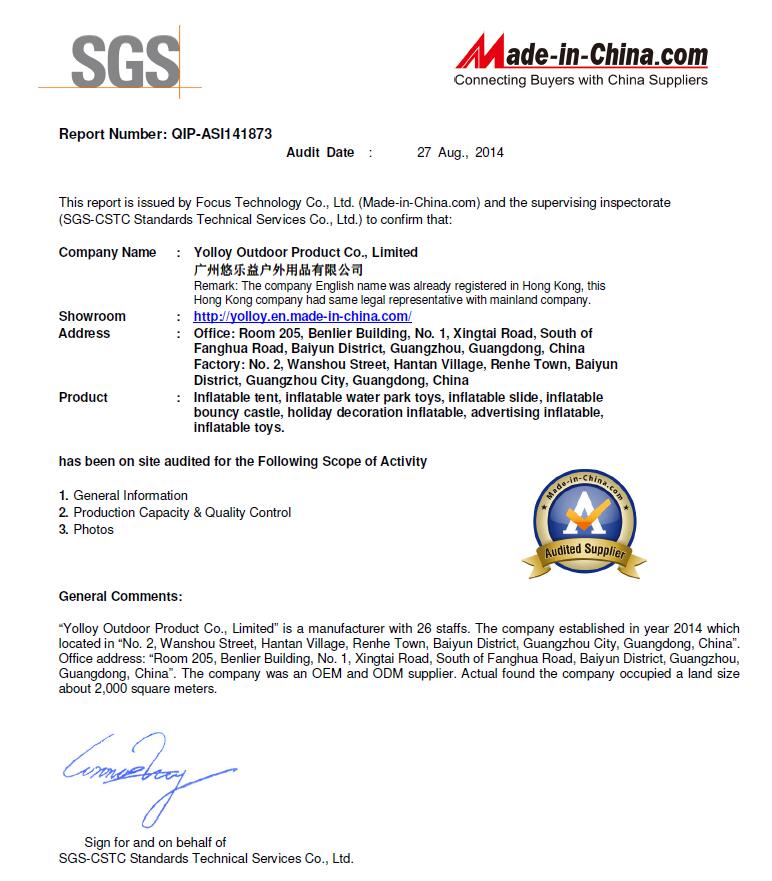
YOLLOY Outdoor Product Co., Limited, based in Guangzhou, China, has built its reputation on a straightforward promise: custom inflatable solutions designed to your specifications, produced to commercial standards, and delivered on time. The company's workflow begins with a design team that creates simulation renderings from your proposal — whether that's a detailed CAD drawing or a rough sketch on a napkin. Designs are revised until you approve, and only then does production begin.
The product range is remarkably broad. YOLLOY manufactures outdoor inflatable tents in cube, tunnel, dome, shelter, and party configurations; clear bubble tents and snow globes for hospitality and events; portable planetarium domes and inflatable projection screens for education and entertainment; inflatable water parks, floating platforms, and aquatic play products; interactive sports games including football arenas, ziplines, and obstacle courses; commercial inflatable slides and bounce houses; paintball bunkers and air-frame arenas; and a full line of advertising inflatables including arches, sky dancers, and custom models.
Quality control is embedded throughout the production process. Sewn products use precision sewing equipment with waterproof nylon thread and reinforced seams at high-stress points. Airtight products are manufactured with high-temperature fusion welding. Every product is inspected and tested before shipment, and each order includes a repair kit. Materials have passed EN71, EN14960, and RoHS-related testing, and blowers meet CE or UL requirements.
YOLLOY reports a 95% on-time delivery rate and responds to inquiries within 24 hours. Typical production time for a regular inflatable product is 6–15 days, with air shipping taking 5–7 days and sea freight 15–30 days or more. Products are carefully packed with soft carpet protection, waterproof PVC bags, and outer PE film, with steel pallets available for large items.
Ready to Start Your Inflatable Project?
Whether you need a single custom tent or a container load of commercial inflatables, YOLLOY's design team is ready to turn your idea into a finished product. Send your requirements — a drawing, a photo, or just a description — and receive a design proposal within days.
Contact YOLLOY Today