Products Category
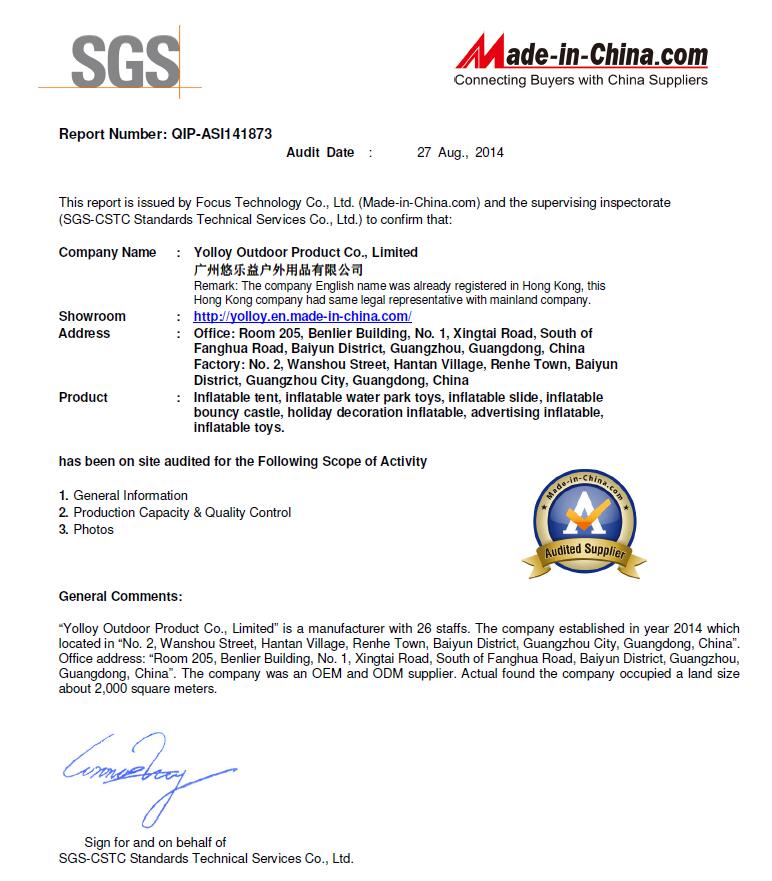
Certification

News

• New Order Successfully Finished for Long-Time Cooperated Japanese Client | YOLLOY Wins Full Client Recognition

• YOLLOY Custom Inflatable Pool Tent for Danish Client: Professional Pool Repair Shelter & Debris Protection

• Trusted Once Again! Greek Captain Re-orders Our Products After 4 Years

• Revolutionize Your Outdoors: The All-Terrain Inflatable Floating Tent for Land & Water

• Elevate Your Summer Fun: The Ultimate Inflatable Water Floating Volleyball Court Trampoline

• Innovative Inflatable Nightclub Tents & Pop-Up Bars: The Ultimate Solution for Portable Party Venues

Contact Us

Name: Sunny Yang
Tel: +86-20-8370 0771
Fax: +86-20-8370 0771
Mobile: 13570587575
E-mail: [email protected]
Add: No 5,Xiong wei Bo Nan Road,ZhongLuoTan Town,Baiyun district,Guangzhou,China
Friend me on Facebook Follow me on Twitter Add me to your circles Follow me on Pinterest Watch my channel on YouTube
News

Should I buy an inflatable obstacle course for my school?

Author:yolloy Date:2026/8/14 20:07:40

If you organize school events, you have probably faced this question: rent an inflatable obstacle course a few times a year, or buy one outright? At first glance, renting feels safer. No storage, no maintenance, no upfront commitment. But for schools that run multiple events — field days, carnivals, fundraisers, after-school programs — the math quickly shifts in favor of ownership.

An inflatable obstacle course is not just a carnival attraction. It is a versatile piece of equipment that can serve physical education classes, school sports days, holiday celebrations, and community outreach events throughout the academic year. This article walks through the key factors that help school administrators and PTA committees make a confident purchasing decision.

Renting vs. Buying: The Numbers Over Time

A typical rental for a mid-size inflatable obstacle course costs between $300 and $600 per day, depending on your location and the unit size. If your school holds four events per year — say a fall carnival, a winter indoor activity day, a spring field day, and an end-of-year celebration — you are spending $1,200 to $2,400 annually on rentals alone.

A commercially manufactured obstacle course, purchased directly from a reputable inflatable obstacle course manufacturer, can pay for itself within two to three years. After that, every event becomes a net positive for the school budget. Even better, the school gains scheduling flexibility: no more competing for rental availability during peak seasons, no more delivery windows that conflict with morning drop-off, and no more last-minute cancellations from overbooked rental companies.

Beyond the Carnival: Educational and Developmental Value

An obstacle course is more than entertainment. Physical education teachers can use it to build coordination, agility, and cardiovascular endurance in a format that feels like play rather than exercise. Crawling through tunnels develops spatial awareness. Climbing over pop-up walls strengthens upper body muscles. Racing through squeeze walls teaches controlled speed and body positioning.

For younger students, an obstacle course supports gross motor skill development. For older students, it introduces friendly competition and goal-setting — beat your previous time, work as a relay team, or simply complete the course without stopping. Teachers can integrate the course into lesson plans for health, teamwork, and even physics concepts like momentum and friction.

What to Look for When Buying

Not all inflatable obstacle courses are built to the same standard. When evaluating a purchase, focus on these four areas:

Material Quality

Look for commercial-grade PVC tarpaulin with reinforced seams. High-quality products use double or quadruple stitching with waterproof nylon thread. The material should be tear-resistant, easy to clean, and able to withstand repeated setup and teardown cycles. Avoid consumer-grade materials designed for occasional backyard use — they will not hold up under the heavy traffic of school events.

Safety Certifications

Confirm that the product meets recognized safety standards. For inflatable play equipment, EN71 and EN14960 are widely accepted certifications that indicate the product has passed tests for mechanical safety, flammability, and chemical content. Ask the manufacturer for documentation. A responsible china inflatable obstacle course supplier will provide certification records without hesitation.

Size and Layout

Measure your available space before you shop. A 40-foot course fits comfortably on most school fields and blacktop areas. A 60-foot course with dual lanes moves more participants per hour but requires a larger footprint and additional buffer zones. If your campus has limited flat ground, consider a compact design with a U-turn layout that keeps the start and finish close together. For indoor use, confirm ceiling height requirements — most courses need at least 18 feet of clearance.

Customization Options

A school-branded obstacle course creates instant visual identity. Look for manufacturers that offer custom colors, printed logos, and themed designs. Customization turns a generic piece of equipment into a recognizable school asset that builds community pride. Some manufacturers also offer flexibility in obstacle elements — choose between crawl tunnels, climbing walls, slide exits, and pop-up barriers to match your students' age range and physical abilities.

Why Source Directly from a Manufacturer

Buying from a middleman adds an unnecessary layer of cost. When you work directly with a manufacturer, you eliminate distributor markups and gain access to customization options that resellers cannot offer. You also establish a direct relationship for future support, replacement parts, and additional orders.

YOLLOY, based in Guangzhou, China, is a manufacturer that specializes in custom inflatable products for commercial and institutional buyers. With a minimum order quantity of just one piece, the company serves schools, event companies, and entertainment venues worldwide. The design team creates simulation renderings from customer proposals, revises based on feedback, and moves into production only after approval. This custom design-to-production approach means schools receive exactly what they need, not a close-enough off-the-shelf product.

Production typically takes 6 to 15 days for a standard inflatable obstacle course. Products ship with appropriately powered blowers compatible with 110V, 220V, or 380V requirements. Each order includes a repair kit, and the company backs its products with a three-year service expectation when properly maintained.

Safety and Compliance: What Schools Must Verify

School districts often require proof of safety compliance before approving equipment purchases. YOLLOY products use materials that have passed EN71, EN14960, and RoHS-related testing. Blowers meet CE or UL requirements. For water-themed obstacle courses that incorporate splash elements, the relevant standard is EN 15649.

Beyond certifications, consider the anchoring system. Steel stakes driven 30 inches or more into grass are the standard for outdoor use. On pavement or blacktop, water barrels or concrete ballast provide secure anchoring. The course should include multiple anchor points — D-rings or round metal rings — distributed along the structure. These are not optional extras; they are the foundation of safe operation in any wind condition.

Staffing matters too. Plan for at least two trained attendants during operation: one at the start line to manage entry and enforce height or age guidelines, and one at the exit to ensure riders clear the area safely. Many schools pair a staff member with parent volunteers, creating a rotation that keeps everyone fresh throughout the event.

Practical Considerations: Power, Storage, and Maintenance

A medium-sized obstacle course typically runs on two blowers, each drawing 7 to 12 amps at 110 volts. Two dedicated 20-amp circuits close to the setup area are ideal. If your school's outdoor outlets are far from the field, budget for a quiet inverter generator. A 7,000-watt unit with clean power output handles a dual-blower course with room to spare.

Storage is often the concern that stops schools from buying. A deflated and rolled obstacle course for a 40- to 60-foot unit fits into a space roughly the size of a large rolling trash bin. Many schools store their course in a PE equipment room, a custodial closet, or a dedicated outdoor storage shed. The key is keeping it dry, clean, and protected from pests. A simple heavy-duty storage bag or rolling cart simplifies transport between the storage area and the setup site.

Maintenance is straightforward. After each use, wipe down surfaces, check seams for wear, and inspect anchor points. The included repair kit handles minor punctures and seam issues. With proper care, a well-manufactured inflatable obstacle course reliably serves a school for years.

Making the Decision

If your school runs two or more events per year that would benefit from an inflatable obstacle course, buying makes financial sense. The upfront cost is real, but the long-term savings, scheduling freedom, and educational value tip the balance heavily toward ownership. When you factor in the ability to customize the course with school colors and logos, the case becomes even stronger.

Start by measuring your available space, defining your budget, and identifying the age range of students who will use the course. Then reach out to a manufacturer like YOLLOY for a consultation. Share your requirements, ask for a rendering, and review the safety documentation. A thoughtful purchase process leads to a piece of equipment that becomes a centerpiece of school life for years to come.


Should I buy an inflatable obstacle course for my school?

Author:yolloy Date:2026/8/14 20:07:40

If you organize school events, you have probably faced this question: rent an inflatable obstacle course a few times a year, or buy one outright? At first glance, renting feels safer. No storage, no maintenance, no upfront commitment. But for schools that run multiple events — field days, carnivals, fundraisers, after-school programs — the math quickly shifts in favor of ownership.

An inflatable obstacle course is not just a carnival attraction. It is a versatile piece of equipment that can serve physical education classes, school sports days, holiday celebrations, and community outreach events throughout the academic year. This article walks through the key factors that help school administrators and PTA committees make a confident purchasing decision.

Renting vs. Buying: The Numbers Over Time

A typical rental for a mid-size inflatable obstacle course costs between $300 and $600 per day, depending on your location and the unit size. If your school holds four events per year — say a fall carnival, a winter indoor activity day, a spring field day, and an end-of-year celebration — you are spending $1,200 to $2,400 annually on rentals alone.

A commercially manufactured obstacle course, purchased directly from a reputable inflatable obstacle course manufacturer, can pay for itself within two to three years. After that, every event becomes a net positive for the school budget. Even better, the school gains scheduling flexibility: no more competing for rental availability during peak seasons, no more delivery windows that conflict with morning drop-off, and no more last-minute cancellations from overbooked rental companies.

Beyond the Carnival: Educational and Developmental Value

An obstacle course is more than entertainment. Physical education teachers can use it to build coordination, agility, and cardiovascular endurance in a format that feels like play rather than exercise. Crawling through tunnels develops spatial awareness. Climbing over pop-up walls strengthens upper body muscles. Racing through squeeze walls teaches controlled speed and body positioning.

For younger students, an obstacle course supports gross motor skill development. For older students, it introduces friendly competition and goal-setting — beat your previous time, work as a relay team, or simply complete the course without stopping. Teachers can integrate the course into lesson plans for health, teamwork, and even physics concepts like momentum and friction.

What to Look for When Buying

Not all inflatable obstacle courses are built to the same standard. When evaluating a purchase, focus on these four areas:

Material Quality

Look for commercial-grade PVC tarpaulin with reinforced seams. High-quality products use double or quadruple stitching with waterproof nylon thread. The material should be tear-resistant, easy to clean, and able to withstand repeated setup and teardown cycles. Avoid consumer-grade materials designed for occasional backyard use — they will not hold up under the heavy traffic of school events.

Safety Certifications

Confirm that the product meets recognized safety standards. For inflatable play equipment, EN71 and EN14960 are widely accepted certifications that indicate the product has passed tests for mechanical safety, flammability, and chemical content. Ask the manufacturer for documentation. A responsible china inflatable obstacle course supplier will provide certification records without hesitation.

Size and Layout

Measure your available space before you shop. A 40-foot course fits comfortably on most school fields and blacktop areas. A 60-foot course with dual lanes moves more participants per hour but requires a larger footprint and additional buffer zones. If your campus has limited flat ground, consider a compact design with a U-turn layout that keeps the start and finish close together. For indoor use, confirm ceiling height requirements — most courses need at least 18 feet of clearance.

Customization Options

A school-branded obstacle course creates instant visual identity. Look for manufacturers that offer custom colors, printed logos, and themed designs. Customization turns a generic piece of equipment into a recognizable school asset that builds community pride. Some manufacturers also offer flexibility in obstacle elements — choose between crawl tunnels, climbing walls, slide exits, and pop-up barriers to match your students' age range and physical abilities.

Why Source Directly from a Manufacturer

Buying from a middleman adds an unnecessary layer of cost. When you work directly with a manufacturer, you eliminate distributor markups and gain access to customization options that resellers cannot offer. You also establish a direct relationship for future support, replacement parts, and additional orders.

YOLLOY, based in Guangzhou, China, is a manufacturer that specializes in custom inflatable products for commercial and institutional buyers. With a minimum order quantity of just one piece, the company serves schools, event companies, and entertainment venues worldwide. The design team creates simulation renderings from customer proposals, revises based on feedback, and moves into production only after approval. This custom design-to-production approach means schools receive exactly what they need, not a close-enough off-the-shelf product.

Production typically takes 6 to 15 days for a standard inflatable obstacle course. Products ship with appropriately powered blowers compatible with 110V, 220V, or 380V requirements. Each order includes a repair kit, and the company backs its products with a three-year service expectation when properly maintained.

Safety and Compliance: What Schools Must Verify

School districts often require proof of safety compliance before approving equipment purchases. YOLLOY products use materials that have passed EN71, EN14960, and RoHS-related testing. Blowers meet CE or UL requirements. For water-themed obstacle courses that incorporate splash elements, the relevant standard is EN 15649.

Beyond certifications, consider the anchoring system. Steel stakes driven 30 inches or more into grass are the standard for outdoor use. On pavement or blacktop, water barrels or concrete ballast provide secure anchoring. The course should include multiple anchor points — D-rings or round metal rings — distributed along the structure. These are not optional extras; they are the foundation of safe operation in any wind condition.

Staffing matters too. Plan for at least two trained attendants during operation: one at the start line to manage entry and enforce height or age guidelines, and one at the exit to ensure riders clear the area safely. Many schools pair a staff member with parent volunteers, creating a rotation that keeps everyone fresh throughout the event.

Practical Considerations: Power, Storage, and Maintenance

A medium-sized obstacle course typically runs on two blowers, each drawing 7 to 12 amps at 110 volts. Two dedicated 20-amp circuits close to the setup area are ideal. If your school's outdoor outlets are far from the field, budget for a quiet inverter generator. A 7,000-watt unit with clean power output handles a dual-blower course with room to spare.

Storage is often the concern that stops schools from buying. A deflated and rolled obstacle course for a 40- to 60-foot unit fits into a space roughly the size of a large rolling trash bin. Many schools store their course in a PE equipment room, a custodial closet, or a dedicated outdoor storage shed. The key is keeping it dry, clean, and protected from pests. A simple heavy-duty storage bag or rolling cart simplifies transport between the storage area and the setup site.

Maintenance is straightforward. After each use, wipe down surfaces, check seams for wear, and inspect anchor points. The included repair kit handles minor punctures and seam issues. With proper care, a well-manufactured inflatable obstacle course reliably serves a school for years.

Making the Decision

If your school runs two or more events per year that would benefit from an inflatable obstacle course, buying makes financial sense. The upfront cost is real, but the long-term savings, scheduling freedom, and educational value tip the balance heavily toward ownership. When you factor in the ability to customize the course with school colors and logos, the case becomes even stronger.

Start by measuring your available space, defining your budget, and identifying the age range of students who will use the course. Then reach out to a manufacturer like YOLLOY for a consultation. Share your requirements, ask for a rendering, and review the safety documentation. A thoughtful purchase process leads to a piece of equipment that becomes a centerpiece of school life for years to come.