Products Category
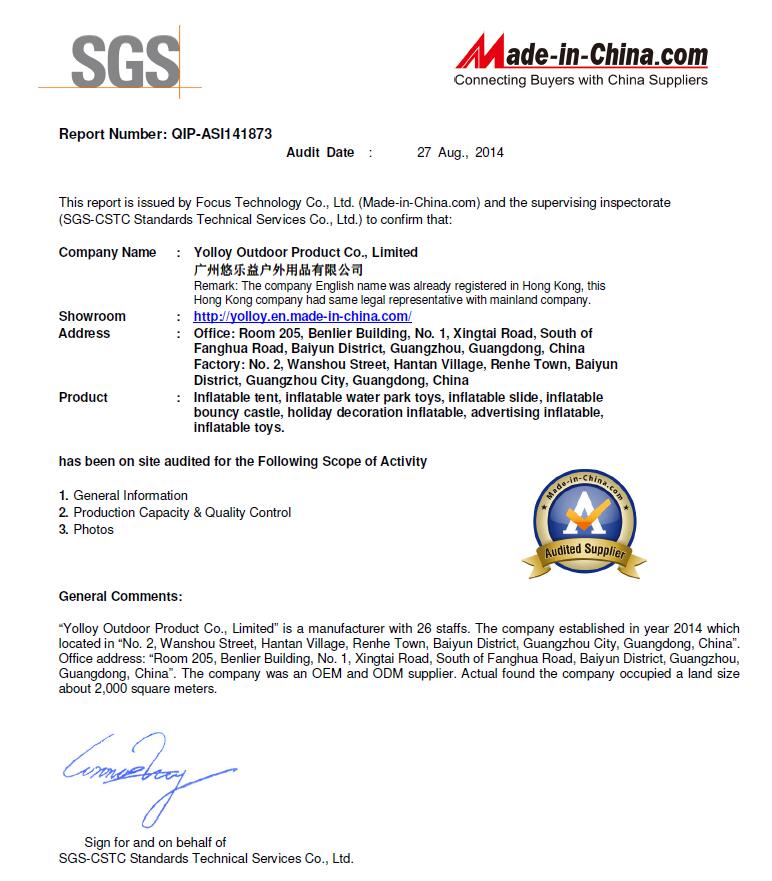
Certification

News

• Inflatable golf club simulator training tent

• The white inflatable party tent in our life

• YOLLOY Unveils Space-Saving Inflatable Car Wash Mat: The Eco-Friendly Solution for Mess-Free Home Detailing

• Custom Snow-Resistant Inflatable Tunnel Tent to Korean Client

• YOLLOY Launches Innovative Inflatable Light Pillar to Revolutionize Advertising and Event Branding

• Our New Batch of Customizable Inflatable Cable Buoys Pass Quality Inspection, Destined for Malaysia Marine Cable Installation

Contact Us

Name: Sunny Yang
Tel: +86-20-8370 0771
Fax: +86-20-8370 0771
Mobile: 13570587575
E-mail: sales@yolloy.com
Add: No 5,Xiong wei Bo Nan Road,ZhongLuoTan Town,Baiyun district,Guangzhou,China
Friend me on Facebook Follow me on Twitter Add me to your circles Follow me on Pinterest Watch my channel on YouTube
News

Large Inflatable Bounce House with Airflow System - Prevent Overheating for Kids Comfort

Designed for Fun: More Than Just a "Cool" Space

Let's not forget the most important part: this is a bounce house , and kids don't care about airflow systems—they care about slides, obstacles, and how high they can jump! The best large inflatable bounce houses don't skimp on fun features just to add ventilation. In fact, the airflow design often enhances the play experience by creating more space and better layout.
Take the "bounce house inflatable bouncer obstacle combo," for example. These models combine a main bounce area with obstacles like tunnels, climbing walls, and a slide—all arranged to keep kids moving and spread out, which helps with airflow too! The large size (we're talking 15-20 feet wide, sometimes more) means there's plenty of room for 8-10 kids to play without bumping into each other, reducing body heat buildup and making the breeze from the airflow system even more effective.
Colors and themes matter too! Bright, cheerful designs (think rainbows, dinosaurs, or outer space) keep kids engaged, while reinforced "landing zones" around slides and climbing areas add an extra layer of safety. And because the materials are UV-resistant, those vibrant colors won't fade, even after months of sun exposure. It's a bounce house that looks as good as it feels to play in.
"We rented the large airflow bounce house for my son's 7th birthday, and it was a game-changer! The kids played for 3 hours straight—no one complained about being hot, and I didn't have to hover like a helicopter parent. Even the other moms were asking where we got it!" — Sarah, mom of two

Beyond Backyards: Commercial Use and Wholesale Options

While parents love these bounce houses for birthday parties and weekend play, they're also a hit with commercial buyers. Think party rental companies, amusement parks, community centers, and schools—places where the bounce house gets daily use and needs to stand up to constant wear and tear. That's where commercial inflatable bounce house wholesale options come in.
Commercial-grade bounce houses with airflow systems are built even tougher, with thicker PVC (15oz vs. standard 10oz) and reinforced stress points (like the base and slide entrances). They're also designed to be easy to clean and maintain—important when you're hosting different groups of kids every day. Imagine a rental company that can offer a "cool bounce house" as a premium option—parents will pay extra for the peace of mind, and kids will beg to come back.
Working with a reputable inflatable bounce house supplier means you can also customize these commercial models. Want your company logo printed on the side? Need a specific size to fit in a school gym? The best manufacturers (like Yolloy) offer custom design services, where you can work with a team to tweak everything from colors to obstacle layouts. And with 24-hour customer support and a 95% on-time delivery rate, you won't have to stress about last-minute cancellations or delays.

Why Choose a Trusted Manufacturer?

With so many options on the market, it's tempting to go for the cheapest bounce house you can find. But when it comes to something your kids (or customers' kids) will be playing in, cutting corners is never worth it. A trusted inflatable bounce house manufacturer doesn't just sell you a product—they partner with you to ensure safety, quality, and satisfaction.
  • Transparent communication: From the moment you inquire, they'll walk you through the design process, answer questions about materials and safety standards, and provide updates on production. No hidden fees, no vague promises.
  • Quality testing: Every bounce house should undergo rigorous testing before it leaves the factory—including pressure tests to check for leaks, stress tests to ensure seams hold, and ventilation tests to verify the airflow system works as promised.
  • After-sales support: What if a vent gets clogged or a seam starts to fray? A good manufacturer will offer replacement parts, repair guides, and quick response times (like 24-hour email support) to keep your bounce house in top shape.
At the end of the day, this isn't just about buying a bounce house. It's about investing in a space where kids can be kids—uninhibited, energetic, and safe. It's about parents getting to watch those moments of pure joy without worry. And it's about choosing a product that's designed with care, from the first sketch to the final stitch.

Final Thoughts: Playtime Should Be Cool, Inside and Out

The large inflatable bounce house with an airflow system isn't just a "better" bounce house—it's a reimagining of what play equipment can be. It's proof that safety and fun don't have to be opposites, and that thoughtful design can turn a simple toy into a space where memories are made. Whether you're a parent looking to make your backyard the neighborhood hotspot, or a business owner wanting to offer the best in inflatable fun, this is the kind of product that stands out.
So, the next time you see kids bouncing in a stuffy, overheated bounce house, remember: there's a better way. A way where laughter doesn't have to be cut short by sweat, where parents can relax, and where playtime is as cool as it is exciting. It's called the large inflatable bounce house with airflow system—and once you try it, you'll never go back to "traditional" again.
Author:yolloy Date:2025/12/15 17:29:10

The Joy of Playtime, and the Worry That Comes With It

There's nothing quite like the sound of kids laughing—loud, unapologetic, full of life. Watch a group of children pile into an inflatable bounce house, and you'll see pure joy: arms flailing, hair flying, tiny feet bouncing higher with every jump. It's the kind of moment parents live for—the kind that makes all the chaos of parenting feel worth it. But if you've ever stood outside that bounce house on a warm day, you've probably noticed something else too: the way the air inside feels thick, the way little faces start to glisten with sweat, and how quickly that nonstop energy turns into slow, sluggish movements. Overheating in bounce houses isn't just a buzzkill; it's a real concern for any parent, teacher, or event planner who wants kids to play hard and stay safe.
That's where the large inflatable bounce house with a built-in airflow system comes in. It's not just a "bigger" version of the bounce houses you might remember from childhood. This is a thoughtfully designed space where safety, comfort, and endless fun collide—where kids can bounce, twist, and tumble for hours without overheating, and parents can relax knowing the play environment is as kind to their little ones as it is exciting. Let's dive into how this game-changing design works, why it matters, and why choosing the right inflatable bounce house manufacturer makes all the difference.

The Problem With Traditional Bounce Houses: Why Overheating Happens

Let's start with the basics: traditional bounce houses are essentially giant, air-filled bubbles. They're made with thick, durable materials to hold air and withstand rough play, but those same materials can trap heat like a greenhouse. On a sunny day, the temperature inside a standard bounce house can rise 15-20 degrees higher than the outside air in less than an hour. Add 5-10 active kids generating body heat, and suddenly you've got a recipe for discomfort, fatigue, and even heat-related issues.
Think about it: kids don't always know when they're overheating. They're too busy racing to the top of the slide or showing off their best flip to notice their shirts are soaked or their cheeks are bright red. Parents end up hovering, calling for "water breaks" every 10 minutes, and cutting playtime short—all while feeling like they're raining on the parade. Traditional designs might have a small vent or two, but they're often an afterthought, not a priority. The result? A bounce house that's more stress than fun for everyone involved.
Did you know? According to safety reports, overheating is one of the top concerns parents cite when renting or buying inflatable play equipment. A 2023 survey of event planners found that 68% had to limit bounce house use due to heat, even on mild days, because of poor ventilation.

The Airflow System: How It Keeps the Air Fresh and Cool

So, what makes the large inflatable bounce house with an airflow system different? It's all in the design—specifically, a network of strategically placed vents, fans, and air channels that work together to keep air moving constantly . This isn't just a "vent" stuck on the side; it's a system built into the bounce house from the ground up, designed by engineers who understand how air circulates (and how kids play).
Let's break it down into simple terms. Imagine the bounce house as a living, breathing space:
  • Multi-directional intake vents: These are placed low on the bounce house, near the base, to pull in fresh, cool air from the ground (where air is typically cooler than at waist height). They're covered with mesh screens to keep out dirt, bugs, and debris, so nothing interrupts the airflow.
  • Exhaust vents at the top: Heat rises, right? These vents are positioned high up, near the roof of the bounce house, to let hot, stale air escape. They're angled slightly downward to prevent rain or debris from getting in, but open enough to create a steady upward draft.
  • Internal air channels: Hidden between the bounce house's layers, these channels act like "air highways," directing fresh air from the intake vents to every corner of the play space—including under the bounce floor and around the slide or obstacle features. No more "dead zones" where heat gets trapped!
  • Adjustable fan speed: Most models come with a fan that has multiple speed settings, so you can crank up the airflow on hot days or dial it back on cooler ones. It's like having a built-in thermostat for fun.
The result? A bounce house where the air is always moving. Stand inside, and you'll feel a gentle, constant breeze—enough to keep kids cool but not so strong that it messes with their jumps or slides. It's the difference between a stuffy, sweaty playpen and an open, airy space where kids can play as long as their little hearts desire.

Safety First: Materials That Protect, Not Just Hold Air

Of course, a great airflow system is only as good as the materials it's built into. When it comes to kids inflatable bounce houses, safety and durability are non-negotiable. After all, this isn't just a toy—it's a space where kids will be running, falling, and bumping into each other, so the materials need to be tough enough to handle rough play and gentle enough to protect tiny bodies.
The best large inflatable bounce houses use high-quality, lightweight PVC (PVC tarpaulin) that's both waterproof and fire-resistant. But not just any PVC—look for materials that meet strict safety standards like EN71, which tests for things like non-toxicity, flame resistance, and durability. For example, Yolloy's bounce houses use PVC that's free from harmful chemicals, so you won't get that strong "plastic smell" when you first inflate it (a red flag for low-quality materials). The fabric is also treated to resist UV rays, so it won't fade or weaken in the sun—important for outdoor use!
What about the seams? They're the most vulnerable part of any inflatable structure. A well-made bounce house will have double-stitched, heat-sealed seams to prevent air leaks and ensure the structure stays firm, even with multiple kids bouncing at once. And because the airflow system is integrated into the design, there's no compromise on air retention—you get constant ventilation and a stable, bouncy surface.
Feature Traditional Bounce House Large Inflatable Bounce House with Airflow System
Material Quality Thin, basic PVC; may have strong odors EN71-certified, fire/waterproof PVC; non-toxic, UV-resistant
Ventilation 1-2 small, passive vents; poor air circulation Multi-directional intake/exhaust vents + internal air channels; constant airflow
Heat Retention Traps heat; temp rises 15-20°F above outside Consistent temp; only 3-5°F above outside air
Seam Strength Single-stitched; prone to leaks over time Double-stitched, heat-sealed; leak-resistant, long-lasting

Large Inflatable Bounce House with Airflow System - Prevent Overheating for Kids Comfort

Author:yolloy Date:2025/12/15 17:29:10

The Joy of Playtime, and the Worry That Comes With It

There's nothing quite like the sound of kids laughing—loud, unapologetic, full of life. Watch a group of children pile into an inflatable bounce house, and you'll see pure joy: arms flailing, hair flying, tiny feet bouncing higher with every jump. It's the kind of moment parents live for—the kind that makes all the chaos of parenting feel worth it. But if you've ever stood outside that bounce house on a warm day, you've probably noticed something else too: the way the air inside feels thick, the way little faces start to glisten with sweat, and how quickly that nonstop energy turns into slow, sluggish movements. Overheating in bounce houses isn't just a buzzkill; it's a real concern for any parent, teacher, or event planner who wants kids to play hard and stay safe.
That's where the large inflatable bounce house with a built-in airflow system comes in. It's not just a "bigger" version of the bounce houses you might remember from childhood. This is a thoughtfully designed space where safety, comfort, and endless fun collide—where kids can bounce, twist, and tumble for hours without overheating, and parents can relax knowing the play environment is as kind to their little ones as it is exciting. Let's dive into how this game-changing design works, why it matters, and why choosing the right inflatable bounce house manufacturer makes all the difference.

The Problem With Traditional Bounce Houses: Why Overheating Happens

Let's start with the basics: traditional bounce houses are essentially giant, air-filled bubbles. They're made with thick, durable materials to hold air and withstand rough play, but those same materials can trap heat like a greenhouse. On a sunny day, the temperature inside a standard bounce house can rise 15-20 degrees higher than the outside air in less than an hour. Add 5-10 active kids generating body heat, and suddenly you've got a recipe for discomfort, fatigue, and even heat-related issues.
Think about it: kids don't always know when they're overheating. They're too busy racing to the top of the slide or showing off their best flip to notice their shirts are soaked or their cheeks are bright red. Parents end up hovering, calling for "water breaks" every 10 minutes, and cutting playtime short—all while feeling like they're raining on the parade. Traditional designs might have a small vent or two, but they're often an afterthought, not a priority. The result? A bounce house that's more stress than fun for everyone involved.
Did you know? According to safety reports, overheating is one of the top concerns parents cite when renting or buying inflatable play equipment. A 2023 survey of event planners found that 68% had to limit bounce house use due to heat, even on mild days, because of poor ventilation.

The Airflow System: How It Keeps the Air Fresh and Cool

So, what makes the large inflatable bounce house with an airflow system different? It's all in the design—specifically, a network of strategically placed vents, fans, and air channels that work together to keep air moving constantly . This isn't just a "vent" stuck on the side; it's a system built into the bounce house from the ground up, designed by engineers who understand how air circulates (and how kids play).
Let's break it down into simple terms. Imagine the bounce house as a living, breathing space:
  • Multi-directional intake vents: These are placed low on the bounce house, near the base, to pull in fresh, cool air from the ground (where air is typically cooler than at waist height). They're covered with mesh screens to keep out dirt, bugs, and debris, so nothing interrupts the airflow.
  • Exhaust vents at the top: Heat rises, right? These vents are positioned high up, near the roof of the bounce house, to let hot, stale air escape. They're angled slightly downward to prevent rain or debris from getting in, but open enough to create a steady upward draft.
  • Internal air channels: Hidden between the bounce house's layers, these channels act like "air highways," directing fresh air from the intake vents to every corner of the play space—including under the bounce floor and around the slide or obstacle features. No more "dead zones" where heat gets trapped!
  • Adjustable fan speed: Most models come with a fan that has multiple speed settings, so you can crank up the airflow on hot days or dial it back on cooler ones. It's like having a built-in thermostat for fun.
The result? A bounce house where the air is always moving. Stand inside, and you'll feel a gentle, constant breeze—enough to keep kids cool but not so strong that it messes with their jumps or slides. It's the difference between a stuffy, sweaty playpen and an open, airy space where kids can play as long as their little hearts desire.

Safety First: Materials That Protect, Not Just Hold Air

Of course, a great airflow system is only as good as the materials it's built into. When it comes to kids inflatable bounce houses, safety and durability are non-negotiable. After all, this isn't just a toy—it's a space where kids will be running, falling, and bumping into each other, so the materials need to be tough enough to handle rough play and gentle enough to protect tiny bodies.
The best large inflatable bounce houses use high-quality, lightweight PVC (PVC tarpaulin) that's both waterproof and fire-resistant. But not just any PVC—look for materials that meet strict safety standards like EN71, which tests for things like non-toxicity, flame resistance, and durability. For example, Yolloy's bounce houses use PVC that's free from harmful chemicals, so you won't get that strong "plastic smell" when you first inflate it (a red flag for low-quality materials). The fabric is also treated to resist UV rays, so it won't fade or weaken in the sun—important for outdoor use!
What about the seams? They're the most vulnerable part of any inflatable structure. A well-made bounce house will have double-stitched, heat-sealed seams to prevent air leaks and ensure the structure stays firm, even with multiple kids bouncing at once. And because the airflow system is integrated into the design, there's no compromise on air retention—you get constant ventilation and a stable, bouncy surface.
Feature Traditional Bounce House Large Inflatable Bounce House with Airflow System Material Quality Thin, basic PVC; may have strong odors EN71-certified, fire/waterproof PVC; non-toxic, UV-resistant Ventilation 1-2 small, passive vents; poor air circulation Multi-directional intake/exhaust vents + internal air channels; constant airflow Heat Retention Traps heat; temp rises 15-20°F above outside Consistent temp; only 3-5°F above outside air Seam Strength Single-stitched; prone to leaks over time Double-stitched, heat-sealed; leak-resistant, long-lasting

Designed for Fun: More Than Just a "Cool" Space

Let's not forget the most important part: this is a bounce house , and kids don't care about airflow systems—they care about slides, obstacles, and how high they can jump! The best large inflatable bounce houses don't skimp on fun features just to add ventilation. In fact, the airflow design often enhances the play experience by creating more space and better layout.
Take the "bounce house inflatable bouncer obstacle combo," for example. These models combine a main bounce area with obstacles like tunnels, climbing walls, and a slide—all arranged to keep kids moving and spread out, which helps with airflow too! The large size (we're talking 15-20 feet wide, sometimes more) means there's plenty of room for 8-10 kids to play without bumping into each other, reducing body heat buildup and making the breeze from the airflow system even more effective.
Colors and themes matter too! Bright, cheerful designs (think rainbows, dinosaurs, or outer space) keep kids engaged, while reinforced "landing zones" around slides and climbing areas add an extra layer of safety. And because the materials are UV-resistant, those vibrant colors won't fade, even after months of sun exposure. It's a bounce house that looks as good as it feels to play in.
"We rented the large airflow bounce house for my son's 7th birthday, and it was a game-changer! The kids played for 3 hours straight—no one complained about being hot, and I didn't have to hover like a helicopter parent. Even the other moms were asking where we got it!" — Sarah, mom of two

Beyond Backyards: Commercial Use and Wholesale Options

While parents love these bounce houses for birthday parties and weekend play, they're also a hit with commercial buyers. Think party rental companies, amusement parks, community centers, and schools—places where the bounce house gets daily use and needs to stand up to constant wear and tear. That's where commercial inflatable bounce house wholesale options come in.
Commercial-grade bounce houses with airflow systems are built even tougher, with thicker PVC (15oz vs. standard 10oz) and reinforced stress points (like the base and slide entrances). They're also designed to be easy to clean and maintain—important when you're hosting different groups of kids every day. Imagine a rental company that can offer a "cool bounce house" as a premium option—parents will pay extra for the peace of mind, and kids will beg to come back.
Working with a reputable inflatable bounce house supplier means you can also customize these commercial models. Want your company logo printed on the side? Need a specific size to fit in a school gym? The best manufacturers (like Yolloy) offer custom design services, where you can work with a team to tweak everything from colors to obstacle layouts. And with 24-hour customer support and a 95% on-time delivery rate, you won't have to stress about last-minute cancellations or delays.

Why Choose a Trusted Manufacturer?

With so many options on the market, it's tempting to go for the cheapest bounce house you can find. But when it comes to something your kids (or customers' kids) will be playing in, cutting corners is never worth it. A trusted inflatable bounce house manufacturer doesn't just sell you a product—they partner with you to ensure safety, quality, and satisfaction.
  • Transparent communication: From the moment you inquire, they'll walk you through the design process, answer questions about materials and safety standards, and provide updates on production. No hidden fees, no vague promises.
  • Quality testing: Every bounce house should undergo rigorous testing before it leaves the factory—including pressure tests to check for leaks, stress tests to ensure seams hold, and ventilation tests to verify the airflow system works as promised.
  • After-sales support: What if a vent gets clogged or a seam starts to fray? A good manufacturer will offer replacement parts, repair guides, and quick response times (like 24-hour email support) to keep your bounce house in top shape.
At the end of the day, this isn't just about buying a bounce house. It's about investing in a space where kids can be kids—uninhibited, energetic, and safe. It's about parents getting to watch those moments of pure joy without worry. And it's about choosing a product that's designed with care, from the first sketch to the final stitch.

Final Thoughts: Playtime Should Be Cool, Inside and Out

The large inflatable bounce house with an airflow system isn't just a "better" bounce house—it's a reimagining of what play equipment can be. It's proof that safety and fun don't have to be opposites, and that thoughtful design can turn a simple toy into a space where memories are made. Whether you're a parent looking to make your backyard the neighborhood hotspot, or a business owner wanting to offer the best in inflatable fun, this is the kind of product that stands out.
So, the next time you see kids bouncing in a stuffy, overheated bounce house, remember: there's a better way. A way where laughter doesn't have to be cut short by sweat, where parents can relax, and where playtime is as cool as it is exciting. It's called the large inflatable bounce house with airflow system—and once you try it, you'll never go back to "traditional" again.