Two operators, two aqua parks, one summer. The difference isn't in the catalog — it's in the materials, the seams, and the support behind the product.
Two amusement operators open their inflatable water park on the same weekend in June. Both ordered a floating aqua playground. Both spent roughly the same amount. By August, one is counting repeat visitors and expansion plans. The other is patching seams, fielding complaints, and wondering where the summer went.
The difference isn't luck. It's in the supplier selection — the questions you ask before the purchase order goes out, the documents you insist on seeing, and the standards a factory is actually willing to stand behind. An inflatable water park is not a commodity. It is a safety-critical, high-traffic commercial asset, and the market is full of options that look identical in photos and perform very differently in the water.
What You'll Learn in This Guide
• Why commercial-grade PVC and reinforced seams matter more than the listed price
• Which safety standards (EN 15649, EN 14960) separate serious manufacturers from resellers
• The five quality signals to verify before you send a deposit
• How custom design turns a generic water park into a visitor magnet
1. The Market Landscape: More Players, Fewer Manufacturers
Industry analysts track dozens of names in the global inflatable water park space — from dedicated aqua park specialists to general inflatable factories to trading companies with no production floor of their own. For a buyer, this creates a specific problem: the product photo on the website may have nothing to do with the factory that actually builds your unit.
That is why the first filter is the simplest: is this a manufacturer, or a reseller? A manufacturer can show you the factory floor, walk you through the welding process, and adjust a design on request. A reseller forwards your email to someone else and marks up the price. When you are buying a commercial inflatable products meant to hold hundreds of people in the water, the middleman adds cost and removes accountability.
A supplier who sends you factory photos within the hour is a manufacturer. A supplier who sends you only a price list is a reseller.
2. Material and Construction: The Part You Cannot See in Photos
Every inflatable water park is made of PVC. Not every PVC is the same.
Commercial-grade inflatable parks use heavy-duty PVC tarpaulin with a thickness and weight rating designed for sustained water exposure and high foot traffic. The seams are where most parks fail — and where most buyers never look. Reinforced seams at high-load areas, precision sewing equipment, and waterproof nylon thread are not marketing bullet points. They are the difference between a park that lasts three seasons and one that starts leaking by mid-July.
| Quality Signal |
What to Ask For |
Why It Matters |
| Material specification |
PVC tarpaulin weight (gsm), thickness, brand/source |
Thin material stretches, tears, and degrades fast under UV and chlorine |
| Seam reinforcement |
Photos of high-load area reinforcement, stitch count per inch |
Seams are the #1 failure point in water park inflatables |
| Welding method |
High-temperature fusion welding for airtight chambers |
Glued or poorly welded seams leak air and water over time |
| Anchor system |
D-ring or round metal anchor points with load ratings |
A floating park that shifts in the wind is a safety hazard, not a ride |
| Blower compatibility |
CE or UL listed blowers, voltage options (110V / 220V / 380V) |
Mismatched blowers cause under-inflation and safety risks |
3. Safety Standards: The Certifications That Actually Mean Something
A factory that claims "high quality" without documentation is making a promise in adjectives. A factory that hands you test reports is making a promise in documents.
For inflatable water park equipment, the standard to know is EN 15649 — the European standard for floating aquatic leisure articles. For inflatable play structures used on land (such as the inflatable bounce house units often paired with water attractions), the corresponding standard is EN 14960. Materials should also carry EN71 and RoHS-related testing. Blowers should meet CE or UL requirements.
None of these are optional decorations on a spec sheet. They are the minimum baseline for a product that will be used by children and adults in a commercial environment. If a supplier cannot produce the relevant documentation, move on — no matter how low the price.
4. Custom Design: Why a Generic Park Leaves Money on the Table
The easiest water park to sell is a cookie-cutter layout from a catalog. The most profitable water park is one built for your specific site, audience, and brand.
A custom inflatable water park can be sized to an exact pool or lake footprint, themed to match a resort or campground brand, and laid out to optimize traffic flow and maximize throughput. Custom printing puts your logo where every visitor with a phone will photograph it. Obstacle courses, climbing walls, splash zones, and rest platforms can all be arranged to match the age range and capacity you expect.
The same principle applies to the broader inflatable entertainment lineup. Pairing a water park with a commercial inflatable slide or a themed bounce area turns a single attraction into a full-day experience — and a full-day experience into a repeat-visit business model.
The Custom Design Process, Step by Step
1. Share your site plan, budget, and target audience — a sketch, photo, or description is enough to start.
2. Designers produce simulation renderings so you can see the layout before production begins.
3. Revisions continue until the design is approved.
4. Factory production begins, with QC testing before shipment.
5. The park ships with matching blowers, a repair kit, and installation guidance.
5. Beyond the Product: Warranty, Support, and Delivery
The purchase is the beginning of the relationship, not the end. A commercial inflatable water park is a multi-season investment, and the supplier's behavior after the sale matters as much as the product itself.
A responsible China inflatable manufacturer will offer a reasonable service-life expectation when the product is used and maintained correctly, supply a repair kit with each unit, and answer inquiries within a business day — not within a business week. They will also be transparent about production timelines (typically one to two weeks for a standard unit, longer for large or complex custom projects) and shipping options by air or sea.
On-time delivery matters. A park that arrives two weeks late has already lost two weeks of peak-season revenue. Look for a supplier that tracks and publishes its on-time delivery rate, not one that simply promises "soon."
6. The Pre-Purchase Checklist
Before You Send a Deposit, Confirm All Seven
Factory verification — ask for a live video walkthrough of the production floor
Material spec sheet — PVC weight, thickness, and source in writing
Safety certificates — EN 15649 for water park products, EN 14960 for play structures, EN71 / RoHS for materials
Seam and reinforcement photos — specifically at high-load areas and corners
Custom design renderings approved before production starts
Warranty terms, repair kit inclusion, and after-sales response time in writing
Production timeline and shipping method confirmed in the order confirmation
Ready to Build a Water Park That Lasts?
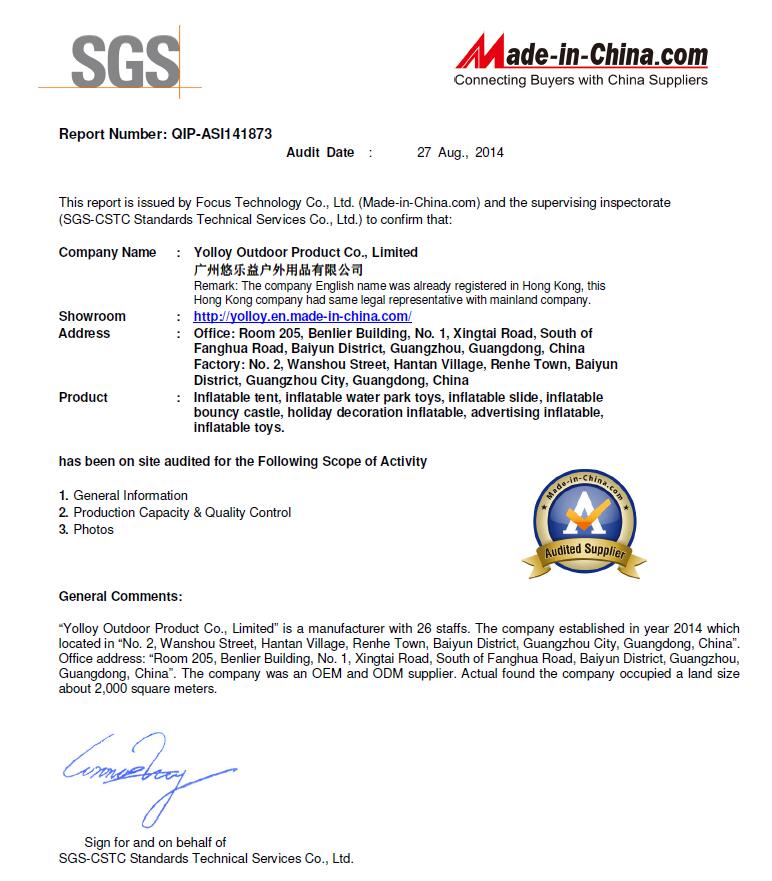
YOLLOY is a Guangzhou-based inflatable products manufacturer with a full lineup of floating water parks, slides, bounce houses, and custom inflatable structures — all built to commercial-grade standards and exported worldwide. Start by browsing the inflatable water park catalog, or send your site plan and budget to the team for a custom design proposal. You will usually hear back within one business day.
Browse the full commercial inflatable products range, or explore complementary attractions like commercial inflatable slides and inflatable bounce houses to build a complete guest experience.