Products Category
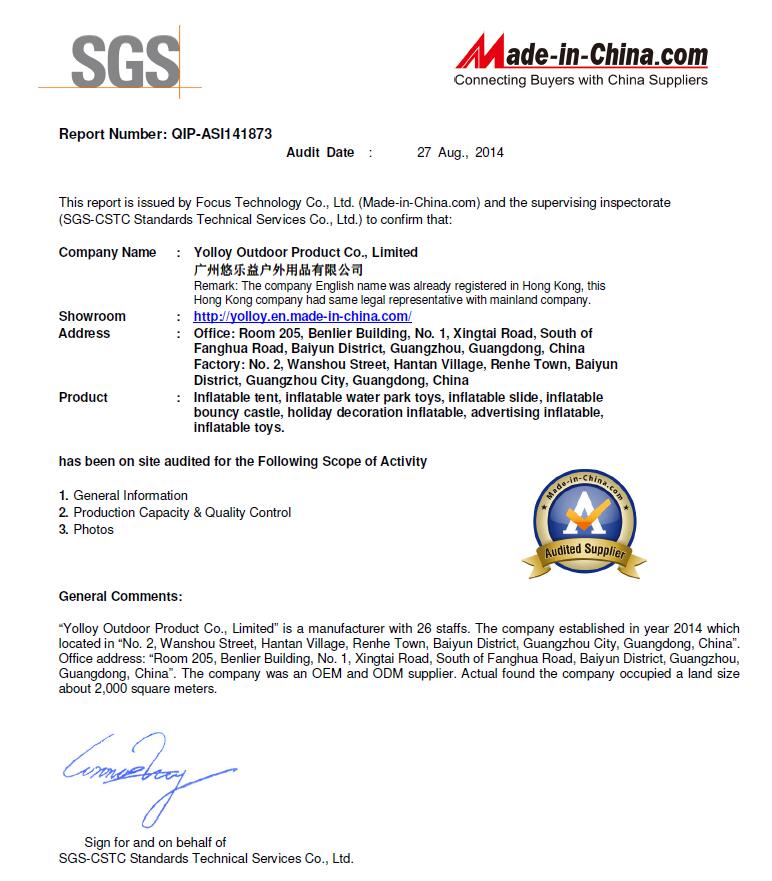
Certification

News

• New Order Successfully Finished for Long-Time Cooperated Japanese Client | YOLLOY Wins Full Client Recognition

• YOLLOY Custom Inflatable Pool Tent for Danish Client: Professional Pool Repair Shelter & Debris Protection

• Trusted Once Again! Greek Captain Re-orders Our Products After 4 Years

• Revolutionize Your Outdoors: The All-Terrain Inflatable Floating Tent for Land & Water

• Elevate Your Summer Fun: The Ultimate Inflatable Water Floating Volleyball Court Trampoline

• Innovative Inflatable Nightclub Tents & Pop-Up Bars: The Ultimate Solution for Portable Party Venues

Contact Us

Name: Sunny Yang
Tel: +86-20-8370 0771
Fax: +86-20-8370 0771
Mobile: 13570587575
E-mail: sales@yolloy.com
Add: No 5,Xiong wei Bo Nan Road,ZhongLuoTan Town,Baiyun district,Guangzhou,China
Friend me on Facebook Follow me on Twitter Add me to your circles Follow me on Pinterest Watch my channel on YouTube
News

Beyond the Tent Pole: Why Inflatable Tents Are Redefining Outdoor Shelter

Author:yolloy Date:2026/7/20 1:12:53

Two campers arrive at the same lakeside site. One unpacks a bundle of aluminum poles, consults a diagram, and starts threading sleeves — forty minutes later, the tent is up. The other unrolls a compact package, connects a blower, and watches the shelter rise in under three minutes. Same campsite, same sunset, two completely different experiences. The difference is not skill or experience. It is the tent itself.

Inflatable tent for camping has moved from a niche curiosity to a mainstream choice, and the reasons go deeper than just convenience. Let's take a real look at what these structures offer, how they compare to traditional pole tents, and what to look for when you are ready to buy — whether you need one tent for weekend getaways or a fleet for a commercial operation.

What Makes an Inflatable Tent Different

A traditional tent relies on a frame of rigid poles — aluminum, fiberglass, or steel — threaded through fabric sleeves to create its shape. An outdoor inflatable tent replaces that skeleton with pressurized air tubes. These tubes, typically made from commercial-grade PVC tarpaulin or reinforced Oxford fabric, are sewn or welded into the tent body. When inflated with an electric blower, the tubes become rigid beams that raise the shelter in one continuous motion.

The structural principle is the same one that holds up inflatable sports domes, exhibition halls, and emergency field hospitals — air under controlled pressure creates a load-bearing frame. The difference is that this technology has now been refined into portable, packable products that individuals and businesses can deploy without engineering teams.

Speed: The Advantage That Changes Everything

Ask anyone who has pitched a traditional tent in fading daylight or unexpected rain, and they will tell you: time matters. A standard pole tent for a family of four takes anywhere from twenty minutes to an hour to set up properly, depending on the design and the skill of the person doing it. An inflatable tent, connected to an electric pump, stands ready in two to five minutes.

This time savings is not just about comfort. For event organizers setting up a dozen tents for a weekend festival, the difference between five minutes and forty minutes per tent is the difference between starting on time and starting late. For emergency response teams deploying field shelters, it is the difference between readiness and delay. For the rental business owner who needs to turn over equipment between Friday and Saturday bookings, it is margin.

More Than Just Camping: The Expanding World of Inflatable Shelters

The conversation around inflatable tents often starts and ends with camping. But the product category has expanded far beyond the campsite. Today, an inflatable tent manufacturer produces shelters for a remarkably wide range of applications:

  • Party and event tents — large-format inflatable structures for weddings, corporate events, and outdoor exhibitions, often with custom branding printed directly on the fabric.
  • Commercial spray booths — airtight inflatable enclosures for automotive painting and detailing, designed with ventilation ports and filtered airflow.
  • Sports shelters — inflatable golf simulator enclosures, sideline medical tents, and equipment storage for tournaments.
  • Clear bubble tents — transparent PVC domes for glamping, stargazing, and outdoor dining, offering a 360-degree view with full weather protection.
  • Emergency and medical tents — rapid-deployment shelters for field hospitals, triage stations, and disaster response.
  • Promotional and advertising models — giant inflatable product replicas, arches, and sky dancers that draw attention at trade shows and retail events.

Each of these applications carries different requirements — material thickness, UV resistance, flame retardancy, anchoring systems, blower specifications — and the best manufacturers offer custom inflatable tent solutions tailored to the specific use case rather than pushing a one-size-fits-all product.

What Holds It Together: Materials and Quality Control

An inflatable tent is only as reliable as the materials and workmanship behind it. The air beams that give the structure its shape are under constant pressure, and the seams that join the fabric panels are under constant tension. When these elements fail, the tent fails — often at the worst possible moment.

Quality manufacturers use precision sewing equipment with waterproof nylon thread and apply additional reinforcement at high-load areas. Airtight sections are manufactured with high-temperature fusion welding equipment rather than adhesives that degrade over time. The blowers — the electric pumps that keep the structure inflated — should meet CE or UL requirements and be matched to the correct voltage for the destination market (110V, 220V, or 380V).

Before committing to a purchase, it is worth asking about material certifications. Reputable producers have their materials tested against relevant standards: EN71 and EN14960 for inflatable play equipment, EN15649 for water park products, and RoHS for restricted substances. The presence of these certifications is a signal that the manufacturer operates a documented quality control system rather than shipping products on trust alone.

The Customization Factor

One of the most significant advantages of working directly with a manufacturer rather than buying off the shelf is the ability to customize. A custom inflatable tent can be built to your exact specifications: size, shape, color, fabric type, and branding.

Need a tent that matches your company's Pantone colors? That can be done. Want your logo printed across the side panels at trade-show scale? That can be done. Have a sketch, a photograph, a site plan, or just a description of what you need? A manufacturer with in-house design capability can prepare simulation renderings from your proposal, revise the design until you approve it, and then release it for production. This is the kind of service that separates a genuine custom manufacturer from a reseller with a catalog.

The Business Case: Buying Direct from the Manufacturer

For businesses — rental companies, event planners, resort operators, sports facility managers — the economics of inflatable tents shift when you buy from the source. A China-based manufacturer like YOLLOY, with its own design team and production facility in Guangzhou, eliminates the distributor markup. The minimum order quantity can be as low as one piece, which means you can start with a sample, test it in your environment, and scale from there.

Standard production time runs six to fifteen days for a regular inflatable product, not including transit. Air freight takes five to seven days for urgent orders; sea freight is available for larger shipments at fifteen to thirty days or more. Every product is inspected and tested before shipment, and a repair kit is supplied with each unit so that minor punctures can be patched in the field — the same way you would repair a bicycle inner tube.

Choosing the Right Partner

When you are comparing manufacturers, here are the questions worth asking before you place an order:

Can they show you a design rendering before production? A manufacturer that can produce a simulation from your description has in-house design capability. A manufacturer that can only send you photos of existing products is a reseller.

What materials do they use, and what certifications do those materials carry? The answer should be specific — PVC tarpaulin, Oxford fabric, nylon, TPU — not "high-quality material."

What blower specifications do they supply? The blower should match your local voltage and carry a CE or UL mark.

What is their on-time delivery track record? A stated rate — such as 95% — is a number you can hold someone to. "We try our best" is not.

Do they offer a warranty? A three-year service life expectation, when the product is used and maintained correctly, is a reasonable benchmark.

Conclusion

The inflatable tent is not a gimmick. It is a genuine engineering alternative to the pole-and-sleeve tent that has dominated the market for decades. The speed advantage is real. The structural robustness in wind is real. The design flexibility — from inflatable bubble tent glamping domes to industrial spray booths — is real and growing.

Whether you are an individual camper tired of wrestling with poles at dusk, or a business buyer sourcing shelters for a commercial fleet, the key is to match the product to the purpose and the manufacturer to the standard. The right partner answers in specifics, not adjectives, and ships with documentation, not promises.

Ready to discuss your inflatable tent project? Visit YOLLOY Outdoor Product Co., Limited to browse the full product range, or contact the team directly at sales@yolloy.com with your requirements, drawings, or site plan. From design to delivery, the process starts with a conversation.


Beyond the Tent Pole: Why Inflatable Tents Are Redefining Outdoor Shelter

Author:yolloy Date:2026/7/20 1:12:53

Two campers arrive at the same lakeside site. One unpacks a bundle of aluminum poles, consults a diagram, and starts threading sleeves — forty minutes later, the tent is up. The other unrolls a compact package, connects a blower, and watches the shelter rise in under three minutes. Same campsite, same sunset, two completely different experiences. The difference is not skill or experience. It is the tent itself.

Inflatable tent for camping has moved from a niche curiosity to a mainstream choice, and the reasons go deeper than just convenience. Let's take a real look at what these structures offer, how they compare to traditional pole tents, and what to look for when you are ready to buy — whether you need one tent for weekend getaways or a fleet for a commercial operation.

What Makes an Inflatable Tent Different

A traditional tent relies on a frame of rigid poles — aluminum, fiberglass, or steel — threaded through fabric sleeves to create its shape. An outdoor inflatable tent replaces that skeleton with pressurized air tubes. These tubes, typically made from commercial-grade PVC tarpaulin or reinforced Oxford fabric, are sewn or welded into the tent body. When inflated with an electric blower, the tubes become rigid beams that raise the shelter in one continuous motion.

The structural principle is the same one that holds up inflatable sports domes, exhibition halls, and emergency field hospitals — air under controlled pressure creates a load-bearing frame. The difference is that this technology has now been refined into portable, packable products that individuals and businesses can deploy without engineering teams.

Speed: The Advantage That Changes Everything

Ask anyone who has pitched a traditional tent in fading daylight or unexpected rain, and they will tell you: time matters. A standard pole tent for a family of four takes anywhere from twenty minutes to an hour to set up properly, depending on the design and the skill of the person doing it. An inflatable tent, connected to an electric pump, stands ready in two to five minutes.

This time savings is not just about comfort. For event organizers setting up a dozen tents for a weekend festival, the difference between five minutes and forty minutes per tent is the difference between starting on time and starting late. For emergency response teams deploying field shelters, it is the difference between readiness and delay. For the rental business owner who needs to turn over equipment between Friday and Saturday bookings, it is margin.

More Than Just Camping: The Expanding World of Inflatable Shelters

The conversation around inflatable tents often starts and ends with camping. But the product category has expanded far beyond the campsite. Today, an inflatable tent manufacturer produces shelters for a remarkably wide range of applications:

  • Party and event tents — large-format inflatable structures for weddings, corporate events, and outdoor exhibitions, often with custom branding printed directly on the fabric.
  • Commercial spray booths — airtight inflatable enclosures for automotive painting and detailing, designed with ventilation ports and filtered airflow.
  • Sports shelters — inflatable golf simulator enclosures, sideline medical tents, and equipment storage for tournaments.
  • Clear bubble tents — transparent PVC domes for glamping, stargazing, and outdoor dining, offering a 360-degree view with full weather protection.
  • Emergency and medical tents — rapid-deployment shelters for field hospitals, triage stations, and disaster response.
  • Promotional and advertising models — giant inflatable product replicas, arches, and sky dancers that draw attention at trade shows and retail events.

Each of these applications carries different requirements — material thickness, UV resistance, flame retardancy, anchoring systems, blower specifications — and the best manufacturers offer custom inflatable tent solutions tailored to the specific use case rather than pushing a one-size-fits-all product.

What Holds It Together: Materials and Quality Control

An inflatable tent is only as reliable as the materials and workmanship behind it. The air beams that give the structure its shape are under constant pressure, and the seams that join the fabric panels are under constant tension. When these elements fail, the tent fails — often at the worst possible moment.

Quality manufacturers use precision sewing equipment with waterproof nylon thread and apply additional reinforcement at high-load areas. Airtight sections are manufactured with high-temperature fusion welding equipment rather than adhesives that degrade over time. The blowers — the electric pumps that keep the structure inflated — should meet CE or UL requirements and be matched to the correct voltage for the destination market (110V, 220V, or 380V).

Before committing to a purchase, it is worth asking about material certifications. Reputable producers have their materials tested against relevant standards: EN71 and EN14960 for inflatable play equipment, EN15649 for water park products, and RoHS for restricted substances. The presence of these certifications is a signal that the manufacturer operates a documented quality control system rather than shipping products on trust alone.

The Customization Factor

One of the most significant advantages of working directly with a manufacturer rather than buying off the shelf is the ability to customize. A custom inflatable tent can be built to your exact specifications: size, shape, color, fabric type, and branding.

Need a tent that matches your company's Pantone colors? That can be done. Want your logo printed across the side panels at trade-show scale? That can be done. Have a sketch, a photograph, a site plan, or just a description of what you need? A manufacturer with in-house design capability can prepare simulation renderings from your proposal, revise the design until you approve it, and then release it for production. This is the kind of service that separates a genuine custom manufacturer from a reseller with a catalog.

The Business Case: Buying Direct from the Manufacturer

For businesses — rental companies, event planners, resort operators, sports facility managers — the economics of inflatable tents shift when you buy from the source. A China-based manufacturer like YOLLOY, with its own design team and production facility in Guangzhou, eliminates the distributor markup. The minimum order quantity can be as low as one piece, which means you can start with a sample, test it in your environment, and scale from there.

Standard production time runs six to fifteen days for a regular inflatable product, not including transit. Air freight takes five to seven days for urgent orders; sea freight is available for larger shipments at fifteen to thirty days or more. Every product is inspected and tested before shipment, and a repair kit is supplied with each unit so that minor punctures can be patched in the field — the same way you would repair a bicycle inner tube.

Choosing the Right Partner

When you are comparing manufacturers, here are the questions worth asking before you place an order:

Can they show you a design rendering before production? A manufacturer that can produce a simulation from your description has in-house design capability. A manufacturer that can only send you photos of existing products is a reseller.

What materials do they use, and what certifications do those materials carry? The answer should be specific — PVC tarpaulin, Oxford fabric, nylon, TPU — not "high-quality material."

What blower specifications do they supply? The blower should match your local voltage and carry a CE or UL mark.

What is their on-time delivery track record? A stated rate — such as 95% — is a number you can hold someone to. "We try our best" is not.

Do they offer a warranty? A three-year service life expectation, when the product is used and maintained correctly, is a reasonable benchmark.

Conclusion

The inflatable tent is not a gimmick. It is a genuine engineering alternative to the pole-and-sleeve tent that has dominated the market for decades. The speed advantage is real. The structural robustness in wind is real. The design flexibility — from inflatable bubble tent glamping domes to industrial spray booths — is real and growing.

Whether you are an individual camper tired of wrestling with poles at dusk, or a business buyer sourcing shelters for a commercial fleet, the key is to match the product to the purpose and the manufacturer to the standard. The right partner answers in specifics, not adjectives, and ships with documentation, not promises.

Ready to discuss your inflatable tent project? Visit YOLLOY Outdoor Product Co., Limited to browse the full product range, or contact the team directly at sales@yolloy.com with your requirements, drawings, or site plan. From design to delivery, the process starts with a conversation.