A vehicle is one of the most significant investments most people make, yet millions of cars, trucks, boats, and RVs sit exposed to sun, rain, hail, and snow every single day. Traditional garages are expensive to build and impossible to move. For homeowners with limited property space, renters who cannot modify their dwellings, and businesses that need temporary vehicle protection at job sites or events, the solution has been frustratingly limited — until now. An
inflatable garage tent offers a portable, durable, and cost-effective alternative that can be set up in minutes and taken down just as quickly.
What Exactly Is an Inflatable Garage Tent?
An inflatable garage tent is a freestanding shelter structure that uses air-filled beams instead of rigid metal or wooden poles to maintain its shape. Powered by an electric blower, these tents inflate within minutes and provide a covered, weather-protected enclosure large enough to house a car, motorcycle, boat, ATV, or even a small aircraft. Unlike traditional pole tents that require a team and hours of assembly, an inflatable garage tent can be deployed by a single person with minimal effort.
The construction quality is what separates a commercial-grade inflatable garage tent from a budget camping shelter. YOLLOY manufactures these structures using commercial-grade PVC tarpaulin, with high-temperature fusion welding for airtight seams and precision-sewn waterproof nylon thread at high-load connection points. The materials pass EN71, EN14960, and RoHS testing standards, and blowers meet CE or UL requirements — details that matter when you are protecting a vehicle worth tens of thousands of dollars.
Who Needs an Inflatable Garage Tent?
The appeal of an inflatable garage tent cuts across a surprisingly wide range of users. Here are the groups that benefit most:
Homeowners without a garage — Many older homes, townhouses, and urban properties lack covered parking. An inflatable garage tent provides instant vehicle protection without the six-figure cost of building a permanent garage.
Car collectors and enthusiasts — Classic car owners, motorcycle collectors, and hobbyists who need extra covered storage space beyond their existing garage capacity can deploy an inflatable tent on their driveway or property.
Auto detailing and repair businesses — Mobile detailers, paint correction specialists, and roadside repair services need a portable, clean workspace. An
inflatable car tent creates a controlled environment for precision work at any location.
Boat and RV owners — Marinas and storage yards charge premium rates for covered storage. A portable inflatable shelter can be placed on private property, saving thousands annually in storage fees while protecting the vehicle from UV damage and weather.
Construction and industrial sites — Contractors need temporary equipment storage, paint booths, and weather-protected work areas on job sites. An inflatable garage tent serves all three purposes and can be moved as the project progresses.
Event organizers and exhibition companies — Car shows, product launches, and outdoor exhibitions often require temporary covered display areas that look professional and can be branded with company logos.
Key Features That Define a Quality Inflatable Garage Tent
Not all inflatable shelters are built to the same standard. When evaluating an inflatable garage tent for purchase, focus on these criteria:
Material Quality — Commercial-grade PVC tarpaulin is the industry standard for durability. It resists tearing, UV degradation, and water penetration. For specialized applications, materials like Oxford fabric, nylon, or TPU may be used. Always verify that the material has passed relevant safety and quality testing.
Seam Construction — The difference between a tent that lasts three months and one that lasts three years often comes down to seams. High-temperature fusion welding creates airtight bonds for inflatable beams, while reinforced stitching with waterproof nylon thread handles connection points. Additional reinforcement at high-load areas prevents premature wear.
Blower System — The blower is the heart of any inflatable structure. Commercial blowers rated for continuous operation should be available in 110V, 220V, or 380V configurations to match the local power supply at the deployment site. CE or UL certification provides assurance of electrical safety and reliability.
Anchoring and Wind Resistance — A garage tent must stay put in windy conditions. D-ring and round metal anchor systems integrated into the base provide secure attachment points for stakes, sandbags, or weights. This is especially important for larger structures with significant wind-facing surface area.
Size and Entry Options — Inflatable garage tents are available in a range of dimensions to accommodate everything from motorcycles to full-size trucks and RVs. Look for models with roll-up or zippered door panels that allow easy vehicle access while maintaining a sealed environment when closed.
The Customization Advantage: Your Tent, Your Specs
One of the strongest arguments for working with a specialized manufacturer is the ability to order a
custom inflatable tent built to your exact specifications. YOLLOY's design-to-production workflow starts with a client proposal — whether that is a detailed drawing, a rough sketch, a photograph of the intended site, or simply a written description of requirements. The design team then prepares simulation renderings, iterates on the design until the client approves every detail, and then releases the final design into production.
Customization options include size and dimensions, color schemes, printed logos and branding, window and door placement, ventilation configuration, and material selection. If you need a garage tent with a specific height to clear a lifted truck, a particular width to fit a double-axle boat trailer, or a branded exterior for a corporate event, those requirements are accommodated in the design phase — not treated as afterthoughts.
Setup, Maintenance, and Longevity
Setting up an inflatable garage tent is genuinely straightforward. Unfold the tent on a flat surface, connect the blower, and switch it on. The structure inflates to its full shape within minutes — typically under 10 minutes for a standard single-vehicle size. Anchoring follows, using stakes for soft ground or weights for hard surfaces. The entire process can be completed by one or two people without tools, ladders, or specialized training.
Maintenance is equally manageable. The most common issue — a puncture — can be repaired using the included repair kit, much like patching a bicycle inner tube. Best practices include inspecting the tent after each use, cleaning surfaces before storage, ensuring the structure is completely dry before packing to prevent mildew, and periodically checking the blower for dust buildup and cord wear. With proper care, a commercial-grade inflatable garage tent from a reputable manufacturer can deliver a service life of approximately three years of regular use.
Cost Comparison: Inflatable Garage vs. Permanent Construction
Building a permanent garage involves architectural plans, permits, foundation work, framing, roofing, electrical installation, and labor — costs that routinely run into the tens of thousands of dollars. For renters, it is often not an option at all. An inflatable garage tent, by contrast, requires no permits, no foundation, and no construction crew. It can be set up on a driveway, a lawn, a job site, or a parking lot. When the need changes, the tent can be deflated, packed into a compact bundle, and transported to a new location — something a concrete garage will never do.
For businesses, the economics are even more compelling. A mobile auto detailer who invests in a portable inflatable work bay can operate in any weather at any client location. A boat dealer who uses an inflatable showroom tent for seasonal sales events avoids year-round lease costs on a permanent showroom. A contractor who deploys a portable equipment shelter on a multi-month project site eliminates daily equipment transport costs and reduces weather-related downtime.
What to Expect from a Reliable Manufacturer
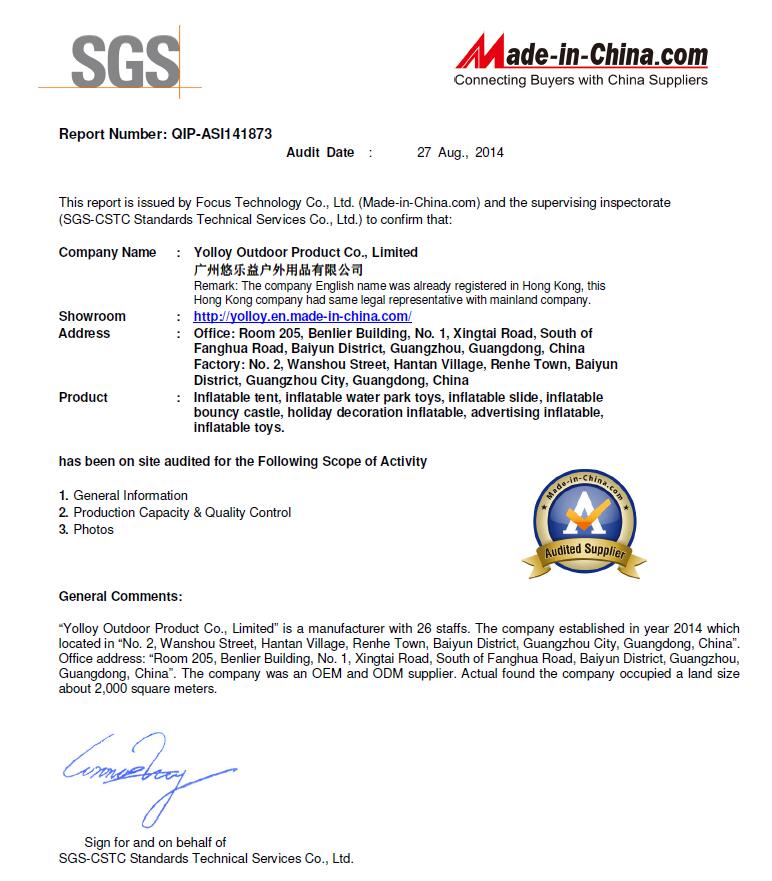
When sourcing an inflatable garage tent, the manufacturer's capabilities matter as much as the product specifications. YOLLOY Outdoor Product Co., Limited, based in Guangzhou, China, offers a minimum order quantity of just one piece — making it practical to test a product before committing to a larger order. Typical production time for a regular inflatable product is 6 to 15 days, excluding transit time. Air shipping adds approximately 5 to 7 days, while sea shipping takes 15 to 30 days or more depending on the destination.
Every product ships with a repair kit for ongoing maintenance. The company reports a 95% on-time delivery rate and has export experience spanning Europe, Asia, South America, Africa, the Middle East, and Latin America. Products are packed using soft carpet protection, waterproof PVC bags, and outer PE film, with steel pallets used for larger items to ensure they arrive in factory condition.
Ready to protect your vehicles with a portable, professional-grade shelter? Whether you need a single inflatable garage tent for your personal vehicle collection or a fleet of custom-branded shelters for your business, YOLLOY's design team is ready to turn your requirements into a finished product. Contact us at
[email protected] or call
+86-20-8370 0771 to discuss your project. Visit
https://www.yolloy.net/ to browse the full range of inflatable tent solutions and start your custom design inquiry today.