How to choose the right obstacle course inflatable, what to look for in a manufacturer, and why sourcing from an experienced factory makes all the difference.
If you run a party rental company, an event management business, or an amusement park, you already know that inflatable obstacle course units are among the most profitable attractions you can own. They draw crowds at school carnivals, corporate team-building days, community festivals, and birthday parties alike. A single well-maintained obstacle course can generate consistent rental income season after season, often paying for itself within a few months of operation.
But not all obstacle courses are built the same. The difference between a unit that lasts three years and one that starts showing wear after a single season often comes down to where and how it was manufactured. This guide walks you through what to look for when sourcing a inflatable obstacle course manufacturer, what materials and certifications matter, and how to get exactly the configuration your business needs.
Why Obstacle Courses Deliver the Highest ROI
Among all inflatable rental categories, obstacle courses consistently rank at the top for return on investment. The reason is simple: they appeal to a uniquely broad audience. Children love racing through tunnels and climbing walls. Teenagers turn them into friendly competitions. Corporate teams use them for bonding exercises. This cross-demographic appeal means higher booking frequency and fewer seasonal gaps compared to water slides or bounce houses alone.
A commercial inflatable obstacle course with a competitive dual-lane configuration — where two participants race side by side — tends to generate even higher repeat bookings. The competitive element keeps guests coming back and encourages word-of-mouth referrals, which is one of the most cost-effective marketing channels for any rental business.
From a practical standpoint, obstacle courses also offer operational advantages. They typically require the same setup crew and blower equipment as a standard bounce house, yet command rental rates two to three times higher. The per-event margin is substantially better, and the unit’s versatility means it can be booked for a wider range of event types throughout the year.
What Makes a Commercial-Grade Obstacle Course
When evaluating obstacle course inflatables for commercial use, the materials and construction methods are the first things to examine. A unit built for backyard use once a summer is fundamentally different from one designed to withstand dozens of rentals per season.
Key quality indicators to look for:
- PVC Tarpaulin Thickness: Commercial-grade units should use at least 0.55mm PVC tarpaulin with anti-UV coating. Thinner materials will degrade faster under sun exposure and repeated use.
- Seam Construction: Heat-welded (high-frequency fusion) seams are far stronger than stitched seams alone. Quality manufacturers use both — precision sewing with waterproof nylon thread, reinforced at all high-load areas, combined with heat welding for airtight sections.
- Anchor Systems: Look for D-ring or round metal anchor points integrated into the design. Proper anchoring is essential for wind resistance and overall safety during operation.
- Blower Quality: The blower is the heart of any inflatable. Commercial units should come with CE or UL-certified blowers, available in 110V, 220V, or 380V configurations to match your local power standards.
Certifications That Matter
Before committing to a purchase, verify that the manufacturer’s materials and products meet recognized safety standards. Reputable factories will provide documentation showing their materials have passed relevant testing. For inflatable play equipment, the key standards include EN71 (safety of toys), EN14960 (inflatable play equipment), and RoHS compliance for material safety. For water park applications, EN15649 is the relevant reference. These certifications are not just paperwork — they are evidence that the manufacturer has invested in third-party testing and quality control processes.
A manufacturer that openly shares certification documentation and welcomes pre-shipment inspection is one you can build a long-term relationship with.
Customization: Getting Exactly What Your Market Needs
One of the biggest advantages of working directly with a factory is the ability to customize. Off-the-shelf obstacle courses may not match your local market’s preferences, your available setup space, or your brand identity. A full-service manufacturer can design a unit from your description, sketch, photograph, or even a site plan and budget.
Customization options typically include size and layout adjustments, color schemes, theme designs, and the addition of your company logo or artwork printed directly on the inflatable. This level of personalization helps your rental stand out in a crowded market and reinforces your brand every time the unit is set up at an event.
The production process usually follows a clear path: designers prepare simulation renderings based on your requirements, you review and approve the design, and only then does production begin. This collaborative approach ensures the final product matches your expectations before any material is cut.
What to Expect from a Reliable Manufacturer
When sourcing from overseas, communication and transparency are just as important as production quality. Here are some practical benchmarks to look for:
- Responsive Communication: Your inquiries should be answered within 24 hours. A manufacturer that is slow to respond during the sales process will likely be even slower after the order is placed.
- Realistic Production Timelines: For a standard custom inflatable product, expect 6 to 15 days of production time, excluding transit. Larger or more complex designs may take longer, and a good manufacturer will set clear expectations upfront.
- Flexible Order Quantities: Not every business needs to order 50 units. A manufacturer that accepts a minimum order of just one piece allows you to test the market and the product quality before scaling up.
- Pre-Shipment Inspection: Products should be inspected and tested before they leave the factory. Ask about the manufacturer’s quality control process and whether they can provide photos or video of your completed unit before shipping.
- After-Sale Support: A repair kit should be included with every inflatable. The manufacturer should also offer guidance on maintenance and be available for follow-up questions after delivery.
Why YOLLOY Stands Out as a Manufacturing Partner
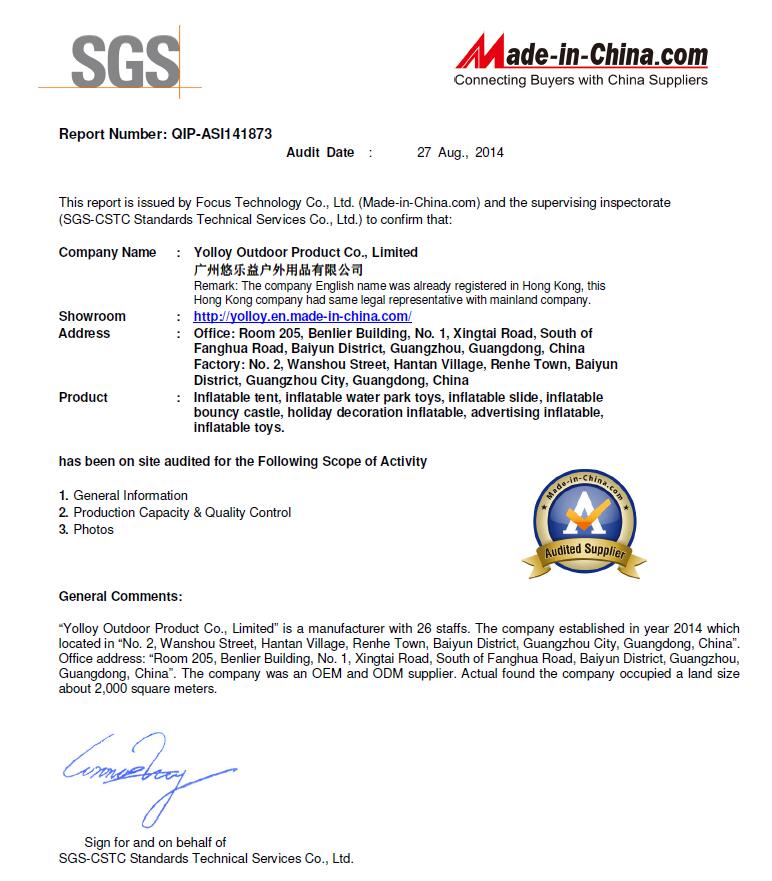
YOLLOY Outdoor Product Co., Limited, based in Guangzhou, China, has built its reputation on delivering custom inflatable solutions that meet the real-world demands of commercial operators. The company’s product range spans far beyond obstacle courses — it includes inflatable tents, clear dome tents, planetarium domes, water park products, interactive sports games, commercial slides, bounce houses, paintball bunkers, air mattresses, and advertising inflatables. This breadth of experience means the production team understands the engineering principles that apply across all inflatable categories.
YOLLOY’s design-to-production workflow is built around close collaboration with the buyer. Designers prepare simulation renderings from your proposal, revise until you approve, and only then release the design to the factory floor. This iterative process reduces the risk of misunderstandings and ensures the final product matches your vision.
On the quality side, YOLLOY uses commercial-grade materials that have passed EN71, EN14960, and RoHS testing. Sewn products use precision sewing equipment with reinforced seams and waterproof nylon thread. Airtight sections are manufactured with high-temperature fusion welding equipment. Every product is inspected and tested before shipment. The company reports a 95% on-time delivery rate and provides a repair kit with each inflatable, along with a three-year service life expectation under proper use and maintenance.
Shipping is available by air (5-7 days transit) or sea (15-30 days or more), and blowers can be supplied for 110V, 220V, or 380V requirements. Products are carefully packed using soft carpet protection, waterproof PVC bags, and outer PE film — with steel pallets for larger units.
Ready to Add a Commercial Obstacle Course to Your Fleet?
Whether you are launching a new rental business or expanding an existing fleet, investing in a high-quality inflatable obstacle course is one of the smartest moves you can make in 2026. The key is choosing a manufacturer that combines quality materials, certified safety standards, responsive communication, and genuine customization capability.
YOLLOY welcomes inquiries from businesses of all sizes. Contact Sunny Yang and the team to discuss your project requirements, request a quote, or start the design process on a custom obstacle course tailored to your market.
Email: [email protected]
Phone: +86-20-8370 0771
Mobile: 13570587575
Website: www.yolloy.net
Address: No. 5, Xiong Wei Bo Nan Road, Zhongluotan Town, Baiyun District, Guangzhou, China