Whether you are organizing an outdoor exhibition, running a glamping site, hosting a corporate event, or setting up a temporary sports facility, the structure you choose defines the experience. Traditional pole tents and frame marquees have served their purpose for decades, but a new generation of shelter solutions is reshaping the industry. An
inflatable dome tent offers a combination of rapid deployment, architectural appeal, and structural integrity that rigid-frame tents simply cannot match.
In this guide, we walk through everything you need to know about inflatable dome tents — from how they work and what types are available, to how to select the right model, customize it for your brand, and source it from a reliable manufacturer.
What Is an Inflatable Dome Tent?
An inflatable dome tent is a fabric shelter that uses air-filled beams instead of metal or fiberglass poles to maintain its shape. A continuous blower system keeps the beams pressurized, creating a rigid yet lightweight frame. The dome geometry distributes stress evenly across the structure, which gives it excellent wind resistance and eliminates the need for internal support columns — resulting in a completely open, unobstructed interior space.
Unlike geodesic domes built from rigid struts, inflatable dome tents can be set up by a small team in minutes. The entire structure — beams, walls, and roof — is integrated into a single unit that inflates with the switch of a blower. When deflated, the tent packs down into a compact carry bag, making it easy to transport and store.
Key Advantages Over Traditional Tents
Rapid Setup and Takedown. Most inflatable dome tents can be fully deployed within 10 to 20 minutes using a standard electric blower. No specialized tools, no heavy lifting equipment, and no large crew are required. This makes them ideal for event rental businesses that need to move between venues quickly.
Unobstructed Interior. Because the structure is supported by air beams along the perimeter, there are no center poles or cross-bracing inside. The entire floor area is usable — a critical advantage for exhibitions, dining setups, performance stages, and sports applications.
Eye-Catching Aesthetics. The smooth, curved silhouette of a dome tent naturally draws attention. For brand activations, product launches, and hospitality venues, the visual impact is immediate and memorable. Many event organizers report that dome structures become a talking point with attendees even before they step inside.
Excellent Wind Performance. The dome shape allows wind to flow around the structure rather than pushing against a flat wall. Combined with D-ring anchor systems and ground stakes, a properly secured inflatable dome can withstand conditions that would challenge traditional pole tents.
Portability and Storage. When deflated, an inflatable dome tent occupies a fraction of the space of a comparable rigid-frame tent. This reduces storage costs and makes transportation simpler — especially for businesses that operate across multiple locations.
Types of Inflatable Dome Tents
Inflatable dome tents come in a wide range of styles, each suited to specific use cases. Understanding the differences helps you match the right model to your business needs.
Standard Opaque Dome Tents. Constructed from commercial-grade PVC tarpaulin or Oxford fabric, these domes are the workhorses of the inflatable tent world. They are commonly used for trade show booths, outdoor markets, emergency shelters, mobile workshops, and sports facility covers. Available in a wide range of colors, they can be printed with logos, graphics, and branding elements.
Clear Inflatable Dome Tents. A
clear inflatable tent features transparent or semi-transparent walls and roof panels, creating a 360-degree view of the surrounding environment. These have become enormously popular for luxury camping (glamping), outdoor dining, wedding receptions, and stargazing events. Guests can enjoy the outdoors while being protected from wind, rain, and insects. The transparent design also makes them a favorite for nighttime events where ambient lighting creates a dramatic visual effect.
Bubble Tents and Snow Globes. A subset of clear dome tents, bubble tents and inflatable snow globes are fully transparent enclosures that create a whimsical, immersive experience. They are widely used in winter holiday markets, rooftop bars, resort properties, and VIP hospitality areas. Some models can be equipped with internal snow-effect machines for themed events.
Projection Domes and Planetariums. These specialized domes use a white or silver interior surface to serve as a 360-degree projection screen. Portable planetarium domes are used by schools, science museums, and traveling educational programs. Inflatable projection domes also support immersive brand experiences, art installations, and corporate presentations.
Special-Application Domes. Inflatable dome technology extends to niche uses as well. Golf simulator enclosures give players a weatherproof practice environment; spray-painting booths provide a controlled workspace for automotive detailing; altitude training chambers create hypoxic conditions for athletic conditioning. These specialized applications demonstrate the versatility of air-beam construction.
How to Choose the Right Inflatable Dome Tent
Choosing the right dome tent involves evaluating several factors beyond just size and price. Here is a practical checklist for buyers:
1. Define Your Primary Use Case. Are you hosting seated dinners, displaying products, running fitness classes, or creating a luxury accommodation? Each use case has different requirements for floor space, ceiling height, door placement, and interior features.
2. Determine the Right Size. Inflatable dome tents are available in diameters from 3 meters to over 20 meters. Consider not just the number of people you need to accommodate, but also the furniture, equipment, and circulation space required.
3. Evaluate Material Options. Commercial-grade PVC tarpaulin offers the best durability for frequent use and outdoor exposure. Oxford fabric is lighter and suitable for occasional use. TPU is an option for applications requiring extreme cold-weather flexibility. For clear domes, the transparency quality and UV resistance of the PVC panels are critical factors.
4. Check Certification and Safety Compliance. Verify that the materials used have passed relevant safety testing. For inflatable products, look for EN71 and EN14960 compliance. For water-related products, EN15649 is applicable. Blowers should carry CE or UL certification for the appropriate voltage standard in your region.
5. Consider Customization Needs. If you need your company logo, specific colors, custom door configurations, window placements, or flooring options, make sure the manufacturer offers full customization services. Many suppliers can work from a description, sketch, or photograph to create a design that matches your vision.
6. Assess Portability and Setup Logistics. Consider the packed weight and dimensions, the number of people needed for setup, the blower power requirements, and the type of ground surface where the tent will be used. These practical factors directly affect your operational efficiency.
Customization: Making Your Dome Tent Uniquely Yours
One of the strongest advantages of working with a factory-direct manufacturer is the ability to customize nearly every aspect of your inflatable dome tent. Customization options typically include:
Color and Branding. Choose any Pantone color for the fabric panels. Print your logo, tagline, artwork, or sponsor graphics on the exterior and interior surfaces. High-resolution digital printing ensures sharp, vibrant results that stand up to outdoor exposure.
Size and Proportion. While standard sizes are available, custom dimensions can be produced to fit specific site plans, venue constraints, or functional requirements. Adjustable beam lengths and panel configurations allow for tailored proportions.
Doors, Windows, and Openings. Specify the number, size, and position of entry points. Add roll-up sidewalls, zippered mesh panels for ventilation, or transparent window sections for natural light. Tunnel connectors can join multiple domes into a larger complex.
Flooring and Interior Features. Options include integrated groundsheets, removable floor panels, cable entry ports for electrical equipment, and internal anchor points for lighting rigs or display fixtures.
Blower Configuration. Blowers can be supplied to match local voltage standards — 110V for North America, 220V for Europe and Asia, or 380V for industrial applications. Quiet-operation blowers are available for hospitality and accommodation settings.
Quality and Durability: What to Look For
The longevity of an inflatable dome tent depends on the quality of materials, construction techniques, and ongoing maintenance. Here are the key quality indicators to evaluate when comparing suppliers:
Seam Construction. For sewn products, look for precision stitching with waterproof nylon thread. High-stress areas — such as beam junctions, anchor points, and door openings — should have double or triple reinforcement. For airtight structures, high-temperature fusion welding creates stronger, more reliable seals than traditional gluing methods.
Material Testing. Reputable manufacturers have their materials tested to relevant standards. EN71 covers toy safety requirements, EN14960 addresses inflatable play equipment, and RoHS compliance ensures the absence of hazardous substances. These certifications provide assurance that the materials are safe for both users and the environment.
Anchor Systems. D-ring or round metal anchor points should be integrated into the structure at regular intervals around the perimeter. These points, combined with appropriate ground stakes or weights, secure the tent against wind uplift. The anchor system should be designed as part of the structural engineering, not added as an afterthought.
Pre-Shipment Inspection. Before a product leaves the factory, it should be fully inflated and inspected for air leaks, seam integrity, blower performance, and overall workmanship. A repair kit should be included with every tent, containing patching material, adhesive, thread, and instructions for minor field repairs.
Warranty and Support. A meaningful warranty — typically in the range of two to three years under normal use conditions — reflects the manufacturer's confidence in their product. Equally important is responsive after-sales support: prompt replies to inquiries, spare parts availability, and technical guidance when needed.
Why Source from YOLLOY?
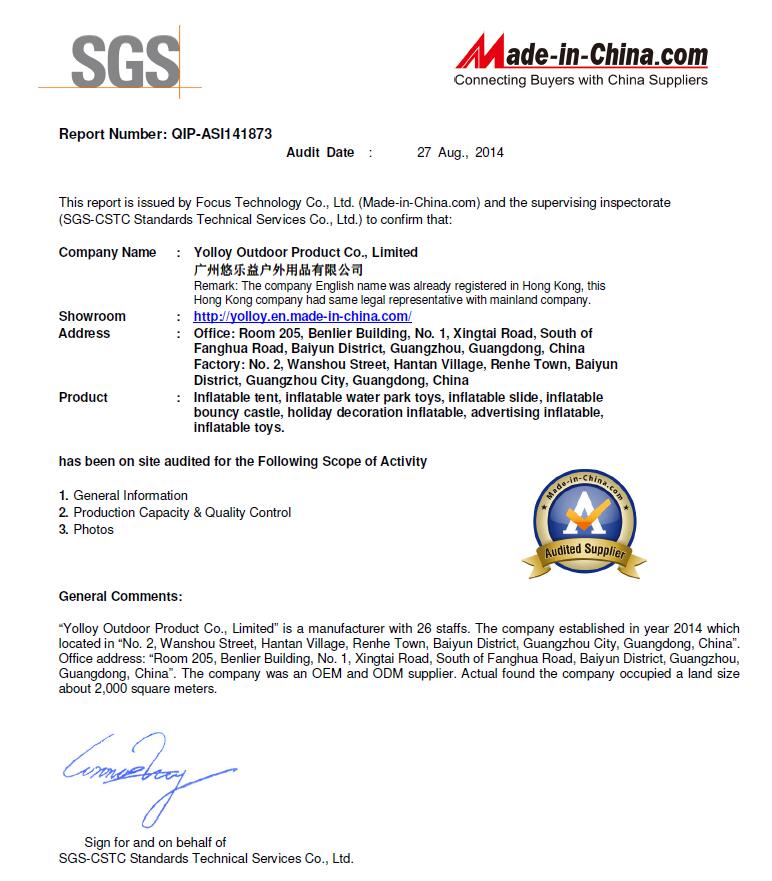
Yolloy Outdoor Product Co., Limited is a specialized inflatable product manufacturer based in Guangzhou, China, with extensive experience in designing and producing custom inflatable dome tents for clients across Europe, Asia, South America, Africa, the Middle East, and Latin America. The company's design-to-production workflow ensures that each project receives individualized attention: designers create simulation renderings from your proposal, revise until you approve, and only then release the design to the factory floor.
Key manufacturing advantages: Custom sizes and colors are standard. Your logo and artwork can be printed directly on the product. The minimum order quantity is just one piece, making YOLLOY accessible to both startups and established businesses. Typical production time for a regular inflatable product is 6 to 15 days, and the company reports a 95% on-time delivery rate. Blowers are supplied in 110V, 220V, or 380V configurations to match your local power standard.
Materials used in production have passed EN71, EN14960, and RoHS testing, while blowers meet CE or UL requirements. Products are individually inspected and tested before shipment. Packaging includes soft carpet protection, waterproof PVC bags, and outer PE film — with steel pallets used for large products to ensure safe transit. Air and sea shipping options are available, with indicative transit times of 5 to 7 days by air and 15 to 30 days or more by sea.
Ready to Find Your Perfect Inflatable Dome Tent?
Whether you are looking for an
inflatable dome tent for sale to launch a glamping business, a clear bubble tent for your resort's rooftop, or a custom-branded event dome for your next activation, YOLLOY can deliver a solution tailored to your requirements. Contact the team at
[email protected] or call
+86-20-8370 0771 to discuss your project. Send a description, sketch, or site plan, and the design team will prepare a simulation rendering for your review — with no obligation.