Inflatable Bounce Houses for Sale: What Every Business Buyer Should Know Before Making a Purchase
August 8, 2026
If you are in the party rental business, run an amusement park, or manage an event venue, you already know that
inflatable bounce houses for sale are not just a seasonal purchase — they are a long-term investment in your revenue stream. The right bounce house attracts families, keeps children entertained, and builds your reputation as a reliable event provider. But with so many suppliers on the market, how do you separate quality products from ones that will let you down after a few rentals?
This guide walks you through everything you need to evaluate when buying commercial inflatable bounce houses — from material quality and safety certifications to customization options and after-sales support. Whether you are buying your first unit or expanding an existing fleet, the information here will help you make a confident, informed decision.
Why Material Quality Is the First Thing to Check
The single most important factor that determines how long your bounce house will last is the fabric it is made from. Commercial-grade units should use heavy-duty PVC tarpaulin that is both waterproof and fire-resistant. Cheaper materials may look fine on day one, but they fade, tear, and delaminate after a few months of regular use.
Equally important is how the material is assembled. High-quality bounce houses use precision sewing equipment with reinforced seams and waterproof nylon thread. Critical stress points — such as anchor attachments, entrance areas, and slide connections — should have additional reinforcement layers. For airtight sections, high-temperature fusion welding produces seams that are stronger than the surrounding fabric itself. When you are evaluating an
inflatable bounce house manufacturer, ask specifically about their sewing and welding processes. A manufacturer that cannot explain these details in depth is likely cutting corners.
Safety Certifications You Should Not Overlook
Safety is non-negotiable in the inflatable industry. Before you buy, verify that the products meet recognized international standards. For inflatable toys and bounce houses, EN 14960 is the key European standard covering safety requirements and test methods. The materials themselves should pass EN 71 (safety of toys) and RoHS (restriction of hazardous substances) testing. These certifications confirm that the PVC tarpaulin and other components are free from harmful chemicals and physically safe for children.
Do not forget about the blower — the electric fan that keeps the bounce house inflated. Blowers are the heart of the system, and they should carry CE or UL certification depending on your region. A reliable supplier will offer blowers configured for your local voltage requirements, whether 110V, 220V, or 380V. Always ask to see the relevant certification documents before placing an order.
Customization: Why One Size Does Not Fit All
A generic bounce house might work for some businesses, but if you want to stand out in a competitive market, customization is where you gain an edge. The best manufacturers can produce units in custom sizes and colors, print your company logo or artwork directly on the fabric, and even design entirely new products from a simple description, sketch, or photograph.
This flexibility is especially valuable for rental businesses that serve themed events, corporate parties, and branded activations. Imagine offering a bounce house in your client's corporate colors with their logo prominently displayed — that kind of personalized service commands premium rental rates and builds customer loyalty. When you are looking for a
commercial inflatable bounce house for sale, prioritize suppliers that offer full design-to-production customization rather than off-the-shelf-only catalogs.
What a Complete Package Should Include
When comparing prices from different suppliers, look beyond the bounce house itself. A complete commercial package should include:
Properly matched blower(s) — correctly sized for the unit and configured for your local voltage. An underpowered blower leads to a saggy, unsafe bounce house, while an overpowered one wastes electricity.
Repair kit — every inflatable product should come with a repair kit containing PVC patches, thread, and adhesive. This allows you to handle minor tears on-site without downtime.
Anchor systems — D-ring or round metal anchors for securing the unit against wind. Proper anchoring is critical for outdoor use.
Storage and transport bag — a durable bag for packing and transporting the deflated unit.
Also confirm the packaging method. Look for soft carpet protection, waterproof PVC bags, and an outer PE film layer. For large orders, steel pallets provide additional protection during transit.
Understanding Production Timelines and Delivery
Lead times vary by manufacturer and order complexity. For a standard bounce house, a typical production time is 6 to 15 days, though large or highly customized units take longer. If you are ordering for a specific season or event, plan with at least a 30-day buffer to account for production, quality inspection, and shipping.
On the shipping side, air freight typically takes 5 to 7 days, while sea freight takes 15 to 30 days or more depending on the destination port. Ask your supplier about their on-time delivery track record. A 95% on-time delivery rate is a good benchmark for a reliable manufacturer. Air and sea shipping options should both be available, and the supplier should be experienced in handling export documentation for your region.
Warranty and After-Sales Support: The Long-Term Picture
A bounce house is a mechanical asset that will experience wear and tear. Before you buy, understand exactly what the warranty covers and how long it lasts. Look for a minimum of 3 years of expected service life when the product is used and maintained correctly. The warranty should cover manufacturing defects in materials and workmanship.
Beyond the warranty, evaluate the supplier's responsiveness. Do they answer emails within 24 hours? Can they provide technical support for repairs and maintenance? A manufacturer that stays communicative after the sale is worth far more than one that disappears once the payment clears. Quick response times and accessible technical guidance are signs of a partner who values your long-term business.
Factors That Drive the Cost of a Commercial Bounce House
The price of a commercial bounce house depends on several variables: size, design complexity, material grade, and the level of customization. Larger units naturally cost more, but they also bring higher rental income. Themed designs — such as castles, pirate ships, or jungle adventures — require more intricate artwork and manufacturing time, which increases the price. Custom logos and branding add value but involve additional printing steps.
Rather than simply looking for the lowest price, calculate the return on investment. A well-built bounce house that lasts 3 or more years with minimal repairs will generate far more profit than a cheaper unit that needs constant patching or replacement after one season. Factor in the cost of the blower, shipping, and any import duties when comparing quotes from different suppliers.
Key Questions to Ask Any Bounce House Supplier
What material specifications do you use (PVC thickness, fire rating, UV resistance)?
Which safety certifications do your products carry (EN 14960, EN 71, RoHS)?
Are your blowers CE or UL certified, and can you supply them in my voltage?
Do you offer custom design — size, color, logo, and theme?
What is included in the package (blower, repair kit, anchors, storage bag)?
What is your current production lead time and shipping timeline?
How long is the warranty, and what does it cover?
What is your minimum order quantity?
Why Choosing the Right Manufacturer Matters
The difference between a bounce house that lasts for years and one that fails after a season often comes down to who manufactured it. A manufacturer with a design-to-production workflow — where designers create simulation renderings from your proposal, revise until you approve, and only then release to production — gives you control over the final product. This approach eliminates surprises and ensures the delivered unit matches your expectations.
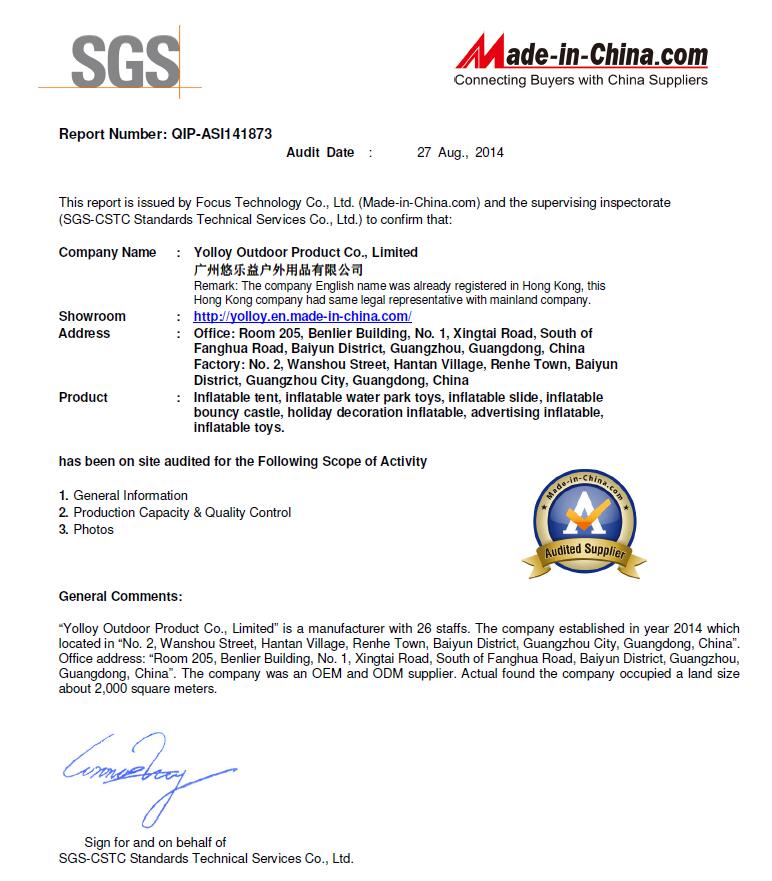
YOLLOY Outdoor Product Co., Limited, based in Guangzhou, China, follows exactly this workflow. The company designs and manufactures custom inflatable bounce houses, commercial slides, interactive sports games, water park products, clear dome tents, and advertising inflatables. Products are made from commercial-grade PVC tarpaulin with materials that have passed EN 71, EN 14960, and RoHS testing, and blowers meet CE or UL requirements. Each inflatable is inspected and tested before shipment, and a repair kit is included with every product. With a 95% on-time delivery rate, a 3-year service life expectation, and a minimum order quantity of just one piece, YOLLOY serves rental businesses, event organizers, and amusement operators across Europe, Asia, South America, Africa, the Middle East, and Latin America.
Ready to invest in a commercial bounce house that will grow your business? Whether you need a standard unit, a themed design, or a fully custom creation, YOLLOY can bring your idea to life. Visit our
Inflatable Bounce House product page to explore our catalog, or contact us directly at
[email protected] to discuss your requirements. Our team typically responds within 24 hours and is happy to provide a custom quote based on your specifications.
About YOLLOY: Yolloy Outdoor Product Co., Limited is a professional inflatable product manufacturer based in Guangzhou, China. The company specializes in custom-designed inflatable tents, bounce houses, water park products, interactive sports games, commercial slides, paintball bunkers, air mattresses, and advertising inflatables. With international certifications, a commitment to quality materials, and a design-to-production workflow, YOLLOY serves clients worldwide. For inquiries, email
[email protected] or call
+86-20-8370 0771.