Products Category
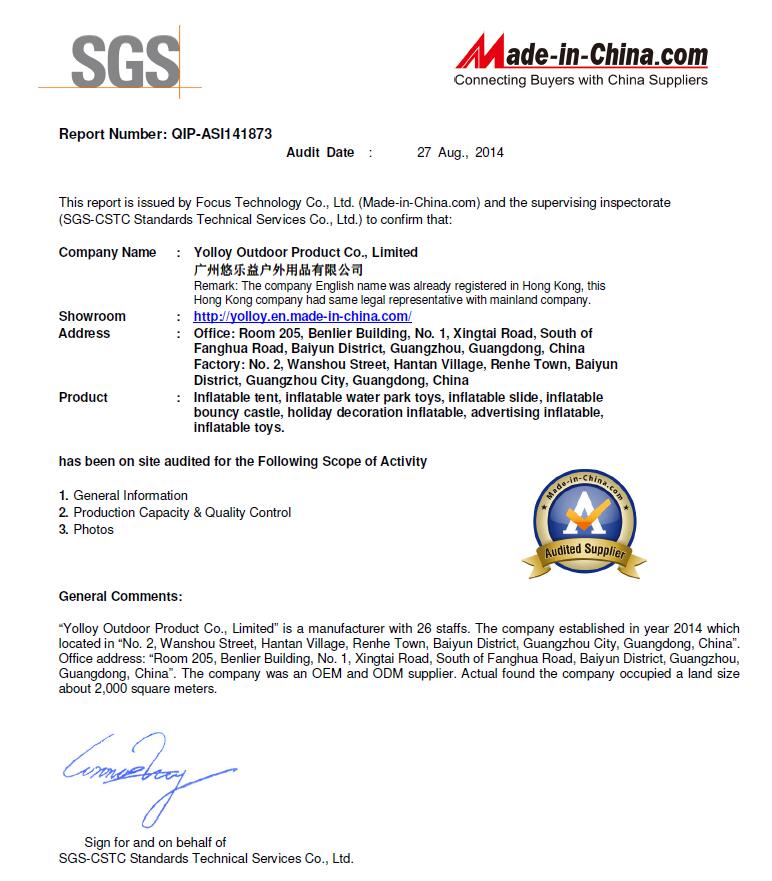
Certification

News

• New Order Successfully Finished for Long-Time Cooperated Japanese Client | YOLLOY Wins Full Client Recognition

• YOLLOY Custom Inflatable Pool Tent for Danish Client: Professional Pool Repair Shelter & Debris Protection

• Trusted Once Again! Greek Captain Re-orders Our Products After 4 Years

• Revolutionize Your Outdoors: The All-Terrain Inflatable Floating Tent for Land & Water

• Elevate Your Summer Fun: The Ultimate Inflatable Water Floating Volleyball Court Trampoline

• Innovative Inflatable Nightclub Tents & Pop-Up Bars: The Ultimate Solution for Portable Party Venues

Contact Us

Name: Sunny Yang
Tel: +86-20-8370 0771
Fax: +86-20-8370 0771
Mobile: 13570587575
E-mail: sales@yolloy.com
Add: No 5,Xiong wei Bo Nan Road,ZhongLuoTan Town,Baiyun district,Guangzhou,China
Friend me on Facebook Follow me on Twitter Add me to your circles Follow me on Pinterest Watch my channel on YouTube
News

How to Launch Your Own Inflatable Water Park: A Complete Guide for Business Owners

Author:yolloy Date:2026/7/25 3:59:47
How to Launch Your Own Inflatable Water Park: A Complete Guide for Business Owners
A practical step-by-step guide covering planning, product selection, sourcing, and launch strategies for your water park venture.
The demand for inflatable water park attractions has surged across the globe. Hotels, resorts, campgrounds, municipalities, and private investors are discovering that these portable aquatic playgrounds deliver the excitement of a traditional water park at a fraction of the cost — and with far greater flexibility. Unlike permanent concrete-and-steel installations, inflatable water parks can be set up on lakes, beaches, swimming pools, and reservoirs, then packed away when the season ends. Whether you are entering the recreation industry for the first time or expanding an existing portfolio, this guide breaks down everything you need to know to get started.
Why an Inflatable Water Park Makes Business Sense
The numbers speak for themselves. Inflatable water parks require significantly less upfront capital than fixed water parks. There is no need for heavy construction, plumbing, or permanent foundations. Installation takes days rather than months, and the equipment can be relocated or expanded as your business grows.
Beyond the financial advantages, inflatable water parks attract a broad demographic. Families with young children, teenagers seeking thrills, corporate groups looking for team-building activities, and fitness enthusiasts all find value in these floating playgrounds. The revenue streams are diverse: daily admission tickets, season passes, birthday party packages, school group bookings, and corporate event rentals.
Step 1: Define Your Water Park Concept
Before you start shopping for equipment, get clear on your vision. A successful inflatable water park is built around a well-defined concept that matches the local market and the physical environment.
Start by answering these questions:
  • Who is your primary audience — young children, teenagers, families, or a mix of all ages?
  • What type of water body will you use — a natural lake, a sheltered bay, a swimming pool, or a reservoir?
  • What is the available water surface area, and what are the depth and anchoring conditions?
  • Will your park focus on pure fun, fitness challenges, team-building obstacle courses, or all of the above?
  • Do you want a compact floating playground or a large-scale inflatable floating water park with multiple zones?
Your answers will guide every subsequent decision, from product selection to pricing strategy.
Step 2: Choose the Right Product Mix
A compelling inflatable water park offers variety. Guests stay longer — and come back more often — when there is something for everyone. Consider including a balanced mix of the following product types:
  • Floating obstacle courses with climbing walls, slides, trampolines, and balance beams — ideal for older children and adults seeking active fun.
  • Inflatable slides that launch riders directly into the water, providing the adrenaline rush guests expect from a water park experience.
  • Floating leisure platforms where guests can relax, sunbathe, or socialize between activities.
  • Water balls and zorb balls for younger children and novelty-seeking visitors.
  • Inflatable boats and floating docks for jet ski mooring, expanding your park's utility beyond pure recreation.
  • Inflatable swimming pools for locations where natural water access is limited or water quality needs to be controlled.
The key is to balance high-energy play zones with relaxation areas. This keeps visitor flow smooth and ensures every guest finds their comfort zone.
Step 3: Partner with the Right Manufacturer
Your choice of supplier will determine the durability, safety, and long-term profitability of your park. When evaluating a China inflatable manufacturer, look beyond the price tag. The lowest quote often means corners have been cut on materials or workmanship — and those corners will show after a season or two of heavy use.
Here is what to look for in a manufacturing partner:
  • Material quality: Commercial-grade PVC tarpaulin should be the standard. For water applications, the material must withstand constant UV exposure, chlorine or saltwater contact, and the physical stress of active play.
  • Manufacturing technique: Airtight products should be made with high-temperature fusion welding equipment, not just stitching. Sewn products should use reinforced seams, waterproof nylon thread, and extra reinforcement at high-load areas.
  • Certifications: Look for EN71, EN14960, and EN15649 compliance for inflatable water park products. Blowers should meet CE or UL requirements. RoHS-related material testing adds another layer of confidence.
  • Customization capability: Can the manufacturer design from your sketch, photograph, or site plan? Can they print your logo and brand colors? A supplier that says "yes" to these questions is a true partner, not just a vendor.
  • Minimum order quantity: For startups and small operators, a low MOQ — ideally one piece — is essential for testing the market before scaling up.
Step 4: Customize Your Park for Maximum Impact
Generic products blend into the background. Custom designs make your park a destination. A reputable commercial inflatable products supplier should offer full customization services, including:
  • Custom sizes and color schemes to match your brand identity
  • Logo and artwork printing on every major module
  • Design from concept — whether you provide a detailed CAD drawing, a rough sketch, a photograph of your site, or just a written description of your vision
  • Age-appropriate themed zones that create a sense of discovery as guests move through the park
  • Blowers configured for your local voltage requirements (110V, 220V, or 380V)
The design process typically involves simulation renderings prepared by the manufacturer's design team. You review, request revisions, and approve the final layout before production begins. This iterative approach ensures the finished product matches your expectations exactly.
Step 5: Prioritize Safety and Quality Assurance
Safety is the foundation of any successful water park business. One incident can undo years of reputation-building. Your manufacturer should demonstrate a systematic approach to quality control at every stage:
Pre-production: Material testing against EN71, EN14960, and EN15649 standards. Selection of appropriate-grade PVC tarpaulin, Oxford fabric, nylon, or TPU based on the specific product requirements.

During production: Precision sewing with reinforced seams and waterproof nylon thread. High-temperature fusion welding for airtight components. Additional reinforcement at all high-load stress points.

Post-production: Full inspection and inflation testing before shipment. D-ring and round metal anchor systems verified for secure installation and wind resistance. CE or UL-compliant blowers supplied with every order.

After delivery: A repair kit included with each product, plus responsive after-sales support for maintenance guidance.
Step 6: Plan Your Launch and Operations
With your equipment ordered and production underway, turn your attention to the operational side. A well-executed launch builds momentum that carries through the entire season.
  • Staffing: Hire and train lifeguards well before opening day. Your supplier should provide operational guidance, but on-the-ground safety is your responsibility.
  • Permits and insurance: Research local regulations for water-based attractions. Your manufacturer's product certifications (EN14960, EN15649) will strengthen your permit applications.
  • Marketing: Build anticipation through social media, local partnerships, and early-bird ticket sales. Professional photos and videos of your inflatable water park in action are your most powerful marketing assets.
  • Maintenance routine: Establish daily inspection checklists, weekly deep-cleaning schedules, and off-season storage protocols. With proper care, commercial inflatable products can deliver a service life of three years or more.
  • Expansion planning: Start with a core set of products, then add new modules each season. Fresh attractions give repeat visitors a reason to return and generate media coverage.
Logistics and Delivery: What to Expect
When sourcing from an experienced China inflatable manufacturer, typical production time for a regular inflatable product ranges from 6 to 15 days, though complex or large custom projects may take longer. Shipping options include air freight (approximately 5–7 days transit) and sea freight (15–30 days or more). Products are packed using soft carpet protection, waterproof PVC bags, and outer PE film, with large items secured on steel pallets for safe transit.
Work with a supplier that communicates clearly about timelines and maintains a track record of on-time delivery. A 95% on-time delivery rate is a reasonable benchmark to expect from a professional manufacturer.
Ready to Build Your Inflatable Water Park?
YOLLOY Outdoor Product Co., Limited is a specialized China inflatable manufacturer based in Guangzhou, with years of experience designing and producing custom inflatable water parks, floating platforms, slides, boats, and interactive water toys for clients across Europe, Asia, South America, Africa, the Middle East, and Latin America.
Every project starts with a conversation. Share your site plan, budget, and vision — YOLLOY's design team will prepare simulation renderings, refine the layout with your feedback, and deliver a park that is ready to make a splash. Contact Sunny Yang at sales@yolloy.com or call +86-20-8370 0771 to begin your journey from concept to opening day.

How to Launch Your Own Inflatable Water Park: A Complete Guide for Business Owners

Author:yolloy Date:2026/7/25 3:59:47

How to Launch Your Own Inflatable Water Park: A Complete Guide for Business Owners
A practical step-by-step guide covering planning, product selection, sourcing, and launch strategies for your water park venture.
The demand for inflatable water park attractions has surged across the globe. Hotels, resorts, campgrounds, municipalities, and private investors are discovering that these portable aquatic playgrounds deliver the excitement of a traditional water park at a fraction of the cost — and with far greater flexibility. Unlike permanent concrete-and-steel installations, inflatable water parks can be set up on lakes, beaches, swimming pools, and reservoirs, then packed away when the season ends. Whether you are entering the recreation industry for the first time or expanding an existing portfolio, this guide breaks down everything you need to know to get started.
Why an Inflatable Water Park Makes Business Sense
The numbers speak for themselves. Inflatable water parks require significantly less upfront capital than fixed water parks. There is no need for heavy construction, plumbing, or permanent foundations. Installation takes days rather than months, and the equipment can be relocated or expanded as your business grows.
Beyond the financial advantages, inflatable water parks attract a broad demographic. Families with young children, teenagers seeking thrills, corporate groups looking for team-building activities, and fitness enthusiasts all find value in these floating playgrounds. The revenue streams are diverse: daily admission tickets, season passes, birthday party packages, school group bookings, and corporate event rentals.
Step 1: Define Your Water Park Concept
Before you start shopping for equipment, get clear on your vision. A successful inflatable water park is built around a well-defined concept that matches the local market and the physical environment.
Start by answering these questions:
  • Who is your primary audience — young children, teenagers, families, or a mix of all ages?
  • What type of water body will you use — a natural lake, a sheltered bay, a swimming pool, or a reservoir?
  • What is the available water surface area, and what are the depth and anchoring conditions?
  • Will your park focus on pure fun, fitness challenges, team-building obstacle courses, or all of the above?
  • Do you want a compact floating playground or a large-scale inflatable floating water park with multiple zones?
Your answers will guide every subsequent decision, from product selection to pricing strategy.
Step 2: Choose the Right Product Mix
A compelling inflatable water park offers variety. Guests stay longer — and come back more often — when there is something for everyone. Consider including a balanced mix of the following product types:
  • Floating obstacle courses with climbing walls, slides, trampolines, and balance beams — ideal for older children and adults seeking active fun.
  • Inflatable slides that launch riders directly into the water, providing the adrenaline rush guests expect from a water park experience.
  • Floating leisure platforms where guests can relax, sunbathe, or socialize between activities.
  • Water balls and zorb balls for younger children and novelty-seeking visitors.
  • Inflatable boats and floating docks for jet ski mooring, expanding your park's utility beyond pure recreation.
  • Inflatable swimming pools for locations where natural water access is limited or water quality needs to be controlled.
The key is to balance high-energy play zones with relaxation areas. This keeps visitor flow smooth and ensures every guest finds their comfort zone.
Step 3: Partner with the Right Manufacturer
Your choice of supplier will determine the durability, safety, and long-term profitability of your park. When evaluating a China inflatable manufacturer, look beyond the price tag. The lowest quote often means corners have been cut on materials or workmanship — and those corners will show after a season or two of heavy use.
Here is what to look for in a manufacturing partner:
  • Material quality: Commercial-grade PVC tarpaulin should be the standard. For water applications, the material must withstand constant UV exposure, chlorine or saltwater contact, and the physical stress of active play.
  • Manufacturing technique: Airtight products should be made with high-temperature fusion welding equipment, not just stitching. Sewn products should use reinforced seams, waterproof nylon thread, and extra reinforcement at high-load areas.
  • Certifications: Look for EN71, EN14960, and EN15649 compliance for inflatable water park products. Blowers should meet CE or UL requirements. RoHS-related material testing adds another layer of confidence.
  • Customization capability: Can the manufacturer design from your sketch, photograph, or site plan? Can they print your logo and brand colors? A supplier that says "yes" to these questions is a true partner, not just a vendor.
  • Minimum order quantity: For startups and small operators, a low MOQ — ideally one piece — is essential for testing the market before scaling up.
Step 4: Customize Your Park for Maximum Impact
Generic products blend into the background. Custom designs make your park a destination. A reputable commercial inflatable products supplier should offer full customization services, including:
  • Custom sizes and color schemes to match your brand identity
  • Logo and artwork printing on every major module
  • Design from concept — whether you provide a detailed CAD drawing, a rough sketch, a photograph of your site, or just a written description of your vision
  • Age-appropriate themed zones that create a sense of discovery as guests move through the park
  • Blowers configured for your local voltage requirements (110V, 220V, or 380V)
The design process typically involves simulation renderings prepared by the manufacturer's design team. You review, request revisions, and approve the final layout before production begins. This iterative approach ensures the finished product matches your expectations exactly.
Step 5: Prioritize Safety and Quality Assurance
Safety is the foundation of any successful water park business. One incident can undo years of reputation-building. Your manufacturer should demonstrate a systematic approach to quality control at every stage:
Pre-production: Material testing against EN71, EN14960, and EN15649 standards. Selection of appropriate-grade PVC tarpaulin, Oxford fabric, nylon, or TPU based on the specific product requirements.

During production: Precision sewing with reinforced seams and waterproof nylon thread. High-temperature fusion welding for airtight components. Additional reinforcement at all high-load stress points.

Post-production: Full inspection and inflation testing before shipment. D-ring and round metal anchor systems verified for secure installation and wind resistance. CE or UL-compliant blowers supplied with every order.

After delivery: A repair kit included with each product, plus responsive after-sales support for maintenance guidance.
Step 6: Plan Your Launch and Operations
With your equipment ordered and production underway, turn your attention to the operational side. A well-executed launch builds momentum that carries through the entire season.
  • Staffing: Hire and train lifeguards well before opening day. Your supplier should provide operational guidance, but on-the-ground safety is your responsibility.
  • Permits and insurance: Research local regulations for water-based attractions. Your manufacturer's product certifications (EN14960, EN15649) will strengthen your permit applications.
  • Marketing: Build anticipation through social media, local partnerships, and early-bird ticket sales. Professional photos and videos of your inflatable water park in action are your most powerful marketing assets.
  • Maintenance routine: Establish daily inspection checklists, weekly deep-cleaning schedules, and off-season storage protocols. With proper care, commercial inflatable products can deliver a service life of three years or more.
  • Expansion planning: Start with a core set of products, then add new modules each season. Fresh attractions give repeat visitors a reason to return and generate media coverage.
Logistics and Delivery: What to Expect
When sourcing from an experienced China inflatable manufacturer, typical production time for a regular inflatable product ranges from 6 to 15 days, though complex or large custom projects may take longer. Shipping options include air freight (approximately 5–7 days transit) and sea freight (15–30 days or more). Products are packed using soft carpet protection, waterproof PVC bags, and outer PE film, with large items secured on steel pallets for safe transit.
Work with a supplier that communicates clearly about timelines and maintains a track record of on-time delivery. A 95% on-time delivery rate is a reasonable benchmark to expect from a professional manufacturer.
Ready to Build Your Inflatable Water Park?
YOLLOY Outdoor Product Co., Limited is a specialized China inflatable manufacturer based in Guangzhou, with years of experience designing and producing custom inflatable water parks, floating platforms, slides, boats, and interactive water toys for clients across Europe, Asia, South America, Africa, the Middle East, and Latin America.
Every project starts with a conversation. Share your site plan, budget, and vision — YOLLOY's design team will prepare simulation renderings, refine the layout with your feedback, and deliver a park that is ready to make a splash. Contact Sunny Yang at sales@yolloy.com or call +86-20-8370 0771 to begin your journey from concept to opening day.