When planning an outdoor event, exhibition, or commercial activity, the structure that shelters your guests, products, or equipment can make or break the experience. Traditional pole tents take time to set up, require substantial manpower, and often lack the visual appeal that modern audiences expect. This is where an inflatable dome tent comes in — a solution that combines speed, portability, and striking design into one package. Whether you are hosting a product launch, running a pop-up dining experience, or setting up a mobile planetarium, a well-made inflatable dome tent delivers a professional, weather-resistant enclosure that sets up in minutes rather than hours.
What Sets an Inflatable Dome Tent Apart
Unlike traditional frame tents that rely on rigid poles and complex assembly, an inflatable dome tent uses continuous air pressure to maintain its shape. A blower runs quietly in the background, keeping the structure firm and stable. This design eliminates the need for a central support column, so the interior space remains completely open and unobstructed — a critical advantage when you need to arrange seating, displays, or projection equipment inside.
The dome shape is not just an aesthetic choice. Its curved profile naturally sheds wind and rain, which gives it superior stability in outdoor conditions compared to flat-sided tents. The aerodynamic design means fewer anchor points are needed, and the structure performs reliably even in moderate wind. For event organizers who have experienced the anxiety of watching a traditional tent sway in gusty weather, this alone is a compelling reason to switch.
Key Advantages for Commercial Users
For businesses that regularly participate in trade shows, outdoor markets, or touring events, the speed of deployment is a practical game-changer. A typical inflatable dome tent can be fully set up by two people in under 15 minutes — just unroll, stake down the corners, and switch on the blower. When the event ends, the process reverses just as quickly. This efficiency translates directly into lower labor costs and more time spent on what actually matters: engaging with customers.
Visibility is another significant advantage. The smooth, curved surface of an inflatable dome tent acts as a natural canvas for branding. Logos, artwork, and promotional messages can be printed directly onto the fabric, turning the structure itself into a three-dimensional advertisement. For companies looking to stand out in a crowded exhibition hall or outdoor festival, this kind of visual impact is hard to beat.
Portability is also worth noting. When deflated, even a large dome tent packs down into a compact bundle that fits in the trunk of a standard car. This makes it practical for mobile businesses — car detailers, event caterers, and promotional roadshow teams — who need to move their setup from location to location on a regular basis.
Creative Applications Across Industries
The versatility of an outdoor inflatable tent goes far beyond the typical event shelter. Here are just a few ways different industries are putting these structures to work:
Pop-up dining and glamping experiences — clear dome versions create an immersive, weather-protected dining environment that guests remember
Mobile planetariums and educational outreach — the dome shape is ideal for 360-degree projection, bringing astronomy and science programs to schools and communities
Car detailing and spray painting — enclosed inflatable booths provide a controlled, dust-free environment for automotive work at any location
Golf simulator enclosures — spacious dome structures accommodate full-swing practice with projection screens
Corporate promotions and brand activations — custom-printed domes serve as eye-catching, walk-in billboards at festivals, sports events, and retail launches
Emergency and medical shelters — rapid deployment makes inflatable structures suitable for field hospitals, triage stations, and disaster relief operations
What to Look for When Sourcing an Inflatable Dome Tent
Not all inflatable tents are built to the same standard. When evaluating suppliers, pay attention to the materials used. Commercial-grade PVC tarpaulin offers the best combination of durability and weather resistance, though Oxford fabric, nylon, and TPU may also be appropriate depending on the intended use. The seams should be reinforced with waterproof nylon thread, and high-load areas — such as blower connection points and anchor rings — need additional reinforcement.
Certifications are another important indicator of quality. Look for products whose materials have passed EN71, EN14960, or RoHS testing — these standards confirm that the materials are safe and free from restricted substances. For water park applications, EN 15649 is the relevant benchmark. Blowers should carry CE or UL certification, and the supplier should be able to provide blowers configured for your local voltage requirements — whether 110V, 220V, or 380V.
Customization capability is equally important. A good manufacturer should be able to work from your design brief — whether that is a detailed drawing, a rough sketch, a photograph, or simply a description of what you need. The ability to produce custom sizes, colors, and printed logos means you get a product that fits your exact requirements rather than settling for an off-the-shelf compromise.
YOLLOY: Your Partner for Custom Inflatable Tents
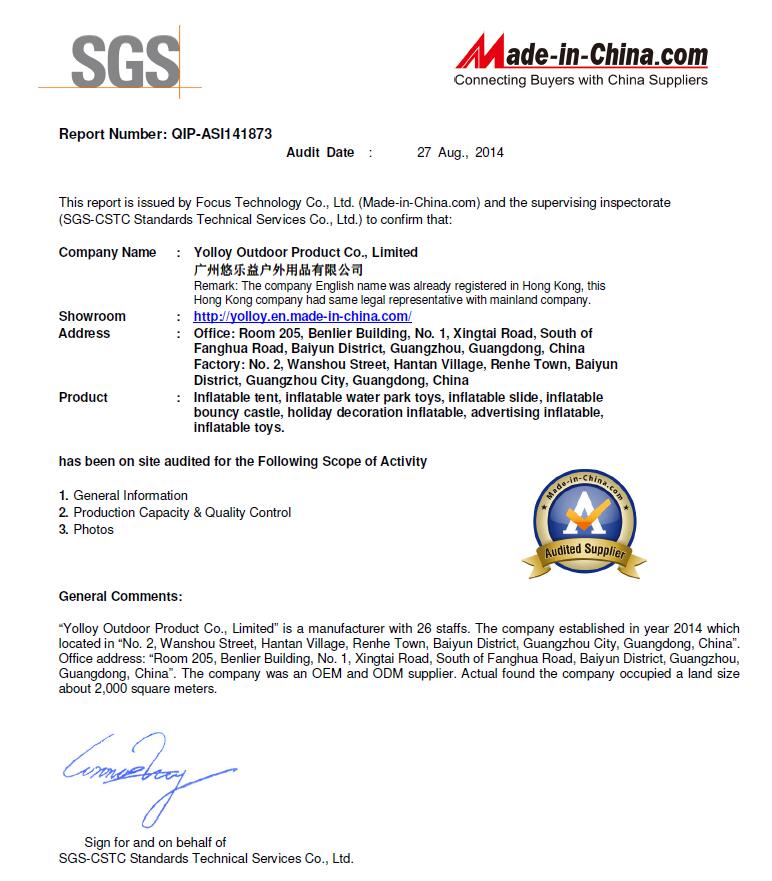
YOLLOY Outdoor Product Co., Limited, based in Guangzhou, China, specializes in the design and manufacture of custom inflatable tent solutions for clients around the world. With a product range that spans outdoor inflatable tents, clear dome tents, portable planetarium domes, water park products, interactive sports games, commercial slides, bounce houses, paintball bunkers, and advertising inflatables, YOLLOY serves a diverse client base across Europe, Asia, South America, Africa, the Middle East, and Latin America.
YOLLOY's custom workflow is designed to be straightforward: clients submit their requirements — whether as a description, sketch, photograph, or site plan — and the design team prepares simulation renderings. The design is revised until the client approves, at which point it enters production. The minimum order quantity is just one piece, making YOLLOY accessible to both small businesses testing a new concept and large enterprises placing bulk orders.
Quality control is embedded throughout the production process. The factory uses precision sewing equipment for sewn products and high-temperature fusion welding equipment for airtight products. Every product is inspected and tested before shipment. Materials are tested to EN71, EN14960, and RoHS standards, and blowers meet CE or UL requirements. D-ring and round metal anchor systems are incorporated where needed for secure installation and wind resistance.
Production time for a regular inflatable product typically ranges from 6 to 15 days, though complex or large custom orders may take longer. Products are packed with soft carpet protection, waterproof PVC bags, and outer PE film — with steel pallets used for larger items — to ensure they arrive in perfect condition. A repair kit is included with each product, and the company reports a 95% on-time delivery rate. Shipping options include air freight (5–7 days transit) and sea freight (15–30 days or more), giving clients flexibility based on their timeline and budget.
Ready to Bring Your Project to Life?
Whether you need a single branded dome for an upcoming event or a fleet of custom inflatable tents for a touring roadshow, YOLLOY has the experience and manufacturing capability to deliver. With responsive support — emails answered within 24 hours — and a commitment to safety, durability, and honest communication, YOLLOY makes the sourcing process straightforward. To discuss your requirements or request a quote, contact the team at [email protected] or call +86-20-8370 0771. Visit https://www.yolloy.net to explore the full product range and start your custom design journey today.
|