How to Choose the Right Inflatable Obstacle Course for Your Business: A Buyer's Guide
A comprehensive look at what to consider when investing in commercial inflatable obstacle courses for events, rental businesses, and entertainment venues.
Inflatable obstacle courses have become one of the most popular attractions at parties, corporate events, school fairs, and amusement parks. Whether you run a rental business, manage a family entertainment center, or organize community events, adding an
obstacle course inflatable to your lineup can significantly boost customer engagement and revenue. But with so many options on the market, how do you know which one is right for your business?
This guide walks you through the key factors to consider when choosing a
commercial inflatable obstacle course, from material quality and safety certifications to customization options and supplier reliability. Whether you are looking to
buy inflatable obstacle course units for the first time or expand an existing inventory, making an informed decision starts with knowing what to look for.
Why Inflatable Obstacle Courses Are a Smart Investment
Unlike traditional fixed playground equipment, inflatable obstacle courses offer portability, quick setup, and versatile use across different venues. They appeal to a wide age range — from children's birthday parties to adult team-building events — making them a high-return asset for rental companies and event organizers. A single well-designed course can serve as the centerpiece of an event, drawing crowds and creating memorable experiences that keep customers coming back.
The demand for interactive inflatable games continues to grow across markets in Europe, Asia, South America, Africa, the Middle East, and Latin America. For businesses looking to capitalize on this trend, sourcing from a reliable
inflatable obstacle course manufacturer is the first critical step toward building a profitable inventory.
Key Factors to Evaluate When Choosing an Obstacle Course
1. Material Quality and Durability
The longevity of an inflatable obstacle course depends heavily on the materials used in its construction. Look for products made with commercial-grade PVC tarpaulin, which offers excellent tear resistance and weather durability. For specific applications, materials like Oxford fabric, nylon, or TPU may also be suitable. High-quality manufacturers use precision sewing equipment, reinforced seams, waterproof nylon thread, and additional reinforcement at high-load areas. Airtight sections should be manufactured with high-temperature fusion and welding equipment for maximum reliability.
2. Safety Certifications and Testing
Safety should never be compromised. Reputable manufacturers ensure their materials and finished products meet recognized safety standards. Key certifications to look for include EN71 and EN14960 for inflatable toys, EN15649 for water park products, and RoHS compliance for material safety. Blowers should meet CE or UL requirements. Additionally, every product should be inspected and tested before shipment, and anchor systems such as D-ring or round metal anchors should be incorporated for wind resistance and stable installation.
3. Customization Capabilities
Every business has unique needs. A capable
inflatable obstacle course supplier should offer customization in terms of size, color, theme, and branding. The best manufacturers can design a product from a simple description, drawing, sketch, photograph, or site plan, and print your logo and artwork directly onto the inflatable. This level of customization allows you to differentiate your offerings and build a recognizable brand identity in your local market.
4. Production Timeline and Minimum Order Quantity
When planning your purchasing schedule, factor in production time. A typical production cycle for a regular inflatable product ranges from 6 to 15 days, excluding transit time. More complex or larger custom products may take longer. Also, look for manufacturers with a low minimum order quantity — ideally one piece — so you can test the product and supplier relationship before placing larger orders.
5. Packaging, Shipping, and After-Sales Support
How your inflatable obstacle course is packaged and shipped matters. Quality suppliers use soft carpet protection, waterproof PVC bags, and outer PE film for packaging, with steel pallets for larger products. Both air and sea shipping options should be available, with indicative transit times of 5-7 days by air and 15-30 days by sea. Each inflatable should come with a repair kit, and the manufacturer should provide responsive customer support — ideally responding to inquiries within 24 hours.
What Sets a Quality Manufacturer Apart
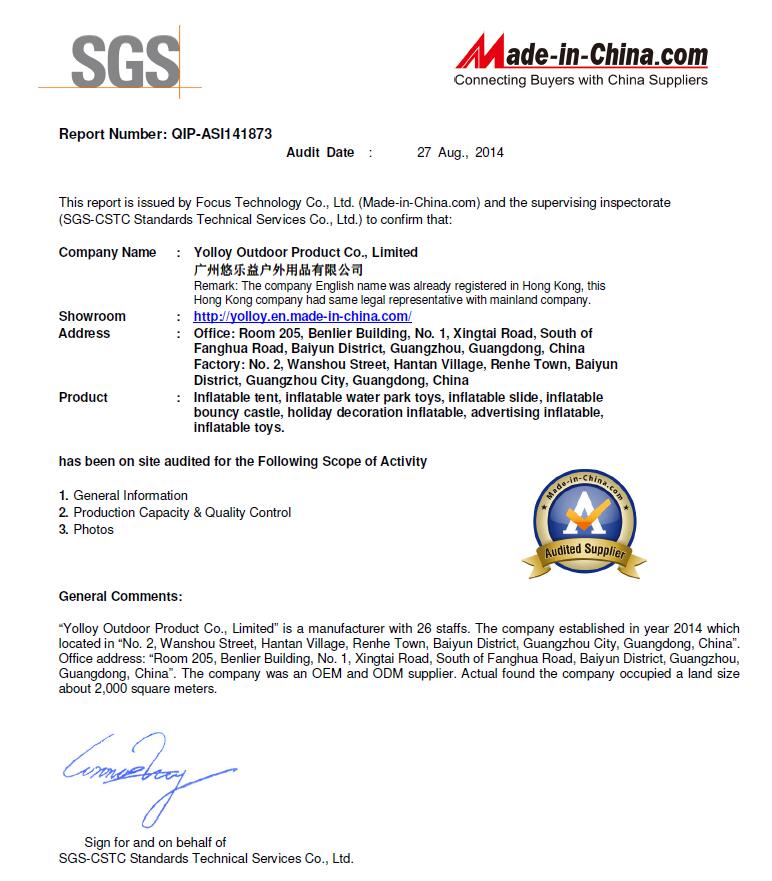
Beyond the product itself, the manufacturer you choose plays a decisive role in your long-term success. Yolloy Outdoor Product Co., Limited, based in Guangzhou, China, operates a complete custom design-to-production workflow. The process starts with designers preparing simulation renderings from your proposal. Revisions continue until you approve the design, which is then released for factory production. Each product is supplied with an appropriately powered blower, available in 110V, 220V, or 380V configurations to match your local electrical standards.
Key indicators of a reliable manufacturer: a proven track record of on-time delivery (look for a stated rate of 95% or above), transparent communication about production timelines, willingness to provide material certifications, and a reasonable warranty or service life expectation — typically around three years when products are used and maintained correctly.
Beyond Obstacle Courses: Expanding Your Product Range
Many of the same quality standards and manufacturing processes that apply to obstacle courses also apply to complementary inflatable products. If you are building a diverse entertainment lineup, consider exploring related categories such as inflatable football arenas, ziplines, bumper balls, and air mattresses. Working with a single trusted manufacturer across multiple product lines simplifies logistics, ensures consistent quality, and often leads to better pricing on bulk orders.