Products Category
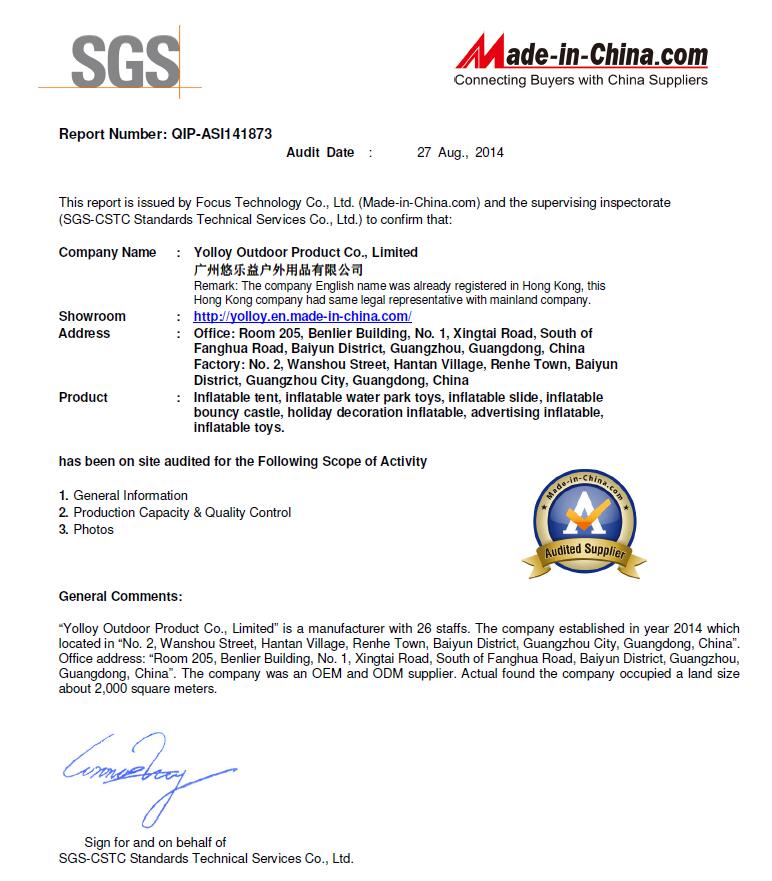
Certification

News

• New Order Successfully Finished for Long-Time Cooperated Japanese Client | YOLLOY Wins Full Client Recognition

• YOLLOY Custom Inflatable Pool Tent for Danish Client: Professional Pool Repair Shelter & Debris Protection

• Trusted Once Again! Greek Captain Re-orders Our Products After 4 Years

• Revolutionize Your Outdoors: The All-Terrain Inflatable Floating Tent for Land & Water

• Elevate Your Summer Fun: The Ultimate Inflatable Water Floating Volleyball Court Trampoline

• Innovative Inflatable Nightclub Tents & Pop-Up Bars: The Ultimate Solution for Portable Party Venues

Contact Us

Name: Sunny Yang
Tel: +86-20-8370 0771
Fax: +86-20-8370 0771
Mobile: 13570587575
E-mail: [email protected]
Add: No 5,Xiong wei Bo Nan Road,ZhongLuoTan Town,Baiyun district,Guangzhou,China
Friend me on Facebook Follow me on Twitter Add me to your circles Follow me on Pinterest Watch my channel on YouTube
News

Beyond the Campground: Why Inflatable Tents Are Taking Over Events, Business, and Outdoor Living

Author:yolloy Date:2026/8/9 4:50:17

When most people hear "inflatable tent," they picture a casual weekend camping trip. But the reality is far bigger. From high-end wedding receptions and corporate brand activations to emergency shelters and sports venues, inflatable tents have quietly become one of the most versatile structures in the outdoor event industry. And for businesses looking to invest in reliable, eye-catching, and easy-to-deploy shelters, understanding what sets quality inflatable tent manufacturers apart is the first step toward making a smart purchase.

What Actually Makes an Inflatable Tent Different?

Traditional pole tents rely on a framework of metal or fiberglass poles threaded through fabric sleeves. Inflatable tents replace that entire skeleton with pressurized air beams — thick, durable tubes that become rigid when inflated. The result is a structure that goes up in minutes instead of an hour, packs down into a compact bag, and — perhaps most importantly — handles wind and weather in a fundamentally different way than a pole tent ever could.

Because air beams flex under load rather than snapping, an inflatable dome tent can absorb gusts that would bend or break a traditional pole frame. This isn't just theory — it's a design principle that makes inflatable structures the go-to choice for event organizers working in exposed outdoor locations.

Four Reasons Businesses Are Switching to Inflatables

1. Setup Time That Actually Matters

For a rental business running back-to-back weekend events, labor is the single biggest operational cost. A traditional 6-person tent can take a two-person crew 30 to 45 minutes to pitch properly. An inflatable equivalent? Under five minutes with an electric pump. Over a season of 40 events, that difference translates into hundreds of saved labor hours.

2. Durability You Can Count On

The best inflatable tents are built with commercial-grade PVC tarpaulin, Oxford fabric, or TPU — materials tested to standards like EN71, EN14960, and RoHS. Reinforced seams use waterproof nylon thread, and high-load areas receive additional reinforcement. When paired with CE or UL-certified blowers, these tents are engineered for repeated commercial use, not occasional backyard outings.

3. One Structure, Endless Applications

This is where inflatable tents truly outshine traditional options. A single product category can serve wildly different markets. An inflatable cube tent might host a luxury brand activation on Monday and serve as a medical triage station on Tuesday. A tunnel tent can be a beer garden at a music festival or a temporary workshop on a construction site. The adaptability is built into the form factor.

4. Customization That Goes Beyond a Logo

Working directly with an inflatable tent factory means you are not limited to off-the-shelf options. Custom sizes, colors, printed logos, and even entirely bespoke designs — from a rough sketch or a photograph — are all achievable. A manufacturer that offers design-to-production service will prepare simulation renderings from your proposal, revise until you approve, and only then release the project for production. That level of customization is rare in the tent industry.

Key takeaway: Whether you need a single inflatable dome tent for a private event or a fleet of branded structures for a touring roadshow, you should expect the same build quality, the same material certifications, and the same attention to detail — regardless of order size.

A Tent for Every Purpose: Understanding the Range

The inflatable tent market today is far more diverse than most buyers realize. Here is a quick tour of what's available from a comprehensive manufacturer:

Dome Tents

The spherical or semi-spherical design provides excellent wind resistance and a striking visual profile. Popular for glamping sites, outdoor dining, and brand pavilions. Available in opaque and clear PVC versions for 360-degree views.

Cube & Tunnel Tents

Modular, stackable, and highly practical. Cube tents work well for trade show booths and retail pop-ups. Tunnel tents excel at creating long, covered walkways or multi-room layouts for festivals and exhibitions.

Party & Event Tents

Designed with aesthetics in mind, these tents often feature larger windows, decorative profiles, and elegant interior volumes. They are the go-to choice for weddings, corporate galas, and VIP hospitality areas.

Special-Purpose Tents

This category includes inflatable car tents for mobile detailing, spray painting booths with ventilation systems, golf simulator enclosures, sports tents, and emergency shelters. Each is engineered for a specific use case, with materials and features tailored accordingly.

What to Look for When Choosing an Inflatable Tent Manufacturer

Not all manufacturers are created equal. Here are the practical criteria that separate a reliable partner from a transactional supplier:

Material transparency. A manufacturer should be upfront about which materials they use — PVC tarpaulin, Oxford fabric, nylon, TPU — and should be able to provide testing certificates (EN71, EN14960, EN15649, RoHS) for the relevant product category.

Blower quality and certification. The blower is the heart of any inflatable tent. CE or UL certification is non-negotiable. The manufacturer should also be able to supply blowers in 110V, 220V, or 380V configurations to match your local power standards.

Minimum order quantity and production time. Some factories require large minimum orders. A flexible manufacturer that accepts a minimum order quantity of one piece — with a typical production time of 6 to 15 days for a regular product — gives you the freedom to test the market before scaling up.

Packaging and shipping. Look for soft carpet protection, waterproof PVC bags, and outer PE film as standard packaging. Larger items shipped on steel pallets indicate a factory that takes transit protection seriously. Air shipping (5-7 days) and sea freight (15-30+ days) should both be available.

After-sales support. Every inflatable product should come with a repair kit. A stated service life expectation of around three years, supported by responsive communication (emails answered within 24 hours), is a good benchmark.

Pro tip: Ask your inflatable tent manufacturers about their design revision process. A factory that offers simulation renderings and iterative design approval before production is one that values precision — and that precision shows in the final product.

The Bottom Line

Inflatable tents have moved well beyond the campground. They are now a mainstream choice for event professionals, rental businesses, brand marketers, and emergency response teams — and for good reason. They are faster to deploy, more adaptable, and increasingly more durable than their traditional counterparts.

The key to a successful investment lies in choosing the right manufacturing partner: one that offers certified materials, flexible customization, transparent production timelines, and genuine after-sales support. Whether you are sourcing your first tent or expanding an existing fleet, those fundamentals will determine how well your investment performs over years of commercial use.

Ready to Explore Your Options?

Whether you need a custom inflatable dome tent for an upcoming event, a branded tunnel tent for a touring activation, or a complete fleet of commercial shelters, YOLLOY offers design-to-production service with certified materials, flexible MOQs, and worldwide shipping. Contact us today to discuss your requirements.

Get in Touch

Beyond the Campground: Why Inflatable Tents Are Taking Over Events, Business, and Outdoor Living

Author:yolloy Date:2026/8/9 4:50:17

When most people hear "inflatable tent," they picture a casual weekend camping trip. But the reality is far bigger. From high-end wedding receptions and corporate brand activations to emergency shelters and sports venues, inflatable tents have quietly become one of the most versatile structures in the outdoor event industry. And for businesses looking to invest in reliable, eye-catching, and easy-to-deploy shelters, understanding what sets quality inflatable tent manufacturers apart is the first step toward making a smart purchase.

What Actually Makes an Inflatable Tent Different?

Traditional pole tents rely on a framework of metal or fiberglass poles threaded through fabric sleeves. Inflatable tents replace that entire skeleton with pressurized air beams — thick, durable tubes that become rigid when inflated. The result is a structure that goes up in minutes instead of an hour, packs down into a compact bag, and — perhaps most importantly — handles wind and weather in a fundamentally different way than a pole tent ever could.

Because air beams flex under load rather than snapping, an inflatable dome tent can absorb gusts that would bend or break a traditional pole frame. This isn't just theory — it's a design principle that makes inflatable structures the go-to choice for event organizers working in exposed outdoor locations.

Four Reasons Businesses Are Switching to Inflatables

1. Setup Time That Actually Matters

For a rental business running back-to-back weekend events, labor is the single biggest operational cost. A traditional 6-person tent can take a two-person crew 30 to 45 minutes to pitch properly. An inflatable equivalent? Under five minutes with an electric pump. Over a season of 40 events, that difference translates into hundreds of saved labor hours.

2. Durability You Can Count On

The best inflatable tents are built with commercial-grade PVC tarpaulin, Oxford fabric, or TPU — materials tested to standards like EN71, EN14960, and RoHS. Reinforced seams use waterproof nylon thread, and high-load areas receive additional reinforcement. When paired with CE or UL-certified blowers, these tents are engineered for repeated commercial use, not occasional backyard outings.

3. One Structure, Endless Applications

This is where inflatable tents truly outshine traditional options. A single product category can serve wildly different markets. An inflatable cube tent might host a luxury brand activation on Monday and serve as a medical triage station on Tuesday. A tunnel tent can be a beer garden at a music festival or a temporary workshop on a construction site. The adaptability is built into the form factor.

4. Customization That Goes Beyond a Logo

Working directly with an inflatable tent factory means you are not limited to off-the-shelf options. Custom sizes, colors, printed logos, and even entirely bespoke designs — from a rough sketch or a photograph — are all achievable. A manufacturer that offers design-to-production service will prepare simulation renderings from your proposal, revise until you approve, and only then release the project for production. That level of customization is rare in the tent industry.

Key takeaway: Whether you need a single inflatable dome tent for a private event or a fleet of branded structures for a touring roadshow, you should expect the same build quality, the same material certifications, and the same attention to detail — regardless of order size.

A Tent for Every Purpose: Understanding the Range

The inflatable tent market today is far more diverse than most buyers realize. Here is a quick tour of what's available from a comprehensive manufacturer:

Dome Tents

The spherical or semi-spherical design provides excellent wind resistance and a striking visual profile. Popular for glamping sites, outdoor dining, and brand pavilions. Available in opaque and clear PVC versions for 360-degree views.

Cube & Tunnel Tents

Modular, stackable, and highly practical. Cube tents work well for trade show booths and retail pop-ups. Tunnel tents excel at creating long, covered walkways or multi-room layouts for festivals and exhibitions.

Party & Event Tents

Designed with aesthetics in mind, these tents often feature larger windows, decorative profiles, and elegant interior volumes. They are the go-to choice for weddings, corporate galas, and VIP hospitality areas.

Special-Purpose Tents

This category includes inflatable car tents for mobile detailing, spray painting booths with ventilation systems, golf simulator enclosures, sports tents, and emergency shelters. Each is engineered for a specific use case, with materials and features tailored accordingly.

What to Look for When Choosing an Inflatable Tent Manufacturer

Not all manufacturers are created equal. Here are the practical criteria that separate a reliable partner from a transactional supplier:

Material transparency. A manufacturer should be upfront about which materials they use — PVC tarpaulin, Oxford fabric, nylon, TPU — and should be able to provide testing certificates (EN71, EN14960, EN15649, RoHS) for the relevant product category.

Blower quality and certification. The blower is the heart of any inflatable tent. CE or UL certification is non-negotiable. The manufacturer should also be able to supply blowers in 110V, 220V, or 380V configurations to match your local power standards.

Minimum order quantity and production time. Some factories require large minimum orders. A flexible manufacturer that accepts a minimum order quantity of one piece — with a typical production time of 6 to 15 days for a regular product — gives you the freedom to test the market before scaling up.

Packaging and shipping. Look for soft carpet protection, waterproof PVC bags, and outer PE film as standard packaging. Larger items shipped on steel pallets indicate a factory that takes transit protection seriously. Air shipping (5-7 days) and sea freight (15-30+ days) should both be available.

After-sales support. Every inflatable product should come with a repair kit. A stated service life expectation of around three years, supported by responsive communication (emails answered within 24 hours), is a good benchmark.

Pro tip: Ask your inflatable tent manufacturers about their design revision process. A factory that offers simulation renderings and iterative design approval before production is one that values precision — and that precision shows in the final product.

The Bottom Line

Inflatable tents have moved well beyond the campground. They are now a mainstream choice for event professionals, rental businesses, brand marketers, and emergency response teams — and for good reason. They are faster to deploy, more adaptable, and increasingly more durable than their traditional counterparts.

The key to a successful investment lies in choosing the right manufacturing partner: one that offers certified materials, flexible customization, transparent production timelines, and genuine after-sales support. Whether you are sourcing your first tent or expanding an existing fleet, those fundamentals will determine how well your investment performs over years of commercial use.

Ready to Explore Your Options?

Whether you need a custom inflatable dome tent for an upcoming event, a branded tunnel tent for a touring activation, or a complete fleet of commercial shelters, YOLLOY offers design-to-production service with certified materials, flexible MOQs, and worldwide shipping. Contact us today to discuss your requirements.

Get in Touch