A portable inflatable tent has become the go-to shelter for travelers who want a real structure without carrying heavy poles or spending an hour on setup. Instead of fiddling with tent pegs and separate poles, you pump a set of air beams, and the frame rises by itself in minutes. That convenience is exactly why more people are taking inflatable camping tents on road trips, festivals, beach weekends, and even business travel.
But "inflatable" covers a wide range of quality. Some models pack down small and hold up for years, while others leak at the seams after a couple of trips. Before you buy, it pays to know what separates a genuinely travel-ready inflatable tent from a gimmick. Here is a practical checklist built around the things that actually matter when you are moving from place to place.
Why a portable inflatable tent makes sense for travel
The biggest selling point is speed. Traditional tents can take 15 to 30 minutes to assemble, and clumsy pole systems are the most common source of broken gear. An inflatable frame removes that weak point entirely. You lay the tent out, connect the pump, and the air beams shape the shelter in five to ten minutes. When you are tired after a long drive or setting up in fading light, that difference is easy to appreciate.
The second advantage is a cleaner packing shape. Air beams collapse into a flat bundle rather than a tangle of rigid poles, which makes them easier to slide into a car boot, attach to a roof rack, or check as baggage. For travelers who switch campsites often, the shorter teardown and packing time adds up quickly.
What to check when you choose an inflatable camping tent
1. Packed size and weight match your travel style
A tent is only portable if you can actually carry and store it. If you travel by car, a heavier, roomier model is fine. If you need to move it on foot, on a motorcycle, or through an airport, look for a compact pack size and the lightest frame material you can afford. Ask the supplier for the exact packed dimensions and weight before ordering, not just the inflated footprint.
2. The inflation system is reliable on the road
Check whether the blower or pump runs on the power you have available. Many portable inflatable tents are supplied with blowers for 110V or 220V, and some runs are available for 380V. If you mostly camp where there is no grid power, a hand or rechargeable pump that works with the tent's valves is worth having as a backup. Multi-valve designs also let you top up or release air without opening the whole structure.
3. Materials determine how long it lasts
Strong, abrasion-resistant fabric is what keeps a travel tent usable trip after trip. Commercial-grade PVC tarpaulin is a common, tough choice for the body and floor, while Oxford fabric, nylon, or TPU may be used for lighter or more flexible builds. Thicker fabric with reinforced, high-frequency welded seams resists punctures and leaks far better than thin fabric with simple stitched joints. Whenever you can, confirm which materials are used and how the seams are joined before you commit.
4. Weather resistance beyond the label
A tent for travel should handle wind and rain, not just calm evenings. Look for a sturdy anchoring system so the structure stays put in a gust, and check the water resistance of the fabric and floor. Solar and UV exposure breaks down fabric over time, so a tent designed to sit outdoors without degrading quickly is a smarter buy. If you plan to use it in strong wind or cold conditions, mention that to the supplier so the frame and anchoring can be specified accordingly.
5. Size and capacity keep a useful balance
Manufacturers often rate capacity optimistically. As a rule, pick a size one step above the number of people who will actually sleep inside, and remember that gear takes up floor space. At the same time, a travel tent that is too roomy loses its portability. Define your group size honestly, then look for the smallest packed size that still gives you comfortable sleeping room.
6. Repairs and spare parts are part of the package
No inflatable product is indestructible, especially on the road. A puncture repair kit and spare valves can mean the difference between a quick fix and a ruined trip. Good inflatable tent manufacturers include a repair kit with each unit and can provide replacement parts when you need them. Confirm this before you buy, because sourcing a tiny valve from a supplier that does not respond is frustrating.
Buying from a manufacturer instead of a retailer
If you need a specific size, color, or logo, buying directly from an inflatable tent manufacturers gives you far more control than a standard retail model. A factory can make a tent to your dimensions and print your artwork, and it is also where you get honest answers about materials and lead times. Many inflatable tent factories start with a simple sketch, a photo, or a description and turn it into a production design, so you are not forced to fit a design you do not love.
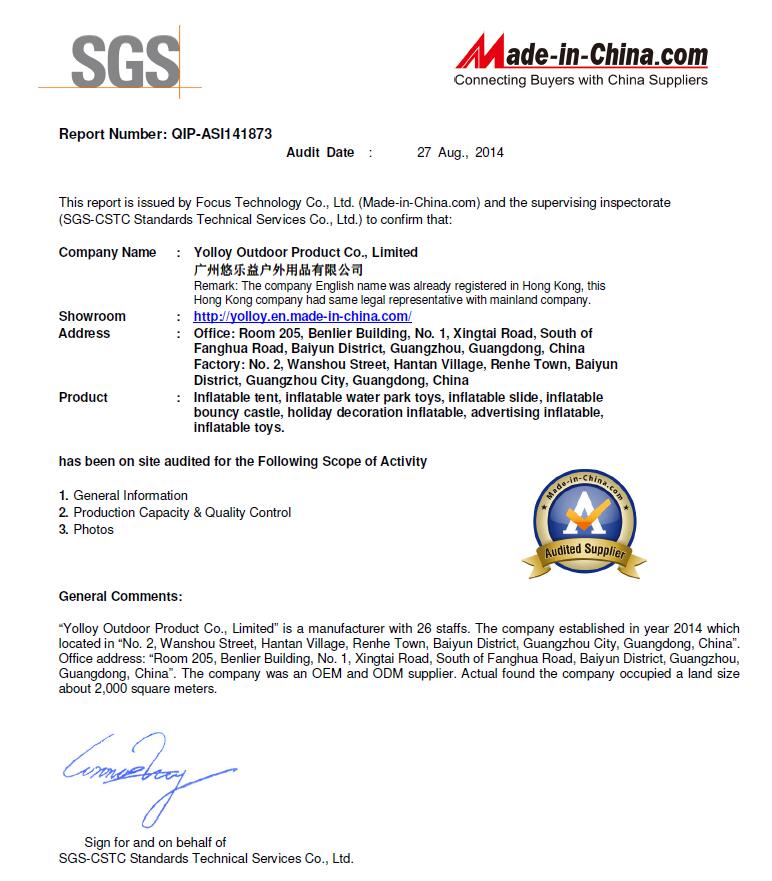
YOLLOY is one such custom inflatable manufacturer, based in Guangzhou, China. The company designs and produces outdoor inflatable tents in styles including cube, tunnel, dome, shelter, car, party, and sport tents, and it follows a build-to-order process: designers prepare a simulation rendering from your proposal, adjust it until you approve, then release it for production. Custom sizes, colors, and your own logo can be printed on the product, and the stated minimum order quantity is one piece, which keeps custom projects practical. Factory production for a regular inflatable product typically runs about 6 to 15 days before transit.
On quality, YOLLOY states that relevant materials have passed EN71, EN14960, and RoHS-related testing, and inflatable toys are associated with EN 14960. Products use precision sewing with reinforced seams and waterproof thread, or high-temperature fusion welding for airtight sections, and each unit is inspected before shipment. Depending on your requirements, blowers can be supplied for 110V, 220V, or 380V.
Keeping your tent reliable trip after trip
Care is simple but important. Dry the tent fully before you pack it so mold never gets a start, store it loosely in a cool, dry place, and inspect seams and valves before each trip. Lay a groundsheet beneath the floor to protect it from sharp ground, and avoid leaving the fabric in direct sun for long stretches when it is not in use. With regular care, a good inflatable camping tent lasts through many seasons.
Whether you want a ready-made model or a fully custom design, the right choice comes down to matching packed size, materials, weather resistance, and dependable after-sales support. Start with your travel routine, and the decision is far easier than it seems. If you need a portable inflatable tent built to your own specification, contact the YOLLOY team at [email protected] with your size, color, and artwork details, and they can prepare a design and quote for you.