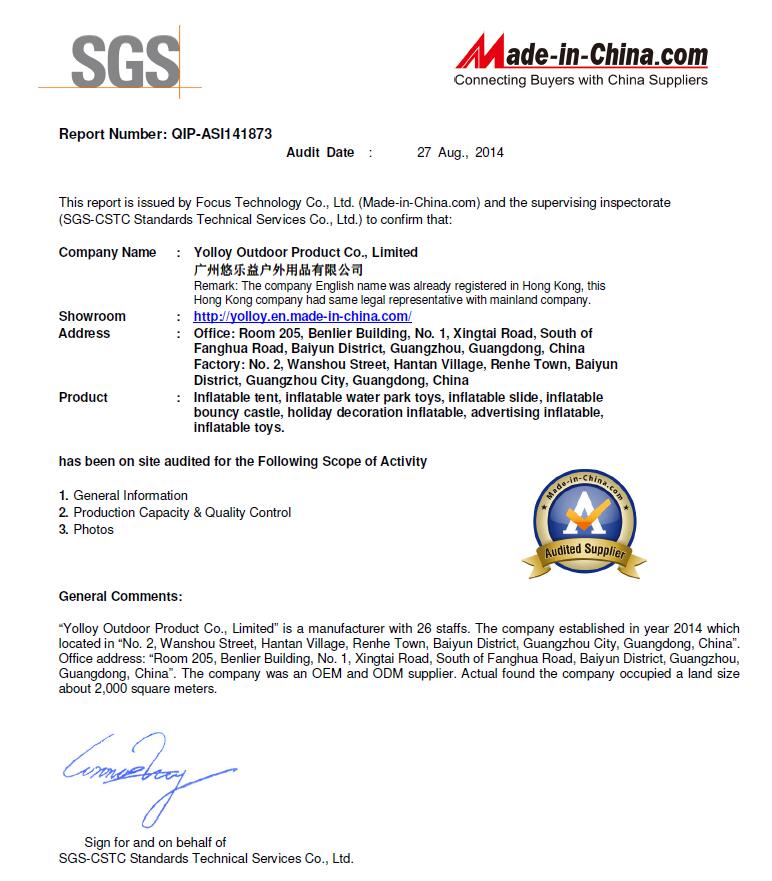
When you order an inflatable tent from a factory on the other side of the world, the product itself is only half the story. The other half is everything that happens between the moment the tent leaves the production line and the moment it reaches your door. That whole chain, from order confirmation to final delivery, is what people mean when they talk about inflatable tent logistics. This article explains what it involves, what a buyer should expect at each stage, and how YOLLOY, an inflatable product manufacturer in Guangzhou, China, handles it.
What is inflatable tent logistics?
Inflatable tent logistics is the process of planning, packing, shipping, and delivering inflatable tents from the factory to the buyer. It sounds simple, but a tent order touches a surprising number of steps: confirming the order details, scheduling production, inspecting the finished product, folding and packing it, booking freight, preparing export documents, clearing customs at both ends, and arranging the final delivery to your address. Each step has its own paperwork, timing, and cost, and getting any one of them wrong can delay the whole order.
For anyone importing inflatable tent wholesale from China, understanding how this chain works is the difference between a smooth first order and a frustrating one. A deflated tent folds into a compact, lightweight package, which makes it cheap to ship relative to its size, but that same flexibility means it needs careful packing and handling along the way.
The logistics journey, step by step
A typical inflatable tent order moves through five main stages. First comes order confirmation, where the size, color, material, and any custom printing are agreed on. Next is production, which for a regular inflatable product at YOLLOY typically takes about 6 to 15 days, with complex or large custom designs taking longer. After production, the tent is inspected and tested before shipment, so problems are caught at the factory rather than at your port. The tent is then deflated, folded, and packed for transport. Finally, the shipment is booked, documented, and sent on its way, either by air or by sea.
Because YOLLOY works with a minimum order quantity of just one piece, even a first-time buyer can walk through this entire process with a single tent before committing to a larger quantity. That makes it easy to test the quality, the packaging, and the shipping experience all at once.
Packaging: the first line of protection
Good logistics starts at the factory, before the freight is even booked. YOLLOY packs each product with soft carpet protection, seals it in a waterproof PVC bag, and wraps it in an outer PE film, which keeps the fabric clean and dry during a long journey. Larger products may be secured on steel pallets so they can be lifted, moved, and stacked safely inside a container or truck.
Blowers travel with the tent, and they matter for logistics too. YOLLOY can supply blowers for 110V, 220V, or 380V power requirements, so you can match the equipment to the electrical standard of your country and avoid surprises at the destination. Every inflatable product also comes with a repair kit, which is useful to have on hand after a long trip.
Air or sea: choosing a shipping method
Once the order is packed, the biggest logistics decision is how to ship it. Air freight is fast, typically arriving in about 5 to 7 days, but it is expensive per kilogram. Sea freight is much cheaper and is the standard choice for inflatable tents, but it takes longer, usually 15 to 30 days or more depending on the route. For most tent buyers, the savings from sea freight are worth the wait, and air freight is reserved for urgent orders.
Within sea freight, you will usually choose between Full Container Load (FCL) and Less than Container Load (LCL). FCL means your goods fill an entire container on their own, which gives you exclusive use of the space and the simplest handling at both ends. LCL means your tents share a container with other shippers' goods, and you pay only for the cubic meters you use. LCL is a good starting point for a first order of a few tents, while FCL becomes more attractive once your order grows large enough to justify a full container. Reliable inflatable tent manufacturers will usually help you work out which option fits your order.
Documentation and customs clearance
Logistics runs on paperwork, and getting it right keeps a shipment moving through customs without delays. The essential documents for an inflatable tent shipment are the bill of lading, the packing list, and the commercial invoice. The packing list should show the dimensions and weight of each package, since customs uses it to verify the volume you declared. The commercial invoice records the value of the goods and the Incoterms agreed between buyer and seller, which define who pays for freight, insurance, and customs at each stage.
Inflatable tents are usually classified under the Harmonized System heading for tents and shelters, but the exact code can vary by country and product type, so it is worth confirming the correct code with your customs broker before booking. Safety certificates are also worth preparing in advance. YOLLOY states that its materials have passed EN71, EN14960, and RoHS-related testing, and its inflatable play equipment is associated with EN 14960 while water park products reference EN 15649. Having these certificates ready can smooth the way at the destination.
Transit times and what to expect
After the shipment is loaded, the main thing left to do is wait. YOLLOY reports a 95% on-time delivery rate for its shipments, and the company states that emails and faxes are answered within 24 hours, so you can expect a quick response if you need a status update. Products are expected to provide a three-year service life when used and maintained correctly, and the responsive support makes the whole import process far less stressful if anything arrives damaged or needs attention.
Getting started with your first order
If you are new to importing a china inflatable tent or other inflatable structures, the process is simpler than it looks. Start by describing the tent you need, including size, color, and any custom printing. YOLLOY's design team prepares simulation renderings from your proposal, revises them until you approve, and then releases the design for production. After production and inspection, the order is packed and booked for shipping, and the freight cost per tent drops as your order grows.
In short, inflatable tent logistics is the full chain that moves a tent from the factory floor to your doorstep, and it covers packaging, freight, documentation, customs, and delivery. Understanding each stage puts you in control of your costs and your delivery schedule, and it is exactly the service YOLLOY provides to customers across Europe, Asia, South America, Africa, the Middle East, and Latin America. If you are planning an order, contact the YOLLOY team with your requirements and they will help you work out the right product, the right packaging, and the right shipping method for your needs.