Products Category
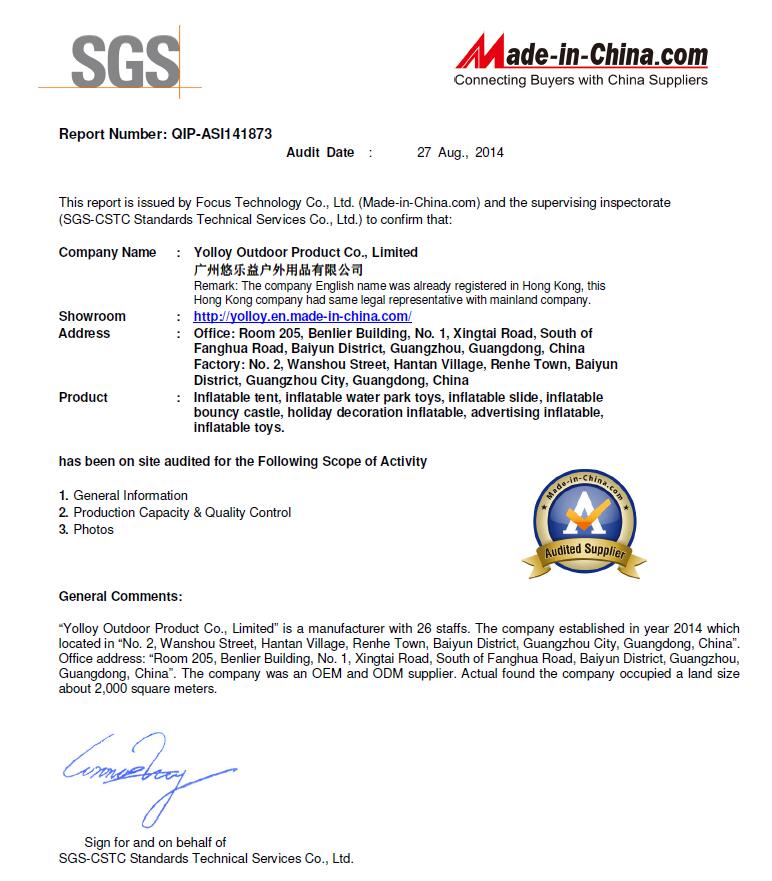
Certification

News

• New Order Successfully Finished for Long-Time Cooperated Japanese Client | YOLLOY Wins Full Client Recognition

• YOLLOY Custom Inflatable Pool Tent for Danish Client: Professional Pool Repair Shelter & Debris Protection

• Trusted Once Again! Greek Captain Re-orders Our Products After 4 Years

• Revolutionize Your Outdoors: The All-Terrain Inflatable Floating Tent for Land & Water

• Elevate Your Summer Fun: The Ultimate Inflatable Water Floating Volleyball Court Trampoline

• Innovative Inflatable Nightclub Tents & Pop-Up Bars: The Ultimate Solution for Portable Party Venues

Contact Us

Name: Sunny Yang
Tel: +86-20-8370 0771
Fax: +86-20-8370 0771
Mobile: 13570587575
E-mail: sales@yolloy.com
Add: No 5,Xiong wei Bo Nan Road,ZhongLuoTan Town,Baiyun district,Guangzhou,China
Friend me on Facebook Follow me on Twitter Add me to your circles Follow me on Pinterest Watch my channel on YouTube
News

How to Choose a Reliable Inflatable Water Park Manufacturer: A Buyer's Complete Guide

Author:yolloy Date:2026/7/14 17:31:06

The inflatable amusement industry is expanding rapidly, with water parks, bounce houses, and inflatable tents becoming staple attractions at resorts, events, and family entertainment centers worldwide. For business owners and event operators, sourcing the right inflatable water park is not just about price — it is about durability, safety compliance, customization capability, and long-term partnership. This guide walks through every factor that matters when choosing an inflatable products manufacturer, with practical insights drawn from real factory operations.

1. Start with Material Quality — The Foundation of Every Inflatable Product

The lifespan and safety of an inflatable structure begin with the raw materials. Commercial-grade products should be built with heavy-duty PVC tarpaulin, typically 0.55mm thickness or higher, which provides the necessary tear resistance and UV protection for outdoor use. For tent applications, manufacturers may offer multiple material options — Oxford fabric for lightweight portability, nylon for flexibility, or TPU for superior weather resistance — depending on the specific use case.

Beyond the base fabric, the thread used in stitching is equally critical. Waterproof nylon thread with UV-resistant properties prevents seam degradation over time. Reinforced seams — often double or quadruple-stitched — are the difference between a product that lasts three seasons and one that fails mid-event. For airtight products such as inflatable domes and bubble tents, high-temperature fusion welding equipment seals the material at the molecular level, creating a bond far stronger than adhesive alone.

2. Safety Certifications: The Non-Negotiable Standard

A trustworthy inflatable water park supplier should be able to produce verifiable safety certifications. In the European market, EN 14960 is the benchmark for inflatable play equipment, covering structural integrity, anchoring requirements, and material safety. For inflatable water parks, EN 15649 specifically addresses floating leisure products used on water. The EN71 standard applies to toy-related safety, while RoHS compliance ensures materials are free from restricted hazardous substances.

For the North American market, CE certification on blowers and electrical components is common, with UL listing providing an additional layer of electrical safety verification. When evaluating a manufacturer, ask directly for current certificates — not just web page claims — and verify the scope of certification matches the products you intend to order.

3. Manufacturing Capabilities: What Happens on the Factory Floor

Production quality is not an accident — it is the result of deliberate processes. A well-organized inflatables factory operates both sewing and welding production lines. Precision sewing equipment handles products like bounce houses and tents, with additional reinforcement at high-load stress points. Welding stations use controlled heat and pressure for airtight seals on domes, slides, and water park components.

Pre-shipment inspection should be standard practice. Every product should be fully inflated, visually inspected for seam integrity, and tested for air retention before it reaches the packaging station. Anchor systems — typically D-ring or round metal anchors embedded into the structure — should be load-tested to ensure wind resistance during outdoor deployment.

Key Factory Evaluation Checklist
  • Does the factory have dedicated sewing and welding production lines?
  • Are materials sourced from certified suppliers with traceable batch records?
  • Is every product fully inflated and inspected before packaging?
  • Does the factory provide blowers with CE or UL certification?
  • Can the manufacturer accommodate custom size, color, and logo requirements?

4. Customization: From Concept Sketch to Finished Product

Off-the-shelf products serve a purpose, but the real competitive advantage comes from customization. A capable manufacturer should take a customer's proposal — whether it is a hand-drawn sketch, a photograph, a CAD file, or a written description — and translate it into professional simulation renderings. This design-to-production workflow lets buyers visualize the finished product, iterate on dimensions and artwork, and approve the final design before manufacturing begins.

Customization extends far beyond colors and logos. Height, width, slide angles, obstacle layouts, themed artwork, and even integrated lighting can all be tailored to the buyer's specific venue and audience. The minimum order quantity (MOQ) matters here: a factory that accepts one-piece orders demonstrates confidence in its production flexibility and is more accessible for small business operators testing new concepts.

5. Beyond Water Parks: The Value of a Full-Range Manufacturer

Many suppliers specialize in a single product category, but buyers with diverse or growing operations benefit from working with a full-range manufacturer. A single factory that produces inflatable water slides, bounce houses, obstacle courses, clear dome tents, portable planetarium domes, paintball bunkers, advertising models, and air mattresses under one roof offers operational simplicity — consolidated shipping, uniform quality standards, and a single point of contact for after-sales support.

For amusement park operators and event rental companies, this breadth means one supplier can furnish an entire venue: water attractions for summer, inflatable tents for year-round shelter, interactive sport games for corporate events, and advertising inflatables for brand visibility. The logistical efficiency alone — one shipment, one warranty policy, one relationship — translates to cost savings and fewer headaches over time.

6. Practical Buyer Concerns: Lead Times, Shipping, and After-Sales

Production lead time is a critical factor for seasonal businesses. For standard inflatable products, a typical factory turnaround is 6 to 15 days, excluding transit time. Larger or highly customized orders may require additional production days. Buyers should confirm this timeline in writing and account for buffer time before peak season.

Shipping logistics vary by destination. Air freight delivers products within 5 to 7 days, suitable for urgent orders or sample shipments. Sea freight, the more economical option for bulk orders, typically requires 15 to 30 days or longer depending on the destination port. A manufacturer with documented on-time delivery performance — ideally at or above 95% — demonstrates supply chain reliability.

Packaging quality is often overlooked until damage occurs in transit. Products should be wrapped in soft carpet or foam protection, sealed in waterproof PVC bags, and covered with an outer PE film layer. Large or heavy products should ship on steel pallets to prevent crushing. Every shipment should include a repair kit with matching material patches and adhesive, enabling on-site repairs without returning the product.

7. Warranty, Service, and Long-Term Partnership

A manufacturer's commitment to quality is reflected in its warranty terms and service responsiveness. An expected service life of approximately three years, when products are used and maintained correctly, is a reasonable benchmark for commercial-grade inflatables — though actual longevity depends on usage frequency and environmental conditions. The warranty should clearly state what is covered and for how long.

Communication is the invisible thread that holds a supplier relationship together. A manufacturer that responds to emails and faxes within 24 hours signals organizational discipline. For overseas buyers operating across time zones, this responsiveness reduces the anxiety of long-distance procurement. Combined with a stated commitment to continuous improvement and honest communication, these soft factors often distinguish excellent suppliers from merely adequate ones.

8. Why Sourcing from a China Inflatable Water Park Manufacturer Makes Strategic Sense

China remains the global hub for inflatable product manufacturing, and for good reason. The concentration of material suppliers, skilled production labor, and decades of industry expertise in regions like Guangzhou creates an ecosystem that is difficult to replicate elsewhere. A china inflatable water park manufacturer based in this corridor benefits from supply chain proximity, competitive material costs, and accumulated know-how across thousands of completed projects.

The key is identifying which Chinese manufacturers operate at an international standard. Look for documented export experience across multiple continents — Europe, North America, South America, the Middle East, Africa, and Southeast Asia — as evidence that products have passed varying regulatory requirements and customer expectations. A manufacturer with a diverse export portfolio has likely refined its products and processes through feedback from markets with different safety cultures and usage patterns.

Putting It All Together: Your Decision Framework

Choosing a manufacturer is ultimately a decision about risk and reward. The lowest quoted price may save upfront cost but risk product failure, safety incidents, and reputational damage. The right choice balances competitive pricing with verifiable quality — materials, certifications, production processes, customization capability, and service reliability.

Before placing an order, ask for product samples or visit the factory if feasible. Review current certifications with their validity dates. Request a production timeline with key milestones. Clarify packaging, shipping, and warranty terms. And perhaps most importantly, gauge the quality of communication — how quickly and clearly does the sales team respond to technical questions? A supplier that communicates well before the sale is likely to support you well after it.

Ready to Source Your Inflatable Products?

YOLLOY Outdoor Product Co., Limited is a Guangzhou-based inflatable products manufacturer offering custom design-to-production service across 10 product categories, from outdoor inflatable tents and clear dome tents to water park toys, interactive sport games, commercial slides, bounce houses, paintball bunkers, and advertising inflatables. With EN71, EN14960, EN15649, and RoHS-compliant materials, CE/UL-certified blowers, reinforced seams, and a documented 95% on-time delivery rate, YOLLOY provides the quality and reliability that commercial buyers demand. Every order includes a repair kit, professional packaging, and flexible shipping by air or sea.

Visit YOLLOY Online →

How to Choose a Reliable Inflatable Water Park Manufacturer: A Buyer's Complete Guide

Author:yolloy Date:2026/7/14 17:31:06

The inflatable amusement industry is expanding rapidly, with water parks, bounce houses, and inflatable tents becoming staple attractions at resorts, events, and family entertainment centers worldwide. For business owners and event operators, sourcing the right inflatable water park is not just about price — it is about durability, safety compliance, customization capability, and long-term partnership. This guide walks through every factor that matters when choosing an inflatable products manufacturer, with practical insights drawn from real factory operations.

1. Start with Material Quality — The Foundation of Every Inflatable Product

The lifespan and safety of an inflatable structure begin with the raw materials. Commercial-grade products should be built with heavy-duty PVC tarpaulin, typically 0.55mm thickness or higher, which provides the necessary tear resistance and UV protection for outdoor use. For tent applications, manufacturers may offer multiple material options — Oxford fabric for lightweight portability, nylon for flexibility, or TPU for superior weather resistance — depending on the specific use case.

Beyond the base fabric, the thread used in stitching is equally critical. Waterproof nylon thread with UV-resistant properties prevents seam degradation over time. Reinforced seams — often double or quadruple-stitched — are the difference between a product that lasts three seasons and one that fails mid-event. For airtight products such as inflatable domes and bubble tents, high-temperature fusion welding equipment seals the material at the molecular level, creating a bond far stronger than adhesive alone.

2. Safety Certifications: The Non-Negotiable Standard

A trustworthy inflatable water park supplier should be able to produce verifiable safety certifications. In the European market, EN 14960 is the benchmark for inflatable play equipment, covering structural integrity, anchoring requirements, and material safety. For inflatable water parks, EN 15649 specifically addresses floating leisure products used on water. The EN71 standard applies to toy-related safety, while RoHS compliance ensures materials are free from restricted hazardous substances.

For the North American market, CE certification on blowers and electrical components is common, with UL listing providing an additional layer of electrical safety verification. When evaluating a manufacturer, ask directly for current certificates — not just web page claims — and verify the scope of certification matches the products you intend to order.

3. Manufacturing Capabilities: What Happens on the Factory Floor

Production quality is not an accident — it is the result of deliberate processes. A well-organized inflatables factory operates both sewing and welding production lines. Precision sewing equipment handles products like bounce houses and tents, with additional reinforcement at high-load stress points. Welding stations use controlled heat and pressure for airtight seals on domes, slides, and water park components.

Pre-shipment inspection should be standard practice. Every product should be fully inflated, visually inspected for seam integrity, and tested for air retention before it reaches the packaging station. Anchor systems — typically D-ring or round metal anchors embedded into the structure — should be load-tested to ensure wind resistance during outdoor deployment.

Key Factory Evaluation Checklist
  • Does the factory have dedicated sewing and welding production lines?
  • Are materials sourced from certified suppliers with traceable batch records?
  • Is every product fully inflated and inspected before packaging?
  • Does the factory provide blowers with CE or UL certification?
  • Can the manufacturer accommodate custom size, color, and logo requirements?

4. Customization: From Concept Sketch to Finished Product

Off-the-shelf products serve a purpose, but the real competitive advantage comes from customization. A capable manufacturer should take a customer's proposal — whether it is a hand-drawn sketch, a photograph, a CAD file, or a written description — and translate it into professional simulation renderings. This design-to-production workflow lets buyers visualize the finished product, iterate on dimensions and artwork, and approve the final design before manufacturing begins.

Customization extends far beyond colors and logos. Height, width, slide angles, obstacle layouts, themed artwork, and even integrated lighting can all be tailored to the buyer's specific venue and audience. The minimum order quantity (MOQ) matters here: a factory that accepts one-piece orders demonstrates confidence in its production flexibility and is more accessible for small business operators testing new concepts.

5. Beyond Water Parks: The Value of a Full-Range Manufacturer

Many suppliers specialize in a single product category, but buyers with diverse or growing operations benefit from working with a full-range manufacturer. A single factory that produces inflatable water slides, bounce houses, obstacle courses, clear dome tents, portable planetarium domes, paintball bunkers, advertising models, and air mattresses under one roof offers operational simplicity — consolidated shipping, uniform quality standards, and a single point of contact for after-sales support.

For amusement park operators and event rental companies, this breadth means one supplier can furnish an entire venue: water attractions for summer, inflatable tents for year-round shelter, interactive sport games for corporate events, and advertising inflatables for brand visibility. The logistical efficiency alone — one shipment, one warranty policy, one relationship — translates to cost savings and fewer headaches over time.

6. Practical Buyer Concerns: Lead Times, Shipping, and After-Sales

Production lead time is a critical factor for seasonal businesses. For standard inflatable products, a typical factory turnaround is 6 to 15 days, excluding transit time. Larger or highly customized orders may require additional production days. Buyers should confirm this timeline in writing and account for buffer time before peak season.

Shipping logistics vary by destination. Air freight delivers products within 5 to 7 days, suitable for urgent orders or sample shipments. Sea freight, the more economical option for bulk orders, typically requires 15 to 30 days or longer depending on the destination port. A manufacturer with documented on-time delivery performance — ideally at or above 95% — demonstrates supply chain reliability.

Packaging quality is often overlooked until damage occurs in transit. Products should be wrapped in soft carpet or foam protection, sealed in waterproof PVC bags, and covered with an outer PE film layer. Large or heavy products should ship on steel pallets to prevent crushing. Every shipment should include a repair kit with matching material patches and adhesive, enabling on-site repairs without returning the product.

7. Warranty, Service, and Long-Term Partnership

A manufacturer's commitment to quality is reflected in its warranty terms and service responsiveness. An expected service life of approximately three years, when products are used and maintained correctly, is a reasonable benchmark for commercial-grade inflatables — though actual longevity depends on usage frequency and environmental conditions. The warranty should clearly state what is covered and for how long.

Communication is the invisible thread that holds a supplier relationship together. A manufacturer that responds to emails and faxes within 24 hours signals organizational discipline. For overseas buyers operating across time zones, this responsiveness reduces the anxiety of long-distance procurement. Combined with a stated commitment to continuous improvement and honest communication, these soft factors often distinguish excellent suppliers from merely adequate ones.

8. Why Sourcing from a China Inflatable Water Park Manufacturer Makes Strategic Sense

China remains the global hub for inflatable product manufacturing, and for good reason. The concentration of material suppliers, skilled production labor, and decades of industry expertise in regions like Guangzhou creates an ecosystem that is difficult to replicate elsewhere. A china inflatable water park manufacturer based in this corridor benefits from supply chain proximity, competitive material costs, and accumulated know-how across thousands of completed projects.

The key is identifying which Chinese manufacturers operate at an international standard. Look for documented export experience across multiple continents — Europe, North America, South America, the Middle East, Africa, and Southeast Asia — as evidence that products have passed varying regulatory requirements and customer expectations. A manufacturer with a diverse export portfolio has likely refined its products and processes through feedback from markets with different safety cultures and usage patterns.

Putting It All Together: Your Decision Framework

Choosing a manufacturer is ultimately a decision about risk and reward. The lowest quoted price may save upfront cost but risk product failure, safety incidents, and reputational damage. The right choice balances competitive pricing with verifiable quality — materials, certifications, production processes, customization capability, and service reliability.

Before placing an order, ask for product samples or visit the factory if feasible. Review current certifications with their validity dates. Request a production timeline with key milestones. Clarify packaging, shipping, and warranty terms. And perhaps most importantly, gauge the quality of communication — how quickly and clearly does the sales team respond to technical questions? A supplier that communicates well before the sale is likely to support you well after it.

Ready to Source Your Inflatable Products?

YOLLOY Outdoor Product Co., Limited is a Guangzhou-based inflatable products manufacturer offering custom design-to-production service across 10 product categories, from outdoor inflatable tents and clear dome tents to water park toys, interactive sport games, commercial slides, bounce houses, paintball bunkers, and advertising inflatables. With EN71, EN14960, EN15649, and RoHS-compliant materials, CE/UL-certified blowers, reinforced seams, and a documented 95% on-time delivery rate, YOLLOY provides the quality and reliability that commercial buyers demand. Every order includes a repair kit, professional packaging, and flexible shipping by air or sea.

Visit YOLLOY Online →