Products Category
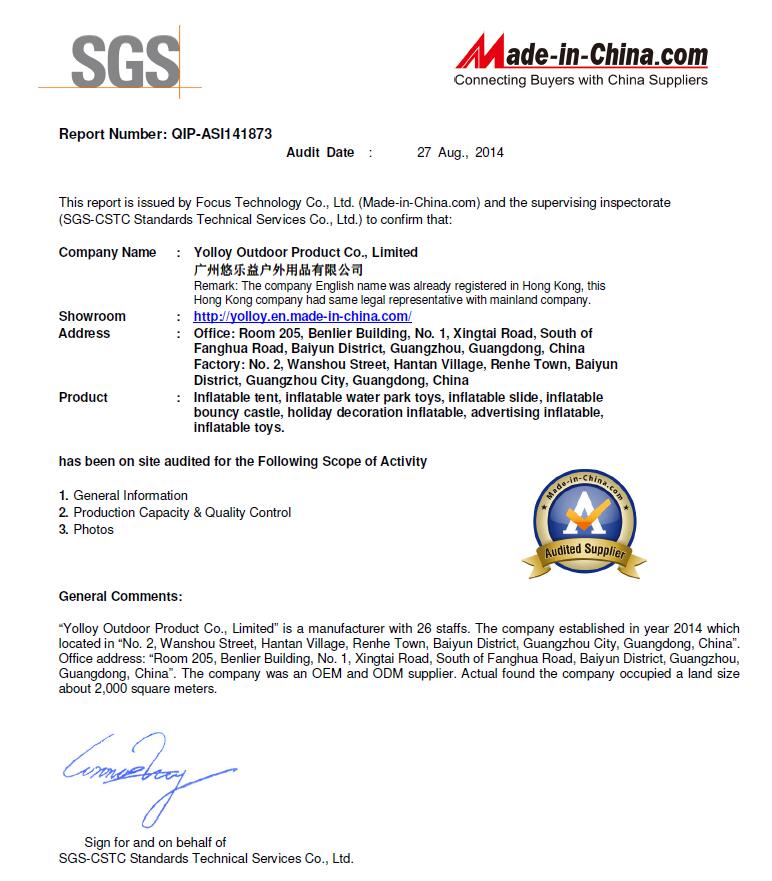
Certification

News

• New Order Successfully Finished for Long-Time Cooperated Japanese Client | YOLLOY Wins Full Client Recognition

• YOLLOY Custom Inflatable Pool Tent for Danish Client: Professional Pool Repair Shelter & Debris Protection

• Trusted Once Again! Greek Captain Re-orders Our Products After 4 Years

• Revolutionize Your Outdoors: The All-Terrain Inflatable Floating Tent for Land & Water

• Elevate Your Summer Fun: The Ultimate Inflatable Water Floating Volleyball Court Trampoline

• Innovative Inflatable Nightclub Tents & Pop-Up Bars: The Ultimate Solution for Portable Party Venues

Contact Us

Name: Sunny Yang
Tel: +86-20-8370 0771
Fax: +86-20-8370 0771
Mobile: 13570587575
E-mail: sales@yolloy.com
Add: No 5,Xiong wei Bo Nan Road,ZhongLuoTan Town,Baiyun district,Guangzhou,China
Friend me on Facebook Follow me on Twitter Add me to your circles Follow me on Pinterest Watch my channel on YouTube
News

How to Choose a Castle Inflatable Bounce House: A Buyer Guide for Party Rental Businesses

Author:yolloy Date:2026/7/14 10:07:25
If you run a party rental business, an event planning company, or an amusement park, a castle inflatable bounce house is one of the most reliable crowd-pleasers you can invest in. Kids love the fairy-tale appeal of a castle-shaped jumping area, and parents appreciate the supervised, contained play environment. But choosing the right bounce house goes far beyond picking a design that looks good in a catalog. The quality of materials, manufacturing standards, safety features, and after-sales support all play a direct role in how long your unit lasts — and how safely it performs event after event.
In this guide, we'll walk through the key factors to evaluate when selecting a commercial-grade inflatable bounce house, from material choices and international safety certifications to customization options and what you should expect from a inflatable bounce house manufacturer who serves global markets.
1. Know Your Materials: What Goes Into a Durable Bounce House
The single biggest factor determining how well a bounce house holds up over time is the fabric it is made from. Commercial-grade inflatables should be constructed from high-quality PVC tarpaulin — typically 0.55mm thick or heavier — that resists tearing, abrasion, and UV degradation. For certain applications, manufacturers also use Oxford fabric, nylon, or TPU, depending on weight requirements and intended use environments.
Beyond the base material, pay attention to how the seams are joined. Precision sewing equipment, reinforced seams, and waterproof nylon thread are standard in properly manufactured units. For airtight sections — such as sealed chambers or water-retaining areas — high-temperature fusion welding provides a much stronger and more reliable bond than stitching alone.
Pro tip: Ask your supplier whether extra reinforcement is applied at high-load areas such as anchor points, entry steps, and slide joints. These are the zones that experience the most stress during operation and are the most common failure points on lower-quality units.
2. Safety Certifications: What Standards Should You Look For?
Safety is non-negotiable when you're putting children and guests on an inflatable structure. Different markets have different regulatory requirements, but several international standards serve as reliable benchmarks no matter where you operate.
EN 14960 — The European safety standard specifically for inflatable play equipment, covering design, materials, anchoring, and operational safety. If you operate in Europe or source from suppliers that export to Europe, this is the key standard to check.
EN 71 — Covers the mechanical and physical safety of toys, including material toxicity limits. Relevant for bounce houses marketed for children's use.
RoHS — Restriction of Hazardous Substances. Confirms that the materials used do not contain harmful levels of restricted chemicals such as lead, mercury, and cadmium.
CE / UL Blowers — The electric blower is the heart of any inflatable. Blowers that carry CE (for European markets) or UL (for North America) certification have been tested for electrical safety and performance.
A reputable china inflatable bounce house supplier should be able to provide test reports or certificates for the materials and blowers used in your order. If a manufacturer cannot show you any third-party test documentation, that is a red flag worth paying attention to.
3. Customization: Making the Bounce House Your Own
A standard off-the-shelf design may work for some operators, but the businesses that stand out are the ones that offer something unique. A quality manufacturer should allow you to customize nearly every aspect of your castle bounce house:
Size and layout — Adapt the footprint to fit your typical venue spaces, whether that means a compact unit for indoor parties or an oversized castle for outdoor festivals.
Colors and themes — Choose color schemes that match your brand or event theme, from classic medieval stone gray to bright, cartoon-inspired palettes.
Logo and artwork printing — Have your company logo, mascot, or custom artwork printed directly onto the fabric for instant brand visibility at every event.
Add-on features — Consider integrating slides, climbing walls, basketball hoops, or obstacle elements into the castle design for a combo unit that offers more play value.
Some manufacturers can even produce a unit starting from nothing more than a hand-drawn sketch, photograph, or site plan — which is especially useful if you have a very specific theme or spatial constraint in mind.
4. Anchoring and Setup: Built-In Features That Matter
How a bounce house connects to the ground directly affects safety, setup time, and the range of surfaces you can use it on. Quality commercial units come with D-ring or round metal anchor points integrated into the structure at all critical load-bearing positions. These anchor systems should be compatible with both ground stakes (for grass and soil) and sandbag or water-weight ballast systems (for indoor surfaces, asphalt, and concrete).
Every anchor point provided by the manufacturer should be used during operation — this is not an area where corners should be cut. The manufacturer's documentation should clearly state how many anchors are needed, where they should be placed, and what wind-speed limits apply. Proper anchoring is as much a product design issue as it is an operational practice, so look for units that include anchor points at regular intervals around the entire perimeter, not just at the corners.
5. The Blower: Choosing the Right Power Supply
Your bounce house is only as good as the blower that keeps it inflated. The blower should be supplied by the manufacturer as a matched pair with the inflatable — meaning the air output (measured in cubic feet or cubic meters per minute) is correctly sized for the volume of the unit. Using an undersized blower results in a soft, unstable structure; an oversized one puts unnecessary strain on seams.
When ordering from an international supplier, confirm that blowers can be provided in the voltage specification your country requires — 110V, 220V, or 380V. The blower should carry CE or UL certification and include features such as thermal overload protection and a waterproof switch housing. Before each use, operators should check the blower intake for debris, inspect the power cord for damage, and keep electrical connections elevated away from standing water.
6. Production Timelines and Shipping: What to Expect
Lead time is a practical concern for any business. A standard inflatable bounce house typically takes 6 to 15 days to produce, not including transit time. Complex custom designs or very large units may take longer. If you have a specific event deadline, communicate it clearly with your supplier before placing the order.
For international orders, air shipping generally takes 5 to 7 days, while sea freight ranges from 15 to 30 days or more depending on the destination port. Products should be packed with care: look for suppliers that use soft carpet protection around delicate areas, waterproof PVC inner bags, and outer PE film. Large or heavy units may ship on steel pallets for added protection during transit.
7. After-Sales Support: Repair Kits, Warranty, and Maintenance
Even the best-made inflatable will eventually need maintenance, and how a manufacturer supports you after the sale is just as important as the quality of the initial product.
Repair kit included — Each inflatable should ship with a repair kit containing patch material and adhesive, so you can handle minor punctures and seam repairs on-site without waiting for outside service.
Warranty terms — Expect a service-life expectation of at least 3 years under normal use and proper maintenance conditions, though exact warranty terms vary by product type.
Responsive communication — Your supplier should respond to inquiries within a reasonable timeframe — ideally within 24 hours on business days.
On-time delivery — Look for manufacturers that track and report their delivery performance. A 95% on-time delivery rate is a strong signal of reliable operations.
After each event, rinse off dirt and debris, wash gently with mild soap and water, and allow the unit to dry completely before rolling and storing. Proper drying prevents mold and mildew. Store indoors, away from rodents, sharp objects, and prolonged direct sunlight to extend the life of your investment.
8. Partnering with the Right Supplier
The inflatable market is large, and not all manufacturers deliver the same level of quality. When you choose a supplier, look for a company that offers end-to-end service: from design consultation and simulation renderings through to factory production, inspection, packing, and shipping. A minimum order quantity of just one piece is a good sign — it suggests the manufacturer is set up for custom, project-based work rather than only high-volume commodity production.
YOLLOY Outdoor Product Co., Ltd., based in Guangzhou, China, designs and manufactures custom inflatable products across ten major categories — from inflatable bounce house with slide combos and castle designs to water parks, interactive sports games, commercial slides, paintball bunkers, and advertising inflatables. Every product follows a design-to-production workflow: designers prepare 3D renderings from your concept, revise until you approve, and then release the final design for factory manufacturing. Products are supplied with matched blowers rated for your local voltage, and each unit ships with a repair kit. Materials are tested for EN71, EN14960, and RoHS compliance, and products are inspected before shipment.
Ready to Add a Castle Bounce House to Your Fleet?
Whether you need a single custom-designed castle inflatable or a full inventory refresh, YOLLOY can work from your sketch, reference photo, or detailed brief to create a product that matches your vision. For inquiries about pricing, production timelines, or design options, contact the YOLLOY team at sales@yolloy.com or visit www.yolloy.net to explore the full product range.

How to Choose a Castle Inflatable Bounce House: A Buyer Guide for Party Rental Businesses

Author:yolloy Date:2026/7/14 10:07:25

If you run a party rental business, an event planning company, or an amusement park, a castle inflatable bounce house is one of the most reliable crowd-pleasers you can invest in. Kids love the fairy-tale appeal of a castle-shaped jumping area, and parents appreciate the supervised, contained play environment. But choosing the right bounce house goes far beyond picking a design that looks good in a catalog. The quality of materials, manufacturing standards, safety features, and after-sales support all play a direct role in how long your unit lasts — and how safely it performs event after event.
In this guide, we'll walk through the key factors to evaluate when selecting a commercial-grade inflatable bounce house, from material choices and international safety certifications to customization options and what you should expect from a inflatable bounce house manufacturer who serves global markets.
1. Know Your Materials: What Goes Into a Durable Bounce House
The single biggest factor determining how well a bounce house holds up over time is the fabric it is made from. Commercial-grade inflatables should be constructed from high-quality PVC tarpaulin — typically 0.55mm thick or heavier — that resists tearing, abrasion, and UV degradation. For certain applications, manufacturers also use Oxford fabric, nylon, or TPU, depending on weight requirements and intended use environments.
Beyond the base material, pay attention to how the seams are joined. Precision sewing equipment, reinforced seams, and waterproof nylon thread are standard in properly manufactured units. For airtight sections — such as sealed chambers or water-retaining areas — high-temperature fusion welding provides a much stronger and more reliable bond than stitching alone.
Pro tip: Ask your supplier whether extra reinforcement is applied at high-load areas such as anchor points, entry steps, and slide joints. These are the zones that experience the most stress during operation and are the most common failure points on lower-quality units.
2. Safety Certifications: What Standards Should You Look For?
Safety is non-negotiable when you're putting children and guests on an inflatable structure. Different markets have different regulatory requirements, but several international standards serve as reliable benchmarks no matter where you operate.
EN 14960 — The European safety standard specifically for inflatable play equipment, covering design, materials, anchoring, and operational safety. If you operate in Europe or source from suppliers that export to Europe, this is the key standard to check.
EN 71 — Covers the mechanical and physical safety of toys, including material toxicity limits. Relevant for bounce houses marketed for children's use.
RoHS — Restriction of Hazardous Substances. Confirms that the materials used do not contain harmful levels of restricted chemicals such as lead, mercury, and cadmium.
CE / UL Blowers — The electric blower is the heart of any inflatable. Blowers that carry CE (for European markets) or UL (for North America) certification have been tested for electrical safety and performance.
A reputable china inflatable bounce house supplier should be able to provide test reports or certificates for the materials and blowers used in your order. If a manufacturer cannot show you any third-party test documentation, that is a red flag worth paying attention to.
3. Customization: Making the Bounce House Your Own
A standard off-the-shelf design may work for some operators, but the businesses that stand out are the ones that offer something unique. A quality manufacturer should allow you to customize nearly every aspect of your castle bounce house:
Size and layout — Adapt the footprint to fit your typical venue spaces, whether that means a compact unit for indoor parties or an oversized castle for outdoor festivals.
Colors and themes — Choose color schemes that match your brand or event theme, from classic medieval stone gray to bright, cartoon-inspired palettes.
Logo and artwork printing — Have your company logo, mascot, or custom artwork printed directly onto the fabric for instant brand visibility at every event.
Add-on features — Consider integrating slides, climbing walls, basketball hoops, or obstacle elements into the castle design for a combo unit that offers more play value.
Some manufacturers can even produce a unit starting from nothing more than a hand-drawn sketch, photograph, or site plan — which is especially useful if you have a very specific theme or spatial constraint in mind.
4. Anchoring and Setup: Built-In Features That Matter
How a bounce house connects to the ground directly affects safety, setup time, and the range of surfaces you can use it on. Quality commercial units come with D-ring or round metal anchor points integrated into the structure at all critical load-bearing positions. These anchor systems should be compatible with both ground stakes (for grass and soil) and sandbag or water-weight ballast systems (for indoor surfaces, asphalt, and concrete).
Every anchor point provided by the manufacturer should be used during operation — this is not an area where corners should be cut. The manufacturer's documentation should clearly state how many anchors are needed, where they should be placed, and what wind-speed limits apply. Proper anchoring is as much a product design issue as it is an operational practice, so look for units that include anchor points at regular intervals around the entire perimeter, not just at the corners.
5. The Blower: Choosing the Right Power Supply
Your bounce house is only as good as the blower that keeps it inflated. The blower should be supplied by the manufacturer as a matched pair with the inflatable — meaning the air output (measured in cubic feet or cubic meters per minute) is correctly sized for the volume of the unit. Using an undersized blower results in a soft, unstable structure; an oversized one puts unnecessary strain on seams.
When ordering from an international supplier, confirm that blowers can be provided in the voltage specification your country requires — 110V, 220V, or 380V. The blower should carry CE or UL certification and include features such as thermal overload protection and a waterproof switch housing. Before each use, operators should check the blower intake for debris, inspect the power cord for damage, and keep electrical connections elevated away from standing water.
6. Production Timelines and Shipping: What to Expect
Lead time is a practical concern for any business. A standard inflatable bounce house typically takes 6 to 15 days to produce, not including transit time. Complex custom designs or very large units may take longer. If you have a specific event deadline, communicate it clearly with your supplier before placing the order.
For international orders, air shipping generally takes 5 to 7 days, while sea freight ranges from 15 to 30 days or more depending on the destination port. Products should be packed with care: look for suppliers that use soft carpet protection around delicate areas, waterproof PVC inner bags, and outer PE film. Large or heavy units may ship on steel pallets for added protection during transit.
7. After-Sales Support: Repair Kits, Warranty, and Maintenance
Even the best-made inflatable will eventually need maintenance, and how a manufacturer supports you after the sale is just as important as the quality of the initial product.
Repair kit included — Each inflatable should ship with a repair kit containing patch material and adhesive, so you can handle minor punctures and seam repairs on-site without waiting for outside service.
Warranty terms — Expect a service-life expectation of at least 3 years under normal use and proper maintenance conditions, though exact warranty terms vary by product type.
Responsive communication — Your supplier should respond to inquiries within a reasonable timeframe — ideally within 24 hours on business days.
On-time delivery — Look for manufacturers that track and report their delivery performance. A 95% on-time delivery rate is a strong signal of reliable operations.
After each event, rinse off dirt and debris, wash gently with mild soap and water, and allow the unit to dry completely before rolling and storing. Proper drying prevents mold and mildew. Store indoors, away from rodents, sharp objects, and prolonged direct sunlight to extend the life of your investment.
8. Partnering with the Right Supplier
The inflatable market is large, and not all manufacturers deliver the same level of quality. When you choose a supplier, look for a company that offers end-to-end service: from design consultation and simulation renderings through to factory production, inspection, packing, and shipping. A minimum order quantity of just one piece is a good sign — it suggests the manufacturer is set up for custom, project-based work rather than only high-volume commodity production.
YOLLOY Outdoor Product Co., Ltd., based in Guangzhou, China, designs and manufactures custom inflatable products across ten major categories — from inflatable bounce house with slide combos and castle designs to water parks, interactive sports games, commercial slides, paintball bunkers, and advertising inflatables. Every product follows a design-to-production workflow: designers prepare 3D renderings from your concept, revise until you approve, and then release the final design for factory manufacturing. Products are supplied with matched blowers rated for your local voltage, and each unit ships with a repair kit. Materials are tested for EN71, EN14960, and RoHS compliance, and products are inspected before shipment.
Ready to Add a Castle Bounce House to Your Fleet?
Whether you need a single custom-designed castle inflatable or a full inventory refresh, YOLLOY can work from your sketch, reference photo, or detailed brief to create a product that matches your vision. For inquiries about pricing, production timelines, or design options, contact the YOLLOY team at sales@yolloy.com or visit www.yolloy.net to explore the full product range.