Outdoor events have always come with a familiar list of headaches: last-minute weather changes, cumbersome equipment setup, limited space, and the never-ending challenge of making a temporary venue feel polished and professional. For event planners, venue managers, and rental businesses, the search for a solution that balances speed, visual appeal, and reliability is ongoing.
This is where the shift toward air-powered structures is making tangible change. A growing number of professionals are turning to the
inflatable tent for events
— not as a novelty, but as a practical, field-tested alternative to traditional frame tents and marquees. When you look past the surface, the advantages go far beyond the quick inflation time.
Why Event Professionals Are Switching to Inflatable Tents
Conventional event tents rely on heavy aluminum or steel frames, crossbars, and tensioned fabric panels. Setup usually requires a trained crew, proper tools, and a generous window of time — all of which shrink once you start working on a real-world event schedule with tight turnaround.
An outdoor inflatable tent flips the equation. Instead of assembling dozens of metal poles, you position the structure, connect the blower, and watch it take shape in minutes. This single difference ripples into everything else: the number of people you need on site, the time you spend on logistics, and how quickly you can break down and move to the next venue.
There is also the factor of visual impact. Inflatable tents have a signature look — smooth curves, clean lines, and a modern silhouette that stands apart from the angular, canopy-style tents audiences have seen for decades. For brand activations, product launches, and upscale private events, that aesthetic matters. It signals that the organizer has thought about the experience, not just the function.
A single operator can deploy a commercial inflatable tent in a fraction of the time required for a traditional frame tent — freeing crew members for other tasks and shrinking the overall event footprint.
More Than One Shape: Matching the Tent to the Event
One common misconception is that all inflatable tents look the same. In practice, the category spans a wide range of configurations, each suited to different scenarios.
-
Cube tents work well for trade show booths, pop-up retail spaces, and corporate hospitality areas where a structured, room-like environment is preferred.
-
Tunnel tents create dramatic entrance corridors or covered walkways, often used at marathons, music festivals, and outdoor exhibitions.
-
Dome tents offer a spacious, open interior with excellent sightlines — ideal for presentations, dining, and VIP lounges.
-
Clear inflatable dome tents and bubble tents provide a transparent, immersive experience. These have found strong traction in glamping resorts, wedding venues, and evening events where guests dine or socialize under the stars while protected from wind and cold.
-
Inflatable snow globes can become seasonal attractions that draw crowds purely on their own visual appeal.
The point is that there is no single "event tent." The right choice depends on the atmosphere you are trying to create, the number of guests, and the nature of the site. A manufacturer with a broad product range and the willingness to customize can help you pinpoint the model that fits — rather than asking you to adapt your event to whatever happens to be in stock.
What Separates a Commercial-Grade Tent from the Rest
Not all inflatable tents are built to the same standard. Products designed for backyard use or light camping typically use thinner materials, simpler stitching, and lower-capacity blowers. When you place one of those in a commercial setting — a full-day outdoor market with hundreds of people walking through, or a corporate activation that needs to stay standing through an afternoon gust — the limitations surface quickly.
This is why understanding build quality matters. A properly engineered
custom inflatable tent
from a specialized
inflatable tent manufacturer
starts with material selection. Commercial-grade PVC tarpaulin provides the tear resistance and waterproofing needed for repeated outdoor use. For applications that require lighter weight without sacrificing strength, Oxford fabric and nylon are also available depending on project requirements.
Seams are the most stressed part of any inflatable structure. Precision sewing equipment with reinforced stitching and waterproof nylon thread is the baseline. In high-load areas — around anchor points, zipper openings, and blower connections — additional reinforcement layers are added during production. For sealed-air models that do not use a continuous blower, high-temperature fusion welding ensures air-tight integrity across every joint.
Blower selection is another factor that shows the difference between a recreational and a commercial product. Professional units are supplied with appropriately powered blowers configured for the local voltage — 110V, 220V, or 380V — and should carry CE or UL certification. The blower is not just a fan; it is the system that keeps the structure stable throughout the event, and under-sizing it leads to sagging, instability, and safety risks.
Customization Is Where Brand Identity Comes In
One of the most underused advantages of inflatable event structures is the ability to integrate branding directly into the tent itself. Because these products are manufactured to order — not pulled from a warehouse shelf — the surface becomes a canvas.
Logos, taglines, artwork, and specific color schemes can be printed onto the fabric using durable, UV-resistant techniques. A corporate event tent does not need to rely on separate banners or signage draped over a generic white canopy; the structure itself communicates the brand from the moment attendees see it across the field. For rental businesses, this same capability means you can offer clients a fully branded venue rather than a neutral rental — a clear competitive advantage when bidding for high-visibility contracts.
The customization goes beyond graphics. Dimensions can be adjusted to fit a specific site footprint. Door and window placements can be reconfigured. Ventilation panels, lighting integration, and internal partition walls can be designed in from the start. Some clients request transparent sections on an otherwise opaque tent for a specific visual effect. All of this starts with a conversation about what the event requires, not what a catalog page happens to list.
Safety and Certification: What to Look For
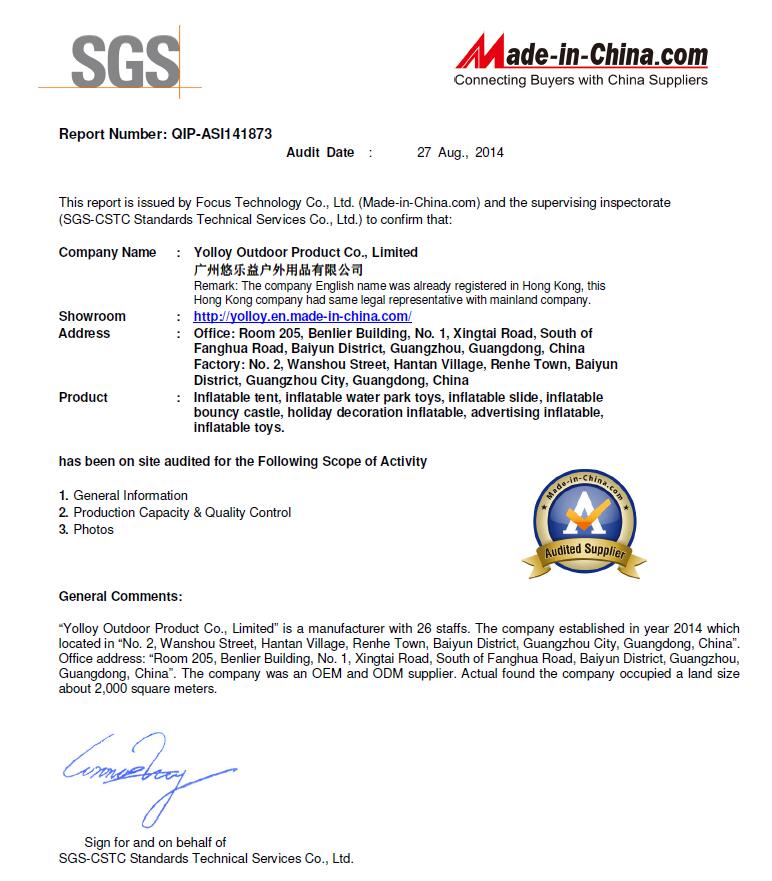
When an inflatable structure houses people — whether for a product demonstration, a seated dinner, or a children's activity zone — safety is the non-negotiable starting point. Responsible manufacturers back their claims with independent testing.
Materials used in inflatable tents should have documented compliance with relevant standards. EN71 testing covers mechanical and physical properties as well as flammability, commonly referenced for inflatable products that may be used around children. EN14960 applies specifically to inflatable play equipment, while EN15649 covers floating leisure articles for use on and in the water. Blowers should be CE or UL listed, confirming they meet electrical safety requirements in their intended market.
On the installation side, anchoring is what keeps a tent where it belongs. D-ring and round metal anchor systems — integrated into the structure at calculated points — provide wind resistance and stability even on uneven ground. The manufacturer should provide clear guidance on anchor placement for different site conditions and weather scenarios.
A repair kit included with every product is a small detail that signals how a company thinks about the full ownership experience. Tears and punctures happen in the real world — the question is whether you can address them on site and keep the event running, or whether you have to shut down and wait for a replacement.
From Inquiry to Delivery: What the Process Should Look Like
Choosing the right manufacturing partner involves more than comparing product photos and price points. The process from first contact to final delivery reveals how seriously a company takes its work.
A well-structured workflow typically starts with requirement gathering: understanding what the tent needs to do, where it will be used, and what constraints apply. The design team then produces simulation renderings — visual representations of the proposed product — so you can see exactly what you will receive before a single piece of material is cut. Revisions continue until the design is approved; only then does it move into production.
Production timelines vary with complexity. A standard inflatable product might ship within 6 to 15 days, while a large or highly customized piece may require more time. Air freight offers delivery within 5 to 7 days for urgent needs, and sea shipping — typically 15 to 30 days — provides a cost-effective option for larger orders. A company that communicates openly about timelines, including any delays, is one you can build a long-term relationship with.
Post-delivery support matters just as much. Inflatables require maintenance, and questions come up. A reasonable expectation is a 24-hour response window for inquiries, along with access to technical support for installation guidance, troubleshooting, and spare parts. Products come with soft carpet protection, waterproof PVC bags, and outer PE film for transit, with large items additionally secured on steel pallets.
Ready to Explore What an Inflatable Tent Can Do for Your Event?
Whether you are planning a brand activation, a wedding, a trade show, or a large-scale festival, the right structure changes how your audience experiences the space. Start a conversation with a team that treats customization as standard practice — and quality as the bottom line. A single piece is all it takes to begin.
Get in Touch & Request a Quote