From weddings and corporate gatherings to music festivals and brand activations, discover why event professionals are switching to inflatable tent solutions.
Outdoor events have always carried an element of risk. One sudden rain shower, an unexpected gust of wind, or an unseasonably hot afternoon can turn a carefully planned gathering into a logistical headache. Event planners, rental business owners, and venue managers know this better than anyone. Yet the demand for outdoor celebrations continues to grow — weddings on scenic hillsides, corporate retreats in remote locations, product launches in open-air settings, and music festivals in sprawling fields. The question is no longer whether to host events outdoors, but how to do it reliably and impressively. This is where inflatable party tents have emerged as a game-changing solution.
Unlike traditional pole-and-canvas structures that require hours of assembly, heavy equipment, and a team of trained staff, inflatable tents offer something genuinely different: a shelter system that combines rapid deployment, striking visual appeal, and structural resilience in a single package. For anyone sourcing event infrastructure — whether as a rental business building inventory or a planner securing a venue — understanding what inflatable party tents bring to the table is essential.
What Makes an Inflatable Tent Different from a Traditional Party Tent?
The fundamental difference lies in the support structure. Traditional party tents rely on rigid metal or aluminum poles that must be threaded through fabric sleeves, locked into position, and anchored with tensioned guy ropes. This process typically requires two to four people, takes anywhere from 30 minutes to over an hour, and demands a certain level of experience to get right.
An inflatable event tent, by contrast, replaces poles with air-filled beams made from high-strength, commercial-grade PVC tarpaulin. These beams are inflated using an electric blower — typically in under five minutes — and once fully pressurized, they create a rigid, self-supporting frame. The tent stands on its own without the need for complex tensioning systems. Deflation is equally straightforward: switch off the blower, open the valves, and the structure collapses into a compact roll that can be transported in a single carry bag.
Key advantage: A single person can set up a mid-sized inflatable party tent in approximately 5 to 10 minutes using an electric pump, compared to 30 to 60 minutes for a traditional pole tent requiring a team of two or more.
Why Event Businesses Are Making the Switch
The shift toward inflatable tent solutions is not just about convenience — it is driven by tangible business advantages that affect the bottom line. Event rental companies, in particular, are finding that the economics of inflatable structures make compelling sense.
Faster Turnaround Means More Bookings
Labor is one of the largest operational costs for any event rental business. The speed advantage of inflatable tents translates directly into reduced setup and takedown time, which means fewer staff hours per event. Over a busy season with dozens of bookings, those saved hours add up to significant cost reductions. More importantly, faster turnaround enables a single inventory set to serve more events in a given period.
Striking Visual Impact That Attracts Clients
Inflatable party tents have a distinctive, modern aesthetic that traditional pole tents cannot match. Their curved, architectural profiles create a sense of occasion the moment guests arrive. White, translucent, or fully transparent models — such as clear PVC dome tents — offer a 360-degree view of the surrounding environment while providing complete weather protection. This visual appeal is a powerful marketing asset: event photos featuring striking inflatable structures tend to perform well on social media, generating organic interest and referrals.
Versatility Across Event Types
One of the strongest arguments for inflatable tents is their adaptability. The same basic structure can serve as a wedding reception hall on Saturday, a corporate exhibition space on Sunday, and a VIP lounge at a music festival the following weekend. Leading inflatable tent manufacturers offer multiple configurations — cube tents, tunnel tents, dome tents, and custom-shaped shelters — each suited to different event formats and spatial requirements. Many models can be connected end-to-end or side-by-side to create larger, multi-room layouts.
Common event applications include: weddings and receptions, corporate product launches, trade show booths, music festival VIP areas, outdoor dining and pop-up restaurants, brand activation spaces, sports event hospitality, and private parties of all sizes.
What to Look for When Sourcing Inflatable Party Tents
Not all inflatable tents are created equal. The quality of materials, manufacturing processes, and design engineering varies considerably across suppliers. For buyers investing in commercial-grade equipment intended for repeated use, several factors deserve careful attention.
Material Quality and Safety Standards
Commercial-grade PVC tarpaulin should be the baseline material for any inflatable tent intended for professional use. Look for materials that have passed relevant safety testing — EN71 and EN14960 certifications are common benchmarks for inflatable structures, while blowers should carry CE or UL certification. High-quality fabrics are waterproof, UV-resistant, flame-retardant, and lead-free. The stitching should use waterproof nylon thread with reinforcement at all high-stress points, and seams should be double-stitched throughout.
Customization Capabilities
For event businesses, the ability to customize tents is a significant competitive advantage. Reputable manufacturers can produce tents in custom sizes, colors, and configurations — and can print client logos, branding, and artwork directly onto the fabric. Some suppliers offer complete design-to-production services, where a customer provides a sketch or description and receives a simulation rendering for approval before manufacturing begins. This level of customization allows rental businesses to offer unique inventory that competitors cannot easily replicate.
Blower Systems and Power Requirements
The blower is the heart of any inflatable tent system. Quality blowers should be rated for continuous operation, with options for 110V, 220V, or 380V power supplies depending on the target market. CE or UL certification is important for safety compliance. Some manufacturers supply blowers matched to the specific tent model, ensuring optimal inflation pressure and airflow. Always confirm that the blower is included in the purchase and that spare parts or replacements are readily available.
Anchoring and Wind Resistance
Wind is the primary environmental challenge for any outdoor structure. Quality inflatable tents incorporate D-ring or round metal anchor points at strategic locations around the perimeter, allowing them to be secured firmly to the ground with stakes, weights, or tie-downs. The air-beam structure itself is inherently more wind-resistant than pole frames because the beams flex rather than break under load. When properly anchored, commercial inflatable tents can handle moderate to strong wind conditions reliably.
The Business Case: Rental Return on Investment
For rental businesses, the financial equation is straightforward. A commercial-grade inflatable party tent represents a capital investment that can pay for itself within a single season of regular bookings. Consider a typical scenario: a mid-sized inflatable tent rented at $300 to $500 per event, booked 20 to 30 times per season, generates $6,000 to $15,000 in annual revenue from a single unit. With a service life of three years or more when properly maintained, the return on investment is substantial.
The operational savings amplify this return. Reduced labor costs per setup, fewer staff required for transport and assembly, and lower risk of damage during handling (since there are no rigid poles to bend or break) all contribute to a healthier bottom line. Additionally, the unique visual appeal of inflatable tents often allows rental businesses to charge a premium rate compared to standard pole tents.
Maintenance and Longevity
Proper maintenance is straightforward and extends the useful life of inflatable tents considerably. After each use, the tent should be cleaned with water and mild detergent, then thoroughly dried before storage to prevent mold and mildew. Most manufacturers supply a repair kit with each tent, and minor punctures can be patched in the field using the same technique as repairing a bicycle inner tube. For storage, tents should be kept in a cool, dry environment away from direct sunlight, ideally in the protective carry bags provided.
When sourced from a quality manufacturer, commercial inflatable tents typically carry a warranty expectation of three years of service life under normal use conditions. The actual lifespan often exceeds this when tents are properly maintained and stored.
Sourcing from the Right Manufacturer
The global market for inflatable structures is dominated by Chinese manufacturers, with Guangzhou serving as a major production hub. When evaluating inflatable tent manufacturers, consider factors beyond price alone: material certifications, quality control processes, customization capabilities, minimum order quantities, production lead times, and after-sales support. A manufacturer that offers a low minimum order quantity (MOQ of one piece) and provides design consultation services is particularly valuable for businesses that are building or diversifying their inventory.
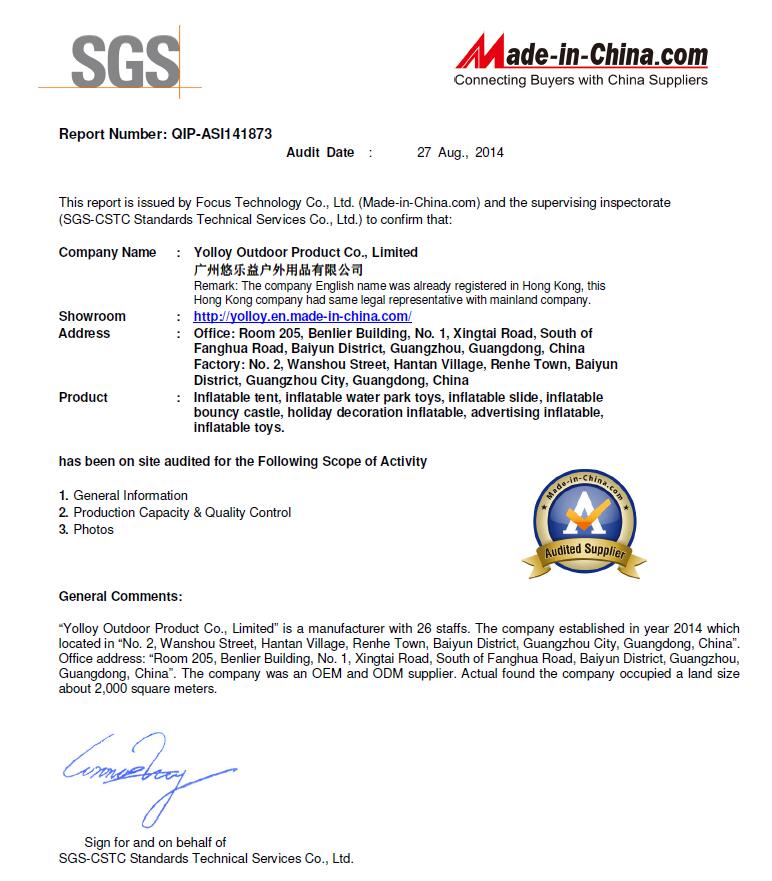
YOLLOY Outdoor Product Co., Limited, based in Guangzhou, China, exemplifies the kind of manufacturer that event businesses should look for. The company offers a comprehensive range of inflatable tents — including cube, tunnel, dome, party, sports, and custom shelter configurations — with full customization in size, color, and branding. Their production process includes simulation rendering from customer proposals, iterative design approval, and factory production with quality inspection before shipment. Products are manufactured using commercial-grade PVC tarpaulin with materials that have passed EN71, EN14960, and RoHS testing, and blowers are available in CE/UL-certified configurations for 110V, 220V, or 380V requirements.
YOLLOY at a glance: Custom inflatable tent manufacturer | MOQ: 1 piece | Typical production time: 6-15 days | Global shipping via air (5-7 days) or sea (15-30+ days) | Repair kit included with every product | 95% on-time delivery rate | 24-hour email response commitment.
Making the Right Choice for Your Business
The decision to invest in inflatable party tents should be driven by your specific business model and event portfolio. For rental companies serving the wedding and corporate event market, the visual impact and quick setup time make inflatable tents a compelling addition to any inventory. For event planners who manage multi-day festivals or traveling roadshows, the portability and rapid deployment are invaluable. For venue operators looking to expand capacity without permanent construction, inflatable structures offer a flexible, cost-effective alternative to traditional buildings.
The outdoor event industry is evolving, and client expectations are rising. Attendees want memorable experiences in beautiful settings, and event hosts want infrastructure that is reliable, efficient, and impressive. Inflatable party tents deliver on all three fronts — and for businesses that adopt them early, they represent a meaningful competitive advantage in an increasingly crowded market.
Ready to explore inflatable tent solutions for your event business? YOLLOY Outdoor Product Co., Limited offers custom-designed inflatable tents for weddings, corporate events, festivals, exhibitions, and more. With a low MOQ of just one piece, global shipping, and complete design-to-production service, getting started has never been easier. Contact the YOLLOY team at [email protected] or visit www.yolloy.net to discuss your requirements and request a quote.
Disclaimer: This article is for informational purposes only. Product specifications, certifications, warranty terms, and delivery timelines should be confirmed directly with the manufacturer before placing an order. All claims about materials, certifications, and service are based on information published on the manufacturer's website as of the article date.