Products Category
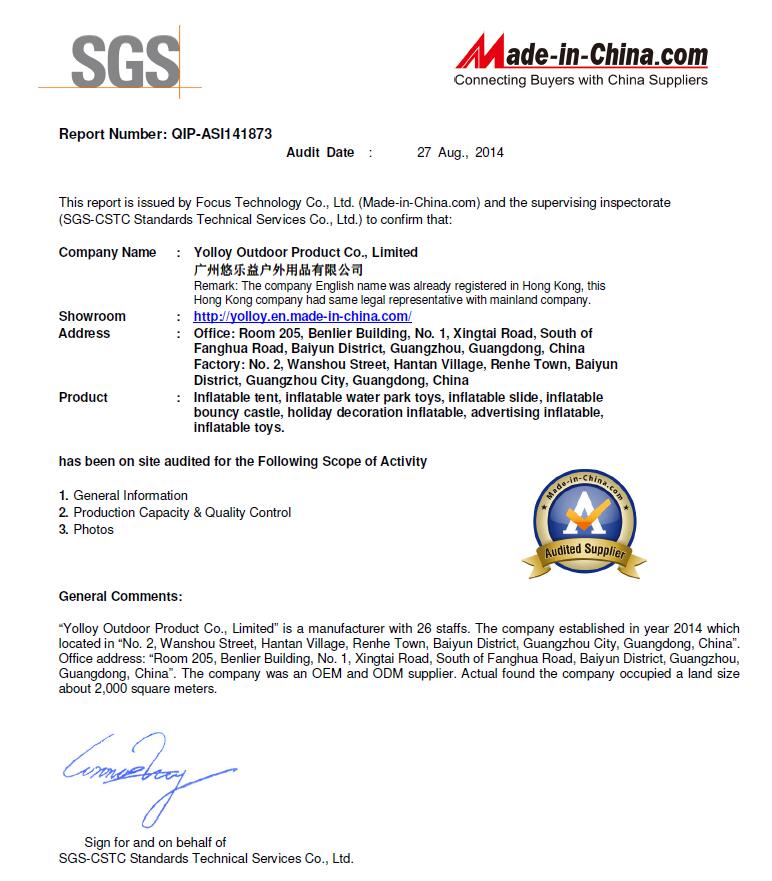
Certification

News

• New Order Successfully Finished for Long-Time Cooperated Japanese Client | YOLLOY Wins Full Client Recognition

• YOLLOY Custom Inflatable Pool Tent for Danish Client: Professional Pool Repair Shelter & Debris Protection

• Trusted Once Again! Greek Captain Re-orders Our Products After 4 Years

• Revolutionize Your Outdoors: The All-Terrain Inflatable Floating Tent for Land & Water

• Elevate Your Summer Fun: The Ultimate Inflatable Water Floating Volleyball Court Trampoline

• Innovative Inflatable Nightclub Tents & Pop-Up Bars: The Ultimate Solution for Portable Party Venues

Contact Us

Name: Sunny Yang
Tel: +86-20-8370 0771
Fax: +86-20-8370 0771
Mobile: 13570587575
E-mail: [email protected]
Add: No 5,Xiong wei Bo Nan Road,ZhongLuoTan Town,Baiyun district,Guangzhou,China
Friend me on Facebook Follow me on Twitter Add me to your circles Follow me on Pinterest Watch my channel on YouTube
News

The Commercial Buyer's Guide to Inflatable Tents: Applications, Benefits, and Sourcing Tips

Author:yolloy Date:2026/8/10 19:50:20
How businesses and event planners are turning to inflatable structures for faster setup, greater versatility, and lower long-term cost.
When most people think of inflatable tents, the image that comes to mind is a family camping trip. And while inflatable tents have certainly made their mark in the outdoor recreation world, their real potential lies far beyond the campground. From high-end outdoor weddings and corporate launch events to emergency medical shelters and portable spray-painting booths, inflatable tents are quietly reshaping how businesses and organizations think about temporary and semi-permanent structures.
For event rental companies, hospitality operators, and government agencies, the shift toward inflatable tent solutions is driven by a simple set of priorities: speed of deployment, structural reliability, and the ability to customize every detail. Sourcing from experienced inflatable tent manufacturers who understand commercial-grade requirements is the foundation of a successful investment.
What Makes a Commercial Inflatable Tent Different
A commercial inflatable tent is not simply a larger version of a camping tent. The materials, construction methods, and safety standards are fundamentally different. Commercial-grade models use reinforced PVC tarpaulin, Oxford fabric, nylon, or TPU, depending on the application. Seams are precision-sewn with waterproof nylon thread, and high-load areas receive additional reinforcement. For airtight structures, high-temperature fusion welding is used instead of stitching.
These tents are designed to stay inflated continuously for days or weeks at a time, powered by industrial blowers that meet CE or UL requirements. Anchoring systems — typically D-ring or round metal anchors — secure the structure against wind and movement. This is a world apart from the consumer camping tent you might inflate with a hand pump for a weekend in the woods.
Types of Inflatable Tents and Their Commercial Applications
One of the biggest advantages of working with specialized manufacturers is the sheer variety of tent types available. Here are the most common categories and how businesses are using them:
Inflatable Dome Tents — The inflatable dome tent is among the most versatile options. Its curved, aerodynamic shape naturally sheds wind and rain, making it ideal for outdoor exhibitions, pop-up retail spaces, and temporary dining areas. The clear PVC versions — often called bubble tents or snow globes — have become wildly popular for luxury camping (glamping), rooftop bars, and winter garden dining, offering a 360-degree view while keeping guests warm and protected.
Inflatable Party and Event Tents — An inflatable party tent solves one of the most persistent problems in event planning: the slow, labor-intensive setup of traditional pole-and-canvas structures. These tents go from packed to operational in minutes, not hours. They are used for weddings, corporate galas, music festivals, and brand activation events. Custom branding can be printed directly onto the tent surface, turning the structure itself into a marketing asset.
Inflatable Cube and Tunnel Tents — Cube tents offer a clean, modern aesthetic that suits trade show booths, product launch spaces, and VIP lounges. Tunnel tents provide long, covered walkways ideal for outdoor festivals, airport temporary corridors, and emergency response pathways.
Specialized Industrial Tents — Inflatable technology also serves highly specific industrial needs. Examples include inflatable spray booths for automotive detailing, inflatable golf simulator enclosures, and portable planetarium domes for educational outreach. The same basic principle — an air-supported structure — adapts to vastly different industries.
Why Businesses Choose Inflatable Over Traditional Tents
The decision to go inflatable is rarely about novelty. It is usually a practical, bottom-line calculation. Here are the factors that matter most to commercial buyers:
Setup Speed and Labor Savings. A traditional frame tent for a 100-person event can take a crew of four an hour or more to assemble. An equivalent inflatable tent, with an electric blower, can be fully operational in 10 to 15 minutes with fewer people. Over a season of back-to-back events, those saved hours translate directly into lower labor costs and the ability to take on more bookings.
Portability and Storage. When deflated, an inflatable tent packs down into a relatively compact bundle. There are no rigid poles to manage, no canvas to fold to an exact length. For businesses that transport equipment between venues, the space savings in the truck matter.
Wind Resistance and Structural Integrity. This point often surprises first-time buyers. The thick, high-pressure air beams in a commercial inflatable tent actually flex under wind load rather than resisting it rigidly, which means they are less likely to suffer catastrophic failure in gusty conditions compared to a pole tent where a single bent pole can collapse the entire structure.
Repair and Maintenance. A puncture in an inflatable beam is repairable in the field with a standard patch kit, much like a bicycle inner tube. A broken aluminum pole, by contrast, usually requires a replacement part shipped from the manufacturer. For businesses that cannot afford downtime, the difference is significant.
Aesthetic and Branding Potential. Inflatable tents are available in custom colors, and company logos or artwork can be printed directly onto the fabric. A branded inflatable dome at a trade show or festival does more than shelter attendees — it draws attention and reinforces brand identity in a way that a plain white canopy never could.
Materials, Safety, and What to Look For
Not all inflatable tents are created equal. When evaluating suppliers, several technical factors should be on your checklist:
Material Quality. Commercial-grade PVC tarpaulin is the standard for most inflatable tents, with Oxford fabric, nylon, or TPU available for specific applications. The material should be waterproof and fire-resistant by default.
Certifications. Look for manufacturers whose materials have passed relevant testing standards. For inflatable toys and play structures, EN 14960 is the applicable European standard. EN 15649 applies to inflatable water park products. EN71 and RoHS compliance indicate that materials are free of harmful substances. Blowers should carry CE or UL certification.
Seam Construction. Quality manufacturers use precision sewing equipment with reinforced seams and waterproof nylon thread. High-stress areas should feature additional reinforcement layers. For fully airtight products, high-temperature fusion welding is the preferred method.
Anchoring and Stability. Confirm that the tent includes metal D-ring or round anchor points and that the blower is appropriately sized for the tent's volume. A properly anchored inflatable tent should remain stable in moderate to strong wind conditions.
Customization: From Sketch to Finished Product
One of the defining features of working directly with a manufacturer is the ability to customize virtually every aspect of the tent. The process typically follows a design-to-production workflow:
Designers prepare 3D simulation renderings based on the customer's proposal — whether that is a detailed CAD drawing, a rough sketch, a photograph of an existing structure, or even just a description of the intended use and a site plan.
The design undergoes revision until the customer approves every detail, from dimensions and color scheme to logo placement and accessory configurations.
Once approved, the design is released to the factory floor for production. The minimum order quantity is typically one piece, which makes custom orders accessible even for small businesses testing a new concept.
Blowers can be configured for 110V, 220V, or 380V power supplies depending on the destination country. A repair kit is included with every order, and the manufacturer's stated service life expectation is approximately three years under proper use and maintenance conditions.
What to Ask a Supplier Before You Order
Making a smart purchasing decision comes down to asking the right questions. Here are the key points to clarify with any inflatable tent manufacturer:
What is the typical production time? For a standard inflatable product, 6 to 15 days is a reasonable expectation. Complex or unusually large custom orders may take longer.
What shipping options are available? Air freight typically takes 5 to 7 days, while sea freight ranges from 15 to 30 days or more depending on the destination port.
What is the on-time delivery track record? A 95% on-time delivery rate is a strong indicator of reliable production and logistics management.
Is a repair kit included? Every inflatable product should come with a repair kit. Ask about warranty terms and expected service life for your specific product type.
Can the blower voltage be customized? If you are importing to a country with a specific electrical standard, confirm the blower configuration before ordering.
The Bigger Picture: Inflatables as a Business Asset
For event rental companies, an inflatable tent is not an expense — it is a revenue-generating asset. The ability to set up quickly means more events per season. The visual impact of a branded dome or a custom party tent commands higher rental fees. And the durability of commercial-grade materials means the tent continues to perform across dozens or even hundreds of deployments.
For hospitality businesses, a clear inflatable dome on a rooftop or in a garden extends the usable season by months, creating an all-weather dining or lounge space that becomes a destination in itself. For government and NGO buyers, inflatable shelters provide rapidly deployable medical triage units, temporary housing, or command centers in disaster response scenarios.
The common thread across all these use cases is the same: inflatable technology delivers a combination of speed, flexibility, and visual appeal that traditional structures simply cannot match.
Ready to explore inflatable tent solutions for your business? Yolloy Outdoor Product Co., Limited is a China-based manufacturer specializing in custom inflatable tents, clear domes, party tents, and specialized industrial shelters. With materials tested to EN71, EN14960, and RoHS standards, CE/UL-certified blowers, and a 95% on-time delivery record, Yolloy supports clients across Europe, Asia, South America, Africa, the Middle East, and beyond. Minimum order quantity starts at just one piece, and the design team works from your concept — whether a detailed drawing or a rough sketch — to deliver a finished product tailored to your exact requirements. Contact Yolloy today at [email protected] or call +86-20-8370 0771 to discuss your project.

The Commercial Buyer's Guide to Inflatable Tents: Applications, Benefits, and Sourcing Tips

Author:yolloy Date:2026/8/10 19:50:20

How businesses and event planners are turning to inflatable structures for faster setup, greater versatility, and lower long-term cost.
When most people think of inflatable tents, the image that comes to mind is a family camping trip. And while inflatable tents have certainly made their mark in the outdoor recreation world, their real potential lies far beyond the campground. From high-end outdoor weddings and corporate launch events to emergency medical shelters and portable spray-painting booths, inflatable tents are quietly reshaping how businesses and organizations think about temporary and semi-permanent structures.
For event rental companies, hospitality operators, and government agencies, the shift toward inflatable tent solutions is driven by a simple set of priorities: speed of deployment, structural reliability, and the ability to customize every detail. Sourcing from experienced inflatable tent manufacturers who understand commercial-grade requirements is the foundation of a successful investment.
What Makes a Commercial Inflatable Tent Different
A commercial inflatable tent is not simply a larger version of a camping tent. The materials, construction methods, and safety standards are fundamentally different. Commercial-grade models use reinforced PVC tarpaulin, Oxford fabric, nylon, or TPU, depending on the application. Seams are precision-sewn with waterproof nylon thread, and high-load areas receive additional reinforcement. For airtight structures, high-temperature fusion welding is used instead of stitching.
These tents are designed to stay inflated continuously for days or weeks at a time, powered by industrial blowers that meet CE or UL requirements. Anchoring systems — typically D-ring or round metal anchors — secure the structure against wind and movement. This is a world apart from the consumer camping tent you might inflate with a hand pump for a weekend in the woods.
Types of Inflatable Tents and Their Commercial Applications
One of the biggest advantages of working with specialized manufacturers is the sheer variety of tent types available. Here are the most common categories and how businesses are using them:
Inflatable Dome Tents — The inflatable dome tent is among the most versatile options. Its curved, aerodynamic shape naturally sheds wind and rain, making it ideal for outdoor exhibitions, pop-up retail spaces, and temporary dining areas. The clear PVC versions — often called bubble tents or snow globes — have become wildly popular for luxury camping (glamping), rooftop bars, and winter garden dining, offering a 360-degree view while keeping guests warm and protected.
Inflatable Party and Event Tents — An inflatable party tent solves one of the most persistent problems in event planning: the slow, labor-intensive setup of traditional pole-and-canvas structures. These tents go from packed to operational in minutes, not hours. They are used for weddings, corporate galas, music festivals, and brand activation events. Custom branding can be printed directly onto the tent surface, turning the structure itself into a marketing asset.
Inflatable Cube and Tunnel Tents — Cube tents offer a clean, modern aesthetic that suits trade show booths, product launch spaces, and VIP lounges. Tunnel tents provide long, covered walkways ideal for outdoor festivals, airport temporary corridors, and emergency response pathways.
Specialized Industrial Tents — Inflatable technology also serves highly specific industrial needs. Examples include inflatable spray booths for automotive detailing, inflatable golf simulator enclosures, and portable planetarium domes for educational outreach. The same basic principle — an air-supported structure — adapts to vastly different industries.
Why Businesses Choose Inflatable Over Traditional Tents
The decision to go inflatable is rarely about novelty. It is usually a practical, bottom-line calculation. Here are the factors that matter most to commercial buyers:
Setup Speed and Labor Savings. A traditional frame tent for a 100-person event can take a crew of four an hour or more to assemble. An equivalent inflatable tent, with an electric blower, can be fully operational in 10 to 15 minutes with fewer people. Over a season of back-to-back events, those saved hours translate directly into lower labor costs and the ability to take on more bookings.
Portability and Storage. When deflated, an inflatable tent packs down into a relatively compact bundle. There are no rigid poles to manage, no canvas to fold to an exact length. For businesses that transport equipment between venues, the space savings in the truck matter.
Wind Resistance and Structural Integrity. This point often surprises first-time buyers. The thick, high-pressure air beams in a commercial inflatable tent actually flex under wind load rather than resisting it rigidly, which means they are less likely to suffer catastrophic failure in gusty conditions compared to a pole tent where a single bent pole can collapse the entire structure.
Repair and Maintenance. A puncture in an inflatable beam is repairable in the field with a standard patch kit, much like a bicycle inner tube. A broken aluminum pole, by contrast, usually requires a replacement part shipped from the manufacturer. For businesses that cannot afford downtime, the difference is significant.
Aesthetic and Branding Potential. Inflatable tents are available in custom colors, and company logos or artwork can be printed directly onto the fabric. A branded inflatable dome at a trade show or festival does more than shelter attendees — it draws attention and reinforces brand identity in a way that a plain white canopy never could.
Materials, Safety, and What to Look For
Not all inflatable tents are created equal. When evaluating suppliers, several technical factors should be on your checklist:
Material Quality. Commercial-grade PVC tarpaulin is the standard for most inflatable tents, with Oxford fabric, nylon, or TPU available for specific applications. The material should be waterproof and fire-resistant by default.
Certifications. Look for manufacturers whose materials have passed relevant testing standards. For inflatable toys and play structures, EN 14960 is the applicable European standard. EN 15649 applies to inflatable water park products. EN71 and RoHS compliance indicate that materials are free of harmful substances. Blowers should carry CE or UL certification.
Seam Construction. Quality manufacturers use precision sewing equipment with reinforced seams and waterproof nylon thread. High-stress areas should feature additional reinforcement layers. For fully airtight products, high-temperature fusion welding is the preferred method.
Anchoring and Stability. Confirm that the tent includes metal D-ring or round anchor points and that the blower is appropriately sized for the tent's volume. A properly anchored inflatable tent should remain stable in moderate to strong wind conditions.
Customization: From Sketch to Finished Product
One of the defining features of working directly with a manufacturer is the ability to customize virtually every aspect of the tent. The process typically follows a design-to-production workflow:
Designers prepare 3D simulation renderings based on the customer's proposal — whether that is a detailed CAD drawing, a rough sketch, a photograph of an existing structure, or even just a description of the intended use and a site plan.
The design undergoes revision until the customer approves every detail, from dimensions and color scheme to logo placement and accessory configurations.
Once approved, the design is released to the factory floor for production. The minimum order quantity is typically one piece, which makes custom orders accessible even for small businesses testing a new concept.
Blowers can be configured for 110V, 220V, or 380V power supplies depending on the destination country. A repair kit is included with every order, and the manufacturer's stated service life expectation is approximately three years under proper use and maintenance conditions.
What to Ask a Supplier Before You Order
Making a smart purchasing decision comes down to asking the right questions. Here are the key points to clarify with any inflatable tent manufacturer:
What is the typical production time? For a standard inflatable product, 6 to 15 days is a reasonable expectation. Complex or unusually large custom orders may take longer.
What shipping options are available? Air freight typically takes 5 to 7 days, while sea freight ranges from 15 to 30 days or more depending on the destination port.
What is the on-time delivery track record? A 95% on-time delivery rate is a strong indicator of reliable production and logistics management.
Is a repair kit included? Every inflatable product should come with a repair kit. Ask about warranty terms and expected service life for your specific product type.
Can the blower voltage be customized? If you are importing to a country with a specific electrical standard, confirm the blower configuration before ordering.
The Bigger Picture: Inflatables as a Business Asset
For event rental companies, an inflatable tent is not an expense — it is a revenue-generating asset. The ability to set up quickly means more events per season. The visual impact of a branded dome or a custom party tent commands higher rental fees. And the durability of commercial-grade materials means the tent continues to perform across dozens or even hundreds of deployments.
For hospitality businesses, a clear inflatable dome on a rooftop or in a garden extends the usable season by months, creating an all-weather dining or lounge space that becomes a destination in itself. For government and NGO buyers, inflatable shelters provide rapidly deployable medical triage units, temporary housing, or command centers in disaster response scenarios.
The common thread across all these use cases is the same: inflatable technology delivers a combination of speed, flexibility, and visual appeal that traditional structures simply cannot match.
Ready to explore inflatable tent solutions for your business? Yolloy Outdoor Product Co., Limited is a China-based manufacturer specializing in custom inflatable tents, clear domes, party tents, and specialized industrial shelters. With materials tested to EN71, EN14960, and RoHS standards, CE/UL-certified blowers, and a 95% on-time delivery record, Yolloy supports clients across Europe, Asia, South America, Africa, the Middle East, and beyond. Minimum order quantity starts at just one piece, and the design team works from your concept — whether a detailed drawing or a rough sketch — to deliver a finished product tailored to your exact requirements. Contact Yolloy today at [email protected] or call +86-20-8370 0771 to discuss your project.