A practical look at why commercial floating water parks are reshaping waterfront entertainment — and how to source the right equipment for your project.
Waterfront property owners, resort managers, and municipal recreation directors face a recurring challenge: a beautiful body of water alone does not keep guests on site or generate consistent revenue. Visitors may admire the view, take a quick swim, and leave within the hour. The difference between a passive shoreline and a profit-driving destination often comes down to one thing — a compelling on-water activity that appeals to families, groups, and repeat visitors. An inflatable floating water park solves this problem by transforming any lake, reservoir, or calm coastal inlet into an interactive attraction that extends dwell time, increases on-site spending, and generates word-of-mouth buzz.
Why Floating Water Parks Are a Growing Commercial Trend
Unlike permanent water park structures that require civil engineering, concrete foundations, and lengthy permitting, inflatable floating systems are modular, seasonal, and can be installed on existing natural or man-made water bodies. This dramatically lowers the barrier to entry for campgrounds, resorts, public beaches, and summer camps looking to add a signature attraction. Once inflated and anchored, the course becomes a physical challenge course on water — slides, climbing walls, trampolines, balance beams, and obstacle runs — all floating on the surface.
The operational advantage is equally compelling. An inflatable water park can be deflated and stored during the off-season, reconfigured to refresh the layout each year, and expanded module by module as demand grows. For operators, this means the investment scales with revenue rather than requiring a massive upfront commitment.
What to Look for in Commercial-Grade Floating Water Park Equipment
Not all inflatable water products are built for the rigors of daily commercial use. When evaluating suppliers, pay close attention to the following factors:
- Material grade: Commercial-grade PVC tarpaulin with UV resistance and reinforced seams is essential for longevity under sun and water exposure. Look for materials that have passed EN 15649 testing, which specifically addresses safety requirements for inflatable water park products.
- Manufacturing process: High-temperature fusion welding creates airtight seams that hold up far better than stitched alternatives in continuous water contact. Precision sewing equipment with waterproof nylon thread and additional reinforcement at high-load areas further extends product life.
- Anchoring system: D-ring or round metal anchor points integrated into the design are critical for secure installation and wind resistance on open water.
- Blower compatibility: Confirm that the supplier can provide blowers rated for your local voltage — 110V, 220V, or 380V — with CE or UL certification.
- Customization capability: The ability to print custom logos, choose specific colors, and design layouts from a site plan, photograph, or sketch gives operators the flexibility to create a branded experience.
Beyond the Obstacle Course: Complementary Products for a Complete Waterfront
A well-rounded waterfront attraction often benefits from more than just the main obstacle course. Operators who diversify their on-water product lineup tend to see higher per-guest spending and broader demographic appeal. YOLLOY's range includes floating leisure platforms that serve as sunbathing decks or gathering areas, inflatable swimming pools for younger children, inflatable boats for casual paddling, and water balls and zorb balls for interactive play. For campgrounds and resorts, pairing a floating water park with inflatable slides and bounce houses on land creates a full-day destination that families find hard to leave.
For event-driven businesses, clear inflatable dome tents and bubble tents can serve as waterfront dining pods, VIP lounges, or sheltered viewing areas — turning a seasonal water attraction into a year-round venue. The same supplier relationship that delivers the water park can often extend to these complementary structures, simplifying logistics and after-sales support.
Sourcing from a Reliable Manufacturing Partner
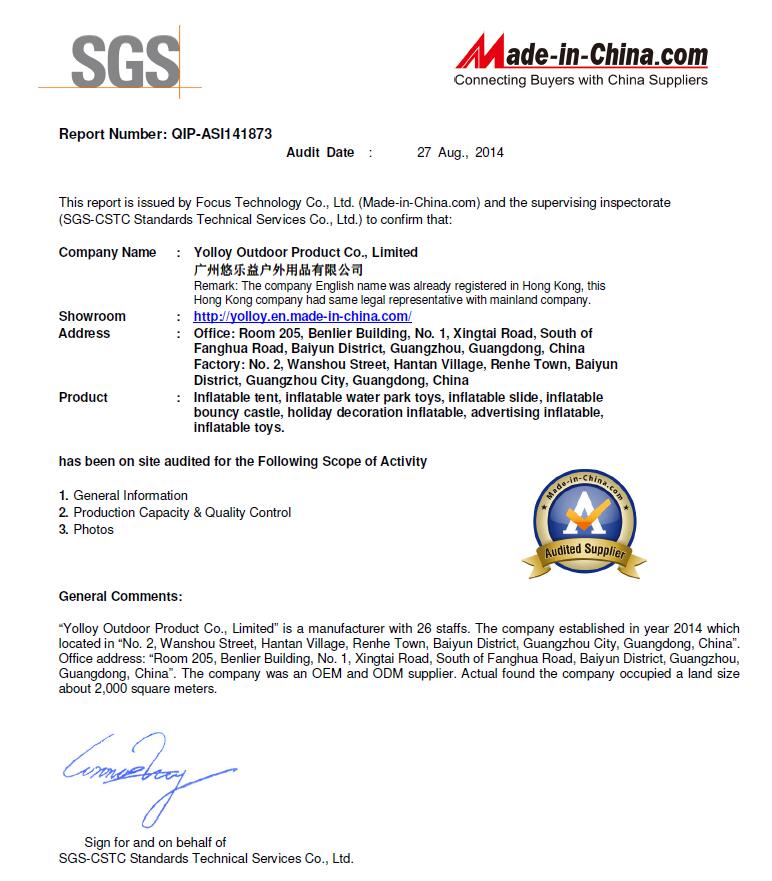
Sourcing directly from a China inflatable manufacturer offers significant cost advantages, but the real value lies in working with a partner that understands the commercial entertainment market. YOLLOY Outdoor Product Co., Limited, based in Guangzhou, operates on a custom design-to-production model: the team prepares simulation renderings from customer proposals, revises the design until approval, and then releases the project for factory production. The stated minimum order quantity is one piece, which makes it practical for operators to prototype a single module before committing to a full park layout.
Material quality is backed by EN71, EN14960, and RoHS testing certifications, while blowers meet CE or UL requirements. Each product is inspected and tested before shipment, and a repair kit is included with every inflatable. The company packages products using soft carpet protection, waterproof PVC bags, and outer PE film — with steel pallets for larger items — ensuring that equipment arrives in ready-to-use condition.
On the service side, YOLLOY reports a 95% on-time delivery rate and a commitment to responding to emails and faxes within 24 hours. Typical production time for a regular inflatable product is 6 to 15 days. Air shipping takes approximately 5 to 7 days, while sea shipping ranges from 15 to 30 days or more depending on the destination. The company exports to Europe, Asia, South America, Africa, the Middle East, and Latin America — so logistics infrastructure is already in place for most major markets.
Planning Your Floating Water Park: Practical Steps
A successful floating water park project starts with a clear brief. Before contacting suppliers, define the following:
- Site dimensions and water conditions: The size of the available water surface, typical water depth, and prevailing wind patterns will determine the feasible layout and anchoring requirements.
- Target audience: A course designed for families with young children will look different from one aimed at teen groups or corporate team-building events.
- Budget range: Knowing your budget helps the manufacturer propose a configuration that balances impact with affordability.
- Branding requirements: If you want custom colors, logos, or themed designs, have those assets ready to share during the design phase.
- Timeline: Factor in production time (6-15 days), shipping, and setup when planning your launch date.
Once you share your requirements, a design-to-production manufacturer will prepare simulation renderings. This step is worth spending time on — it is the moment to adjust sizes, swap modules, and fine-tune the layout before production begins. The revision cycle continues until you sign off on the final design, giving you full control over the end product.
Ready to transform your waterfront into a revenue-generating attraction? Whether you are planning a full floating water park, adding complementary inflatable products to an existing venue, or exploring a custom concept, YOLLOY's design team can prepare simulation renderings from your proposal — at no upfront commitment. Reach out to Sunny Yang at [email protected] or call +86-20-8370 0771 to start the conversation. With a one-piece minimum order quantity, you can test the waters before scaling up.
|