Products Category
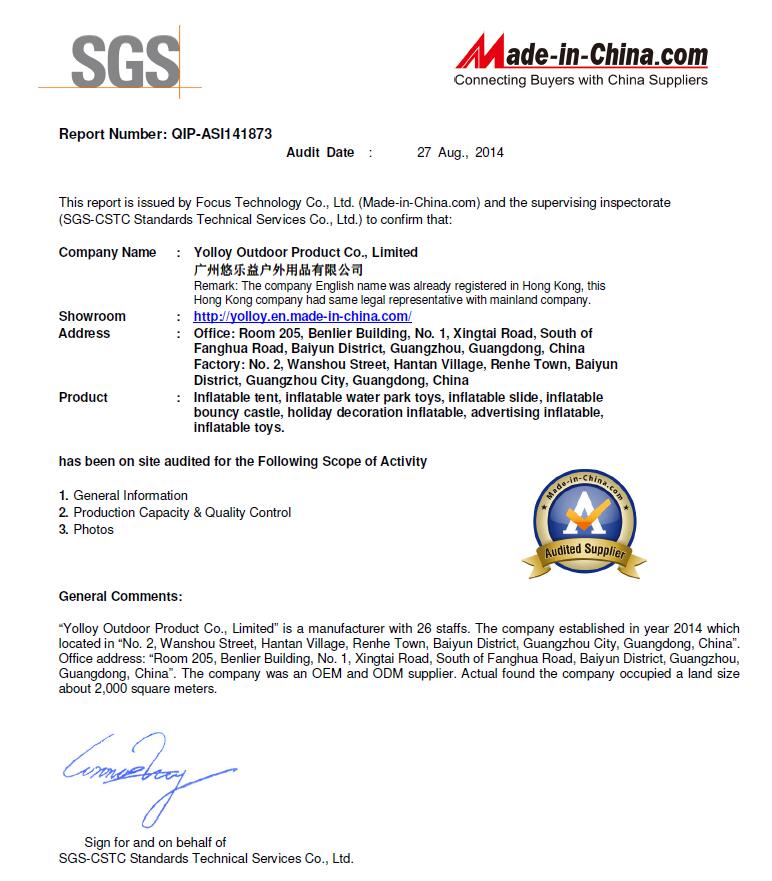
Certification

News

• New Order Successfully Finished for Long-Time Cooperated Japanese Client | YOLLOY Wins Full Client Recognition

• YOLLOY Custom Inflatable Pool Tent for Danish Client: Professional Pool Repair Shelter & Debris Protection

• Trusted Once Again! Greek Captain Re-orders Our Products After 4 Years

• Revolutionize Your Outdoors: The All-Terrain Inflatable Floating Tent for Land & Water

• Elevate Your Summer Fun: The Ultimate Inflatable Water Floating Volleyball Court Trampoline

• Innovative Inflatable Nightclub Tents & Pop-Up Bars: The Ultimate Solution for Portable Party Venues

Contact Us

Name: Sunny Yang
Tel: +86-20-8370 0771
Fax: +86-20-8370 0771
Mobile: 13570587575
E-mail: sales@yolloy.com
Add: No 5,Xiong wei Bo Nan Road,ZhongLuoTan Town,Baiyun district,Guangzhou,China
Friend me on Facebook Follow me on Twitter Add me to your circles Follow me on Pinterest Watch my channel on YouTube
News

Clear Inflatable Bubble Tents: A Complete Buying Guide for Commercial and Event Use

Author:yolloy Date:2026/8/5 6:53:58
A transparent dome under the stars, a private dining pod on a hotel lawn, a branded activation space at a festival — the clear inflatable bubble tent has moved from novelty to necessity across the hospitality, events, and leisure industries. Lightweight, quick to deploy, and visually striking, these structures offer an experience that traditional frame tents simply cannot match.
But not all bubble tents are built the same. The difference between a tent that lasts three seasons and one that fails on its first windy night comes down to who manufactured it, what materials they used, and how they reinforced the seams. This guide walks through what to look for — and where to find inflatable tent manufacturers that deliver on quality, customization, and reliable after-sales support.
What Makes a Quality Inflatable Dome Tent
An inflatable dome tent relies on air pressure to hold its shape. That means the integrity of every seam, valve, and fabric panel directly determines how long the tent will last and how safely it will perform. When evaluating a supplier, pay attention to four core areas.
Material Selection
The best commercial-grade bubble tents use PVC tarpaulin for the main body, with options for Oxford fabric, nylon, or TPU depending on the application. PVC tarpaulin offers excellent weather resistance and durability for outdoor use, while TPU provides a clearer, more flexible transparency preferred for premium glamping and hospitality settings. A reputable manufacturer will guide you toward the right material based on your climate, usage frequency, and budget — not push a one-size-fits-all solution.
Seam Construction and Reinforcement
Look for precision sewing equipment with reinforced seams and waterproof nylon thread. High-load areas — around anchor points, door openings, and blower connections — should have additional reinforcement layers. For airtight sections, high-temperature fusion welding equipment produces stronger, more consistent seals than stitching alone. These are not details you want to compromise on; a seam failure at a commercial event is not a warranty claim — it is a lost booking.
Certifications and Compliance
For products sold into European and North American markets, material certifications matter. Ask whether the manufacturer's materials have passed EN71, EN14960, and RoHS testing. For inflatable water park products, EN 15649 is the relevant standard. Blowers should carry CE or UL certification. A supplier that can provide documentation for these standards is one that takes quality control seriously — and one that will not put your business at regulatory risk.
Anchoring and Wind Resistance
A clear dome tent looks elegant, but it still needs to stay put. Quality manufacturers incorporate D-ring or round metal anchor systems into the design and can advise on the correct anchoring method for your site conditions — whether that means ground stakes, sandbags, or water barrels. Wind resistance is a function of both the tent's structural design and the anchoring system; the two must be engineered together.
Where Bubble Tents Shine: Real-World Applications
The versatility of clear inflatable structures is what drives their growing adoption. Here are the scenarios where they deliver the strongest return on investment.
Glamping and Outdoor Hospitality. Hotels, resorts, and eco-lodges use bubble tents to create premium outdoor accommodation that guests photograph and share. A transparent dome on a wooden deck, furnished with a bed and soft lighting, commands nightly rates that rival traditional hotel rooms — with a fraction of the construction cost.
Private Dining and Events. Restaurants and event venues deploy bubble domes as private dining pods on terraces, rooftops, and garden spaces. They extend seating capacity into colder months and create an intimate atmosphere that guests book well in advance.
Brand Activations and Festivals. A branded bubble tent at a music festival, trade show, or product launch draws attention in a way that standard pop-up tents never will. Custom printing of logos and artwork on the tent body turns the structure itself into a billboard.
Planetarium and Educational Domes. Portable planetarium domes paired with projection systems bring immersive educational experiences to schools, science centers, and community events. The inflatable structure sets up in under an hour and packs into a transportable case.
Seasonal Attractions and Winter Villages. Snow globe tents — clear domes with artificial snow effects — have become a winter attraction staple at shopping centers, Christmas markets, and holiday resorts. They create Instagram-worthy moments that drive foot traffic and ticket sales.
Customization: Getting Exactly What Your Business Needs
Off-the-shelf products rarely fit a specific business vision. The best manufacturers offer custom design from a description, drawing, sketch, photograph, or even a site plan. That means you can specify custom sizes, colors, door and window placements, ventilation configurations, and printed branding. Some manufacturers will prepare simulation renderings from your proposal before cutting a single panel — so you see exactly what you are getting and can revise the design until it is right.
Customization extends to the blower system as well. Depending on your market, you may need 110V, 220V, or 380V power compatibility. Confirm that the supplier can match the blower to your local electrical standards so you are not stuck with incompatible equipment on delivery day.
Production, Packaging, and Shipping: What to Expect
A typical production timeline for a regular inflatable product runs 6 to 15 days, excluding transit. Complex or large custom orders take longer — and a good manufacturer will tell you that upfront rather than overpromise. Products should be packed with soft carpet protection, waterproof PVC bags, and outer PE film, with large items shipped on steel pallets to prevent damage in transit.
For shipping, air freight typically delivers within 5 to 7 days, while sea freight takes 15 to 30 days or more depending on the destination port. A manufacturer with a stated 95% on-time delivery rate and a track record of exporting to Europe, Asia, South America, Africa, the Middle East, and Latin America is one that has solved the logistics piece.
Every inflatable product should ship with a repair kit. Ask about this before ordering — a repair kit included as standard signals that the manufacturer stands behind their product's service life and expects you to use it for years, not months.
Service Life and Warranty
When used and maintained correctly, a well-made commercial inflatable tent can serve reliably for three years or more. The key phrase is "maintained correctly" — proper cleaning, drying before storage, and avoiding over-inflation extend the lifespan significantly. Manufacturers that offer a clear warranty expectation (typically around three years for commercial-grade products, subject to product type and terms) and respond to inquiries within 24 hours are the ones worth building a long-term supplier relationship with.
Key Questions to Ask Before Ordering
What is the minimum order quantity? Some manufacturers require large minimums; others accept single-piece orders. For businesses testing a new concept, a low MOQ is essential.
Can you provide material certification documents? If the answer is vague, move on. Legitimate manufacturers have testing reports for EN71, EN14960, RoHS, and related standards.
How do you handle custom designs? The process should include renderings, revision rounds, and final approval before production begins.
What blower options do you offer? Confirm voltage compatibility (110V, 220V, or 380V) and whether the blower carries CE or UL certification.
What is included in the package? The tent body, blower, repair kit, anchors, and carry bags should all be itemized in the quotation.
What are the shipping options and timelines? Air freight for urgency, sea freight for budget — and a clear estimate of transit time for each.
The Bottom Line
A clear inflatable bubble tent is an investment in your business's visual identity, guest experience, and revenue potential. The difference between a tent that becomes a signature attraction and one that becomes a storage headache is the manufacturer behind it. Look for proven materials, documented certifications, flexible customization, and transparent communication throughout the ordering process. When those pieces are in place, the tent does more than shelter — it sells.

Looking for a Reliable Inflatable Tent Manufacturer?
YOLLOY Outdoor Product Co., Limited designs and manufactures custom inflatable tents, clear dome tents, bubble tents, portable planetarium domes, water park products, interactive sports games, commercial slides, bounce houses, paintball bunkers, and advertising inflatables from its factory in Guangzhou, China. With over a decade of export experience, certified materials (EN71, EN14960, RoHS, EN 15649), CE/UL-compliant blowers, and a stated 95% on-time delivery rate, YOLLOY serves buyers across Europe, Asia, South America, Africa, the Middle East, and Latin America.
Custom sizes, colors, and printed branding are available. Minimum order quantity starts at one piece. Designers prepare simulation renderings from your proposal, revise until approval, and release to production — so you see exactly what you are getting before manufacturing begins. Contact us today to discuss your project.


Clear Inflatable Bubble Tents: A Complete Buying Guide for Commercial and Event Use

Author:yolloy Date:2026/8/5 6:53:58

A transparent dome under the stars, a private dining pod on a hotel lawn, a branded activation space at a festival — the clear inflatable bubble tent has moved from novelty to necessity across the hospitality, events, and leisure industries. Lightweight, quick to deploy, and visually striking, these structures offer an experience that traditional frame tents simply cannot match.
But not all bubble tents are built the same. The difference between a tent that lasts three seasons and one that fails on its first windy night comes down to who manufactured it, what materials they used, and how they reinforced the seams. This guide walks through what to look for — and where to find inflatable tent manufacturers that deliver on quality, customization, and reliable after-sales support.
What Makes a Quality Inflatable Dome Tent
An inflatable dome tent relies on air pressure to hold its shape. That means the integrity of every seam, valve, and fabric panel directly determines how long the tent will last and how safely it will perform. When evaluating a supplier, pay attention to four core areas.
Material Selection
The best commercial-grade bubble tents use PVC tarpaulin for the main body, with options for Oxford fabric, nylon, or TPU depending on the application. PVC tarpaulin offers excellent weather resistance and durability for outdoor use, while TPU provides a clearer, more flexible transparency preferred for premium glamping and hospitality settings. A reputable manufacturer will guide you toward the right material based on your climate, usage frequency, and budget — not push a one-size-fits-all solution.
Seam Construction and Reinforcement
Look for precision sewing equipment with reinforced seams and waterproof nylon thread. High-load areas — around anchor points, door openings, and blower connections — should have additional reinforcement layers. For airtight sections, high-temperature fusion welding equipment produces stronger, more consistent seals than stitching alone. These are not details you want to compromise on; a seam failure at a commercial event is not a warranty claim — it is a lost booking.
Certifications and Compliance
For products sold into European and North American markets, material certifications matter. Ask whether the manufacturer's materials have passed EN71, EN14960, and RoHS testing. For inflatable water park products, EN 15649 is the relevant standard. Blowers should carry CE or UL certification. A supplier that can provide documentation for these standards is one that takes quality control seriously — and one that will not put your business at regulatory risk.
Anchoring and Wind Resistance
A clear dome tent looks elegant, but it still needs to stay put. Quality manufacturers incorporate D-ring or round metal anchor systems into the design and can advise on the correct anchoring method for your site conditions — whether that means ground stakes, sandbags, or water barrels. Wind resistance is a function of both the tent's structural design and the anchoring system; the two must be engineered together.
Where Bubble Tents Shine: Real-World Applications
The versatility of clear inflatable structures is what drives their growing adoption. Here are the scenarios where they deliver the strongest return on investment.
Glamping and Outdoor Hospitality. Hotels, resorts, and eco-lodges use bubble tents to create premium outdoor accommodation that guests photograph and share. A transparent dome on a wooden deck, furnished with a bed and soft lighting, commands nightly rates that rival traditional hotel rooms — with a fraction of the construction cost.
Private Dining and Events. Restaurants and event venues deploy bubble domes as private dining pods on terraces, rooftops, and garden spaces. They extend seating capacity into colder months and create an intimate atmosphere that guests book well in advance.
Brand Activations and Festivals. A branded bubble tent at a music festival, trade show, or product launch draws attention in a way that standard pop-up tents never will. Custom printing of logos and artwork on the tent body turns the structure itself into a billboard.
Planetarium and Educational Domes. Portable planetarium domes paired with projection systems bring immersive educational experiences to schools, science centers, and community events. The inflatable structure sets up in under an hour and packs into a transportable case.
Seasonal Attractions and Winter Villages. Snow globe tents — clear domes with artificial snow effects — have become a winter attraction staple at shopping centers, Christmas markets, and holiday resorts. They create Instagram-worthy moments that drive foot traffic and ticket sales.
Customization: Getting Exactly What Your Business Needs
Off-the-shelf products rarely fit a specific business vision. The best manufacturers offer custom design from a description, drawing, sketch, photograph, or even a site plan. That means you can specify custom sizes, colors, door and window placements, ventilation configurations, and printed branding. Some manufacturers will prepare simulation renderings from your proposal before cutting a single panel — so you see exactly what you are getting and can revise the design until it is right.
Customization extends to the blower system as well. Depending on your market, you may need 110V, 220V, or 380V power compatibility. Confirm that the supplier can match the blower to your local electrical standards so you are not stuck with incompatible equipment on delivery day.
Production, Packaging, and Shipping: What to Expect
A typical production timeline for a regular inflatable product runs 6 to 15 days, excluding transit. Complex or large custom orders take longer — and a good manufacturer will tell you that upfront rather than overpromise. Products should be packed with soft carpet protection, waterproof PVC bags, and outer PE film, with large items shipped on steel pallets to prevent damage in transit.
For shipping, air freight typically delivers within 5 to 7 days, while sea freight takes 15 to 30 days or more depending on the destination port. A manufacturer with a stated 95% on-time delivery rate and a track record of exporting to Europe, Asia, South America, Africa, the Middle East, and Latin America is one that has solved the logistics piece.
Every inflatable product should ship with a repair kit. Ask about this before ordering — a repair kit included as standard signals that the manufacturer stands behind their product's service life and expects you to use it for years, not months.
Service Life and Warranty
When used and maintained correctly, a well-made commercial inflatable tent can serve reliably for three years or more. The key phrase is "maintained correctly" — proper cleaning, drying before storage, and avoiding over-inflation extend the lifespan significantly. Manufacturers that offer a clear warranty expectation (typically around three years for commercial-grade products, subject to product type and terms) and respond to inquiries within 24 hours are the ones worth building a long-term supplier relationship with.
Key Questions to Ask Before Ordering
What is the minimum order quantity? Some manufacturers require large minimums; others accept single-piece orders. For businesses testing a new concept, a low MOQ is essential.
Can you provide material certification documents? If the answer is vague, move on. Legitimate manufacturers have testing reports for EN71, EN14960, RoHS, and related standards.
How do you handle custom designs? The process should include renderings, revision rounds, and final approval before production begins.
What blower options do you offer? Confirm voltage compatibility (110V, 220V, or 380V) and whether the blower carries CE or UL certification.
What is included in the package? The tent body, blower, repair kit, anchors, and carry bags should all be itemized in the quotation.
What are the shipping options and timelines? Air freight for urgency, sea freight for budget — and a clear estimate of transit time for each.
The Bottom Line
A clear inflatable bubble tent is an investment in your business's visual identity, guest experience, and revenue potential. The difference between a tent that becomes a signature attraction and one that becomes a storage headache is the manufacturer behind it. Look for proven materials, documented certifications, flexible customization, and transparent communication throughout the ordering process. When those pieces are in place, the tent does more than shelter — it sells.

Looking for a Reliable Inflatable Tent Manufacturer?
YOLLOY Outdoor Product Co., Limited designs and manufactures custom inflatable tents, clear dome tents, bubble tents, portable planetarium domes, water park products, interactive sports games, commercial slides, bounce houses, paintball bunkers, and advertising inflatables from its factory in Guangzhou, China. With over a decade of export experience, certified materials (EN71, EN14960, RoHS, EN 15649), CE/UL-compliant blowers, and a stated 95% on-time delivery rate, YOLLOY serves buyers across Europe, Asia, South America, Africa, the Middle East, and Latin America.
Custom sizes, colors, and printed branding are available. Minimum order quantity starts at one piece. Designers prepare simulation renderings from your proposal, revise until approval, and release to production — so you see exactly what you are getting before manufacturing begins. Contact us today to discuss your project.