When most people think of inflatable tents, they picture a family camping trip — a weekend in the woods, a simple shelter against the elements. But the reality is far more expansive. Over the past decade, inflatable tent technology has evolved from a niche camping alternative into a full-scale commercial solution used by event planners, hotel operators, sports facility managers, and emergency response teams across the globe. Leading inflatable tent manufacturers now produce structures that rival traditional brick-and-mortar venues in durability, versatility, and visual appeal.
What changed? Advances in materials, precision engineering, and custom design capabilities have made commercial inflatable tents a practical and profitable choice for businesses that need temporary or semi-permanent covered spaces. From transparent bubble domes overlooking a mountain resort to massive inflatable event halls that can host hundreds of guests, the commercial inflatable tent market is reshaping how we think about outdoor and semi-outdoor spaces.
Why Businesses Are Switching to Inflatable Structures
Traditional event tents and marquees require heavy steel frames, large teams for setup, and significant storage space. An inflatable event tent, by contrast, can be deployed by a small crew in a fraction of the time. An electric blower does the heavy lifting — inflating the structure in minutes rather than hours. When the event is over, the tent deflates, rolls up, and fits into a compact transport bag or onto a pallet.
This speed and simplicity translates directly into cost savings. Event rental companies can handle more bookings per season with less labor. Hotels and resorts can add seasonal dining or lounge areas without permanent construction. Sports clubs can set up temporary training facilities and take them down when the season ends. The flexibility is unmatched by any rigid-frame alternative.
Key advantage: Commercial-grade inflatable tents use reinforced PVC tarpaulin or Oxford fabric with high-temperature fusion-welded seams, making them resistant to wind, rain, and UV exposure — not the lightweight materials associated with consumer camping gear.
The Rise of the Inflatable Dome Tent in Commercial Applications
Perhaps no design has captured the commercial imagination quite like the inflatable dome tent. Its geodesic shape is not just architecturally striking — it is inherently stable against wind loads and sheds rain and snow naturally. This makes it ideal for year-round outdoor use in varying climates.
The applications are remarkably diverse. Restaurants use dome tents for private outdoor dining pods. Wedding venues set them up as ceremony spaces with panoramic views. Glamping resorts offer dome accommodations that blend luxury with nature. Planetariums and educational organizations use projection-ready domes for immersive astronomy shows. Fitness centers deploy them as temporary yoga studios or spin class spaces. Even automotive detailers use sealed inflatable domes as mobile spray booths — a far cry from the camping tent most people imagine.
For businesses that want to stand out, the clear PVC dome tent — often called a bubble tent — takes the concept further. Transparent walls offer uninterrupted 360-degree views of the surrounding environment, whether that is a snowy landscape, a beachfront, or a city skyline. These structures have become social media magnets, generating organic marketing for the venues that use them.
Custom Design: The Real Competitive Edge
Off-the-shelf tent solutions rarely meet the specific needs of a commercial operation. This is where custom inflatable tent manufacturing becomes a game-changer. A professional inflatable manufacturer can produce a tent to virtually any specification — custom dimensions, branded colors, printed logos, specific door and window placements, integrated lighting channels, and even climate-control-compatible venting.
The design process typically starts with a client proposal — a sketch, a photograph, a site plan, or even just a description of the intended use. The manufacturer's design team creates simulation renderings, refines them based on client feedback, and only moves to production once the design is approved. This ensures that what arrives at the client's location is exactly what was envisioned, not a close approximation.
For businesses building a brand, this level of customization is invaluable. A hotel chain can deploy identical branded dome suites across multiple properties. An event company can create a signature look that clients recognize instantly. A sports brand can build a mobile activation space that embodies its visual identity. The tent becomes not just a shelter, but a marketing asset.
Material Quality and Safety: What to Look For
Not all inflatable tents are created equal. Commercial buyers should look for manufacturers that use commercial-grade PVC tarpaulin with reinforced seams, double-stitched with waterproof nylon thread. High-stress areas — anchor points, door frames, blower connection ports — should have additional reinforcement layers.
Safety certifications are a critical benchmark. Reputable manufacturers have their materials tested to meet standards such as EN71 (safety of toys), EN14960 (inflatable play equipment), and RoHS (restriction of hazardous substances). For water park and aquatic inflatables, EN 15649 is the relevant standard. Blowers should carry CE or UL certification, and the manufacturer should be able to supply appropriately rated blowers for 110V, 220V, or 380V electrical systems depending on the destination country.
A quality manufacturer will also include a repair kit with every product, conduct pre-shipment inspection and testing, and provide proper anchoring hardware — typically D-ring or round metal anchor systems — to ensure safe installation in windy conditions.
The Business Case: ROI of Commercial Inflatable Tents
For event rental businesses, the math is straightforward. A commercial inflatable tent that can be set up by two people in 15 minutes can serve far more events per month than a traditional frame tent requiring a four-person crew and two hours of setup. The reduced labor cost alone often justifies the investment within the first season.
For hospitality businesses, inflatable domes and bubble tents create premium inventory from previously unused outdoor space. A restaurant that adds several heated dome dining pods can significantly expand its seating capacity without a construction permit. A resort that offers bubble tent accommodations can charge premium rates for a unique guest experience, often achieving payback within months.
The minimum order quantity from many manufacturers is just one piece, making it feasible for small businesses to test a concept before scaling. Production times typically range from 6 to 15 days for standard products, and shipping options include both air freight (5-7 days) and sea freight (15-30+ days), allowing buyers to balance speed against cost.
Installation, Maintenance, and Longevity
Setting up a commercial inflatable tent is straightforward but requires attention to a few key details. The site should be cleared of sharp objects and debris. The tent should be anchored securely using the provided D-ring or stake system, with additional weighting or tie-downs in windy conditions. The blower should be connected to a reliable power source, and the tent should be inspected periodically during use to ensure consistent inflation.
Maintenance is minimal compared to rigid structures. The PVC or Oxford fabric exterior can be cleaned with mild soap and water. Zippers and mesh panels should be kept free of debris. The blower should be stored in a dry environment when not in use. If a puncture does occur, repairs are straightforward — similar to patching a bicycle inner tube — and every unit ships with a repair kit.
With proper care and correct usage, commercial inflatable tents can provide a service life of approximately three years or more, depending on frequency of use and environmental conditions. The packaging itself is designed for longevity — products are wrapped in soft carpet protection, sealed in waterproof PVC bags, and covered with outer PE film, with large items shipped on steel pallets for maximum protection during transit.
Choosing the Right Manufacturer
When sourcing commercial inflatable tents, the manufacturer's capabilities matter as much as the product itself. Key considerations include:
Design capability: Can the manufacturer work from a sketch, photograph, or site plan to create a custom design? Do they provide simulation renderings before production?
Material options: Does the manufacturer offer multiple material choices — PVC tarpaulin, Oxford fabric, nylon, TPU — suited to different applications?
Certifications: Are the materials and blowers certified to relevant international standards (EN, CE, UL, RoHS)?
Production speed: What are the typical lead times, and can the manufacturer meet seasonal deadlines?
Shipping and logistics: Does the manufacturer have experience exporting to your region, and can they arrange air or sea freight?
After-sales support: Is a repair kit included? What is the warranty? How responsive is the communication?
A manufacturer that checks all these boxes — offering custom design, certified materials, efficient production, and reliable logistics — can become a long-term partner rather than a one-time supplier.
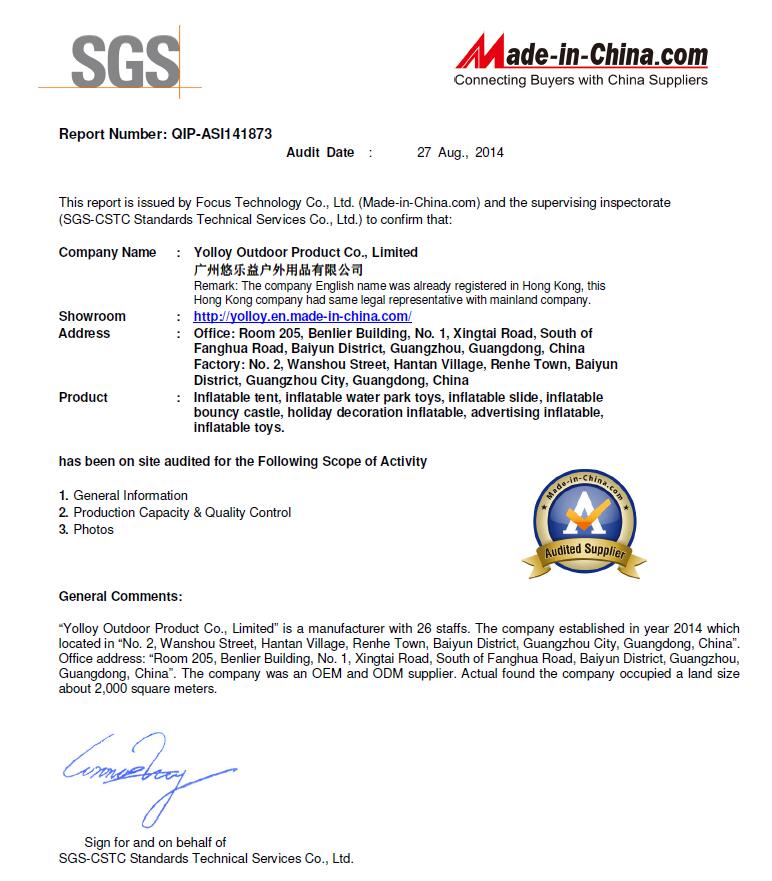
Ready to explore commercial inflatable tent solutions for your business? Whether you are planning an outdoor event space, expanding your hospitality offerings, or launching a mobile sports facility, the right inflatable tent can transform your concept into reality. With custom design capabilities, internationally certified materials, and a track record of on-time delivery to markets across Europe, Asia, the Americas, Africa, and the Middle East, YOLLOY provides end-to-end inflatable solutions — from initial design rendering to final delivery. Every product includes a repair kit, appropriate blower, and comprehensive packaging for safe transit. Contact the YOLLOY team at [email protected] or call +86-20-8370 0771 to discuss your project requirements.