How floating playgrounds, custom inflatable attractions, and modular water parks are reshaping the hospitality and entertainment industry — and what to look for in a manufacturing partner.
Picture a lakeside resort that transforms a quiet shoreline into the region's most popular family destination. Imagine a waterfront club that adds a new revenue stream that pays for itself within a single season. The common thread behind these scenarios? A well-designed inflatable water park — sourced from a manufacturer that understands the difference between a consumer toy and a commercial-grade attraction.
The global inflatable amusement market is no longer just about bounce houses at children's parties. Resorts, campgrounds, municipal parks, cruise lines, and event organizers are increasingly turning to commercial inflatable products as low-overhead, high-return attractions. But not all inflatables are built to the same standard — and the difference between a product that lasts three seasons and one that fails by mid-July comes down to materials, manufacturing precision, and the expertise of your supplier.
The Commercial Inflatable Water Park: More Than a Pool Toy
A inflatable floating water park is a modular system of interconnected inflatable platforms, slides, climbing walls, trampolines, and obstacles designed to float on lakes, reservoirs, ocean bays, or large swimming pools. Unlike the small inflatable pools sold at retail stores, these are engineered structures — some spanning over 30 meters in length — that must withstand constant UV exposure, wave action, user impact, and daily commercial use.
The key distinction is in the construction. Commercial-grade inflatable water parks use high-density PVC tarpaulin with reinforced seams, precision high-temperature fusion welding, and multi-point anchor systems. Each module is independently sealed so that a puncture in one section does not compromise the entire structure. When you buy from a specialized China inflatable manufacturer with a dedicated quality-control process, you receive products that have been individually inspected and tested before shipment — not mass-produced units that pass through a warehouse unseen.
What to look for in a commercial inflatable water park: Commercial-grade PVC tarpaulin construction, high-temperature fusion-welded seams, independent air chambers, D-ring or round metal anchor systems, and blowers certified to CE or UL standards. A repair kit should be supplied with every order.
Why Businesses Are Choosing Inflatables Over Permanent Structures
The appeal of inflatable attractions for commercial operators comes down to four practical advantages that permanent structures simply cannot match.
Lower upfront investment. A permanent water park requires land acquisition, civil engineering, concrete foundations, plumbing, and ongoing structural maintenance. An inflatable floating water park, by contrast, can be deployed on any suitable body of water with minimal site preparation. The capital outlay is a fraction of a fixed installation, and the return on investment can be measured in months rather than years.
Seasonal flexibility. Inflatable water parks can be installed at the start of the summer season and deflated, packed, and stored during the off-season. This not only protects the equipment from winter damage but also frees up the waterfront space for alternative uses. Some operators rotate different inflatable configurations year to year to keep the attraction fresh for returning guests.
Rapid deployment. A commercial inflatable water park can be delivered, inflated, and anchored within days — not the months required for construction. For resort operators and event planners working on tight timelines, this speed is a decisive advantage.
Customizable and brandable. This is where working with an experienced manufacturer makes a tangible difference. Custom colors, branded printing, logo placement, and bespoke layouts allow each installation to reflect the operator's identity. A floating water park at a luxury resort should look different from one at a summer camp — and a manufacturer that offers custom design services can tailor the experience accordingly.
Beyond Water Parks: The Full Commercial Inflatable Ecosystem
While water parks are a flagship category, the commercial inflatable landscape extends far beyond floating obstacles. For businesses looking to diversify their attraction portfolio, several complementary product lines are worth considering.
| Product Category |
Best For |
Key Business Benefit |
| Inflatable Obstacle Courses |
Team-building events, school groups, festivals |
High throughput, repeat bookings |
| Commercial Inflatable Slides |
Waterfront parks, poolside attractions |
Strong visual draw, social media appeal |
| Inflatable Bounce Houses |
Family entertainment centers, rental businesses |
Low maintenance, consistent demand |
| Inflatable Tents & Domes |
Glamping sites, event venues, hospitality |
Year-round utility, premium pricing |
| Interactive Sports Games |
Amusement parks, carnivals, team-building |
High engagement, competitive appeal |
| Inflatable Paintball Bunkers |
Paintball arenas, tactical training facilities |
Portable, reconfigurable layouts |
The advantage of sourcing all these categories from a single manufacturer is consistency — in material quality, safety standards, and after-sales support. When you expand your offering from a water park to include event tents, sports games, and advertising inflatables, having one accountable supplier simplifies logistics and reduces risk.
What Separates a Reliable Inflatable Manufacturer from the Rest
The inflatable manufacturing industry in China is large and varied. Some factories produce primarily for the consumer market — thin materials, basic stitching, price-point competition. Others serve the commercial sector with industrial-grade materials, rigorous testing, and export-quality standards. Here are the factors that distinguish the latter.
Material certifications. A manufacturer serving the European and North American markets should be able to demonstrate that their materials have passed relevant testing. For inflatable toys, this means EN 14960 compliance. For water park products, EN 15649 is the applicable standard. PVC tarpaulin should meet EN71 and RoHS requirements. These are not optional extras — they are the baseline for products used by paying customers.
Production capabilities. A manufacturer that handles both sewn and welded construction under one roof can produce a wider range of products with tighter quality control. Sewn products — such as tents and bounce houses — require precision sewing equipment, reinforced seams, waterproof nylon thread, and additional reinforcement at high-load areas. Welded products — such as airtight water park modules — require high-temperature fusion equipment and pressure testing before shipment.
Custom design workflow. The best manufacturers do not simply take orders from a catalog. They offer a design-to-production service: a designer prepares simulation renderings based on the customer's proposal, revisions continue until the design is approved, and only then does production begin. This process ensures that what arrives at your location matches what you envisioned — and what you paid for.
Minimum order quantity and production time. A manufacturer that accepts a minimum order of one piece — with a typical production time of 6 to 15 days for a regular inflatable product — signals that they are set up for custom work, not just mass production. Complex or large custom products will naturally take longer, but the willingness to start with a single unit is a meaningful indicator of flexibility.
Blower compatibility. Every inflatable product needs a blower, and the blower must match the local electrical standard. A manufacturer that can supply blowers configured for 110V, 220V, or 380V requirements eliminates the headache of sourcing compatible pumps separately. Blowers should carry CE or UL certification appropriate to the destination market.
Questions to ask before placing an order: What materials are used and what certifications do they hold? Can you provide a design rendering before production? What is the typical production time for my product type? Do blowers meet CE or UL requirements for my region? Is a repair kit included with the order? What are the shipping options and indicative transit times?
Packaging, Shipping, and After-Sales: The Details That Matter
A product that arrives damaged is a liability, regardless of how well it was manufactured. Professional packaging matters: soft carpet protection to prevent abrasion, waterproof PVC bags to guard against moisture, and outer PE film for additional security. Large products should be shipped on steel pallets to prevent crushing during transit.
Shipping options should include both air freight (indicative transit of 5 to 7 days) and sea freight (15 to 30 days or more). A manufacturer that reports a 95% on-time delivery rate and commits to answering emails within 24 hours is demonstrating the operational discipline that commercial buyers depend on.
After-sales support is equally important. Every inflatable product should come with a repair kit. The warranty expectation — typically around three years for products used and maintained correctly — should be clearly stated. And when something goes wrong, the manufacturer should be reachable and responsive, not hiding behind an auto-reply.
Making the Investment: A Practical Roadmap
If you are considering adding an inflatable water park or complementary inflatable attraction to your business, here is a practical sequence to follow:
- Assess your site. Identify the body of water, available space, depth, shoreline access, and any local regulatory requirements. Photographs and measurements are essential for the design phase.
- Define your budget and target audience. A luxury resort catering to adults will have different requirements than a family campground. Be clear about who you are serving and what experience you want to deliver.
- Request a custom design. Share your site plan, budget, and audience profile with the manufacturer. Ask for simulation renderings before committing to production.
- Review material specifications and certifications. Confirm that the materials meet the relevant standards for your market (EN 14960, EN 15649, EN71, RoHS, CE/UL for blowers).
- Confirm production timeline and shipping method. Align the delivery date with your operational calendar. Build in buffer time for customs clearance and installation.
- Plan your launch. A new attraction deserves a marketing push. Coordinate social media announcements, local press outreach, and any soft-opening events to maximize early-season bookings.
Ready to Bring an Inflatable Water Park to Your Business?
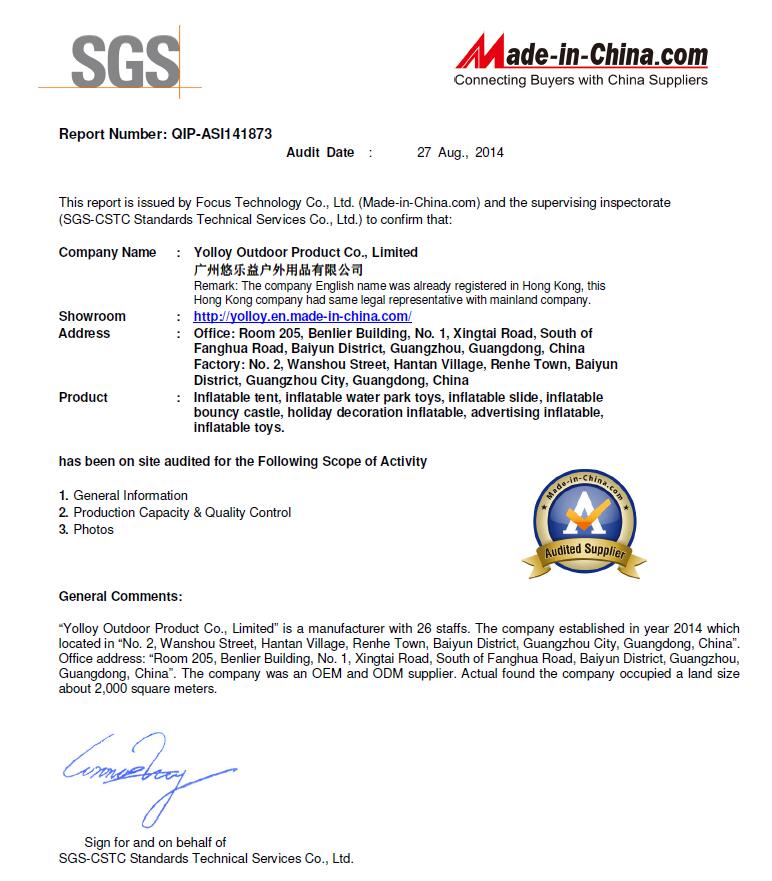
YOLLOY Outdoor Product Co., Limited designs and manufactures custom inflatable water parks, floating platforms, commercial slides, inflatable tents, interactive sports games, and more — all built to international safety standards with materials certified to EN71, EN14960, EN15649, and RoHS. Every product is inspected before shipment, shipped with a repair kit, and backed by responsive after-sales support.
Contact YOLLOY for a Custom Quote