Products Category
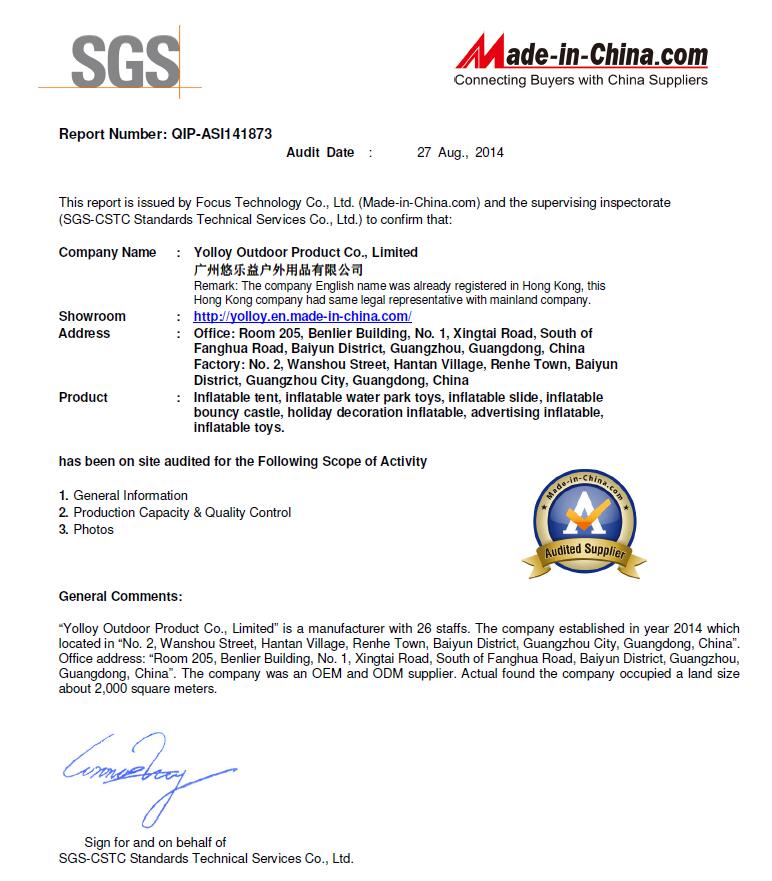
Certification

News

• New Order Successfully Finished for Long-Time Cooperated Japanese Client | YOLLOY Wins Full Client Recognition

• YOLLOY Custom Inflatable Pool Tent for Danish Client: Professional Pool Repair Shelter & Debris Protection

• Trusted Once Again! Greek Captain Re-orders Our Products After 4 Years

• Revolutionize Your Outdoors: The All-Terrain Inflatable Floating Tent for Land & Water

• Elevate Your Summer Fun: The Ultimate Inflatable Water Floating Volleyball Court Trampoline

• Innovative Inflatable Nightclub Tents & Pop-Up Bars: The Ultimate Solution for Portable Party Venues

Contact Us

Name: Sunny Yang
Tel: +86-20-8370 0771
Fax: +86-20-8370 0771
Mobile: 13570587575
E-mail: [email protected]
Add: No 5,Xiong wei Bo Nan Road,ZhongLuoTan Town,Baiyun district,Guangzhou,China
Friend me on Facebook Follow me on Twitter Add me to your circles Follow me on Pinterest Watch my channel on YouTube
News

Why Inflatable Golf Simulator Tents Are the Smartest Investment for Indoor Golf Operators

Author:yolloy Date:2026/8/5 10:33:55

Golf simulators have exploded in popularity over the past five years. What was once a niche pastime for dedicated enthusiasts has become a mainstream entertainment category, with indoor golf centers, simulator bars, and home setups appearing in cities worldwide. But behind every great simulator setup is a critical piece of infrastructure that often goes overlooked: the enclosure. And for operators who need flexibility, portability, and rapid deployment, an inflatable golf simulator tent is rapidly becoming the enclosure of choice.

The Rise of Golf Simulators and the Enclosure Challenge

The global golf simulator market has seen remarkable growth, driven by urbanization, limited access to outdoor courses, and the rise of entertainment-driven golf experiences. Indoor golf centers, sports bars with simulator bays, corporate entertainment venues, and even residential installations are all contributing to surging demand. But every simulator requires a controlled environment: protection from wind and ambient light, adequate ceiling height for full swings, and a contained space that keeps golf balls safely within the hitting area.

Traditional solutions — permanent building construction, steel-frame enclosures, or tension-fabric structures — come with significant drawbacks. They require building permits, take weeks or months to construct, and cannot be relocated once installed. For a seasonal business, a pop-up event, or a venue that needs to reconfigure its space, these limitations are deal-breakers.

This is where inflatable tent manufacturers have stepped in with a solution that addresses all of these pain points. An inflatable golf simulator enclosure can be deployed on virtually any flat surface — a parking lot, a field, an exhibition hall floor — and be fully operational in under 30 minutes. When the season ends or the event wraps up, it deflates and packs into a compact transportable package.

What Makes an Inflatable Golf Simulator Tent Different

At first glance, an inflatable golf simulator enclosure might look similar to the inflatable tents used for camping or events. But the engineering requirements are fundamentally different. A golf simulator tent must provide:

Sufficient interior height — A full golf swing with a driver requires a minimum ceiling height of approximately 3 meters (10 feet), and ideally more for taller players. The enclosure must maintain this clearance across the entire hitting area.

Light control — Projector-based launch monitors and impact screens perform best in controlled lighting conditions. The enclosure fabric must block ambient light while providing a suitable interior surface for projection.

Ball containment — The enclosure must safely contain golf balls traveling at high speeds, including errant shots. Reinforced side panels and netting integration are essential safety features.

Weather resistance — For outdoor or semi-outdoor installations, the structure must withstand wind, rain, and UV exposure while maintaining structural integrity.

Ventilation — Players spending extended periods inside need adequate airflow, especially in warmer climates.

Leading manufacturers address these requirements through material selection and design engineering. Commercial-grade PVC tarpaulin with UV-resistant coating provides durability and light control. High-temperature fusion welding creates airtight seams that maintain inflation pressure. Mesh ventilation panels integrated into the design allow airflow without compromising the enclosure's structural performance. And D-ring anchor systems secure the structure against wind loads — a critical feature for any outdoor installation.

Real-World Applications: Where Inflatable Golf Simulators Excel

Pop-Up Golf Experiences and Seasonal Operations

The most compelling use case for an inflatable golf simulator enclosure is the pop-up model. A golf entertainment business can set up in a parking lot during the summer months, at a ski resort during the winter off-season, or at a beachfront location during tourist season. When the season ends, the entire setup packs down and moves to the next location. This model simply does not work with permanent construction, but it is routine with an inflatable enclosure.

Golf Simulator Bars and Entertainment Venues

Sports bars and entertainment complexes are increasingly adding golf simulator bays as a revenue-generating attraction. These venues often operate in leased spaces where permanent modifications are restricted or prohibitively expensive. An inflatable enclosure offers a non-permanent solution that can be installed without structural changes to the building, making it an attractive option for tenants and landlords alike.

Corporate Events and Brand Activations

Golf brands, automotive companies, and luxury goods manufacturers frequently use golf simulators at trade shows, product launches, and promotional events. The visual impact of a branded inflatable dome with a full golf simulator inside creates a memorable experience that draws crowds. The ability to print custom logos and artwork directly onto the enclosure fabric turns the structure itself into a branding asset.

Military and Institutional Recreation

Military bases, university campuses, and residential communities are increasingly investing in recreational facilities. An inflatable golf simulator enclosure can be deployed on a sports field, next to a gymnasium, or in any available outdoor space, providing a turnkey recreation solution that does not require new construction.

The Customization Edge: Designing for Your Specific Needs

One of the strongest advantages of working with a specialized custom inflatable tent manufacturer is the ability to tailor every aspect of the enclosure to your specific requirements. Off-the-shelf solutions rarely fit perfectly, and in the golf simulator world, a poor fit means compromised functionality.

A proper design-to-production workflow starts with the client's specifications: the intended simulator setup (single bay, double bay, or multi-sport), the available site dimensions, the local climate conditions, and the budget. The manufacturer's design team produces simulation renderings that show exactly how the finished enclosure will look and function. The client reviews and revises until the design is approved, and only then does production begin.

Customization options typically include sizing (from compact single-bay units to large multi-bay facilities), color schemes to match brand guidelines, printed logos and artwork, door and window placement, ventilation configurations, and blower voltage specifications (110V, 220V, or 380V) to match local power infrastructure. With a minimum order quantity as low as one piece from some china inflatable tent suppliers, even a single-location operator can order a fully customized enclosure without committing to bulk quantities.

What to Evaluate When Sourcing an Inflatable Golf Simulator Enclosure

Choosing the right supplier is the single most important decision in this process. Here are the criteria that matter most:

Material Quality and Safety Certifications — The enclosure fabric should be commercial-grade PVC tarpaulin with appropriate UV and weather resistance. Look for materials that have passed EN71, EN14960, and RoHS testing. Blowers should carry CE or UL certification. For golf-specific applications, the fabric must be opaque enough to provide adequate light control for projection systems.

Design Engineering and Structural Integrity — Evaluate the seam construction method. High-temperature fusion welding produces stronger, more airtight seams than traditional stitching. Check that the design includes reinforcement at high-load areas such as blower connection points, anchor attachment points, and entranceways. D-ring or round metal anchor systems should be integrated into the base for wind resistance and installation stability.

Production Timeline and Logistics — A typical production time for a custom inflatable product is 6–15 days, excluding transit. Air shipping adds approximately 5–7 days, while sea shipping takes 15–30 days or more. Factor these timelines into your project planning, especially if you are targeting a specific season or event date.

After-Sales Support — A repair kit should be included with every product. The manufacturer should provide clear maintenance instructions. A three-year service life expectation is a reasonable benchmark when products are used and maintained correctly. Responsive communication — with emails and inquiries answered within 24 hours — is a strong indicator of reliable after-sales support.

Global Export Experience — Suppliers with experience exporting to Europe, Asia, South America, Africa, the Middle East, and Latin America understand the varying compliance requirements, voltage standards, and logistics challenges of different markets. This experience translates into smoother transactions and fewer surprises.

The Business Case: Why Inflatable Makes Financial Sense

The financial argument for an inflatable golf simulator enclosure is straightforward when you compare total cost of ownership against permanent construction. A permanent structure requires architectural plans, building permits, foundation work, and weeks or months of construction labor — easily running into tens of thousands of dollars before the first simulator is even installed. An inflatable enclosure, by contrast, requires no permits, no foundation, and can be deployed by a small team in under an hour.

But the bigger financial advantage is flexibility. A permanent structure is a sunk cost tied to a specific location. If the location underperforms, you cannot pick up the building and move it. An inflatable enclosure can be relocated, reconfigured, or even sold if the business model changes. This flexibility is particularly valuable for operators testing a new market or running a seasonal business.

Storage and transport costs are also lower. A deflated enclosure packs down to a fraction of its deployed size, fitting into a standard vehicle or shipping container. There is no need for specialized transport equipment or warehousing.

For event rental businesses that add golf simulator experiences to their offerings, the math is even more compelling. A single enclosure that deploys in 30 minutes can serve multiple events per week during peak season. The labor savings alone — compared to setting up a pole-and-canvas structure — can pay for the enclosure within a single season.

Maintenance and Care: Keeping Your Enclosure in Top Condition

Inflatable enclosures are not maintenance-free, but they are straightforward to maintain with a consistent routine. After each use, inspect the structure for any punctures, seam separations, or anchor-point wear. Clean the fabric with mild soap and water, and ensure the enclosure is completely dry before packing to prevent mildew. The included repair kit handles most minor punctures, and the repair process is similar to patching a bicycle inner tube.

Blower maintenance is equally important. Commercial blowers designed for continuous operation should be checked periodically for dust accumulation, cord wear, and proper airflow. Since blowers are available in multiple voltage configurations, always verify that the blower matches the local power supply before deployment. A spare blower is a worthwhile investment for operators who cannot afford downtime.

Proper storage extends the life of the enclosure significantly. Store the deflated enclosure in a cool, dry environment, away from direct sunlight and sharp objects. Use the provided storage bags or containers, and avoid stacking heavy items on top of the packed enclosure.

Ready to Launch Your Inflatable Golf Simulator Business?

Whether you are planning a pop-up golf experience, adding simulator bays to your entertainment venue, or launching a brand activation campaign, the right enclosure partner makes all the difference. YOLLOY Outdoor Product Co., Limited designs and manufactures custom inflatable golf simulator enclosures, sports domes, and event structures from its production base in Guangzhou, China. With commercial-grade PVC tarpaulin construction, CE/UL-certified blowers, EN71/EN14960/RoHS-compliant materials, and a minimum order quantity of just one piece, YOLLOY serves operators and businesses across Europe, Asia, the Americas, and beyond. Every order includes a repair kit, and the company reports a 95% on-time delivery rate with production completed in 6–15 days for standard products. For inquiries about custom designs, dimensions, pricing, or lead times, contact the team at [email protected] or call +86-20-8370 0771.

Why Inflatable Golf Simulator Tents Are the Smartest Investment for Indoor Golf Operators

Author:yolloy Date:2026/8/5 10:33:55

Golf simulators have exploded in popularity over the past five years. What was once a niche pastime for dedicated enthusiasts has become a mainstream entertainment category, with indoor golf centers, simulator bars, and home setups appearing in cities worldwide. But behind every great simulator setup is a critical piece of infrastructure that often goes overlooked: the enclosure. And for operators who need flexibility, portability, and rapid deployment, an inflatable golf simulator tent is rapidly becoming the enclosure of choice.

The Rise of Golf Simulators and the Enclosure Challenge

The global golf simulator market has seen remarkable growth, driven by urbanization, limited access to outdoor courses, and the rise of entertainment-driven golf experiences. Indoor golf centers, sports bars with simulator bays, corporate entertainment venues, and even residential installations are all contributing to surging demand. But every simulator requires a controlled environment: protection from wind and ambient light, adequate ceiling height for full swings, and a contained space that keeps golf balls safely within the hitting area.

Traditional solutions — permanent building construction, steel-frame enclosures, or tension-fabric structures — come with significant drawbacks. They require building permits, take weeks or months to construct, and cannot be relocated once installed. For a seasonal business, a pop-up event, or a venue that needs to reconfigure its space, these limitations are deal-breakers.

This is where inflatable tent manufacturers have stepped in with a solution that addresses all of these pain points. An inflatable golf simulator enclosure can be deployed on virtually any flat surface — a parking lot, a field, an exhibition hall floor — and be fully operational in under 30 minutes. When the season ends or the event wraps up, it deflates and packs into a compact transportable package.

What Makes an Inflatable Golf Simulator Tent Different

At first glance, an inflatable golf simulator enclosure might look similar to the inflatable tents used for camping or events. But the engineering requirements are fundamentally different. A golf simulator tent must provide:

Sufficient interior height — A full golf swing with a driver requires a minimum ceiling height of approximately 3 meters (10 feet), and ideally more for taller players. The enclosure must maintain this clearance across the entire hitting area.

Light control — Projector-based launch monitors and impact screens perform best in controlled lighting conditions. The enclosure fabric must block ambient light while providing a suitable interior surface for projection.

Ball containment — The enclosure must safely contain golf balls traveling at high speeds, including errant shots. Reinforced side panels and netting integration are essential safety features.

Weather resistance — For outdoor or semi-outdoor installations, the structure must withstand wind, rain, and UV exposure while maintaining structural integrity.

Ventilation — Players spending extended periods inside need adequate airflow, especially in warmer climates.

Leading manufacturers address these requirements through material selection and design engineering. Commercial-grade PVC tarpaulin with UV-resistant coating provides durability and light control. High-temperature fusion welding creates airtight seams that maintain inflation pressure. Mesh ventilation panels integrated into the design allow airflow without compromising the enclosure's structural performance. And D-ring anchor systems secure the structure against wind loads — a critical feature for any outdoor installation.

Real-World Applications: Where Inflatable Golf Simulators Excel

Pop-Up Golf Experiences and Seasonal Operations

The most compelling use case for an inflatable golf simulator enclosure is the pop-up model. A golf entertainment business can set up in a parking lot during the summer months, at a ski resort during the winter off-season, or at a beachfront location during tourist season. When the season ends, the entire setup packs down and moves to the next location. This model simply does not work with permanent construction, but it is routine with an inflatable enclosure.

Golf Simulator Bars and Entertainment Venues

Sports bars and entertainment complexes are increasingly adding golf simulator bays as a revenue-generating attraction. These venues often operate in leased spaces where permanent modifications are restricted or prohibitively expensive. An inflatable enclosure offers a non-permanent solution that can be installed without structural changes to the building, making it an attractive option for tenants and landlords alike.

Corporate Events and Brand Activations

Golf brands, automotive companies, and luxury goods manufacturers frequently use golf simulators at trade shows, product launches, and promotional events. The visual impact of a branded inflatable dome with a full golf simulator inside creates a memorable experience that draws crowds. The ability to print custom logos and artwork directly onto the enclosure fabric turns the structure itself into a branding asset.

Military and Institutional Recreation

Military bases, university campuses, and residential communities are increasingly investing in recreational facilities. An inflatable golf simulator enclosure can be deployed on a sports field, next to a gymnasium, or in any available outdoor space, providing a turnkey recreation solution that does not require new construction.

The Customization Edge: Designing for Your Specific Needs

One of the strongest advantages of working with a specialized custom inflatable tent manufacturer is the ability to tailor every aspect of the enclosure to your specific requirements. Off-the-shelf solutions rarely fit perfectly, and in the golf simulator world, a poor fit means compromised functionality.

A proper design-to-production workflow starts with the client's specifications: the intended simulator setup (single bay, double bay, or multi-sport), the available site dimensions, the local climate conditions, and the budget. The manufacturer's design team produces simulation renderings that show exactly how the finished enclosure will look and function. The client reviews and revises until the design is approved, and only then does production begin.

Customization options typically include sizing (from compact single-bay units to large multi-bay facilities), color schemes to match brand guidelines, printed logos and artwork, door and window placement, ventilation configurations, and blower voltage specifications (110V, 220V, or 380V) to match local power infrastructure. With a minimum order quantity as low as one piece from some china inflatable tent suppliers, even a single-location operator can order a fully customized enclosure without committing to bulk quantities.

What to Evaluate When Sourcing an Inflatable Golf Simulator Enclosure

Choosing the right supplier is the single most important decision in this process. Here are the criteria that matter most:

Material Quality and Safety Certifications — The enclosure fabric should be commercial-grade PVC tarpaulin with appropriate UV and weather resistance. Look for materials that have passed EN71, EN14960, and RoHS testing. Blowers should carry CE or UL certification. For golf-specific applications, the fabric must be opaque enough to provide adequate light control for projection systems.

Design Engineering and Structural Integrity — Evaluate the seam construction method. High-temperature fusion welding produces stronger, more airtight seams than traditional stitching. Check that the design includes reinforcement at high-load areas such as blower connection points, anchor attachment points, and entranceways. D-ring or round metal anchor systems should be integrated into the base for wind resistance and installation stability.

Production Timeline and Logistics — A typical production time for a custom inflatable product is 6–15 days, excluding transit. Air shipping adds approximately 5–7 days, while sea shipping takes 15–30 days or more. Factor these timelines into your project planning, especially if you are targeting a specific season or event date.

After-Sales Support — A repair kit should be included with every product. The manufacturer should provide clear maintenance instructions. A three-year service life expectation is a reasonable benchmark when products are used and maintained correctly. Responsive communication — with emails and inquiries answered within 24 hours — is a strong indicator of reliable after-sales support.

Global Export Experience — Suppliers with experience exporting to Europe, Asia, South America, Africa, the Middle East, and Latin America understand the varying compliance requirements, voltage standards, and logistics challenges of different markets. This experience translates into smoother transactions and fewer surprises.

The Business Case: Why Inflatable Makes Financial Sense

The financial argument for an inflatable golf simulator enclosure is straightforward when you compare total cost of ownership against permanent construction. A permanent structure requires architectural plans, building permits, foundation work, and weeks or months of construction labor — easily running into tens of thousands of dollars before the first simulator is even installed. An inflatable enclosure, by contrast, requires no permits, no foundation, and can be deployed by a small team in under an hour.

But the bigger financial advantage is flexibility. A permanent structure is a sunk cost tied to a specific location. If the location underperforms, you cannot pick up the building and move it. An inflatable enclosure can be relocated, reconfigured, or even sold if the business model changes. This flexibility is particularly valuable for operators testing a new market or running a seasonal business.

Storage and transport costs are also lower. A deflated enclosure packs down to a fraction of its deployed size, fitting into a standard vehicle or shipping container. There is no need for specialized transport equipment or warehousing.

For event rental businesses that add golf simulator experiences to their offerings, the math is even more compelling. A single enclosure that deploys in 30 minutes can serve multiple events per week during peak season. The labor savings alone — compared to setting up a pole-and-canvas structure — can pay for the enclosure within a single season.

Maintenance and Care: Keeping Your Enclosure in Top Condition

Inflatable enclosures are not maintenance-free, but they are straightforward to maintain with a consistent routine. After each use, inspect the structure for any punctures, seam separations, or anchor-point wear. Clean the fabric with mild soap and water, and ensure the enclosure is completely dry before packing to prevent mildew. The included repair kit handles most minor punctures, and the repair process is similar to patching a bicycle inner tube.

Blower maintenance is equally important. Commercial blowers designed for continuous operation should be checked periodically for dust accumulation, cord wear, and proper airflow. Since blowers are available in multiple voltage configurations, always verify that the blower matches the local power supply before deployment. A spare blower is a worthwhile investment for operators who cannot afford downtime.

Proper storage extends the life of the enclosure significantly. Store the deflated enclosure in a cool, dry environment, away from direct sunlight and sharp objects. Use the provided storage bags or containers, and avoid stacking heavy items on top of the packed enclosure.

Ready to Launch Your Inflatable Golf Simulator Business?

Whether you are planning a pop-up golf experience, adding simulator bays to your entertainment venue, or launching a brand activation campaign, the right enclosure partner makes all the difference. YOLLOY Outdoor Product Co., Limited designs and manufactures custom inflatable golf simulator enclosures, sports domes, and event structures from its production base in Guangzhou, China. With commercial-grade PVC tarpaulin construction, CE/UL-certified blowers, EN71/EN14960/RoHS-compliant materials, and a minimum order quantity of just one piece, YOLLOY serves operators and businesses across Europe, Asia, the Americas, and beyond. Every order includes a repair kit, and the company reports a 95% on-time delivery rate with production completed in 6–15 days for standard products. For inquiries about custom designs, dimensions, pricing, or lead times, contact the team at [email protected] or call +86-20-8370 0771.