Products Category
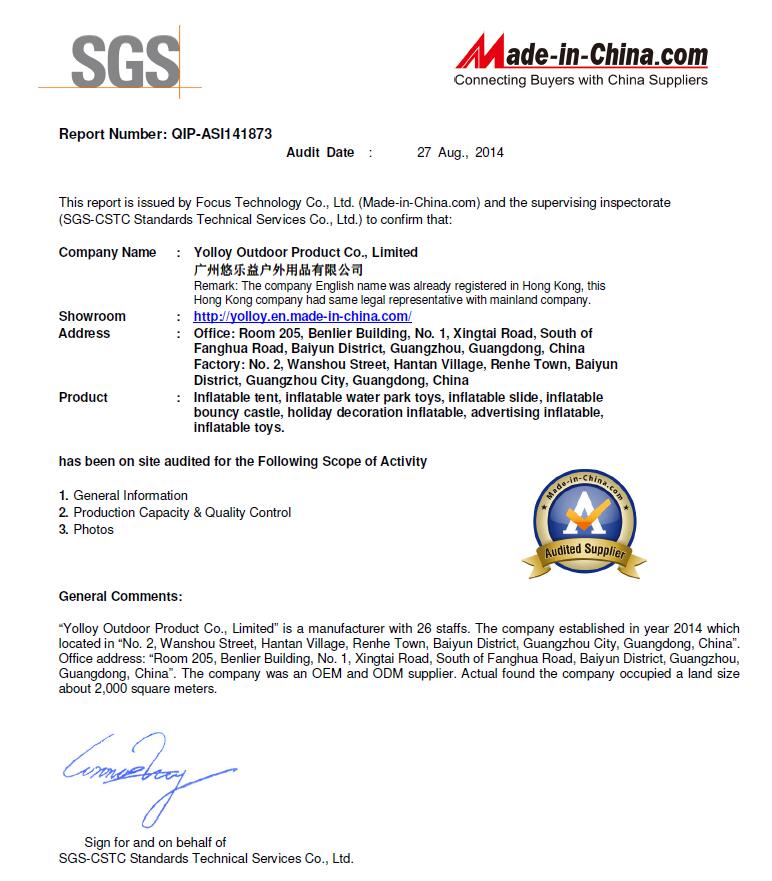
Certification

News

• New Order Successfully Finished for Long-Time Cooperated Japanese Client | YOLLOY Wins Full Client Recognition

• YOLLOY Custom Inflatable Pool Tent for Danish Client: Professional Pool Repair Shelter & Debris Protection

• Trusted Once Again! Greek Captain Re-orders Our Products After 4 Years

• Revolutionize Your Outdoors: The All-Terrain Inflatable Floating Tent for Land & Water

• Elevate Your Summer Fun: The Ultimate Inflatable Water Floating Volleyball Court Trampoline

• Innovative Inflatable Nightclub Tents & Pop-Up Bars: The Ultimate Solution for Portable Party Venues

Contact Us

Name: Sunny Yang
Tel: +86-20-8370 0771
Fax: +86-20-8370 0771
Mobile: 13570587575
E-mail: sales@yolloy.com
Add: No 5,Xiong wei Bo Nan Road,ZhongLuoTan Town,Baiyun district,Guangzhou,China
Friend me on Facebook Follow me on Twitter Add me to your circles Follow me on Pinterest Watch my channel on YouTube
News

Why Custom Inflatable Tents Are Revolutionizing Outdoor Events and Commercial Spaces

Author:yolloy Date:2026/7/20 12:23:39
From rapid deployment to fully customized branding, inflatable tent technology is reshaping how businesses approach temporary structures.
Picture this: a corporate event venue that goes from flat-packed to fully operational in under 30 minutes. A branded hospitality suite that travels in the back of a van and inflates at the push of a button. A weatherproof medical triage station deployed in a disaster zone within minutes of arrival. These scenarios are not futuristic — they are happening right now, powered by custom inflatable tent technology that has quietly transformed the temporary structure industry.
For decades, event organizers, rental businesses, and emergency response teams relied on heavy aluminum-frame tents and pole-supported marquees. These traditional structures required hours of setup, teams of trained personnel, and significant transport logistics. The shift toward inflatable architecture has changed the equation entirely — and the businesses that have made the switch are not looking back.
What Sets Inflatable Tents Apart from Traditional Structures
The core advantage of an outdoor inflatable tent lies in its structural design. Instead of rigid poles and cross-braces, these tents use pressurized air beams that form a self-supporting framework. The result is a structure that combines remarkable strength with extraordinary portability. A commercial-grade inflatable tent can weigh a fraction of its aluminum-frame equivalent while offering comparable or superior wind resistance when properly anchored.
Setup time is perhaps the most dramatic difference. While a traditional frame tent for a 100-person event might require a crew of four working for two to three hours, an equivalent inflatable tent can often be deployed by two people in under 30 minutes. The air beams do the heavy lifting — literally — inflating to form the structural skeleton while the fabric shell takes shape automatically.
Key advantages at a glance: Rapid single-person or two-person setup, compact transport volume, no loose poles or small parts to lose, integrated anchoring systems, and the ability to set up on surfaces where stakes cannot penetrate by using ballast weights.
Customization: The Competitive Edge for Businesses
One of the most compelling reasons businesses choose inflatable tents is the degree of customization available. Unlike off-the-shelf frame tents that come in standard sizes and limited color options, a custom inflatable tent can be designed from the ground up to match specific requirements. Size, shape, color, branding, window placement, door configuration, and interior layout can all be specified to the buyer's exact needs.
For event rental companies, this means being able to offer clients a distinctive product that stands out in a crowded market. For corporate users, it means a branded environment that reinforces brand identity at every touchpoint. Logos and artwork can be printed directly onto the tent fabric, turning the structure itself into a marketing asset. This level of personalization is difficult to achieve with traditional tent systems and nearly impossible at the same price point.
Manufacturers like YOLLOY take customization further by offering design-from-concept services. Customers can submit a description, rough sketch, photograph, or site plan, and the design team produces simulation renderings for approval before production begins. This collaborative approach ensures that the final product matches the buyer's vision precisely — whether that is a inflatable dome tent for a luxury glamping resort, a branded cube tent for a trade show, or a tunnel-shaped shelter for a sports event.
Applications That Go Far Beyond Camping
While the word "tent" may evoke images of weekend camping trips, the commercial inflatable tent market serves a remarkably diverse range of industries. Inflatable tent for events represents one of the fastest-growing segments, with applications spanning corporate hospitality, product launches, music festivals, wedding receptions, and sporting events. But the use cases extend well beyond the event industry.
In the automotive sector, inflatable spray booths and car detailing tents provide mobile, controlled-environment workspaces. Golf simulator enclosures allow driving ranges and entertainment venues to expand their offerings without permanent construction. The medical and emergency response sectors use inflatable shelters for field hospitals, triage stations, and temporary housing. The military and humanitarian aid organizations value the rapid deployment and compact transport profile of inflatable structures in crisis zones.
Other commercial applications include inflatable sports domes for year-round training facilities, portable planetarium domes for educational programs, and inflatable projection screens for outdoor cinema events. The versatility of air-supported structures means that the same manufacturing platform can produce a clear bubble tent for stargazing, a paintball bunker arena, and an advertising arch — all from the same factory floor.
Materials and Quality: What Separates Professional-Grade from Consumer Products
Not all inflatable tents are created equal. The difference between a consumer-grade camping tent and a commercial-grade inflatable structure comes down to materials, construction methods, and quality control. Professional-grade inflatable tents use commercial PVC tarpaulin, Oxford fabric, nylon, or TPU depending on the application, with material selection driven by factors such as UV exposure, temperature range, and expected usage frequency.
The manufacturing process itself is a critical quality indicator. High-quality inflatable tents are produced using precision sewing equipment with reinforced seams and waterproof nylon thread. High-load areas receive additional reinforcement to withstand repeated inflation cycles and wind stress. For airtight products, high-temperature fusion welding equipment creates seamless, leak-proof bonds that far outperform glued or taped seams.
Certifications provide an objective benchmark for quality. Reputable manufacturers ensure their materials meet relevant safety standards — EN71 for toy safety, EN14960 for inflatable play equipment, and EN15649 for floating leisure products. Blowers should carry CE or UL certification appropriate to the destination market's voltage requirements. Before shipment, each product should undergo inspection and testing to verify both structural integrity and blower performance.
What to Look for in an Inflatable Tent Manufacturer
Choosing the right manufacturing partner is as important as choosing the right product. A qualified manufacturer should offer more than a catalog of standard designs — they should provide design-to-production service that takes a customer's concept from initial sketch to finished product. Look for manufacturers who can produce simulation renderings during the design phase and who are willing to iterate on design until the customer approves every detail.
Production flexibility is another key consideration. The best manufacturers maintain a low minimum order quantity — sometimes as low as one piece — which allows businesses to test a design before committing to a larger order. Production lead times for standard inflatable products typically range from 6 to 15 days, though complex custom projects may take longer. A manufacturer that consistently meets or beats its stated delivery timelines — with a documented on-time delivery rate — is worth its weight in gold.
After-sales support also matters. Each inflatable product should ship with a repair kit, and the manufacturer should provide clear guidance on maintenance procedures. Packaging quality is a telling detail: professional manufacturers use soft carpet protection, waterproof PVC bags, and outer PE film, with steel pallets for larger products. These details indicate a manufacturer that cares about the condition in which products arrive — and by extension, the condition in which they will perform.
The Bottom Line
The inflatable tent market has matured significantly over the past decade. What was once a niche product category is now a mainstream solution for temporary structures across events, hospitality, emergency response, sports, and commercial applications. The advantages of rapid deployment, compact transport, full customization, and competitive pricing make inflatable tents a compelling alternative to traditional frame structures for a growing number of professional users.
For businesses considering the switch, the key is to partner with a manufacturer that combines design capability, production quality, and reliable service. YOLLOY Outdoor Product Co., Limited, based in Guangzhou, China, offers end-to-end custom inflatable solutions — from concept design and rendering through factory production and global shipping. With products exported to markets across Europe, Asia, South America, Africa, the Middle East, and Latin America, and a stated 95% on-time delivery rate, the company has built a reputation on safety, durability, and responsive customer service.
Ready to explore custom inflatable tent solutions for your business? Whether you need a single branded event tent or a full fleet of commercial inflatable structures, the right manufacturing partner makes all the difference. Contact YOLLOY today to discuss your project requirements, request a design rendering, or get a quote. From concept to delivery, your vision drives the process — and the result is a product built to your exact specifications.


Why Custom Inflatable Tents Are Revolutionizing Outdoor Events and Commercial Spaces

Author:yolloy Date:2026/7/20 12:23:39

From rapid deployment to fully customized branding, inflatable tent technology is reshaping how businesses approach temporary structures.
Picture this: a corporate event venue that goes from flat-packed to fully operational in under 30 minutes. A branded hospitality suite that travels in the back of a van and inflates at the push of a button. A weatherproof medical triage station deployed in a disaster zone within minutes of arrival. These scenarios are not futuristic — they are happening right now, powered by custom inflatable tent technology that has quietly transformed the temporary structure industry.
For decades, event organizers, rental businesses, and emergency response teams relied on heavy aluminum-frame tents and pole-supported marquees. These traditional structures required hours of setup, teams of trained personnel, and significant transport logistics. The shift toward inflatable architecture has changed the equation entirely — and the businesses that have made the switch are not looking back.
What Sets Inflatable Tents Apart from Traditional Structures
The core advantage of an outdoor inflatable tent lies in its structural design. Instead of rigid poles and cross-braces, these tents use pressurized air beams that form a self-supporting framework. The result is a structure that combines remarkable strength with extraordinary portability. A commercial-grade inflatable tent can weigh a fraction of its aluminum-frame equivalent while offering comparable or superior wind resistance when properly anchored.
Setup time is perhaps the most dramatic difference. While a traditional frame tent for a 100-person event might require a crew of four working for two to three hours, an equivalent inflatable tent can often be deployed by two people in under 30 minutes. The air beams do the heavy lifting — literally — inflating to form the structural skeleton while the fabric shell takes shape automatically.
Key advantages at a glance: Rapid single-person or two-person setup, compact transport volume, no loose poles or small parts to lose, integrated anchoring systems, and the ability to set up on surfaces where stakes cannot penetrate by using ballast weights.
Customization: The Competitive Edge for Businesses
One of the most compelling reasons businesses choose inflatable tents is the degree of customization available. Unlike off-the-shelf frame tents that come in standard sizes and limited color options, a custom inflatable tent can be designed from the ground up to match specific requirements. Size, shape, color, branding, window placement, door configuration, and interior layout can all be specified to the buyer's exact needs.
For event rental companies, this means being able to offer clients a distinctive product that stands out in a crowded market. For corporate users, it means a branded environment that reinforces brand identity at every touchpoint. Logos and artwork can be printed directly onto the tent fabric, turning the structure itself into a marketing asset. This level of personalization is difficult to achieve with traditional tent systems and nearly impossible at the same price point.
Manufacturers like YOLLOY take customization further by offering design-from-concept services. Customers can submit a description, rough sketch, photograph, or site plan, and the design team produces simulation renderings for approval before production begins. This collaborative approach ensures that the final product matches the buyer's vision precisely — whether that is a inflatable dome tent for a luxury glamping resort, a branded cube tent for a trade show, or a tunnel-shaped shelter for a sports event.
Applications That Go Far Beyond Camping
While the word "tent" may evoke images of weekend camping trips, the commercial inflatable tent market serves a remarkably diverse range of industries. Inflatable tent for events represents one of the fastest-growing segments, with applications spanning corporate hospitality, product launches, music festivals, wedding receptions, and sporting events. But the use cases extend well beyond the event industry.
In the automotive sector, inflatable spray booths and car detailing tents provide mobile, controlled-environment workspaces. Golf simulator enclosures allow driving ranges and entertainment venues to expand their offerings without permanent construction. The medical and emergency response sectors use inflatable shelters for field hospitals, triage stations, and temporary housing. The military and humanitarian aid organizations value the rapid deployment and compact transport profile of inflatable structures in crisis zones.
Other commercial applications include inflatable sports domes for year-round training facilities, portable planetarium domes for educational programs, and inflatable projection screens for outdoor cinema events. The versatility of air-supported structures means that the same manufacturing platform can produce a clear bubble tent for stargazing, a paintball bunker arena, and an advertising arch — all from the same factory floor.
Materials and Quality: What Separates Professional-Grade from Consumer Products
Not all inflatable tents are created equal. The difference between a consumer-grade camping tent and a commercial-grade inflatable structure comes down to materials, construction methods, and quality control. Professional-grade inflatable tents use commercial PVC tarpaulin, Oxford fabric, nylon, or TPU depending on the application, with material selection driven by factors such as UV exposure, temperature range, and expected usage frequency.
The manufacturing process itself is a critical quality indicator. High-quality inflatable tents are produced using precision sewing equipment with reinforced seams and waterproof nylon thread. High-load areas receive additional reinforcement to withstand repeated inflation cycles and wind stress. For airtight products, high-temperature fusion welding equipment creates seamless, leak-proof bonds that far outperform glued or taped seams.
Certifications provide an objective benchmark for quality. Reputable manufacturers ensure their materials meet relevant safety standards — EN71 for toy safety, EN14960 for inflatable play equipment, and EN15649 for floating leisure products. Blowers should carry CE or UL certification appropriate to the destination market's voltage requirements. Before shipment, each product should undergo inspection and testing to verify both structural integrity and blower performance.
What to Look for in an Inflatable Tent Manufacturer
Choosing the right manufacturing partner is as important as choosing the right product. A qualified manufacturer should offer more than a catalog of standard designs — they should provide design-to-production service that takes a customer's concept from initial sketch to finished product. Look for manufacturers who can produce simulation renderings during the design phase and who are willing to iterate on design until the customer approves every detail.
Production flexibility is another key consideration. The best manufacturers maintain a low minimum order quantity — sometimes as low as one piece — which allows businesses to test a design before committing to a larger order. Production lead times for standard inflatable products typically range from 6 to 15 days, though complex custom projects may take longer. A manufacturer that consistently meets or beats its stated delivery timelines — with a documented on-time delivery rate — is worth its weight in gold.
After-sales support also matters. Each inflatable product should ship with a repair kit, and the manufacturer should provide clear guidance on maintenance procedures. Packaging quality is a telling detail: professional manufacturers use soft carpet protection, waterproof PVC bags, and outer PE film, with steel pallets for larger products. These details indicate a manufacturer that cares about the condition in which products arrive — and by extension, the condition in which they will perform.
The Bottom Line
The inflatable tent market has matured significantly over the past decade. What was once a niche product category is now a mainstream solution for temporary structures across events, hospitality, emergency response, sports, and commercial applications. The advantages of rapid deployment, compact transport, full customization, and competitive pricing make inflatable tents a compelling alternative to traditional frame structures for a growing number of professional users.
For businesses considering the switch, the key is to partner with a manufacturer that combines design capability, production quality, and reliable service. YOLLOY Outdoor Product Co., Limited, based in Guangzhou, China, offers end-to-end custom inflatable solutions — from concept design and rendering through factory production and global shipping. With products exported to markets across Europe, Asia, South America, Africa, the Middle East, and Latin America, and a stated 95% on-time delivery rate, the company has built a reputation on safety, durability, and responsive customer service.
Ready to explore custom inflatable tent solutions for your business? Whether you need a single branded event tent or a full fleet of commercial inflatable structures, the right manufacturing partner makes all the difference. Contact YOLLOY today to discuss your project requirements, request a design rendering, or get a quote. From concept to delivery, your vision drives the process — and the result is a product built to your exact specifications.