A water inflatable obstacle course can turn an ordinary resort into a destination guests talk about long after their vacation ends. With floating climbing walls, balance beams, slides, and splash zones, these attractions offer guests of all ages an experience that blends physical challenge with pure fun. But with so many options on the market, how do you choose the right one for your resort? This guide breaks down what to look for, from course types and materials to customization and safety, so you can invest with confidence.
Types of Water Inflatable Obstacle Courses for Resorts
Not all water inflatable obstacle course setups are alike. The best choice depends on your resort's natural setting, existing water features, and the kind of guest experience you want to deliver. Here are the three most common configurations:
Floating Obstacle Courses for Lakes and Beaches
If your resort has a lake, calm bay, or designated swimming area along a beach, a floating obstacle course is a natural fit. These courses are anchored to the bottom and spread across the water surface, creating a continuous path of challenges. Guests swim, climb, and slide their way from one module to the next. The visual impact alone — a colorful, action-packed course stretching across the water — becomes a powerful marketing asset. Drone footage and guest photos from these courses generate significant organic social media exposure for resorts.
Pool-Based Obstacle Courses
For resorts with large swimming pools, a pool-based course offers a more controlled environment. These courses are typically smaller in scale but still pack a punch with climbing walls, tunnels, and slides positioned over the water. They are easier to supervise and can be set up and taken down more quickly. A inflatable obstacle course designed for pool use is also ideal for resorts that want to rotate attractions seasonally or host themed events.
Modular and Customizable Courses
For resorts that want maximum flexibility, modular courses are the answer. These systems are built from interchangeable modules — slides, balance beams, climbing towers, splash zones, tunnels — that can be rearranged into different layouts. You can start with a core configuration and expand each season, keeping the experience fresh for returning guests. A modular approach also makes it easy to create separate zones for different age groups or skill levels within the same course.
Key Factors to Consider When Choosing a Course
Space and Water Conditions
Measure your available water area carefully — not just the length and width, but also the depth. Most commercial courses require a minimum water depth of 1.2 to 1.5 meters for safety. Consider whether the water is saltwater or freshwater, as saltwater environments demand materials with strong corrosion resistance. Also think about wave conditions: a course in a protected lagoon will have different anchoring requirements than one exposed to open water.
Guest Demographics
Who stays at your resort? If you cater primarily to families with young children, look for courses with lower platforms, gentler slides, and extra safety features. If your guests are mostly adults or teenagers, go for taller climbs, faster slides, and more physically demanding obstacles. Many resorts find that a course with a mix of easy and challenging sections works best, letting everyone find their comfort zone.
Material Quality and Durability
The material is what separates a course that lasts multiple seasons from one that needs constant repairs. Commercial-grade PVC tarpaulin is the industry standard for good reason: it is waterproof, UV-resistant, and built to handle hundreds of guests per day. For platforms that need to feel firm and stable underfoot, look for Drop Stitch Fabric (DSF) — the same technology used in high-end stand-up paddleboards. This material inflates to high pressure and creates a surface as rigid as a wooden plank, which is critical for floating docks and party platforms. Always confirm that materials meet recognized safety certifications such as EN71 or EN15649.
Safety Features
Safety should be the top priority. Look for courses with reinforced seams, rounded edges, non-slip surfaces, and pressure relief valves that prevent over-inflation. Anchor systems should be robust and designed for your specific water conditions. A reputable manufacturer will provide detailed safety guidelines, recommended lifeguard-to-guest ratios, and a repair kit with every order. Before buying, ask about the manufacturer's quality control process — for example, whether each product undergoes a full inflation and leak test before shipment.
Customization Options
A generic, off-the-shelf course works, but a custom-designed one becomes a signature attraction. The best manufacturers offer OEM and ODM services, meaning they can build a course around your resort's theme, brand colors, and specific requirements. Want a tropical jungle theme with inflatable palm trees and a giant toucan slide? Or a pirate-themed course with a ship's rigging climb and a kraken-tentacle descent? Customization also extends to practical details like logo placement, module sizing, and the mix of obstacle types. A well-designed custom course becomes a landmark that guests associate uniquely with your resort.
The Investment Perspective
Compared to permanent concrete water attractions, an inflatable water park obstacle course offers a significantly faster return on investment. Installation takes days rather than months, and the modular nature means you can start small and expand over time. The revenue potential extends beyond ticket sales: resorts can create stay-and-play packages, host corporate team-building events, and charge for private group bookings. The social media exposure generated by guests sharing their experiences provides free marketing that traditional advertising cannot match.
Pro Tip: When evaluating suppliers, look beyond the price tag. Ask about delivery timelines, after-sales support, warranty terms, and whether repair kits and maintenance guides are included. A slightly higher upfront cost often pays for itself through fewer repairs and longer product life.
Why Choose YOLLOY for Your Resort's Obstacle Course
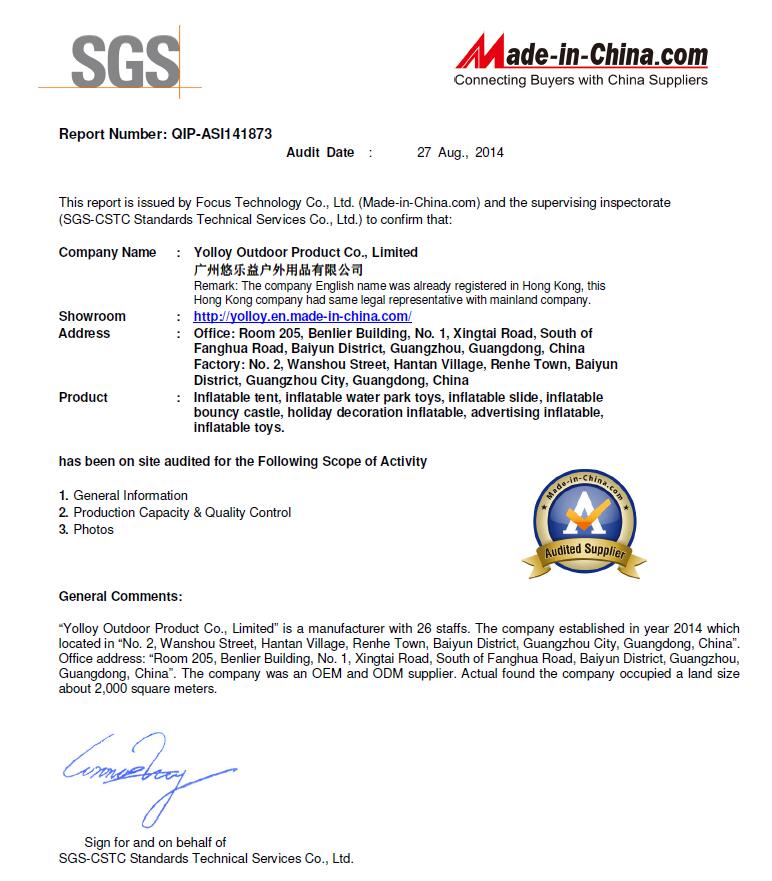
YOLLOY Outdoor Product Co., Limited is a specialized inflatable product manufacturer based in Guangzhou, China, with over a decade of experience in designing and producing custom inflatables for commercial use. The company has supplied inflatable water parks, obstacle courses, slides, and related products to clients across Europe, Asia, South America, Africa, the Middle East, and Latin America.
YOLLOY's approach to every project starts with understanding the client's vision. Their design team creates 3D renderings from your ideas, sketches, or site plans, and revises them until you are fully satisfied. Production uses commercial-grade PVC tarpaulin and Drop Stitch Fabric, with reinforced seams, high-temperature fusion welding, and anti-UV coatings. Every product goes through a 24-hour inflation and leak test before leaving the factory. Materials meet EN71, EN14960, and EN15649 standards, and blowers are available for 110V, 220V, or 380V requirements to suit your region.
Customization is at the core of what YOLLOY does. You can specify custom sizes, colors, themes, and logo placements. The minimum order quantity is just one piece, so even a single custom course is possible. Production typically takes 6 to 15 days for a standard product, and YOLLOY maintains a 95% on-time delivery rate. Each order includes a repair kit, and the company backs its products with a three-year warranty when used and maintained correctly.
What to Ask Before You Buy
Here is a quick checklist of questions to ask any supplier before committing to a water inflatable obstacle course:
- What materials are used, and do they meet EN71 or equivalent safety standards?
- Can the course be customized to fit my resort's theme and water area?
- What is the typical production timeline, and what is your on-time delivery rate?
- Do you provide a repair kit, maintenance guide, and after-sales support?
- What warranty do you offer, and what does it cover?
- Can you share case studies or references from other resort clients?
Conclusion
The best water inflatable obstacle course for a resort is one that fits the available water space, matches the guest profile, and is built from durable, safety-certified materials by a manufacturer with a proven track record. A modular, customizable course gives you the flexibility to grow and refresh the attraction over time, keeping guests excited and engaged season after season. Whether your resort is lakeside, beachfront, or pool-centered, the right course can become a defining feature — driving bookings, increasing on-site spending, and generating the kind of word-of-mouth buzz that no advertising budget can buy.