Products Category
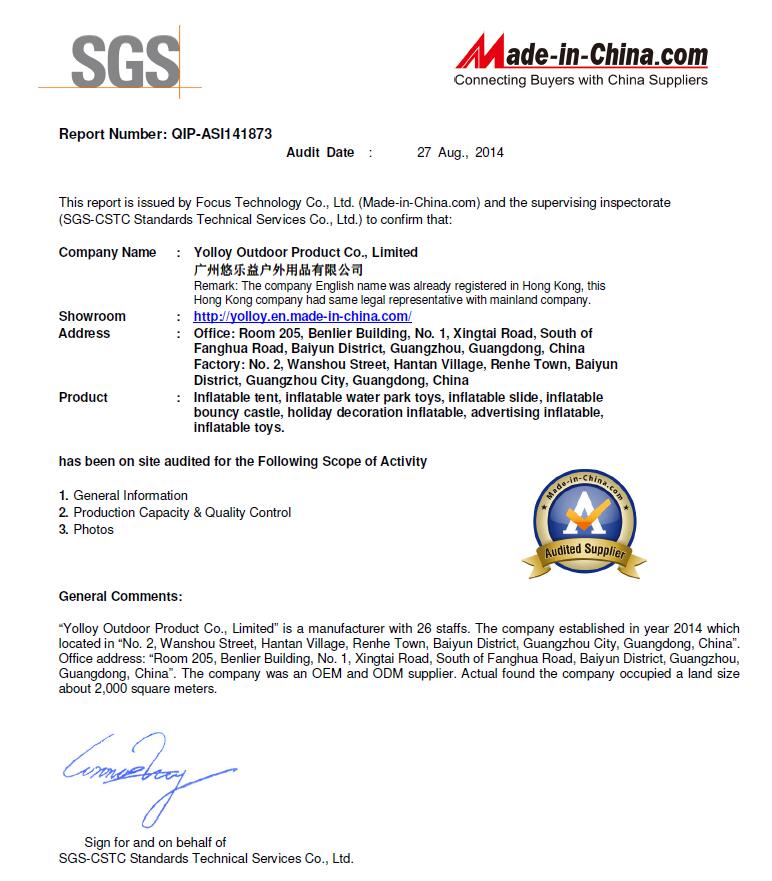
Certification

News

• New Order Successfully Finished for Long-Time Cooperated Japanese Client | YOLLOY Wins Full Client Recognition

• YOLLOY Custom Inflatable Pool Tent for Danish Client: Professional Pool Repair Shelter & Debris Protection

• Trusted Once Again! Greek Captain Re-orders Our Products After 4 Years

• Revolutionize Your Outdoors: The All-Terrain Inflatable Floating Tent for Land & Water

• Elevate Your Summer Fun: The Ultimate Inflatable Water Floating Volleyball Court Trampoline

• Innovative Inflatable Nightclub Tents & Pop-Up Bars: The Ultimate Solution for Portable Party Venues

Contact Us

Name: Sunny Yang
Tel: +86-20-8370 0771
Fax: +86-20-8370 0771
Mobile: 13570587575
E-mail: [email protected]
Add: No 5,Xiong wei Bo Nan Road,ZhongLuoTan Town,Baiyun district,Guangzhou,China
Friend me on Facebook Follow me on Twitter Add me to your circles Follow me on Pinterest Watch my channel on YouTube
News

What is the best inflatable karting track for a family?

Author:yolloy Date:2026/8/19 11:45:12

When a family starts looking for an outdoor activity that everyone can enjoy together, an inflatable karting track tends to come up early in the conversation. It has the excitement of a small race circuit, but without the permanent concrete, heavy machinery, or high running costs of a real go-kart venue. Deciding which one actually fits a family, though, takes more than picking the biggest one you can find. You need to match the track to the space you have, the age range of your children, and how often you will actually use it.

What makes a karting track family-friendly

A track that is genuinely family-friendly is not just smaller — it is designed around softer, safer contact than a traditional race circuit. The edges are inflated and padded, so a child who bumps into the wall bounces off a soft barrier instead of hitting a hard barrier. The driving or riding point is close to the ground, which keeps young children comfortable and lowers any sense of risk. Because the whole unit is made from flexible material, supervision becomes easier and the setup works in a backyard, a rented hall, or a community park.

Most families run these tracks with pedal karts, small electric bumper cars, or zorb-style bumper balls, so children as young as three or four can take part alongside older siblings. That range is the real selling point for a family: one setup can entertain a five-year-old, a nine-year-old, and a set of visiting cousins at the same event. If you are considering one, think about the width of the lanes and the internal play area, because that determines how many children can race at once without constant pile-ups.

The features that matter most

Size and space planning. The footprint you can spare dictates everything else. Measure the area before you buy. A compact track works well in a backyard, while a larger configuration suits rental businesses, schools, and larger community events. Remember to allow room outside the inflated walls for children to wait and for adults to supervise.

Build quality and material. Commercial-grade PVC tarpaulin is the standard to look for because it resists punctures, wipes clean easily, and copes with repeated outdoor use. Reinforced seams at high-stress points and waterproof nylon stitching matter far more than a flashy print. High-load areas should have additional reinforcement so the track stays intact after busy weekends.

Safety and anchoring. Soft, low walls, a non-slip floor, and clear play boundaries make the biggest difference for younger riders. On windy days a large inflatable can move if it is not fixed down, so look for anchor points such as D-rings or a round metal anchor system. Check the number of entry and exit flaps too — a family-facing design makes it easy for a child to get in and out without help.

Setup and blower. Every inflatable track needs a blower to stay inflated, so confirm the voltage you need (110V, 220V, or 380V) before you commit. A good blower inflates the unit in minutes and keeps it stable for a full session. If you plan to move the track between locations, weigh portability heavily — a model that one person can put up and pack away will get far more use than a heavier one.

Inflatable versus a permanent go-kart circuit

For most families, an inflatable track wins on the practical points. It is far cheaper than building or renting a fixed circuit, takes no permanent land, and stores away when not in use. It also works with different riding modes — pedal karts one weekend, bumper balls the next — so the same unit stays fresh. A permanent venue might suit a serious operator with dedicated space, but for a household, an inflatable is the more sensible balance of cost, space, and flexibility.

Choosing a manufacturer you can customise

Because every family and venue is different, off-the-shelf sizes rarely fit everyone. A manufacturer that supports custom inflatable tents and sport games lets you set the dimensions, colours, and artwork rather than accepting whatever a retailer stocks. Custom design should let you start from a description, drawing, sketch, or even a simple site plan, and see a rendering before anything goes into production. A sensible minimum order quantity of one piece matters too, so a single family or small club can order exactly one track without being forced into bulk.

Production times for a regular inflatable product typically run from around six to fifteen days, excluding shipping, and reliable suppliers will tell you their transit expectations up front. Safety certification is worth verifying as well — materials that have passed EN71 or EN14960 testing, and blowers that meet CE or UL requirements, give you confidence that the product was checked before it left the factory.

Making the most of it once it arrives

Once your track is set up, keep a few habits in mind. Place it on flat ground away from sharp objects, fix the anchors properly, and always supervise younger children, especially at start and finish areas. Wipe down the surface after outdoor use, inspect for punctures, and use the repair kit that comes with the unit to fix small holes before they grow. Follow the manufacturer's guidance on inflation and loading, and the track should deliver years of family weekends rather than a single season.

If you already have room to expand later, the same logic applies to other interactive sport games such as an inflatable obstacle course or a zipline — many families start with a karting track and add elements over time to build a small entertainment corner at home. The key is starting with a track that matches your space and your children's ages, and buying it from a supplier willing to build it to fit you.

A quick checklist before you buy

Confirm the sizing against your actual space. Choose commercial-grade PVC with reinforced seams for durability. Verify soft walls, non-slip flooring, and proper anchoring points. Match the blower voltage to your power supply. Decide early whether you need a compact unit for the backyard or a larger one for events. And if the standard sizes are not right, ask for customisation — the best family track is the one that fits your own family.


What is the best inflatable karting track for a family?

Author:yolloy Date:2026/8/19 11:45:12

When a family starts looking for an outdoor activity that everyone can enjoy together, an inflatable karting track tends to come up early in the conversation. It has the excitement of a small race circuit, but without the permanent concrete, heavy machinery, or high running costs of a real go-kart venue. Deciding which one actually fits a family, though, takes more than picking the biggest one you can find. You need to match the track to the space you have, the age range of your children, and how often you will actually use it.

What makes a karting track family-friendly

A track that is genuinely family-friendly is not just smaller — it is designed around softer, safer contact than a traditional race circuit. The edges are inflated and padded, so a child who bumps into the wall bounces off a soft barrier instead of hitting a hard barrier. The driving or riding point is close to the ground, which keeps young children comfortable and lowers any sense of risk. Because the whole unit is made from flexible material, supervision becomes easier and the setup works in a backyard, a rented hall, or a community park.

Most families run these tracks with pedal karts, small electric bumper cars, or zorb-style bumper balls, so children as young as three or four can take part alongside older siblings. That range is the real selling point for a family: one setup can entertain a five-year-old, a nine-year-old, and a set of visiting cousins at the same event. If you are considering one, think about the width of the lanes and the internal play area, because that determines how many children can race at once without constant pile-ups.

The features that matter most

Size and space planning. The footprint you can spare dictates everything else. Measure the area before you buy. A compact track works well in a backyard, while a larger configuration suits rental businesses, schools, and larger community events. Remember to allow room outside the inflated walls for children to wait and for adults to supervise.

Build quality and material. Commercial-grade PVC tarpaulin is the standard to look for because it resists punctures, wipes clean easily, and copes with repeated outdoor use. Reinforced seams at high-stress points and waterproof nylon stitching matter far more than a flashy print. High-load areas should have additional reinforcement so the track stays intact after busy weekends.

Safety and anchoring. Soft, low walls, a non-slip floor, and clear play boundaries make the biggest difference for younger riders. On windy days a large inflatable can move if it is not fixed down, so look for anchor points such as D-rings or a round metal anchor system. Check the number of entry and exit flaps too — a family-facing design makes it easy for a child to get in and out without help.

Setup and blower. Every inflatable track needs a blower to stay inflated, so confirm the voltage you need (110V, 220V, or 380V) before you commit. A good blower inflates the unit in minutes and keeps it stable for a full session. If you plan to move the track between locations, weigh portability heavily — a model that one person can put up and pack away will get far more use than a heavier one.

Inflatable versus a permanent go-kart circuit

For most families, an inflatable track wins on the practical points. It is far cheaper than building or renting a fixed circuit, takes no permanent land, and stores away when not in use. It also works with different riding modes — pedal karts one weekend, bumper balls the next — so the same unit stays fresh. A permanent venue might suit a serious operator with dedicated space, but for a household, an inflatable is the more sensible balance of cost, space, and flexibility.

Choosing a manufacturer you can customise

Because every family and venue is different, off-the-shelf sizes rarely fit everyone. A manufacturer that supports custom inflatable tents and sport games lets you set the dimensions, colours, and artwork rather than accepting whatever a retailer stocks. Custom design should let you start from a description, drawing, sketch, or even a simple site plan, and see a rendering before anything goes into production. A sensible minimum order quantity of one piece matters too, so a single family or small club can order exactly one track without being forced into bulk.

Production times for a regular inflatable product typically run from around six to fifteen days, excluding shipping, and reliable suppliers will tell you their transit expectations up front. Safety certification is worth verifying as well — materials that have passed EN71 or EN14960 testing, and blowers that meet CE or UL requirements, give you confidence that the product was checked before it left the factory.

Making the most of it once it arrives

Once your track is set up, keep a few habits in mind. Place it on flat ground away from sharp objects, fix the anchors properly, and always supervise younger children, especially at start and finish areas. Wipe down the surface after outdoor use, inspect for punctures, and use the repair kit that comes with the unit to fix small holes before they grow. Follow the manufacturer's guidance on inflation and loading, and the track should deliver years of family weekends rather than a single season.

If you already have room to expand later, the same logic applies to other interactive sport games such as an inflatable obstacle course or a zipline — many families start with a karting track and add elements over time to build a small entertainment corner at home. The key is starting with a track that matches your space and your children's ages, and buying it from a supplier willing to build it to fit you.

A quick checklist before you buy

Confirm the sizing against your actual space. Choose commercial-grade PVC with reinforced seams for durability. Verify soft walls, non-slip flooring, and proper anchoring points. Match the blower voltage to your power supply. Decide early whether you need a compact unit for the backyard or a larger one for events. And if the standard sizes are not right, ask for customisation — the best family track is the one that fits your own family.