Products Category
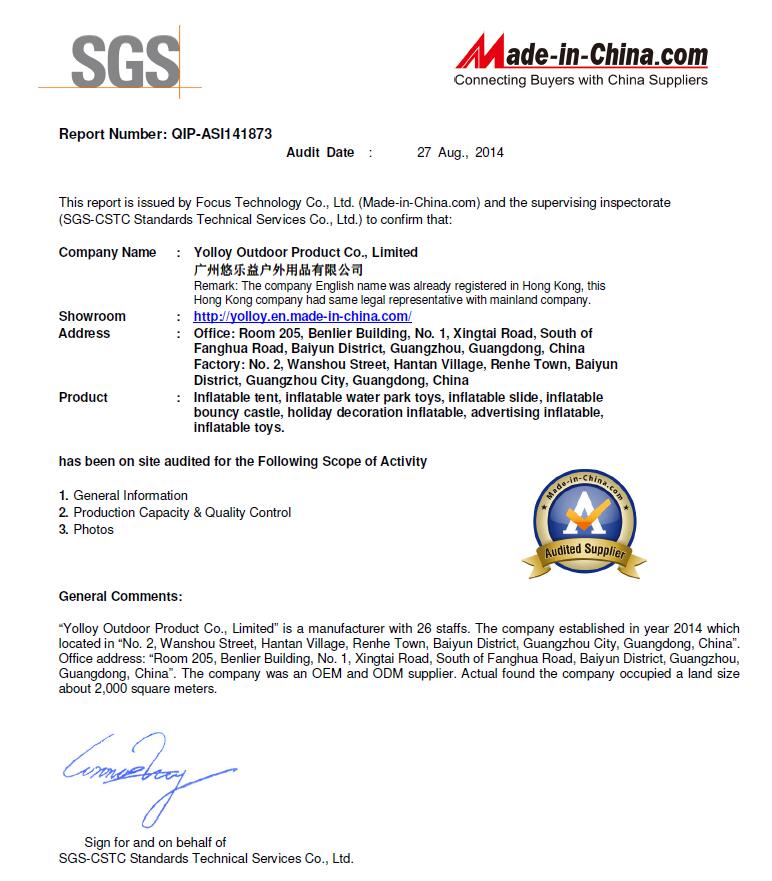
Certification

News

• New Order Successfully Finished for Long-Time Cooperated Japanese Client | YOLLOY Wins Full Client Recognition

• YOLLOY Custom Inflatable Pool Tent for Danish Client: Professional Pool Repair Shelter & Debris Protection

• Trusted Once Again! Greek Captain Re-orders Our Products After 4 Years

• Revolutionize Your Outdoors: The All-Terrain Inflatable Floating Tent for Land & Water

• Elevate Your Summer Fun: The Ultimate Inflatable Water Floating Volleyball Court Trampoline

• Innovative Inflatable Nightclub Tents & Pop-Up Bars: The Ultimate Solution for Portable Party Venues

Contact Us

Name: Sunny Yang
Tel: +86-20-8370 0771
Fax: +86-20-8370 0771
Mobile: 13570587575
E-mail: [email protected]
Add: No 5,Xiong wei Bo Nan Road,ZhongLuoTan Town,Baiyun district,Guangzhou,China
Friend me on Facebook Follow me on Twitter Add me to your circles Follow me on Pinterest Watch my channel on YouTube
News

What are the safety rules for inflatable bounce houses?

Author:yolloy Date:2026/8/12 23:14:04

Inflatable bounce houses are a highlight at birthday parties, school carnivals, and community festivals. Children love the thrill of jumping, bouncing, and tumbling inside a colorful, air-filled structure. But behind the fun lies a serious responsibility: safety. According to the U.S. Consumer Product Safety Commission (CPSC), there were more than 18,000 emergency department visits in 2018 associated with bounce houses, and between 2003 and 2013, 12 deaths were linked to inflatable amusement devices. The vast majority of these incidents were preventable — caused by improper anchoring, operation in unsafe wind conditions, overcrowding, or lack of adult supervision, not by equipment failure.

Whether you are a parent renting an inflatable bounce house for a backyard party or a commercial operator managing a rental fleet, knowing and following the essential safety rules is the single most important step you can take. This guide walks through the key safety practices every bounce house user and operator should follow.

1. Proper Setup and Anchoring: The Foundation of Safety

Anchoring is the most critical safety step when setting up a bounce house. Every inflatable must be fully anchored before any child enters — no exceptions. This rule applies even on calm days, because weather can change suddenly and a bounce house acts like a sail, catching wind with its large surface area.

On grass or soil: Use heavy-duty metal stakes at least 380 mm (15 inches) long, driven into the ground at a 45-degree angle away from the unit. Use all anchor points — most commercial bounce houses have at least six D-ring anchor points at corners and along the sides. If your unit has eight, use all eight. Drive stakes with a rubber mallet or small sledgehammer; never rely on stepping on them, as shallow stakes provide no real holding force.

On concrete, asphalt, or hard surfaces: Stakes cannot be driven into hard surfaces. Use sandbags or water barrels instead, with a minimum of 25 to 50 kg (55 to 110 lbs) of weight at each anchor point. Purpose-built commercial sandbags are the safest option. Never operate a bounce house on a hard surface without proper anchoring — an unanchored unit can become airborne at wind speeds as low as 15 mph.

Place the bounce house on a flat, even surface free of sharp objects, rocks, and debris. Maintain at least 2 meters (6 feet) of clearance on all sides and 4.5 meters (15 feet) above the unit — away from tree branches, power lines, fences, and buildings.

2. Wind Conditions: Know When to Say No

Wind is the leading cause of serious bounce house accidents. The incidents that make national headlines — units lifting into the air with children inside — are almost always wind-related. Most manufacturers specify a maximum safe operating wind speed of 15 to 25 mph (24 to 38 km/h). The conservative, safest rule is: never operate above 15 mph sustained wind speed.

Pay attention to gusts, not just sustained wind. A calm day with occasional 25 mph gusts is not safe. Use an anemometer to measure wind speed at regular intervals during operation. If you do not have an anemometer, observe the trees — if the tops of trees are swaying or small trees are in motion, it is likely too windy to operate. Smartphone weather apps can give you a general forecast, but they do not account for localized conditions like wind funneling between buildings.

Check the weather forecast before every setup. If conditions are predicted to deteriorate, have a plan to deflate and secure the unit immediately. No event or party is worth the risk of a wind-related incident.

3. Active Adult Supervision: Every Minute, Without Exception

An unattended bounce house is a serious liability. Every minute the unit is inflated and accessible, a responsible adult must be actively watching. This means one person whose sole job is supervision — not someone scrolling through their phone, chatting at the snack table, or multitasking.

The supervisor should enforce the following rules at all times:

  • No shoes, eyeglasses, jewelry, or sharp objects inside the unit
  • No food, drinks, or gum — these create choking hazards and damage the vinyl
  • No flips, wrestling, roughhousing, or climbing on walls
  • No lying down while others are bouncing — this leads to collisions and trampling
  • Keep children away from the blower, power cords, and any gas generators

4. Capacity Limits and Age Separation

The single biggest cause of bounce house injuries is collisions between children of different sizes. A 10-year-old landing on a 3-year-old is how broken bones and head injuries happen. Always separate younger children (under 6) from older children, and never allow teenagers and toddlers in the unit at the same time.

Every commercial inflatable has a maximum occupancy rating. Common limits range from 4 to 8 children for standard bounce houses, depending on the unit size. Overcrowding increases collision risk, puts excess stress on the bounce floor and seams, and makes it impossible for children to control their movements. For large parties, rotate groups in and out on a timer — five minutes in, five minutes out — so everyone gets a safe, enjoyable experience.

5. Pre-Use Equipment Inspection

Before every use, perform a thorough inspection of the bounce house and its equipment:

  • Check the entire unit for tears, holes, or seam separation
  • Inspect all anchor points and D-rings for rust, bending, or damage
  • Verify the blower is functioning properly and the air intake screen is clear of debris
  • Confirm the connection tube between blower and unit is securely attached
  • Look for symmetry — a misshapen or sagging structure may indicate internal issues
  • Check that the unit deflates at a steady, controlled rate when power is cut — users should have time to exit safely

During operation, monitor inflation levels. If the unit starts sagging or losing air, stop immediately and check for leaks or blower problems. Re-check anchor points and weather conditions periodically throughout the event.

6. Why Manufacturing Quality Matters for Safety

Safety starts long before the bounce house is inflated at your event — it begins on the factory floor. A well-manufactured bounce house uses commercial-grade PVC tarpaulin, reinforced seams with waterproof nylon thread, and additional reinforcement at high-load areas. D-ring anchor systems should be welded or sewn into the structure, not merely glued on. Blowers should meet CE or UL safety requirements and be appropriately powered for the unit size.

When choosing an inflatable bounce house manufacturer, look for one that provides clear documentation — including operator manuals, maximum occupancy limits, anchor specifications, and wind speed ratings. A reputable manufacturer will also supply a repair kit with each inflatable, use materials that pass EN71, EN14960, and RoHS-related testing, and conduct inspection and quality control checks before shipment.

As a leading china inflatable bounce house supplier, Yolloy Outdoor Product Co., Limited designs and manufactures bounce houses with safety and durability as top priorities. Every product is built with precision sewing equipment, reinforced stress points, and high-temperature fusion welding for airtight sections. The company provides clear operating instructions, appropriate blowers for 110V, 220V, or 380V requirements, and a repair kit with each unit. Yolloy's custom design-to-production process means clients can specify the exact sizes, colors, materials, and safety features they need — all backed by responsive after-sales service and worldwide shipping.

7. Conclusion: Safety Is a Shared Responsibility

Bounce house safety is not complicated, but it requires consistency and attention to detail. The four pillars — proper anchoring, respect for wind limits, active adult supervision, and appropriate capacity management — are straightforward to implement. The injuries that make headlines are almost always traceable to one or more of these rules being ignored.

Whether you are a rental operator, an event organizer, or a parent, your vigilance is the most important safety tool. Take the time to inspect the equipment, check the weather, secure every anchor point, and watch the children at play. A bounce house should be the highlight of the day — not the reason for a trip to the emergency room.


What are the safety rules for inflatable bounce houses?

Author:yolloy Date:2026/8/12 23:14:04

Inflatable bounce houses are a highlight at birthday parties, school carnivals, and community festivals. Children love the thrill of jumping, bouncing, and tumbling inside a colorful, air-filled structure. But behind the fun lies a serious responsibility: safety. According to the U.S. Consumer Product Safety Commission (CPSC), there were more than 18,000 emergency department visits in 2018 associated with bounce houses, and between 2003 and 2013, 12 deaths were linked to inflatable amusement devices. The vast majority of these incidents were preventable — caused by improper anchoring, operation in unsafe wind conditions, overcrowding, or lack of adult supervision, not by equipment failure.

Whether you are a parent renting an inflatable bounce house for a backyard party or a commercial operator managing a rental fleet, knowing and following the essential safety rules is the single most important step you can take. This guide walks through the key safety practices every bounce house user and operator should follow.

1. Proper Setup and Anchoring: The Foundation of Safety

Anchoring is the most critical safety step when setting up a bounce house. Every inflatable must be fully anchored before any child enters — no exceptions. This rule applies even on calm days, because weather can change suddenly and a bounce house acts like a sail, catching wind with its large surface area.

On grass or soil: Use heavy-duty metal stakes at least 380 mm (15 inches) long, driven into the ground at a 45-degree angle away from the unit. Use all anchor points — most commercial bounce houses have at least six D-ring anchor points at corners and along the sides. If your unit has eight, use all eight. Drive stakes with a rubber mallet or small sledgehammer; never rely on stepping on them, as shallow stakes provide no real holding force.

On concrete, asphalt, or hard surfaces: Stakes cannot be driven into hard surfaces. Use sandbags or water barrels instead, with a minimum of 25 to 50 kg (55 to 110 lbs) of weight at each anchor point. Purpose-built commercial sandbags are the safest option. Never operate a bounce house on a hard surface without proper anchoring — an unanchored unit can become airborne at wind speeds as low as 15 mph.

Place the bounce house on a flat, even surface free of sharp objects, rocks, and debris. Maintain at least 2 meters (6 feet) of clearance on all sides and 4.5 meters (15 feet) above the unit — away from tree branches, power lines, fences, and buildings.

2. Wind Conditions: Know When to Say No

Wind is the leading cause of serious bounce house accidents. The incidents that make national headlines — units lifting into the air with children inside — are almost always wind-related. Most manufacturers specify a maximum safe operating wind speed of 15 to 25 mph (24 to 38 km/h). The conservative, safest rule is: never operate above 15 mph sustained wind speed.

Pay attention to gusts, not just sustained wind. A calm day with occasional 25 mph gusts is not safe. Use an anemometer to measure wind speed at regular intervals during operation. If you do not have an anemometer, observe the trees — if the tops of trees are swaying or small trees are in motion, it is likely too windy to operate. Smartphone weather apps can give you a general forecast, but they do not account for localized conditions like wind funneling between buildings.

Check the weather forecast before every setup. If conditions are predicted to deteriorate, have a plan to deflate and secure the unit immediately. No event or party is worth the risk of a wind-related incident.

3. Active Adult Supervision: Every Minute, Without Exception

An unattended bounce house is a serious liability. Every minute the unit is inflated and accessible, a responsible adult must be actively watching. This means one person whose sole job is supervision — not someone scrolling through their phone, chatting at the snack table, or multitasking.

The supervisor should enforce the following rules at all times:

  • No shoes, eyeglasses, jewelry, or sharp objects inside the unit
  • No food, drinks, or gum — these create choking hazards and damage the vinyl
  • No flips, wrestling, roughhousing, or climbing on walls
  • No lying down while others are bouncing — this leads to collisions and trampling
  • Keep children away from the blower, power cords, and any gas generators

4. Capacity Limits and Age Separation

The single biggest cause of bounce house injuries is collisions between children of different sizes. A 10-year-old landing on a 3-year-old is how broken bones and head injuries happen. Always separate younger children (under 6) from older children, and never allow teenagers and toddlers in the unit at the same time.

Every commercial inflatable has a maximum occupancy rating. Common limits range from 4 to 8 children for standard bounce houses, depending on the unit size. Overcrowding increases collision risk, puts excess stress on the bounce floor and seams, and makes it impossible for children to control their movements. For large parties, rotate groups in and out on a timer — five minutes in, five minutes out — so everyone gets a safe, enjoyable experience.

5. Pre-Use Equipment Inspection

Before every use, perform a thorough inspection of the bounce house and its equipment:

  • Check the entire unit for tears, holes, or seam separation
  • Inspect all anchor points and D-rings for rust, bending, or damage
  • Verify the blower is functioning properly and the air intake screen is clear of debris
  • Confirm the connection tube between blower and unit is securely attached
  • Look for symmetry — a misshapen or sagging structure may indicate internal issues
  • Check that the unit deflates at a steady, controlled rate when power is cut — users should have time to exit safely

During operation, monitor inflation levels. If the unit starts sagging or losing air, stop immediately and check for leaks or blower problems. Re-check anchor points and weather conditions periodically throughout the event.

6. Why Manufacturing Quality Matters for Safety

Safety starts long before the bounce house is inflated at your event — it begins on the factory floor. A well-manufactured bounce house uses commercial-grade PVC tarpaulin, reinforced seams with waterproof nylon thread, and additional reinforcement at high-load areas. D-ring anchor systems should be welded or sewn into the structure, not merely glued on. Blowers should meet CE or UL safety requirements and be appropriately powered for the unit size.

When choosing an inflatable bounce house manufacturer, look for one that provides clear documentation — including operator manuals, maximum occupancy limits, anchor specifications, and wind speed ratings. A reputable manufacturer will also supply a repair kit with each inflatable, use materials that pass EN71, EN14960, and RoHS-related testing, and conduct inspection and quality control checks before shipment.

As a leading china inflatable bounce house supplier, Yolloy Outdoor Product Co., Limited designs and manufactures bounce houses with safety and durability as top priorities. Every product is built with precision sewing equipment, reinforced stress points, and high-temperature fusion welding for airtight sections. The company provides clear operating instructions, appropriate blowers for 110V, 220V, or 380V requirements, and a repair kit with each unit. Yolloy's custom design-to-production process means clients can specify the exact sizes, colors, materials, and safety features they need — all backed by responsive after-sales service and worldwide shipping.

7. Conclusion: Safety Is a Shared Responsibility

Bounce house safety is not complicated, but it requires consistency and attention to detail. The four pillars — proper anchoring, respect for wind limits, active adult supervision, and appropriate capacity management — are straightforward to implement. The injuries that make headlines are almost always traceable to one or more of these rules being ignored.

Whether you are a rental operator, an event organizer, or a parent, your vigilance is the most important safety tool. Take the time to inspect the equipment, check the weather, secure every anchor point, and watch the children at play. A bounce house should be the highlight of the day — not the reason for a trip to the emergency room.