Products Category
Certification

News

• New Order Successfully Finished for Long-Time Cooperated Japanese Client | YOLLOY Wins Full Client Recognition

• YOLLOY Custom Inflatable Pool Tent for Danish Client: Professional Pool Repair Shelter & Debris Protection

• Trusted Once Again! Greek Captain Re-orders Our Products After 4 Years

• Revolutionize Your Outdoors: The All-Terrain Inflatable Floating Tent for Land & Water

• Elevate Your Summer Fun: The Ultimate Inflatable Water Floating Volleyball Court Trampoline

• Innovative Inflatable Nightclub Tents & Pop-Up Bars: The Ultimate Solution for Portable Party Venues

Contact Us

Name: Sunny Yang
Tel: +86-20-8370 0771
Fax: +86-20-8370 0771
Mobile: 13570587575
E-mail: [email protected]
Add: No 5,Xiong wei Bo Nan Road,ZhongLuoTan Town,Baiyun district,Guangzhou,China
Friend me on Facebook Follow me on Twitter Add me to your circles Follow me on Pinterest Watch my channel on YouTube
News

The Complete Guide to Inflatable Tents: From Weekend Camping to Large-Scale Commercial Events

Author:yolloy Date:2026/8/7 11:07:48

The outdoor shelter industry has seen a quiet but decisive shift over the last few years. Traditional pole-and-canvas tents, once the default choice for camping trips, trade shows, and outdoor events, are steadily being replaced by a faster, more versatile alternative: the inflatable tent. Whether you are planning a weekend camping trip, outfitting a glamping resort, or running a rental business that supplies large-scale event structures, choosing the right inflatable camping tent can make the difference between a smooth operation and a logistical headache.

What Makes an Inflatable Tent Different

An inflatable tent replaces the rigid pole framework of a conventional tent with air-filled beams — typically made from reinforced PVC tarpaulin, Oxford fabric, or TPU. A portable electric blower inflates the structure in minutes, and once the beams are pressurized, the tent stands firm without the need for manual assembly of dozens of separate poles and connectors.

The result is a shelter that goes up in a fraction of the time, packs down into a compact carry bag, and withstands wind and weather through the distributed tension of the airbeam structure rather than a handful of ground stakes. For event organizers, campsite operators, and rental businesses, this speed translates directly into lower labor costs and faster turnaround between bookings.

Why the Market Is Moving Toward Inflatable Tents

The case for inflatable tents goes beyond convenience. Several structural advantages are pushing more buyers toward this category:

Rapid Setup. A single person can inflate a mid-sized tent in minutes using a standard electric blower. No poles to thread, no colour-coded clips to match, no assembly diagram to decipher. For commercial operators who set up and tear down multiple times a week, this alone can justify the switch.

Space Without Columns. Because the walls are supported by air pressure rather than a forest of internal poles, inflatable tents offer unobstructed interior space. A 6-metre tunnel tent, for example, provides a continuous open floor area that would be impossible with a pole-frame equivalent. This makes them ideal for product displays, dining areas, medical triage stations, and any application where clear floor space matters.

Durability That Surprises First-Time Buyers. A common misconception is that inflatable means fragile. In practice, commercial-grade inflatable tents use high-density PVC tarpaulin with reinforced seams, waterproof nylon thread, and additional reinforcement at all high-load attachment points. The airbeam structure distributes wind load across the entire shell rather than concentrating it on pole joints — which is why many inflatable tents perform better in sustained wind than their pole-frame counterparts.

Not All Inflatable Tents Are Built the Same

When you start comparing products from different inflatable tent manufacturers, a few quality markers separate well-engineered tents from budget alternatives.

Material Matters. The best inflatable tents use commercial-grade PVC tarpaulin for the shell, with Oxford fabric, nylon, or TPU available for specific applications. The choice of material affects everything from UV resistance to cold-weather flexibility. A tent built for summer festivals may not perform well in alpine conditions, and vice versa. Working with an experienced manufacturer means matching the material specification to the actual use environment.

Seam Construction. Air-tight products require high-temperature fusion welding equipment, not just stitching. Sewn products need precision sewing machines, reinforced seams, and waterproof nylon thread. Manufacturers that invest in both welding and sewing capabilities can handle the full range of inflatable products — from airtight water park toys to sewn tent shells.

Anchor Systems. Wind resistance depends heavily on how the tent is anchored. Look for D-ring or round metal anchor points integrated into the structure, not added as an afterthought. The anchor system should be designed to work with the specific product's shape and size, and the manufacturer should provide clear guidance on anchoring requirements for different wind conditions.

Beyond Camping: The Commercial Applications of Inflatable Tents

While the term "inflatable tent" often brings to mind a weekend camping trip, the commercial side of the market is where the real growth is happening. Event rental companies, exhibition organizers, sports clubs, emergency response teams, and hospitality businesses are all adopting inflatable structures for their speed, portability, and visual impact.

A best inflatable tent for commercial use is not the same as a camping tent. Commercial tents are built to withstand repeated setup and teardown cycles, often in different locations each week. They need to support branding — printed logos, custom colours, and themed designs — and they need to comply with fire safety and material safety standards relevant to public events.

Some of the most common commercial applications include inflatable party tents for weddings and corporate events, inflatable dome tents for immersive dining experiences, inflatable shelters for outdoor medical stations, and inflatable sports tents for tournament sidelines. The list keeps growing as more industries discover the combination of fast setup and striking visual presence that inflatable tents offer.

What to Look for in an Inflatable Tent Manufacturer

If you are sourcing inflatable tents for a business — whether you run a rental company, a resort, an event planning agency, or a government procurement office — choosing the right manufacturing partner is as important as choosing the right product. Here are the factors that matter most:

Custom Design Capability. Can the manufacturer produce a tent from your description, a rough sketch, a photograph, or a site plan? A full-service manufacturer starts with simulation renderings, revises the design until you approve it, and only then releases it for production. This design-to-production workflow ensures that what arrives at your door matches what you envisioned.

Certifications and Testing. Reputable manufacturers have their materials and finished products tested against recognized standards. For inflatable tents, relevant certifications include EN71 for material safety, EN14960 for inflatable toys, EN15649 for water park inflatables, and RoHS compliance for restricted substances. Blowers should carry CE or UL certification. If a manufacturer cannot provide or reference these certifications, that is a red flag.

Flexible Order Quantities. Not every buyer needs a container load. Some manufacturers accept orders as small as a single piece, which is valuable for prototype testing, small events, or trial runs before committing to a larger order. This flexibility signals that the manufacturer is willing to work with you at your scale, not just theirs.

Global Export Experience. Exporting inflatable products involves navigating voltage requirements (110V, 220V, or 380V blowers), packaging for sea and air freight, customs documentation, and transit time expectations. A manufacturer with established export channels to Europe, Asia, the Americas, the Middle East, and Africa is more likely to handle your shipment smoothly than one that only serves its domestic market.

One Manufacturer, a Full Product Range

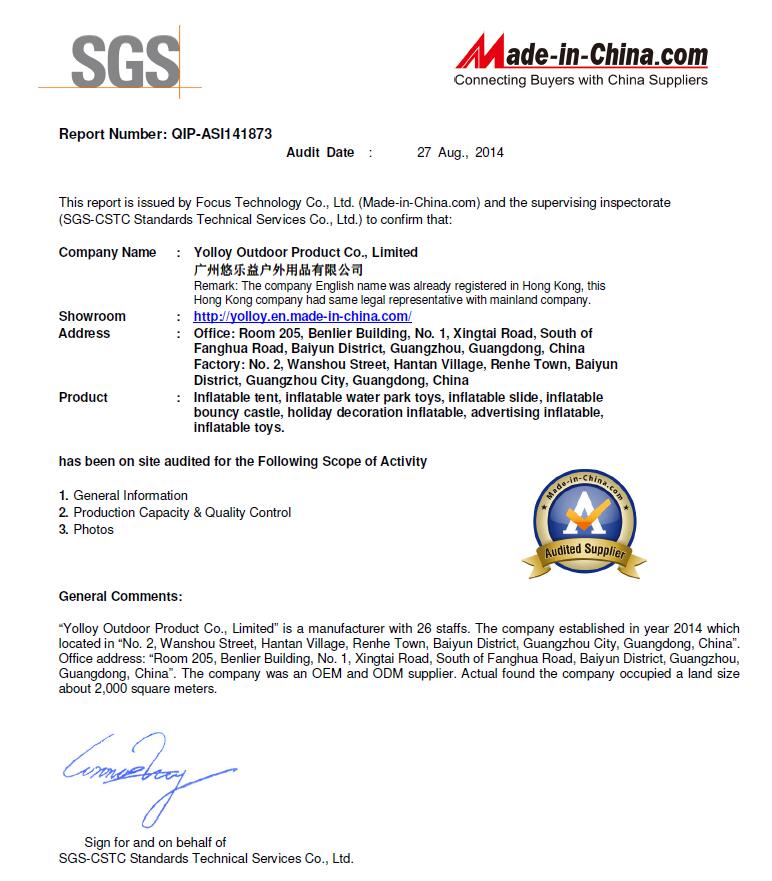
YOLLOY Outdoor Product Co., Limited, based in Guangzhou, China, is one of the established inflatable tent manufacturers serving buyers across Europe, Asia, South America, Africa, the Middle East, and Latin America. The company's product range goes well beyond camping tents and covers the full spectrum of inflatable solutions:

Outdoor Inflatable Tents — cube, tunnel, dome, shelter, car, party, sports, emergency, and workshop configurations. Each tent type is designed for a specific use case, from a compact inflatable car tent for mobile detailing to a large inflatable party tent for weddings.

Clear Inflatable Dome Tents — bubble tents, snow globes, and transparent domes that create immersive outdoor experiences for glamping resorts, restaurant terraces, and stargazing events.

Portable Planetarium Domes — inflatable projection domes and screens for educational programs, mobile science centres, and immersive media installations.

Inflatable Water Park Toys — floating platforms, pools, boats, water balls, and aquatic play products for resorts, water parks, and lakefront recreation businesses.

Interactive Sport Games — inflatable football arenas, ziplines, obstacle courses, bumper balls, and gaga ball pits for team-building events, sports clubs, and family entertainment centres.

Commercial Inflatable Slides and Bounce Houses — water slides, slip-and-slides, and themed bounce houses for rental businesses and amusement parks.

Inflatable Paintball Bunkers — air bunkers, speedball obstacles, and full arena sets for paintball and airsoft fields.

Inflatable Advertising Models — custom-branded arches, sky dancers, lighting decorations, inflatable mascots, and seasonal displays for brand activations and retail promotions.

How the Custom Design Process Works

YOLLOY's custom workflow is straightforward: you provide a description, drawing, sketch, photograph, or site plan — along with your budget — and the design team prepares simulation renderings. You review the renderings, request revisions, and only after your final approval does the design move to the factory floor. This iterative process means you see exactly what you are getting before production begins.

Custom sizes and colours are standard. Company logos and custom artwork can be printed directly onto the product. The minimum order quantity is one piece, which makes it practical to order a single prototype for testing before scaling up. Typical production time for a regular inflatable product is 6 to 15 days, with complex or large custom projects taking longer. Blowers are supplied to match your local voltage requirements — 110V, 220V, or 380V.

Quality Control and Safety Standards

Every inflatable product leaves the factory only after inspection and testing. YOLLOY's materials have passed EN71, EN14960, and RoHS-related testing, with water park inflatables also referencing EN15649. Blowers meet CE or UL requirements. Each inflatable ships with a repair kit, and the company states a three-year service life expectation when products are used and maintained correctly.

Packaging is designed to protect the product during international transit: soft carpet protection, waterproof PVC bags, and outer PE film, with steel pallets used for larger items. The company reports a 95% on-time delivery rate, with air shipping taking 5 to 7 days and sea freight taking 15 to 30 days or more depending on the destination.

Ready to Discuss Your Project?

Whether you need a single inflatable camping tent for a pilot project, a complete set of commercial inflatable tents for a rental fleet, or a fully customized inflatable structure for a unique venue, YOLLOY's design team is ready to work from your brief. Contact Sunny Yang at [email protected] or call +86-20-8370 0771 to start the conversation. Emails and inquiries are answered within 24 hours.


The Complete Guide to Inflatable Tents: From Weekend Camping to Large-Scale Commercial Events

Author:yolloy Date:2026/8/7 11:07:48

The outdoor shelter industry has seen a quiet but decisive shift over the last few years. Traditional pole-and-canvas tents, once the default choice for camping trips, trade shows, and outdoor events, are steadily being replaced by a faster, more versatile alternative: the inflatable tent. Whether you are planning a weekend camping trip, outfitting a glamping resort, or running a rental business that supplies large-scale event structures, choosing the right inflatable camping tent can make the difference between a smooth operation and a logistical headache.

What Makes an Inflatable Tent Different

An inflatable tent replaces the rigid pole framework of a conventional tent with air-filled beams — typically made from reinforced PVC tarpaulin, Oxford fabric, or TPU. A portable electric blower inflates the structure in minutes, and once the beams are pressurized, the tent stands firm without the need for manual assembly of dozens of separate poles and connectors.

The result is a shelter that goes up in a fraction of the time, packs down into a compact carry bag, and withstands wind and weather through the distributed tension of the airbeam structure rather than a handful of ground stakes. For event organizers, campsite operators, and rental businesses, this speed translates directly into lower labor costs and faster turnaround between bookings.

Why the Market Is Moving Toward Inflatable Tents

The case for inflatable tents goes beyond convenience. Several structural advantages are pushing more buyers toward this category:

Rapid Setup. A single person can inflate a mid-sized tent in minutes using a standard electric blower. No poles to thread, no colour-coded clips to match, no assembly diagram to decipher. For commercial operators who set up and tear down multiple times a week, this alone can justify the switch.

Space Without Columns. Because the walls are supported by air pressure rather than a forest of internal poles, inflatable tents offer unobstructed interior space. A 6-metre tunnel tent, for example, provides a continuous open floor area that would be impossible with a pole-frame equivalent. This makes them ideal for product displays, dining areas, medical triage stations, and any application where clear floor space matters.

Durability That Surprises First-Time Buyers. A common misconception is that inflatable means fragile. In practice, commercial-grade inflatable tents use high-density PVC tarpaulin with reinforced seams, waterproof nylon thread, and additional reinforcement at all high-load attachment points. The airbeam structure distributes wind load across the entire shell rather than concentrating it on pole joints — which is why many inflatable tents perform better in sustained wind than their pole-frame counterparts.

Not All Inflatable Tents Are Built the Same

When you start comparing products from different inflatable tent manufacturers, a few quality markers separate well-engineered tents from budget alternatives.

Material Matters. The best inflatable tents use commercial-grade PVC tarpaulin for the shell, with Oxford fabric, nylon, or TPU available for specific applications. The choice of material affects everything from UV resistance to cold-weather flexibility. A tent built for summer festivals may not perform well in alpine conditions, and vice versa. Working with an experienced manufacturer means matching the material specification to the actual use environment.

Seam Construction. Air-tight products require high-temperature fusion welding equipment, not just stitching. Sewn products need precision sewing machines, reinforced seams, and waterproof nylon thread. Manufacturers that invest in both welding and sewing capabilities can handle the full range of inflatable products — from airtight water park toys to sewn tent shells.

Anchor Systems. Wind resistance depends heavily on how the tent is anchored. Look for D-ring or round metal anchor points integrated into the structure, not added as an afterthought. The anchor system should be designed to work with the specific product's shape and size, and the manufacturer should provide clear guidance on anchoring requirements for different wind conditions.

Beyond Camping: The Commercial Applications of Inflatable Tents

While the term "inflatable tent" often brings to mind a weekend camping trip, the commercial side of the market is where the real growth is happening. Event rental companies, exhibition organizers, sports clubs, emergency response teams, and hospitality businesses are all adopting inflatable structures for their speed, portability, and visual impact.

A best inflatable tent for commercial use is not the same as a camping tent. Commercial tents are built to withstand repeated setup and teardown cycles, often in different locations each week. They need to support branding — printed logos, custom colours, and themed designs — and they need to comply with fire safety and material safety standards relevant to public events.

Some of the most common commercial applications include inflatable party tents for weddings and corporate events, inflatable dome tents for immersive dining experiences, inflatable shelters for outdoor medical stations, and inflatable sports tents for tournament sidelines. The list keeps growing as more industries discover the combination of fast setup and striking visual presence that inflatable tents offer.

What to Look for in an Inflatable Tent Manufacturer

If you are sourcing inflatable tents for a business — whether you run a rental company, a resort, an event planning agency, or a government procurement office — choosing the right manufacturing partner is as important as choosing the right product. Here are the factors that matter most:

Custom Design Capability. Can the manufacturer produce a tent from your description, a rough sketch, a photograph, or a site plan? A full-service manufacturer starts with simulation renderings, revises the design until you approve it, and only then releases it for production. This design-to-production workflow ensures that what arrives at your door matches what you envisioned.

Certifications and Testing. Reputable manufacturers have their materials and finished products tested against recognized standards. For inflatable tents, relevant certifications include EN71 for material safety, EN14960 for inflatable toys, EN15649 for water park inflatables, and RoHS compliance for restricted substances. Blowers should carry CE or UL certification. If a manufacturer cannot provide or reference these certifications, that is a red flag.

Flexible Order Quantities. Not every buyer needs a container load. Some manufacturers accept orders as small as a single piece, which is valuable for prototype testing, small events, or trial runs before committing to a larger order. This flexibility signals that the manufacturer is willing to work with you at your scale, not just theirs.

Global Export Experience. Exporting inflatable products involves navigating voltage requirements (110V, 220V, or 380V blowers), packaging for sea and air freight, customs documentation, and transit time expectations. A manufacturer with established export channels to Europe, Asia, the Americas, the Middle East, and Africa is more likely to handle your shipment smoothly than one that only serves its domestic market.

One Manufacturer, a Full Product Range

YOLLOY Outdoor Product Co., Limited, based in Guangzhou, China, is one of the established inflatable tent manufacturers serving buyers across Europe, Asia, South America, Africa, the Middle East, and Latin America. The company's product range goes well beyond camping tents and covers the full spectrum of inflatable solutions:

Outdoor Inflatable Tents — cube, tunnel, dome, shelter, car, party, sports, emergency, and workshop configurations. Each tent type is designed for a specific use case, from a compact inflatable car tent for mobile detailing to a large inflatable party tent for weddings.

Clear Inflatable Dome Tents — bubble tents, snow globes, and transparent domes that create immersive outdoor experiences for glamping resorts, restaurant terraces, and stargazing events.

Portable Planetarium Domes — inflatable projection domes and screens for educational programs, mobile science centres, and immersive media installations.

Inflatable Water Park Toys — floating platforms, pools, boats, water balls, and aquatic play products for resorts, water parks, and lakefront recreation businesses.

Interactive Sport Games — inflatable football arenas, ziplines, obstacle courses, bumper balls, and gaga ball pits for team-building events, sports clubs, and family entertainment centres.

Commercial Inflatable Slides and Bounce Houses — water slides, slip-and-slides, and themed bounce houses for rental businesses and amusement parks.

Inflatable Paintball Bunkers — air bunkers, speedball obstacles, and full arena sets for paintball and airsoft fields.

Inflatable Advertising Models — custom-branded arches, sky dancers, lighting decorations, inflatable mascots, and seasonal displays for brand activations and retail promotions.

How the Custom Design Process Works

YOLLOY's custom workflow is straightforward: you provide a description, drawing, sketch, photograph, or site plan — along with your budget — and the design team prepares simulation renderings. You review the renderings, request revisions, and only after your final approval does the design move to the factory floor. This iterative process means you see exactly what you are getting before production begins.

Custom sizes and colours are standard. Company logos and custom artwork can be printed directly onto the product. The minimum order quantity is one piece, which makes it practical to order a single prototype for testing before scaling up. Typical production time for a regular inflatable product is 6 to 15 days, with complex or large custom projects taking longer. Blowers are supplied to match your local voltage requirements — 110V, 220V, or 380V.

Quality Control and Safety Standards

Every inflatable product leaves the factory only after inspection and testing. YOLLOY's materials have passed EN71, EN14960, and RoHS-related testing, with water park inflatables also referencing EN15649. Blowers meet CE or UL requirements. Each inflatable ships with a repair kit, and the company states a three-year service life expectation when products are used and maintained correctly.

Packaging is designed to protect the product during international transit: soft carpet protection, waterproof PVC bags, and outer PE film, with steel pallets used for larger items. The company reports a 95% on-time delivery rate, with air shipping taking 5 to 7 days and sea freight taking 15 to 30 days or more depending on the destination.

Ready to Discuss Your Project?

Whether you need a single inflatable camping tent for a pilot project, a complete set of commercial inflatable tents for a rental fleet, or a fully customized inflatable structure for a unique venue, YOLLOY's design team is ready to work from your brief. Contact Sunny Yang at [email protected] or call +86-20-8370 0771 to start the conversation. Emails and inquiries are answered within 24 hours.