Products Category
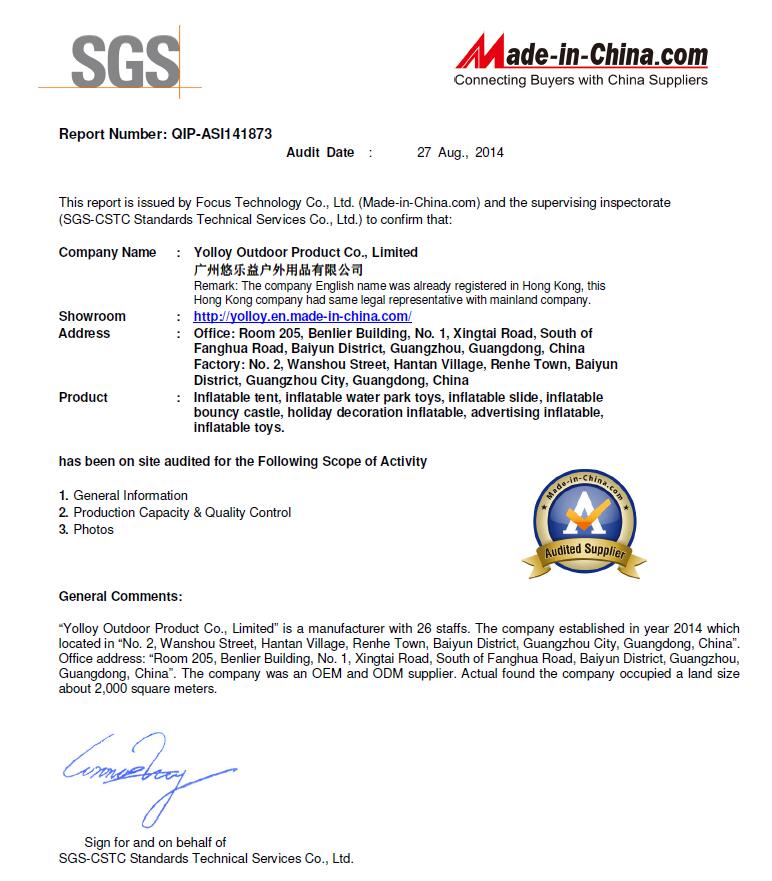
Certification

News

• New Order Successfully Finished for Long-Time Cooperated Japanese Client | YOLLOY Wins Full Client Recognition

• YOLLOY Custom Inflatable Pool Tent for Danish Client: Professional Pool Repair Shelter & Debris Protection

• Trusted Once Again! Greek Captain Re-orders Our Products After 4 Years

• Revolutionize Your Outdoors: The All-Terrain Inflatable Floating Tent for Land & Water

• Elevate Your Summer Fun: The Ultimate Inflatable Water Floating Volleyball Court Trampoline

• Innovative Inflatable Nightclub Tents & Pop-Up Bars: The Ultimate Solution for Portable Party Venues

Contact Us

Name: Sunny Yang
Tel: +86-20-8370 0771
Fax: +86-20-8370 0771
Mobile: 13570587575
E-mail: [email protected]
Add: No 5,Xiong wei Bo Nan Road,ZhongLuoTan Town,Baiyun district,Guangzhou,China
Friend me on Facebook Follow me on Twitter Add me to your circles Follow me on Pinterest Watch my channel on YouTube
News

The Complete Guide to Commercial Inflatable Tents: Versatility, Durability, and Smart Investment

Author:yolloy Date:2026/8/12 7:40:23

Why businesses and event planners worldwide are switching to air-supported structures

When you think about outdoor shelters — whether for a corporate event, a wedding reception, a trade show booth, or an emergency response operation — the first image that comes to mind may be a traditional pole-and-canvas structure. But there is a growing shift toward a smarter alternative: inflatable tent outdoor solutions. These air-supported structures have evolved far beyond simple camping gear. Today, commercial-grade inflatable tents are redefining how businesses, event planners, and organizations approach temporary and semi-permanent outdoor spaces.

What Is an Inflatable Tent?

An inflatable tent uses air-filled beams instead of rigid metal or fiberglass poles to create its structure. The beams are inflated with an electric blower, and once fully pressurized, they form a sturdy, self-supporting frame. The tent fabric — typically commercial-grade PVC tarpaulin, Oxford fabric, nylon, or TPU — is permanently attached to the air beams, creating a single integrated unit that requires no assembly of separate components.

Unlike traditional tents that require threading poles through fabric sleeves and carefully tensioning multiple guy lines, an inflatable tent can be set up by one or two people in a matter of minutes. This speed and simplicity make inflatable tents particularly attractive for commercial applications where time and labor efficiency are critical factors in the bottom line.

Why Choose Inflatable Tents for Commercial Use?

Rapid Deployment

Time is money in the events and rental industry. An inflatable dome tent can be fully deployed in a matter of minutes with an electric pump, compared to the 30 to 60 minutes often required for a comparable pole tent. This rapid deployment is invaluable for event rental companies, exhibition organizers, and emergency response teams who need to establish functional shelter quickly and efficiently.

Superior Wind Resistance

Contrary to what one might assume, inflatable tents perform exceptionally well in windy conditions. The thick, pressurized air beams have a significantly larger diameter than traditional tent poles and can flex under wind load without bending, snapping, or permanently deforming. When properly anchored with D-ring or metal ground stake systems, a well-constructed inflatable tent can withstand strong winds that would compromise standard pole structures.

Single-Unit Convenience

An inflatable tent is a complete structure — no loose poles, no separate flysheets, no detachable connectors. This means zero risk of losing or misplacing essential components during transport or setup. When it is time to pack up, simply deflate, roll, and store. The convenience factor directly reduces labor costs and simplifies logistics for rental businesses managing multiple installations per week.

Versatile Applications Across Industries

One of the greatest strengths of inflatable tents is their remarkable adaptability. The same fundamental air-beam technology can be configured into a wide range of shapes and sizes to serve entirely different purposes. An inflatable dome tent can serve as a planetarium, a luxury glamping pod, or a branded trade show pavilion. A cube-shaped inflatable tent works perfectly as a medical triage unit, a portable workshop, or a spray painting booth. Tunnel designs are ideal for exhibition corridors and covered walkways, while custom-shaped tents can be fully branded for high-impact promotional events.

Types of Inflatable Tents Available

The modern inflatable tent market offers a diverse range of designs to match specific operational needs:

Dome Tents — Spherical or geodesic structures offering excellent interior space and wind resistance. Widely used for glamping sites, outdoor dining venues, planetariums, and immersive event experiences.

Cube Tents — Square or rectangular designs with high ceilings and straight walls that maximize usable floor space. Ideal for trade show booths, medical stations, portable offices, and equipment shelters.

Tunnel Tents — Elongated structures perfect for exhibition hallways, covered pedestrian corridors, and sequential event layouts at festivals and fairs.

Clear Dome Tents — Transparent PVC domes providing panoramic 360-degree views. Increasingly popular for luxury camping, rooftop dining experiences, stargazing events, and winter garden installations.

Party and Event Tents — Large-capacity structures designed for weddings, corporate galas, music festivals, and community celebrations.

Specialty Tents — Application-specific designs including car shelters, inflatable spray painting booths, golf simulator enclosures, nightclub tents, and sports facility covers.

Customization: Getting Exactly What You Need

One of the most significant advantages of sourcing from a specialized manufacturer is the ability to customize virtually every aspect of your inflatable tent. Working from a sketch, photograph, site plan, or even a verbal description, an experienced design team can create 3D simulation renderings for your review and approval before production begins. This collaborative design process ensures the final product matches your exact vision and functional requirements.

Customization options include: Size (virtually any dimensions), color and branding (logos and artwork printed directly onto the fabric), material selection (PVC tarpaulin, Oxford fabric, nylon, or TPU), blower voltage (110V, 220V, or 380V), and accessories (windows, doors, flooring, lighting systems, and anchor configurations).

Quality and Safety Standards

When investing in commercial inflatable equipment, quality and safety certifications are non-negotiable. Reputable manufacturers use materials tested to meet EN71, EN14960, and RoHS standards, while inflatable water park products reference EN 15649. Blowers should meet CE or UL requirements for electrical safety.

Manufacturing quality is evident in the details: precision sewing equipment, reinforced seams, waterproof nylon thread, and additional reinforcement at high-load stress areas. Airtight seams are created through high-temperature fusion welding — a process that ensures long-term air retention and structural integrity. Each product should be inspected and tested before shipment, and a repair kit should be included with every purchase. Look for manufacturers that offer a warranty period — typically around three years of service life when products are used and maintained correctly — and commit to responsive after-sales support.

How to Choose the Right Inflatable Tent Manufacturer

When sourcing custom inflatable tent products for commercial use, consider these key evaluation criteria:

1. Custom Design Capability — Can the manufacturer translate your concept into a production-ready design? Look for a provider that offers simulation renderings and a collaborative design approval process rather than a simple catalog order system.

2. Material Quality and Certifications — Verify that commercial-grade materials are used and that relevant safety certifications (EN71, EN14960, RoHS, CE, UL) are in place. Ask about material sourcing and testing protocols.

3. Minimum Order Quantity — Some manufacturers require large minimum orders that can be prohibitive for small businesses. Look for flexible MOQ policies — some manufacturers accept orders starting from just one piece.

4. Production Timeline — Standard production typically takes 6 to 15 days for regular inflatable products. Complex or large custom orders may take longer. Confirm timelines before committing.

5. Shipping and Logistics — Ensure the manufacturer can arrange air freight (approximately 5–7 days transit) or sea shipping (15–30+ days) to your destination. Verify packaging standards — quality manufacturers use soft carpet protection, waterproof PVC bags, and steel pallets for large items.

6. After-Sales Support — A repair kit, warranty coverage, and responsive customer service (ideally within 24 hours) are essential for protecting your investment and minimizing downtime.

Making the Smart Investment

Inflatable tents represent a forward-thinking investment for businesses in the event rental, hospitality, emergency response, and outdoor recreation industries. Their combination of rapid setup, structural durability, versatile design, and extensive customization potential makes them a compelling alternative to traditional pole tents. Whether you need a single custom tent for a signature event or a fleet of commercial-grade structures for your rental business, partnering with an experienced manufacturer ensures you receive a product that meets your specifications and delivers reliable performance for years to come. With the right partner, an inflatable tent is not just a shelter — it is a scalable, branded, and highly functional asset that grows with your business.


The Complete Guide to Commercial Inflatable Tents: Versatility, Durability, and Smart Investment

Author:yolloy Date:2026/8/12 7:40:23

Why businesses and event planners worldwide are switching to air-supported structures

When you think about outdoor shelters — whether for a corporate event, a wedding reception, a trade show booth, or an emergency response operation — the first image that comes to mind may be a traditional pole-and-canvas structure. But there is a growing shift toward a smarter alternative: inflatable tent outdoor solutions. These air-supported structures have evolved far beyond simple camping gear. Today, commercial-grade inflatable tents are redefining how businesses, event planners, and organizations approach temporary and semi-permanent outdoor spaces.

What Is an Inflatable Tent?

An inflatable tent uses air-filled beams instead of rigid metal or fiberglass poles to create its structure. The beams are inflated with an electric blower, and once fully pressurized, they form a sturdy, self-supporting frame. The tent fabric — typically commercial-grade PVC tarpaulin, Oxford fabric, nylon, or TPU — is permanently attached to the air beams, creating a single integrated unit that requires no assembly of separate components.

Unlike traditional tents that require threading poles through fabric sleeves and carefully tensioning multiple guy lines, an inflatable tent can be set up by one or two people in a matter of minutes. This speed and simplicity make inflatable tents particularly attractive for commercial applications where time and labor efficiency are critical factors in the bottom line.

Why Choose Inflatable Tents for Commercial Use?

Rapid Deployment

Time is money in the events and rental industry. An inflatable dome tent can be fully deployed in a matter of minutes with an electric pump, compared to the 30 to 60 minutes often required for a comparable pole tent. This rapid deployment is invaluable for event rental companies, exhibition organizers, and emergency response teams who need to establish functional shelter quickly and efficiently.

Superior Wind Resistance

Contrary to what one might assume, inflatable tents perform exceptionally well in windy conditions. The thick, pressurized air beams have a significantly larger diameter than traditional tent poles and can flex under wind load without bending, snapping, or permanently deforming. When properly anchored with D-ring or metal ground stake systems, a well-constructed inflatable tent can withstand strong winds that would compromise standard pole structures.

Single-Unit Convenience

An inflatable tent is a complete structure — no loose poles, no separate flysheets, no detachable connectors. This means zero risk of losing or misplacing essential components during transport or setup. When it is time to pack up, simply deflate, roll, and store. The convenience factor directly reduces labor costs and simplifies logistics for rental businesses managing multiple installations per week.

Versatile Applications Across Industries

One of the greatest strengths of inflatable tents is their remarkable adaptability. The same fundamental air-beam technology can be configured into a wide range of shapes and sizes to serve entirely different purposes. An inflatable dome tent can serve as a planetarium, a luxury glamping pod, or a branded trade show pavilion. A cube-shaped inflatable tent works perfectly as a medical triage unit, a portable workshop, or a spray painting booth. Tunnel designs are ideal for exhibition corridors and covered walkways, while custom-shaped tents can be fully branded for high-impact promotional events.

Types of Inflatable Tents Available

The modern inflatable tent market offers a diverse range of designs to match specific operational needs:

Dome Tents — Spherical or geodesic structures offering excellent interior space and wind resistance. Widely used for glamping sites, outdoor dining venues, planetariums, and immersive event experiences.

Cube Tents — Square or rectangular designs with high ceilings and straight walls that maximize usable floor space. Ideal for trade show booths, medical stations, portable offices, and equipment shelters.

Tunnel Tents — Elongated structures perfect for exhibition hallways, covered pedestrian corridors, and sequential event layouts at festivals and fairs.

Clear Dome Tents — Transparent PVC domes providing panoramic 360-degree views. Increasingly popular for luxury camping, rooftop dining experiences, stargazing events, and winter garden installations.

Party and Event Tents — Large-capacity structures designed for weddings, corporate galas, music festivals, and community celebrations.

Specialty Tents — Application-specific designs including car shelters, inflatable spray painting booths, golf simulator enclosures, nightclub tents, and sports facility covers.

Customization: Getting Exactly What You Need

One of the most significant advantages of sourcing from a specialized manufacturer is the ability to customize virtually every aspect of your inflatable tent. Working from a sketch, photograph, site plan, or even a verbal description, an experienced design team can create 3D simulation renderings for your review and approval before production begins. This collaborative design process ensures the final product matches your exact vision and functional requirements.

Customization options include: Size (virtually any dimensions), color and branding (logos and artwork printed directly onto the fabric), material selection (PVC tarpaulin, Oxford fabric, nylon, or TPU), blower voltage (110V, 220V, or 380V), and accessories (windows, doors, flooring, lighting systems, and anchor configurations).

Quality and Safety Standards

When investing in commercial inflatable equipment, quality and safety certifications are non-negotiable. Reputable manufacturers use materials tested to meet EN71, EN14960, and RoHS standards, while inflatable water park products reference EN 15649. Blowers should meet CE or UL requirements for electrical safety.

Manufacturing quality is evident in the details: precision sewing equipment, reinforced seams, waterproof nylon thread, and additional reinforcement at high-load stress areas. Airtight seams are created through high-temperature fusion welding — a process that ensures long-term air retention and structural integrity. Each product should be inspected and tested before shipment, and a repair kit should be included with every purchase. Look for manufacturers that offer a warranty period — typically around three years of service life when products are used and maintained correctly — and commit to responsive after-sales support.

How to Choose the Right Inflatable Tent Manufacturer

When sourcing custom inflatable tent products for commercial use, consider these key evaluation criteria:

1. Custom Design Capability — Can the manufacturer translate your concept into a production-ready design? Look for a provider that offers simulation renderings and a collaborative design approval process rather than a simple catalog order system.

2. Material Quality and Certifications — Verify that commercial-grade materials are used and that relevant safety certifications (EN71, EN14960, RoHS, CE, UL) are in place. Ask about material sourcing and testing protocols.

3. Minimum Order Quantity — Some manufacturers require large minimum orders that can be prohibitive for small businesses. Look for flexible MOQ policies — some manufacturers accept orders starting from just one piece.

4. Production Timeline — Standard production typically takes 6 to 15 days for regular inflatable products. Complex or large custom orders may take longer. Confirm timelines before committing.

5. Shipping and Logistics — Ensure the manufacturer can arrange air freight (approximately 5–7 days transit) or sea shipping (15–30+ days) to your destination. Verify packaging standards — quality manufacturers use soft carpet protection, waterproof PVC bags, and steel pallets for large items.

6. After-Sales Support — A repair kit, warranty coverage, and responsive customer service (ideally within 24 hours) are essential for protecting your investment and minimizing downtime.

Making the Smart Investment

Inflatable tents represent a forward-thinking investment for businesses in the event rental, hospitality, emergency response, and outdoor recreation industries. Their combination of rapid setup, structural durability, versatile design, and extensive customization potential makes them a compelling alternative to traditional pole tents. Whether you need a single custom tent for a signature event or a fleet of commercial-grade structures for your rental business, partnering with an experienced manufacturer ensures you receive a product that meets your specifications and delivers reliable performance for years to come. With the right partner, an inflatable tent is not just a shelter — it is a scalable, branded, and highly functional asset that grows with your business.