Products Category
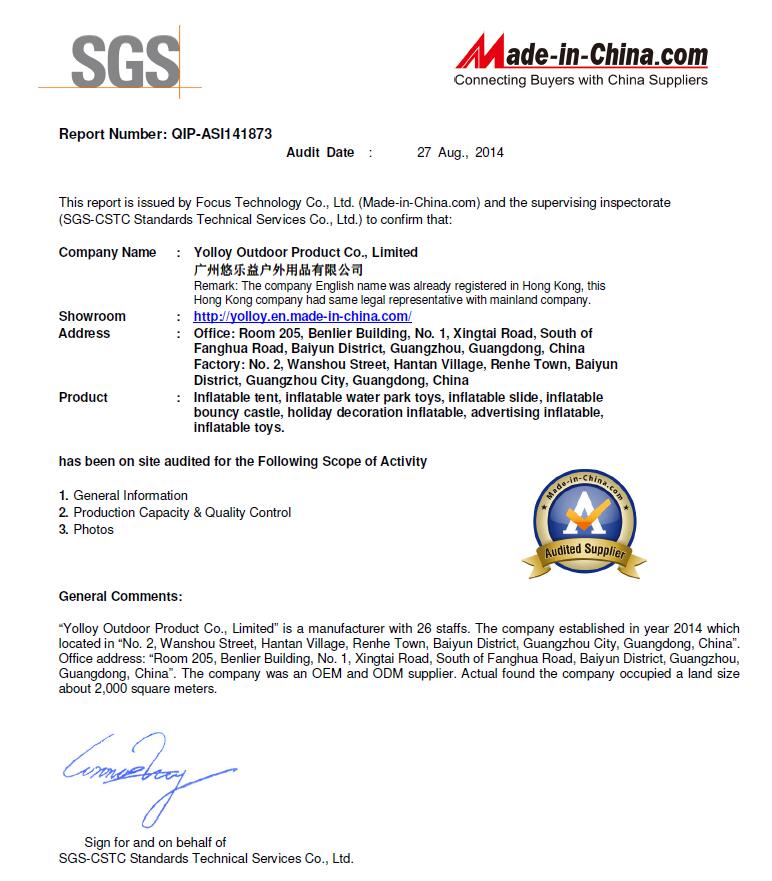
Certification

News

• Inflatable spider dome is our favorite outdoor tent when we go out

• How good of the Portable Inflatable Golf Field Tent

• Popular Portable Inflatable Golf Field In Our Life

• Discover the Revolutionary Inflatable Tent Cover for Pools

• YOLLOY Inflatable Car Wash Mat

• New Water Park Inflatables Delivered for Japanese Client

Contact Us

Name: Sunny Yang
Tel: +86-20-8370 0771
Fax: +86-20-8370 0771
Mobile: 13570587575
E-mail: sales@yolloy.com
Add: No 5,Xiong wei Bo Nan Road,ZhongLuoTan Town,Baiyun district,Guangzhou,China
Friend me on Facebook Follow me on Twitter Add me to your circles Follow me on Pinterest Watch my channel on YouTube
News

Tear-Resistant Inflatable Winter Tent – Durable Against Sharp Objects

Author:yolloy Date:2026/4/2 16:58:51

Winter has a certain magic to it. The serene quiet of a snow-covered landscape, the crispness of the air, the way sunlight glints off ice crystals. It's an invitation to the outdoors, a call to experience a world transformed. But with this beauty comes a challenge: the elements. The cold, the wind, and, surprisingly, the hidden hazards that can turn a peaceful winter outing into a logistical nightmare. We're talking about frozen, sharp branches hidden under snow, jagged ice edges, or even the simple act of leaning your skis against your shelter.

For decades, the answer to winter shelter has been a complex web of poles, pegs, and heavy fabric—a puzzle that becomes exponentially harder to solve with frozen fingers. Traditional tents, while functional, have always had a vulnerability. They can be cumbersome, and a single, well-placed tear can compromise the entire structure.

But what if there was a better way? What if you could have a robust, warm, and astonishingly durable winter shelter that sets up in minutes, not hours? What if that shelter wasn't just resistant to the cold, but also to the very things that threaten lesser materials? This is where the evolution of outdoor equipment takes a giant leap forward. We're diving deep into the world of the modern tear-resistant inflatable winter tent, a feat of material science and engineering that is redefining what's possible for winter adventures, events, and even commercial use. Prepare to have your perceptions of "inflatable" completely transformed.

Chapter 1: Shattering the Myth of Inflatable Fragility

Let's be honest. When you hear the word "inflatable," what's the first thing that comes to mind? A pool toy? A birthday party balloon? Something that seems one stray pin away from a sad, deflated demise. This is the single biggest misconception we need to tackle right away. A professional-grade inflatable tent is about as similar to a pool float as a monster truck is to a tricycle. They share a basic principle—air pressure—but the materials, construction, and purpose are worlds apart.

The secret lies in the fabric. We're not talking about thin vinyl or rubber. We're talking about high-tech, commercial-grade materials like the waterproof and fire-retardant PVC tarpaulin used in Yolloy products. This isn't just a single sheet of plastic. It's a composite material, typically featuring a strong inner scrim of polyester or nylon fabric, which provides immense tensile strength and tear resistance. This core fabric is then coated on both sides with thick, flexible PVC (Polyvinyl Chloride).

Think of it like reinforced concrete. The inner fabric is the rebar, preventing tears from starting or spreading, while the outer PVC coating provides the waterproofing, air-holding capability, and resistance to abrasion and UV rays. This material is so tough that it's the industry standard for things that need to be both airtight and incredibly durable. The same core technology that makes a Yolloy winter tent possible is trusted in some of the most demanding environments imaginable. Consider an inflatable floating water park , which endures constant sun, chlorinated or salt water, and the non-stop scraping and climbing of hundreds of people every day. The material has to be flawless, and it's this level of industrial strength that is engineered into every tent.

A key indicator of quality and safety is certification. Yolloy's commitment to using materials that pass rigorous standards, such as the EN71 safety standard , isn't just a talking point. It's your assurance that the tent is free from harmful chemicals and is manufactured to a benchmark of quality that goes far beyond typical consumer goods. For water-based products, the use of eco-friendly TPU material further showcases a dedication to performance without compromising on user safety or environmental responsibility.

So, the next time you picture an inflatable structure, shift your mental image from a party balloon to the heavy-duty tarpaulin on a long-haul truck, or the robust material of a white-water raft navigating rocky rapids. That is the true starting point for understanding the durability of a professional inflatable tent. The "pop" is a myth; the reality is resilience.

Chapter 2: The Science Behind Resisting Tears and Punctures

"Okay," you might be thinking, "the material is tough. But how does it actually resist a sharp object?" It comes down to a combination of material properties, structural design, and meticulous manufacturing techniques. It's not magic; it's a deliberate application of science.

The Power of the Weave: Ripstop Principle

Many high-end technical fabrics, including the core of our PVC tarpaulin, incorporate a "ripstop" weave. During the weaving process, thicker, stronger reinforcement yarns are interwoven at regular intervals in a crosshatch pattern. You might be able to see this if you look closely at the material—a grid of tiny squares.

This grid is a mechanical marvel. If a sharp object does manage to create a small puncture or tear, the tear will travel until it hits one of these reinforcement threads. The thicker thread acts as a barrier, a "rip-stopper," localizing the damage and preventing it from propagating across the entire fabric panel. This is the difference between a tiny, easily repairable hole and a catastrophic failure that ruins your gear and your day.

The Unsung Hero: Seam Strength

A tent is only as strong as its weakest point, and in many conventional tents, that point is the stitching. Every needle puncture creates a tiny hole, a potential entry point for water and a stress riser that can start a tear. In an inflatable structure, stitched seams are simply not an option—they wouldn't be airtight.

Instead, Yolloy employs advanced techniques like high-frequency welding or heat welding. This process uses heat and pressure to fuse the overlapping pieces of PVC tarpaulin together at a molecular level. The result is a seamless, continuous bond that is actually stronger than the original material itself. There are no threads to rot or break, and no needle holes to weaken the structure. When you try to pull a welded seam apart, the fabric around it will tear before the seam itself gives way. This is critical for both air retention and overall structural integrity, especially against tearing forces.

Material Comparison: A Clear Winner

To put this in perspective, let's compare the material used in a high-quality Yolloy inflatable tent to that of a standard nylon backpacking tent. While both are designed for shelter, their physical properties are tailored for vastly different philosophies of use.

Property Standard Nylon Tent Fabric Yolloy Commercial-Grade PVC Tarpaulin
Puncture Resistance Low to Moderate. Vulnerable to sharp twigs and rocks. Very High. The thick PVC layer dissipates force from sharp points.
Tear Strength (Post-Puncture) Low. A small tear can easily run without a ripstop weave. Extremely High. Ripstop core and welded seams prevent tear propagation.
Abrasion Resistance Moderate. Thin coatings can wear off from rubbing against rough surfaces. Exceptional. Designed for constant contact with abrasive surfaces.
Waterproofing Relies on a thin coating (DWR) that requires re-application. Seams must be sealed. Inherently 100% waterproof. Welded seams create a monolithic, impermeable barrier.
Repairability Requires sewing and seam-sealing. Difficult in the field. Simple. A small patch kit with compatible glue creates a permanent, airtight bond in minutes.

As the table clearly shows, while a nylon tent prioritizes being lightweight above all else, the PVC tarpaulin of an inflatable tent is engineered from the ground up for maximum durability and resilience. It's a trade-off, but for applications where reliability and toughness are paramount, the choice is clear.

Chapter 3: Real-World Tests: Durability in Action

Theory and material science are one thing, but the real question is: how does this hold up in the messy, unpredictable real world? Let's walk through some common winter scenarios that would spell disaster for a lesser tent, and see how a tear-resistant inflatable structure fares.

Scenario 1: The Hidden Branch Ambush

You've set up your camp. A strong gust of wind whips through the trees, snapping a dead, frozen branch. It falls and scrapes down the side of your tent. With a conventional tent, you'd hear a sickening ripping sound. With a Yolloy inflatable tent, the outcome is different. The smooth, tough outer PVC layer is incredibly slick. The branch is more likely to slide off than to dig in. Even if the point is sharp enough to press into the material, the fabric's thickness and flexibility allow it to deform and absorb the impact. A permanent puncture is unlikely; at worst, you might get a surface scuff that does nothing to compromise the tent's integrity.

Scenario 2: The Gear Lean

After a long day of skiing or snowboarding, you come back to camp and carelessly lean your skis against the tent. The sharp, metal edges press against the inflated wall. This is a classic puncture scenario. However, the air pressure inside the tent works in your favor. It creates a firm, yet yielding, surface. The force from the ski edge is distributed over a wider area of the fabric, preventing any single point from bearing all the stress. The material is simply too tough and the internal pressure too supportive for such a casual contact to cause damage. This is the same principle that allows a commercial car detailing inflatable tent to stand up to the hustle and bustle of a busy workshop, where tools, equipment, and car parts are constantly being moved around. The durability has to be trusted in a professional environment.

Scenario 3: The Icy Ground Setup

Winter ground is rarely smooth. It's often a lumpy, frozen mix of dirt, rocks, and ice. Laying down a standard tent floor on this surface is a recipe for micro-tears and abrasion. Yolloy inflatable tents, particularly those designed for rugged use, feature an even thicker, reinforced floor material. This "tub" floor is welded to the main tent body, creating a completely sealed and incredibly tough base. It's designed to be dragged, set up on imperfect surfaces, and withstand the friction and pressure from within without complaint.

Scenario 4: The Unforeseen Accident

Let's imagine the worst-case scenario. A truly freak accident. Someone trips with a sharp tool, and it manages to create a legitimate puncture. Is the trip ruined? Absolutely not. Because of the ripstop nature of the fabric, the hole will not expand. The tent will deflate slowly, not pop. And the repair is astonishingly simple. Every tent comes with a patch kit. You simply clean the area, apply the special adhesive, press the patch on, and wait a few minutes. The chemical weld creates a bond that is just as strong and airtight as the original material. You can re-inflate and be back in business, fully sheltered and secure. This field repairability is a critical, and often overlooked, aspect of true durability. This robustness is even more critical in industrial applications like a sealed spray booth , where any breach could compromise a paint job or release fumes. The material has to be both tough and easily maintainable.

Chapter 4: Beyond Toughness: The Inflatable Advantage

Being incredibly durable is a massive plus, but the benefits of a modern inflatable tent go far beyond simply not breaking. The technology unlocks new possibilities for comfort, experience, and versatility.

The Ultimate Winter Room with a View

This is where products like the Yolloy inflatable snow globe tent truly shine. Imagine sitting in a warm, comfortable chair, protected from wind and snow, while having a panoramic, 360-degree view of the winter landscape around you. The transparent, yet equally durable, PVC allows you to be fully immersed in nature without being exposed to it. It transforms a tent from a mere shelter into an experience portal. It's perfect for backyard winter get-togethers, unique restaurant seating, or simply the most epic personal campsite you can imagine.

Effortless Setup in Harsh Conditions

Anyone who has fumbled with frozen aluminum poles while wearing thick gloves knows the pain of setting up a traditional tent in the cold. An inflatable tent eliminates this struggle.

  • Roll the tent out on your desired spot.
  • Secure the corners with stakes.
  • Connect the included electric pump.
  • Flick a switch and watch it rise.

Within minutes, you have a fully erect, stable structure. This speed isn't just about convenience; it's a safety feature. In rapidly deteriorating weather, getting your shelter up quickly is paramount.

Surprising Stability in Wind and Snow

How can a "bubble" of air be stable in a storm? It's all about physics. The rounded, aerodynamic shape of many inflatable tents presents a low profile to the wind, allowing it to flow over and around rather than pushing against a flat wall. The air-filled beams are incredibly rigid under pressure, creating a strong, semi-flexible frame that can absorb gusts without snapping like a rigid pole. When properly anchored, these tents are exceptionally stable. Furthermore, their continuous, smooth surface sheds snow much more effectively than a traditional tent with multiple nooks and crannies where snow can accumulate. This versatility and engineering prowess is evident across the product line, from leisure tents to a specialized mobile golf simulator inflatable tent , which needs to be stable enough for year-round, indoor-outdoor use.

Chapter 5: The Yolloy Promise: Quality from Concept to Your Doorstep

A superior product is born from a superior process. The tear-resistance and durability of a Yolloy tent aren't an accident; they are the result of a philosophy that permeates every stage of the business, guided by a simple yet powerful slogan: "Provide customers with professional and qualified products."

Customization at the Core

Yolloy isn't just a reseller; it's a manufacturer with a deep well of design expertise. This is most evident in their support for custom design . The process is collaborative and customer-focused. It begins with your idea, whether it's a specific size for a commercial event, a unique window placement for a camping tent, or a completely new concept. The design team then translates that idea into a detailed 3D mock-up. You get to see exactly what your product will look like, suggest modifications, and tweak the design until it's perfect—all before a single piece of fabric is cut. This ensures the final product is not just high-quality, but is precisely what you need.

A Service That Builds Trust

Great products can be let down by poor service, but Yolloy ensures the customer experience is as robust as its tents. This is built on two pillars: communication and reliability. The guarantee of a response to emails within 24 hours means you're never left wondering about the status of your inquiry or order. Throughout the production process, there's a commitment to keeping you informed, confirming details to ensure complete transparency.

Moreover, in a world of supply chain uncertainties, a 95% on-time delivery rate is a testament to meticulous planning and project management. And in the rare case of a delay, proactive communication ensures you are notified in advance, allowing you to plan accordingly. This respect for the customer's time and trust is a cornerstone of the company's ethos.

Continuous Innovation

A great company never stands still. The commitment to innovation is clear in the pipeline of new products for 2025. Items like a "space-saving inflatable wash mat," an "anti-snow tunnel tent," and "inflatable light pillars" show a company that is constantly listening to the market, identifying new problems to solve, and pushing the boundaries of what is possible with inflatable technology.

Conclusion: Redefining Your Winter World

The inflatable winter tent is no longer a novelty; it is the pinnacle of modern shelter technology. It represents a paradigm shift away from the fragile and cumbersome solutions of the past. We've seen that "inflatable" does not mean "fragile"—in fact, when engineered correctly with materials like commercial-grade PVC tarpaulin, it means the opposite. It means resilience, toughness, and an almost stubborn refusal to be defeated by sharp objects or harsh weather.

With features like ripstop cores, welded seams, and a design philosophy that prioritizes real-world durability, a Yolloy inflatable tent offers more than just a place to sleep. It offers peace of mind. It offers a unique, immersive way to experience the outdoors. It offers a quick, safe, and reliable shelter that stands strong against rogue branches, ski edges, and icy terrain.

So, as you plan your next winter adventure, event, or commercial venture, it's time to look beyond the poles and pegs. It's time to consider a shelter that is as tough as it is brilliant, as easy to set up as it is durable. It's not just a tent; it's a portable, reliable, and often magical environment, engineered by Yolloy to bring professional quality to every customer.


Tear-Resistant Inflatable Winter Tent – Durable Against Sharp Objects

Author:yolloy Date:2026/4/2 16:58:51

Winter has a certain magic to it. The serene quiet of a snow-covered landscape, the crispness of the air, the way sunlight glints off ice crystals. It's an invitation to the outdoors, a call to experience a world transformed. But with this beauty comes a challenge: the elements. The cold, the wind, and, surprisingly, the hidden hazards that can turn a peaceful winter outing into a logistical nightmare. We're talking about frozen, sharp branches hidden under snow, jagged ice edges, or even the simple act of leaning your skis against your shelter.

For decades, the answer to winter shelter has been a complex web of poles, pegs, and heavy fabric—a puzzle that becomes exponentially harder to solve with frozen fingers. Traditional tents, while functional, have always had a vulnerability. They can be cumbersome, and a single, well-placed tear can compromise the entire structure.

But what if there was a better way? What if you could have a robust, warm, and astonishingly durable winter shelter that sets up in minutes, not hours? What if that shelter wasn't just resistant to the cold, but also to the very things that threaten lesser materials? This is where the evolution of outdoor equipment takes a giant leap forward. We're diving deep into the world of the modern tear-resistant inflatable winter tent, a feat of material science and engineering that is redefining what's possible for winter adventures, events, and even commercial use. Prepare to have your perceptions of "inflatable" completely transformed.

Chapter 1: Shattering the Myth of Inflatable Fragility

Let's be honest. When you hear the word "inflatable," what's the first thing that comes to mind? A pool toy? A birthday party balloon? Something that seems one stray pin away from a sad, deflated demise. This is the single biggest misconception we need to tackle right away. A professional-grade inflatable tent is about as similar to a pool float as a monster truck is to a tricycle. They share a basic principle—air pressure—but the materials, construction, and purpose are worlds apart.

The secret lies in the fabric. We're not talking about thin vinyl or rubber. We're talking about high-tech, commercial-grade materials like the waterproof and fire-retardant PVC tarpaulin used in Yolloy products. This isn't just a single sheet of plastic. It's a composite material, typically featuring a strong inner scrim of polyester or nylon fabric, which provides immense tensile strength and tear resistance. This core fabric is then coated on both sides with thick, flexible PVC (Polyvinyl Chloride).

Think of it like reinforced concrete. The inner fabric is the rebar, preventing tears from starting or spreading, while the outer PVC coating provides the waterproofing, air-holding capability, and resistance to abrasion and UV rays. This material is so tough that it's the industry standard for things that need to be both airtight and incredibly durable. The same core technology that makes a Yolloy winter tent possible is trusted in some of the most demanding environments imaginable. Consider an inflatable floating water park , which endures constant sun, chlorinated or salt water, and the non-stop scraping and climbing of hundreds of people every day. The material has to be flawless, and it's this level of industrial strength that is engineered into every tent.

A key indicator of quality and safety is certification. Yolloy's commitment to using materials that pass rigorous standards, such as the EN71 safety standard , isn't just a talking point. It's your assurance that the tent is free from harmful chemicals and is manufactured to a benchmark of quality that goes far beyond typical consumer goods. For water-based products, the use of eco-friendly TPU material further showcases a dedication to performance without compromising on user safety or environmental responsibility.

So, the next time you picture an inflatable structure, shift your mental image from a party balloon to the heavy-duty tarpaulin on a long-haul truck, or the robust material of a white-water raft navigating rocky rapids. That is the true starting point for understanding the durability of a professional inflatable tent. The "pop" is a myth; the reality is resilience.

Chapter 2: The Science Behind Resisting Tears and Punctures

"Okay," you might be thinking, "the material is tough. But how does it actually resist a sharp object?" It comes down to a combination of material properties, structural design, and meticulous manufacturing techniques. It's not magic; it's a deliberate application of science.

The Power of the Weave: Ripstop Principle

Many high-end technical fabrics, including the core of our PVC tarpaulin, incorporate a "ripstop" weave. During the weaving process, thicker, stronger reinforcement yarns are interwoven at regular intervals in a crosshatch pattern. You might be able to see this if you look closely at the material—a grid of tiny squares.

This grid is a mechanical marvel. If a sharp object does manage to create a small puncture or tear, the tear will travel until it hits one of these reinforcement threads. The thicker thread acts as a barrier, a "rip-stopper," localizing the damage and preventing it from propagating across the entire fabric panel. This is the difference between a tiny, easily repairable hole and a catastrophic failure that ruins your gear and your day.

The Unsung Hero: Seam Strength

A tent is only as strong as its weakest point, and in many conventional tents, that point is the stitching. Every needle puncture creates a tiny hole, a potential entry point for water and a stress riser that can start a tear. In an inflatable structure, stitched seams are simply not an option—they wouldn't be airtight.

Instead, Yolloy employs advanced techniques like high-frequency welding or heat welding. This process uses heat and pressure to fuse the overlapping pieces of PVC tarpaulin together at a molecular level. The result is a seamless, continuous bond that is actually stronger than the original material itself. There are no threads to rot or break, and no needle holes to weaken the structure. When you try to pull a welded seam apart, the fabric around it will tear before the seam itself gives way. This is critical for both air retention and overall structural integrity, especially against tearing forces.

Material Comparison: A Clear Winner

To put this in perspective, let's compare the material used in a high-quality Yolloy inflatable tent to that of a standard nylon backpacking tent. While both are designed for shelter, their physical properties are tailored for vastly different philosophies of use.

Property Standard Nylon Tent Fabric Yolloy Commercial-Grade PVC Tarpaulin
Puncture Resistance Low to Moderate. Vulnerable to sharp twigs and rocks. Very High. The thick PVC layer dissipates force from sharp points.
Tear Strength (Post-Puncture) Low. A small tear can easily run without a ripstop weave. Extremely High. Ripstop core and welded seams prevent tear propagation.
Abrasion Resistance Moderate. Thin coatings can wear off from rubbing against rough surfaces. Exceptional. Designed for constant contact with abrasive surfaces.
Waterproofing Relies on a thin coating (DWR) that requires re-application. Seams must be sealed. Inherently 100% waterproof. Welded seams create a monolithic, impermeable barrier.
Repairability Requires sewing and seam-sealing. Difficult in the field. Simple. A small patch kit with compatible glue creates a permanent, airtight bond in minutes.

As the table clearly shows, while a nylon tent prioritizes being lightweight above all else, the PVC tarpaulin of an inflatable tent is engineered from the ground up for maximum durability and resilience. It's a trade-off, but for applications where reliability and toughness are paramount, the choice is clear.

Chapter 3: Real-World Tests: Durability in Action

Theory and material science are one thing, but the real question is: how does this hold up in the messy, unpredictable real world? Let's walk through some common winter scenarios that would spell disaster for a lesser tent, and see how a tear-resistant inflatable structure fares.

Scenario 1: The Hidden Branch Ambush

You've set up your camp. A strong gust of wind whips through the trees, snapping a dead, frozen branch. It falls and scrapes down the side of your tent. With a conventional tent, you'd hear a sickening ripping sound. With a Yolloy inflatable tent, the outcome is different. The smooth, tough outer PVC layer is incredibly slick. The branch is more likely to slide off than to dig in. Even if the point is sharp enough to press into the material, the fabric's thickness and flexibility allow it to deform and absorb the impact. A permanent puncture is unlikely; at worst, you might get a surface scuff that does nothing to compromise the tent's integrity.

Scenario 2: The Gear Lean

After a long day of skiing or snowboarding, you come back to camp and carelessly lean your skis against the tent. The sharp, metal edges press against the inflated wall. This is a classic puncture scenario. However, the air pressure inside the tent works in your favor. It creates a firm, yet yielding, surface. The force from the ski edge is distributed over a wider area of the fabric, preventing any single point from bearing all the stress. The material is simply too tough and the internal pressure too supportive for such a casual contact to cause damage. This is the same principle that allows a commercial car detailing inflatable tent to stand up to the hustle and bustle of a busy workshop, where tools, equipment, and car parts are constantly being moved around. The durability has to be trusted in a professional environment.

Scenario 3: The Icy Ground Setup

Winter ground is rarely smooth. It's often a lumpy, frozen mix of dirt, rocks, and ice. Laying down a standard tent floor on this surface is a recipe for micro-tears and abrasion. Yolloy inflatable tents, particularly those designed for rugged use, feature an even thicker, reinforced floor material. This "tub" floor is welded to the main tent body, creating a completely sealed and incredibly tough base. It's designed to be dragged, set up on imperfect surfaces, and withstand the friction and pressure from within without complaint.

Scenario 4: The Unforeseen Accident

Let's imagine the worst-case scenario. A truly freak accident. Someone trips with a sharp tool, and it manages to create a legitimate puncture. Is the trip ruined? Absolutely not. Because of the ripstop nature of the fabric, the hole will not expand. The tent will deflate slowly, not pop. And the repair is astonishingly simple. Every tent comes with a patch kit. You simply clean the area, apply the special adhesive, press the patch on, and wait a few minutes. The chemical weld creates a bond that is just as strong and airtight as the original material. You can re-inflate and be back in business, fully sheltered and secure. This field repairability is a critical, and often overlooked, aspect of true durability. This robustness is even more critical in industrial applications like a sealed spray booth , where any breach could compromise a paint job or release fumes. The material has to be both tough and easily maintainable.

Chapter 4: Beyond Toughness: The Inflatable Advantage

Being incredibly durable is a massive plus, but the benefits of a modern inflatable tent go far beyond simply not breaking. The technology unlocks new possibilities for comfort, experience, and versatility.

The Ultimate Winter Room with a View

This is where products like the Yolloy inflatable snow globe tent truly shine. Imagine sitting in a warm, comfortable chair, protected from wind and snow, while having a panoramic, 360-degree view of the winter landscape around you. The transparent, yet equally durable, PVC allows you to be fully immersed in nature without being exposed to it. It transforms a tent from a mere shelter into an experience portal. It's perfect for backyard winter get-togethers, unique restaurant seating, or simply the most epic personal campsite you can imagine.

Effortless Setup in Harsh Conditions

Anyone who has fumbled with frozen aluminum poles while wearing thick gloves knows the pain of setting up a traditional tent in the cold. An inflatable tent eliminates this struggle.

  • Roll the tent out on your desired spot.
  • Secure the corners with stakes.
  • Connect the included electric pump.
  • Flick a switch and watch it rise.

Within minutes, you have a fully erect, stable structure. This speed isn't just about convenience; it's a safety feature. In rapidly deteriorating weather, getting your shelter up quickly is paramount.

Surprising Stability in Wind and Snow

How can a "bubble" of air be stable in a storm? It's all about physics. The rounded, aerodynamic shape of many inflatable tents presents a low profile to the wind, allowing it to flow over and around rather than pushing against a flat wall. The air-filled beams are incredibly rigid under pressure, creating a strong, semi-flexible frame that can absorb gusts without snapping like a rigid pole. When properly anchored, these tents are exceptionally stable. Furthermore, their continuous, smooth surface sheds snow much more effectively than a traditional tent with multiple nooks and crannies where snow can accumulate. This versatility and engineering prowess is evident across the product line, from leisure tents to a specialized mobile golf simulator inflatable tent , which needs to be stable enough for year-round, indoor-outdoor use.

Chapter 5: The Yolloy Promise: Quality from Concept to Your Doorstep

A superior product is born from a superior process. The tear-resistance and durability of a Yolloy tent aren't an accident; they are the result of a philosophy that permeates every stage of the business, guided by a simple yet powerful slogan: "Provide customers with professional and qualified products."

Customization at the Core

Yolloy isn't just a reseller; it's a manufacturer with a deep well of design expertise. This is most evident in their support for custom design . The process is collaborative and customer-focused. It begins with your idea, whether it's a specific size for a commercial event, a unique window placement for a camping tent, or a completely new concept. The design team then translates that idea into a detailed 3D mock-up. You get to see exactly what your product will look like, suggest modifications, and tweak the design until it's perfect—all before a single piece of fabric is cut. This ensures the final product is not just high-quality, but is precisely what you need.

A Service That Builds Trust

Great products can be let down by poor service, but Yolloy ensures the customer experience is as robust as its tents. This is built on two pillars: communication and reliability. The guarantee of a response to emails within 24 hours means you're never left wondering about the status of your inquiry or order. Throughout the production process, there's a commitment to keeping you informed, confirming details to ensure complete transparency.

Moreover, in a world of supply chain uncertainties, a 95% on-time delivery rate is a testament to meticulous planning and project management. And in the rare case of a delay, proactive communication ensures you are notified in advance, allowing you to plan accordingly. This respect for the customer's time and trust is a cornerstone of the company's ethos.

Continuous Innovation

A great company never stands still. The commitment to innovation is clear in the pipeline of new products for 2025. Items like a "space-saving inflatable wash mat," an "anti-snow tunnel tent," and "inflatable light pillars" show a company that is constantly listening to the market, identifying new problems to solve, and pushing the boundaries of what is possible with inflatable technology.

Conclusion: Redefining Your Winter World

The inflatable winter tent is no longer a novelty; it is the pinnacle of modern shelter technology. It represents a paradigm shift away from the fragile and cumbersome solutions of the past. We've seen that "inflatable" does not mean "fragile"—in fact, when engineered correctly with materials like commercial-grade PVC tarpaulin, it means the opposite. It means resilience, toughness, and an almost stubborn refusal to be defeated by sharp objects or harsh weather.

With features like ripstop cores, welded seams, and a design philosophy that prioritizes real-world durability, a Yolloy inflatable tent offers more than just a place to sleep. It offers peace of mind. It offers a unique, immersive way to experience the outdoors. It offers a quick, safe, and reliable shelter that stands strong against rogue branches, ski edges, and icy terrain.

So, as you plan your next winter adventure, event, or commercial venture, it's time to look beyond the poles and pegs. It's time to consider a shelter that is as tough as it is brilliant, as easy to set up as it is durable. It's not just a tent; it's a portable, reliable, and often magical environment, engineered by Yolloy to bring professional quality to every customer.