The inflatable entertainment industry is booming, and few segments are growing as fast as the
inflatable water park market. From lakeside resorts in Europe to beachfront hotels in Southeast Asia, these floating playgrounds are drawing crowds and generating revenue at a pace that traditional fixed water parks simply cannot match. If you have been considering adding an inflatable water park to your business — or launching one from scratch — this guide walks you through every critical step, from site selection to finding the right manufacturing partner.
Why Now Is the Right Time to Invest
A traditional concrete water park can take three to five years to plan, permit, and build — and cost millions before the first ticket is sold. A
commercial inflatable water park, by contrast, can be installed on an existing lake, reservoir, or beach within days. There is no excavation, no permanent structure, and no multi-year wait. For resort operators, municipal recreation departments, and independent entrepreneurs alike, the speed-to-market advantage is transformative.
Beyond speed, the flexibility is unmatched. You can relocate the park seasonally, reconfigure the layout each year to keep the experience fresh, and scale up gradually as demand grows. This low-risk, high-reward model has made inflatable water parks one of the most attractive outdoor entertainment investments available today.
Step 1: Choose the Right Location
Location is everything. An inflatable water park needs a calm body of water — a lake, a protected bay, a large pond, or even a spacious swimming pool with sufficient depth. Key factors to evaluate include:
Water depth and clarity — most parks require at least 1.5 to 3 meters of water for safe operation.
Accessibility — proximity to parking, restrooms, and food services significantly impacts visitor satisfaction.
Permits and regulations — local authorities may require safety inspections, insurance, and environmental approvals before you open.
Seasonal considerations — if you operate in a region with cold winters, plan for seasonal setup and takedown, which is one of the key advantages of inflatable products.
Once you have a shortlist of potential sites, share the site dimensions with your manufacturer. A professional
inflatable water park manufacturers will help you design a layout that maximizes the available space while ensuring safe traffic flow between attractions.
Step 2: Understand the Core Product Categories
A successful inflatable water park is never just a random collection of floats. It is a thoughtfully designed experience that combines several product types into a cohesive circuit. The most common categories include:
Floating platforms and connecting walkways — the structural backbone that lets guests move safely between zones.
Water slides and slip-and-slides — available in various heights and gradients, from gentle beginner slopes to adrenaline-pumping descents.
Climbing walls and obstacle courses — add a competitive edge and keep visitors engaged for longer sessions.
Bounce trampolines and jumping pillows — classic crowd-pleasers that appeal to all age groups.
Floating loungers and relaxation zones — give guests a place to rest without leaving the water, extending their stay.
When sourcing an
inflatable water park for sale, look for a supplier that can provide all of these from a single production line. This ensures consistent anchoring systems, uniform safety standards, and a unified visual design across your entire park.
Step 3: Customize Your Park to Stand Out
In a competitive market, a generic park will struggle to attract repeat visitors. Customization is one of the strongest advantages of working with a dedicated factory. You can match colors to your brand palette, print your logo and artwork directly onto the commercial-grade PVC tarpaulin, and tailor the entire layout to the specific shape and dimensions of your site.
The process typically starts with a simple proposal: you provide a description, sketch, photograph, or site plan, and the design team produces simulation renderings for your review. Revisions continue until the design is approved. This collaborative approach ensures the final product reflects your vision — not a pre-made template. Whether you are building a compact attraction for a boutique hotel or a sprawling park for a major resort, the design is built around your needs.
Step 4: Never Compromise on Safety and Material Quality
When families visit your park, their safety is your responsibility. The materials and construction methods used by the manufacturer directly impact both guest well-being and product lifespan. A reputable
inflatable water park factory will use commercial-grade PVC tarpaulin, reinforced seams with waterproof nylon thread, and high-temperature fusion welding for airtight components. High-load areas should receive additional reinforcement.
Certifications are equally important. Look for materials tested to international standards such as EN71 and EN14960 for inflatable toys, and EN15649 specifically for inflatable water park products. Blowers should carry CE or UL certification. A proper D-ring or round metal anchor system should be integrated into every product for secure installation and wind resistance. Every item should be inspected and tested before shipment, and a repair kit should be included with each inflatable — these are baseline expectations, not optional extras.
Step 5: Budget Realistically and Plan for ROI
Your budget needs to cover more than just the products themselves. Plan for shipping costs (air freight typically takes 5 to 7 days, while sea freight takes 15 to 30 days or more), any import duties and taxes, site preparation, insurance, safety equipment, staffing, and marketing. A well-maintained inflatable water park can deliver a service life of approximately three years, making it important to calculate your return on investment over that horizon.
Pro tip: Start with a manageable pilot park and expand based on real customer feedback. Many successful operators begin with a core set of attractions and add new elements each season, keeping the experience fresh and encouraging repeat visits.
Step 6: Find the Right Manufacturing Partner
Your choice of manufacturer will make or break your project. When evaluating suppliers, ask these practical questions:
What is the minimum order quantity? Some factories demand large bulk orders; others accept orders starting from a single piece — ideal for testing a new product or launching a pilot park.
What is the production timeline? A standard inflatable product typically takes 6 to 15 days to produce, excluding transit. Complex custom projects will take longer, and a good manufacturer communicates this clearly upfront.
Can the blower match local voltage? Blowers should be available for 110V, 220V, or 380V requirements depending on your country.
What shipping options are available? A flexible manufacturer should offer both air and sea freight, with transparent transit times and costs.
What after-sales support is provided? Confirm that the manufacturer responds to inquiries within 24 hours and provides repair kits and replacement parts as needed.
One additional consideration: the ability to cross-source. The same factory that supplies your water park can often provide complementary products — outdoor inflatable tents, clear dome tents for glamping, inflatable slides and bounce houses, and interactive sports games. Consolidating procurement with a single reliable supplier simplifies logistics and reduces overall costs.
Ready to Launch Your Inflatable Water Park?
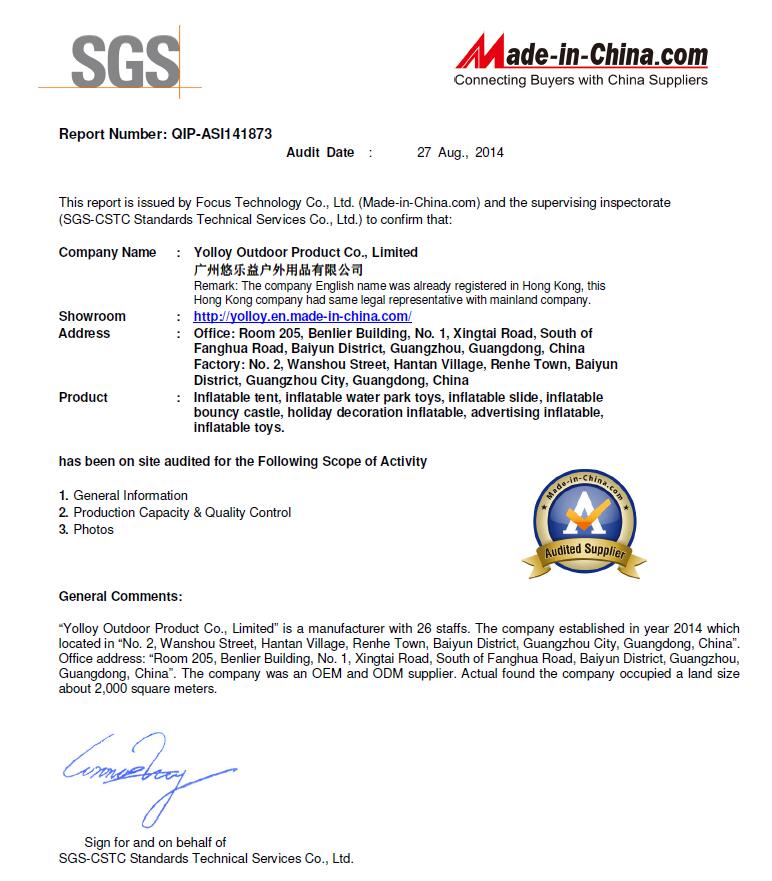
YOLLOY Outdoor Product Co., Limited is a custom inflatable manufacturer based in Guangzhou, China, with export experience across Europe, Asia, South America, Africa, the Middle East, and Latin America. From floating platforms and water slides to obstacle courses and climbing walls, every product is built to order with your specifications, colors, and branding. The design team works from your proposal to create simulation renderings, and production begins only after you approve the final design.
Contact YOLLOY today at [email protected] or call +86-20-8370 0771 to discuss your project and receive a custom proposal with simulation renderings.