Picture a wedding reception drifting on a calm lake at sunset, or a corporate lounge floating beside a marina during a regatta. These are not fantasy concepts — they are real events made possible by the inflatable floating tent, a specialized category of inflatable structure that combines the portability of an air-supported shelter with the buoyancy needed for water deployment. For event rental companies, waterfront resorts, and hospitality operators looking to differentiate their offerings, floating tents represent one of the fastest-growing segments in the commercial inflatable market.
Yet sourcing a floating tent is not as straightforward as ordering a standard ground tent. The product must balance structural integrity, waterproofing, anchoring, and material durability against constant exposure to water, sun, and wind. This guide explains what to look for in a floating tent, how to evaluate a manufacturer, and why YOLLOY — a Guangzhou-based inflatable solution provider with a global export footprint — has become a preferred partner for buyers across Europe, Asia, the Middle East, and the Americas.
What Exactly Is an Inflatable Floating Tent?
An inflatable floating tent is a dual-function structure: an air-supported shelter mounted on a buoyant platform that keeps the entire assembly stable on water. Unlike a traditional tent pitched on dry land, a floating tent must handle wave motion, current drift, and constant moisture. The tent portion uses air beams — inflated in minutes with a continuous blower — instead of metal poles, while the base platform provides the flotation that keeps the tent above the waterline.
This category overlaps with several related products, including the inflatable boat tent, which attaches directly to a vessel for on-water shelter, and floating leisure platforms that serve as swimming docks or sunbathing decks. The common thread is that all of these products operate in wet environments, so material selection and seam construction are even more critical than they are for land-based inflatables.
Key difference from land tents: Floating tents require reinforced anchor points — typically D-ring or round metal systems — rated for aquatic conditions, plus UV-resistant coatings that prevent degradation from prolonged sun exposure reflected off the water surface.
Commercial Applications That Drive Demand
Floating tents are not just a novelty. They solve real operational challenges for several types of businesses.
Waterfront Resorts and Hotels. A floating tent anchored off a private beach or lagoon creates an exclusive dining or lounge area that guests cannot find anywhere else. It adds premium inventory without the cost and permitting complexity of permanent construction. Resorts in the Maldives, Thailand, and the Caribbean have been early adopters of this concept.
Event Rental Companies. For businesses that already rent tents, tables, and chairs for weddings and corporate events, adding a floating tent to the catalog opens up lakefront, riverside, and marina venues that were previously inaccessible. A single floating tent booking can command a premium rate that justifies the investment quickly.
Yacht Charter and Marina Operators. A floating tent can serve as a temporary boarding lounge, a dockside event space, or a floating platform for water sports registration and equipment storage during regattas and sailing competitions.
Glamping and Eco-Tourism Sites. Floating tents offer a unique overnight accommodation experience — essentially a floating hotel room — that appeals to travelers seeking Instagram-worthy stays. Paired with a clear dome roof for stargazing, the product becomes a year-round revenue generator.
What to Look for in a Floating Tent Manufacturer
When evaluating suppliers, there are several non-negotiable criteria that separate capable factories from the rest.
Material Quality and Water Resistance. The fabric must withstand constant moisture without delaminating, mildewing, or losing tensile strength. Commercial-grade PVC tarpaulin is the industry standard for floating applications, but the specific weight, weave density, and UV coating formulation all matter. YOLLOY uses materials that have passed EN71, EN14960, and RoHS-related testing. For water park and floating products, compliance with EN 15649 is the relevant benchmark. Ask any potential supplier to provide material test certificates before committing to a purchase order.
Seam Construction and Airtight Welding. The seams are where floating tents either hold up or fail. High-quality manufacturing uses precision sewing equipment with waterproof nylon thread, plus high-temperature fusion welding for airtight sections. This dual approach — stitched reinforcement plus welded seals — prevents both air leakage from the beams and water ingress through the seams. YOLLOY inspects and tests every product before shipment, and each unit ships with a repair kit for field maintenance.
Customization Flexibility. Every waterfront venue has different dimensions, depth profiles, and anchoring conditions. An off-the-shelf floating tent rarely fits perfectly. YOLLOY offers fully custom inflatable tent design services: the design team prepares 3D simulation renderings from your proposal — whether that is a detailed CAD file, a hand-drawn sketch, or a verbal description — and revises until you approve. The stated minimum order quantity is just one piece, making it practical to order a sample before committing to a bulk purchase. Custom sizes, colors, and logo printing are available on all products.
Anchoring and Wind Resistance. Water amplifies wind loads. A floating tent must stay securely in position even when gusts pick up. YOLLOY incorporates D-ring or round metal anchor systems into its designs, and the engineering team can advise on the appropriate anchoring configuration based on your venue's typical conditions. Blowers are supplied for 110V, 220V, or 380V requirements, matched to your local electrical standard.
Why YOLLOY Stands Out for Floating Tent Sourcing
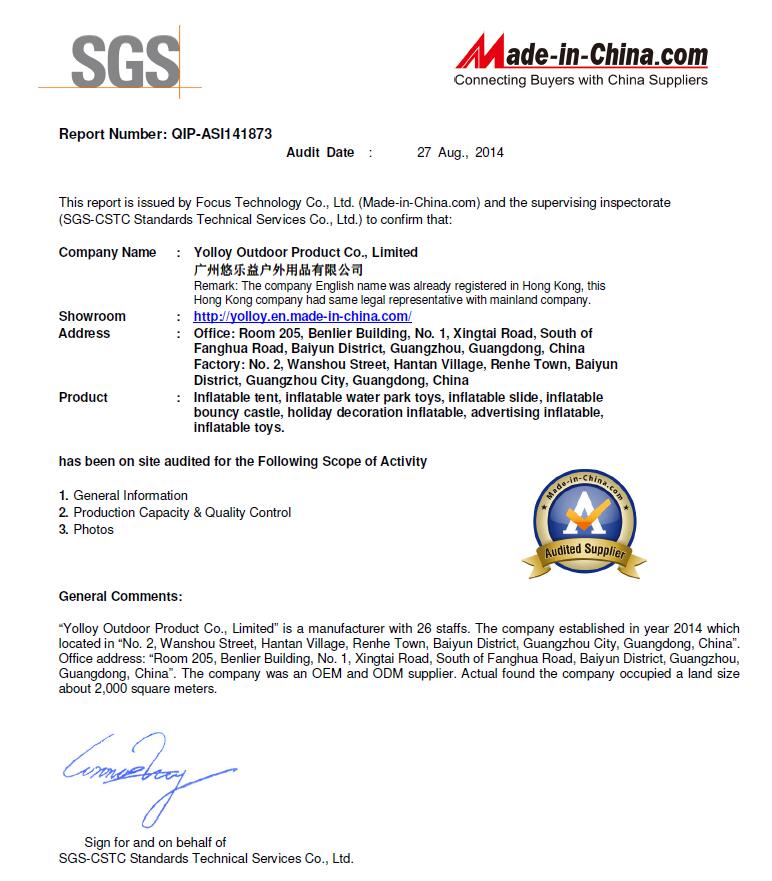
YOLLOY Outdoor Product Co., Limited operates from Guangzhou, China — a city with deep roots in inflatable manufacturing. But geographic proximity to supply chains is not the reason international buyers choose YOLLOY. Several operational factors set the company apart.
End-to-End Custom Manufacturing. The workflow is straightforward: a customer shares a concept, the design team creates simulation renderings, the design is revised until approval, and only then does production begin. This collaborative process eliminates the risk of receiving a product that does not match your vision. The catalog spans much more than floating tents — it includes outdoor inflatable tents, clear dome tents, water park products, interactive sports games, commercial slides, bounce houses, paintball bunkers, air mattresses, and advertising inflatables. For buyers who need multiple product types, consolidating orders with one manufacturer simplifies logistics and reduces per-unit shipping costs.
Proven Quality and Responsive Service. Materials are tested to EN71, EN14960, and RoHS standards, with water park products referencing EN 15649. Blowers meet CE or UL requirements. The company reports a 95% on-time delivery rate, with typical production taking 6 to 15 days for a regular inflatable product. Air shipping is available in 5 to 7 days, and sea freight ranges from 15 to 30 days or more. Every product is packed with soft carpet protection, waterproof PVC bags, and outer PE film — large items ship on steel pallets. The company states a three-year service life expectation when products are used and maintained correctly, and emails are answered within 24 hours.
Global Export Experience. YOLLOY ships to Europe, Asia, South America, Africa, the Middle East, and Latin America. The team is experienced in handling international documentation, customs clearance requirements, and voltage-specific blower configurations for different markets.
Practical tip: Before ordering, confirm the blower voltage matches your country's standard (110V for North America, 220V for Europe and Asia, 380V for industrial applications). YOLLOY supplies all three configurations, but specifying this upfront avoids delays.
Questions to Ask Before You Place an Order
Even with a reputable supplier, a few clarifying questions can prevent costly misunderstandings. We recommend asking these before you commit:
- What is the weight capacity of the floating platform? Confirm the maximum occupant load and whether the platform can support additional equipment such as tables, chairs, and sound systems.
- What anchoring system is included? Ask about anchor types, the number of anchor points, and whether they are suitable for your specific water conditions — calm lake, flowing river, or tidal marina.
- What UV protection does the material have? Water reflects sunlight, accelerating UV degradation. Confirm the UV rating and expected lifespan under continuous outdoor exposure.
- Can the tent portion be detached from the platform? A modular design allows you to use the floating platform independently as a swimming dock or sun deck when the tent is not needed.
- What is the current production lead time? Lead times vary by season and order complexity. Confirm the timeline before placing a deposit, especially if you need the product for a specific event date.
The Bottom Line
The inflatable floating tent is more than a novelty — it is a practical, revenue-generating asset for hospitality operators, event planners, and rental businesses that serve waterfront venues. The key to a successful investment is not just the product design, but the manufacturer behind it. A supplier that offers material transparency, design collaboration, international certifications, and responsive after-sales support is worth far more than a marginally lower per-unit price from an unverified source.
YOLLOY has built its reputation on safety, durability, responsive service, and honest communication. With a factory in Guangzhou, a design team that works from your concept, and a product range that covers everything from floating tents to water parks, the company is well-positioned to serve wholesale buyers worldwide. Whether you need a single custom floating tent for a flagship resort project or a container-load of event inventory, the process starts with a conversation.
Ready to Add Floating Tents to Your Product Line?
Contact YOLLOY today to discuss your floating tent project. The design team will prepare a detailed proposal with 3D renderings and pricing based on your specifications. Reach out at [email protected] or call +86-20-8370 0771. Visit www.yolloy.net to browse the full product catalog and explore the company's custom manufacturing capabilities.