Products Category
Certification

News

• New Order Successfully Finished for Long-Time Cooperated Japanese Client | YOLLOY Wins Full Client Recognition

• YOLLOY Custom Inflatable Pool Tent for Danish Client: Professional Pool Repair Shelter & Debris Protection

• Trusted Once Again! Greek Captain Re-orders Our Products After 4 Years

• Revolutionize Your Outdoors: The All-Terrain Inflatable Floating Tent for Land & Water

• Elevate Your Summer Fun: The Ultimate Inflatable Water Floating Volleyball Court Trampoline

• Innovative Inflatable Nightclub Tents & Pop-Up Bars: The Ultimate Solution for Portable Party Venues

Contact Us

Name: Sunny Yang
Tel: +86-20-8370 0771
Fax: +86-20-8370 0771
Mobile: 13570587575
E-mail: sales@yolloy.com
Add: No 5,Xiong wei Bo Nan Road,ZhongLuoTan Town,Baiyun district,Guangzhou,China
Friend me on Facebook Follow me on Twitter Add me to your circles Follow me on Pinterest Watch my channel on YouTube
News

Inflatable Dome Tents: The Smart Choice for Commercial Events, Hospitality, and Brand Activations

Author:yolloy Date:2026/8/3 12:18:10

Inflatable Dome Tents: The Smart Choice for Commercial Events, Hospitality, and Brand Activations

The demand for flexible, eye-catching temporary structures has never been higher. Event organizers, hospitality operators, and marketing teams are moving away from traditional pole-and-canvas tents toward a faster, more visually striking alternative: the inflatable dome tent. With rapid setup times, distinctive architectural profiles, and growing customization options, inflatable domes are reshaping how businesses think about portable shelter and branded spaces.

What Makes an Inflatable Dome Tent Different

Unlike traditional frame tents that rely on rigid poles and heavy canvas, an inflatable dome tent uses air-filled beams to support its structure. A continuously running electric blower maintains internal air pressure, keeping the dome rigid and stable. This design eliminates the need for internal support columns, creating a fully open interior with no obstructions — a critical advantage for exhibitions, dining areas, product launches, and immersive brand experiences.

The curved, geodesic shape is not just aesthetic. It naturally sheds wind and rain more effectively than flat-walled tents, and the absence of sharp corners reduces wind load. For outdoor events in unpredictable weather, this structural integrity is a practical benefit that goes beyond appearance.

Key Commercial Applications

A large inflatable tent with a dome profile fits a surprisingly wide range of commercial uses:

  • Event hospitality and VIP lounges — create premium, enclosed spaces at festivals, sporting events, and trade shows.
  • Pop-up retail and brand activations — the unique silhouette draws attention and can be fully printed with logos, graphics, and brand colors.
  • Outdoor dining and glamping — clear-dome variants offer 360-degree views, making them popular for luxury camping resorts and rooftop restaurants.
  • Exhibition and trade show booths — a dome structure stands out on any exhibition floor, giving exhibitors a memorable presence.
  • Emergency and medical shelters — rapid deployment makes inflatable domes suitable for field hospitals, command centers, and disaster relief operations.
  • Sports and recreation — used as indoor sports domes, golf simulator enclosures, and covered training facilities.

Materials and Construction: What to Look For

When sourcing a custom inflatable tent, material quality directly determines service life and safety. Commercial-grade PVC tarpaulin is the industry standard for most inflatable tents, valued for its waterproof properties, UV resistance, and tear strength. For specialty applications, manufacturers may use Oxford fabric, nylon, or TPU (thermoplastic polyurethane) depending on weight, transparency, and environmental requirements.

Pay attention to seam construction. High-quality inflatable domes use precision sewing equipment with waterproof nylon thread and reinforced stitching at high-stress points. For airtight chambers, high-temperature fusion welding creates stronger, more reliable seals than adhesive bonding alone. D-ring or round metal anchor points should be integrated into the design for secure ground anchoring and wind resistance.

Key quality indicators: Look for materials that have passed EN71, EN14960, and RoHS testing. Blowers should carry CE or UL certification. These standards verify that the product meets European and North American safety requirements for inflatable structures.

Customization: Branding and Functional Options

One of the strongest arguments for choosing an inflatable dome over an off-the-shelf tent is the level of customization available. Reputable inflatable tent manufacturers can produce domes in custom sizes, colors, and configurations to match specific event requirements. Customer logos, artwork, and full-wrap graphics can be printed directly onto the tent surface, turning the structure itself into a large-format advertising medium.

Beyond visual branding, functional customization options include:

  • Door and window placement tailored to traffic flow and ventilation needs
  • Clear or tinted PVC window panels for natural light and views
  • Internal partition walls for multi-room layouts
  • Flooring options including groundsheets, raised platforms, and hard flooring
  • Lighting integration, HVAC ports, and cable management channels
  • Blower voltage options (110V, 220V, or 380V) to match local power standards

Setup, Maintenance, and Longevity

A commercial inflatable dome tent typically inflates in minutes with the included electric blower. Once inflated, the blower runs continuously at low power to maintain pressure — a setup that is far faster than assembling a traditional frame tent of comparable size. Deflation is equally quick, and the entire structure packs down into a compact bundle for transport and storage.

Properly maintained, a commercial-grade inflatable dome can deliver a service life of approximately three years under regular use. Each product should come with a repair kit for minor punctures or seam fixes. When not in use, the tent should be cleaned, thoroughly dried, and stored in a cool, dry environment to prevent mildew and material degradation. Packing typically involves soft carpet protection, waterproof PVC bags, and an outer PE film layer — with steel pallets used for larger units during shipping.

Choosing the Right Supplier

When evaluating inflatable tent manufacturers, consider these factors beyond the product specification sheet:

  • Design-to-production workflow — Does the supplier provide simulation renderings from your brief? Can they iterate on designs until you approve?
  • Minimum order quantity — Some factories require large minimum orders; look for suppliers who accept single-piece orders for custom projects.
  • Production lead time — Typical production for a regular inflatable product ranges from 6 to 15 days, excluding transit. Complex or large custom orders may take longer.
  • Certifications and testing — Verify that materials and blowers carry relevant certifications (EN71, EN14960, RoHS, CE, UL).
  • Shipping options — Air freight (5–7 days) and sea freight (15–30+ days) should both be available, with the supplier handling export packaging and documentation.
  • After-sales support — A repair kit should be included. The supplier should respond to inquiries within 24 hours and have a track record of on-time delivery.

Get a Custom Inflatable Dome Tent for Your Business

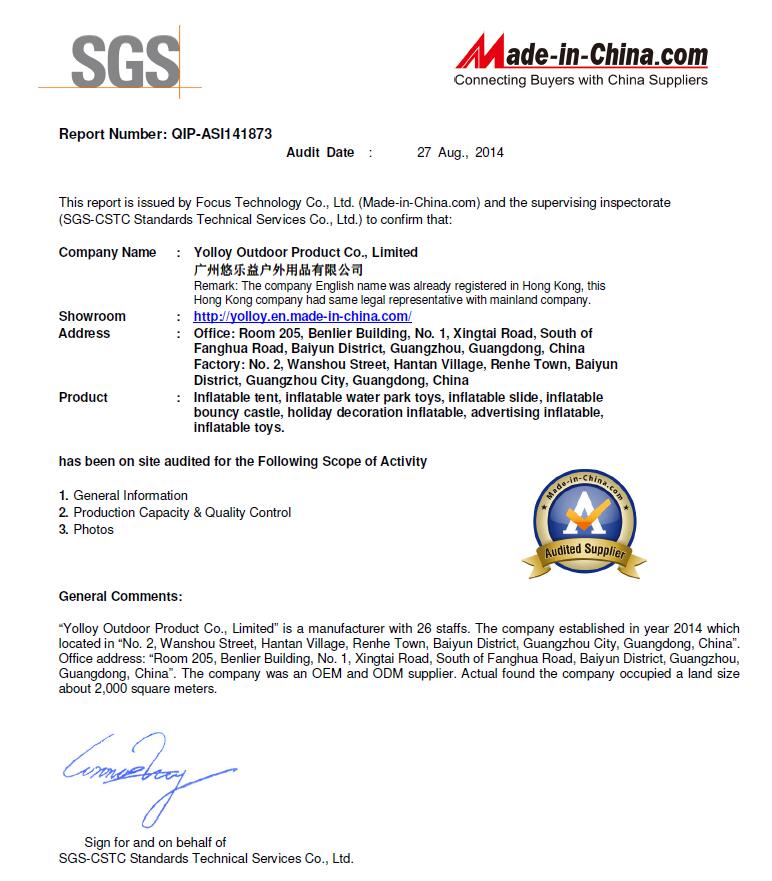
YOLLOY Outdoor Product Co., Limited is a Guangzhou-based inflatable product manufacturer specializing in custom-designed inflatable dome tents, clear bubble tents, party tents, and commercial event structures. Every project starts with a design consultation — share your concept, dimensions, branding requirements, and budget, and the design team will prepare simulation renderings for your review. Production begins only after you approve the final design.

With a minimum order quantity of one piece, EN71 and EN14960-compliant materials, CE/UL-certified blowers, and a stated 95% on-time delivery rate, YOLLOY serves clients across Europe, Asia, South America, Africa, the Middle East, and Latin America. Production lead times range from 6 to 15 days for standard products, and every order includes a repair kit and appropriate blower for your voltage requirements.

To discuss your project or request a quote, contact the YOLLOY team at sales@yolloy.com or call +86-20-8370 0771. Visit the website to browse the full range of inflatable dome tents and outdoor event structures.

Inflatable Dome Tents: The Smart Choice for Commercial Events, Hospitality, and Brand Activations

Author:yolloy Date:2026/8/3 12:18:10

Inflatable Dome Tents: The Smart Choice for Commercial Events, Hospitality, and Brand Activations

The demand for flexible, eye-catching temporary structures has never been higher. Event organizers, hospitality operators, and marketing teams are moving away from traditional pole-and-canvas tents toward a faster, more visually striking alternative: the inflatable dome tent. With rapid setup times, distinctive architectural profiles, and growing customization options, inflatable domes are reshaping how businesses think about portable shelter and branded spaces.

What Makes an Inflatable Dome Tent Different

Unlike traditional frame tents that rely on rigid poles and heavy canvas, an inflatable dome tent uses air-filled beams to support its structure. A continuously running electric blower maintains internal air pressure, keeping the dome rigid and stable. This design eliminates the need for internal support columns, creating a fully open interior with no obstructions — a critical advantage for exhibitions, dining areas, product launches, and immersive brand experiences.

The curved, geodesic shape is not just aesthetic. It naturally sheds wind and rain more effectively than flat-walled tents, and the absence of sharp corners reduces wind load. For outdoor events in unpredictable weather, this structural integrity is a practical benefit that goes beyond appearance.

Key Commercial Applications

A large inflatable tent with a dome profile fits a surprisingly wide range of commercial uses:

  • Event hospitality and VIP lounges — create premium, enclosed spaces at festivals, sporting events, and trade shows.
  • Pop-up retail and brand activations — the unique silhouette draws attention and can be fully printed with logos, graphics, and brand colors.
  • Outdoor dining and glamping — clear-dome variants offer 360-degree views, making them popular for luxury camping resorts and rooftop restaurants.
  • Exhibition and trade show booths — a dome structure stands out on any exhibition floor, giving exhibitors a memorable presence.
  • Emergency and medical shelters — rapid deployment makes inflatable domes suitable for field hospitals, command centers, and disaster relief operations.
  • Sports and recreation — used as indoor sports domes, golf simulator enclosures, and covered training facilities.

Materials and Construction: What to Look For

When sourcing a custom inflatable tent, material quality directly determines service life and safety. Commercial-grade PVC tarpaulin is the industry standard for most inflatable tents, valued for its waterproof properties, UV resistance, and tear strength. For specialty applications, manufacturers may use Oxford fabric, nylon, or TPU (thermoplastic polyurethane) depending on weight, transparency, and environmental requirements.

Pay attention to seam construction. High-quality inflatable domes use precision sewing equipment with waterproof nylon thread and reinforced stitching at high-stress points. For airtight chambers, high-temperature fusion welding creates stronger, more reliable seals than adhesive bonding alone. D-ring or round metal anchor points should be integrated into the design for secure ground anchoring and wind resistance.

Key quality indicators: Look for materials that have passed EN71, EN14960, and RoHS testing. Blowers should carry CE or UL certification. These standards verify that the product meets European and North American safety requirements for inflatable structures.

Customization: Branding and Functional Options

One of the strongest arguments for choosing an inflatable dome over an off-the-shelf tent is the level of customization available. Reputable inflatable tent manufacturers can produce domes in custom sizes, colors, and configurations to match specific event requirements. Customer logos, artwork, and full-wrap graphics can be printed directly onto the tent surface, turning the structure itself into a large-format advertising medium.

Beyond visual branding, functional customization options include:

  • Door and window placement tailored to traffic flow and ventilation needs
  • Clear or tinted PVC window panels for natural light and views
  • Internal partition walls for multi-room layouts
  • Flooring options including groundsheets, raised platforms, and hard flooring
  • Lighting integration, HVAC ports, and cable management channels
  • Blower voltage options (110V, 220V, or 380V) to match local power standards

Setup, Maintenance, and Longevity

A commercial inflatable dome tent typically inflates in minutes with the included electric blower. Once inflated, the blower runs continuously at low power to maintain pressure — a setup that is far faster than assembling a traditional frame tent of comparable size. Deflation is equally quick, and the entire structure packs down into a compact bundle for transport and storage.

Properly maintained, a commercial-grade inflatable dome can deliver a service life of approximately three years under regular use. Each product should come with a repair kit for minor punctures or seam fixes. When not in use, the tent should be cleaned, thoroughly dried, and stored in a cool, dry environment to prevent mildew and material degradation. Packing typically involves soft carpet protection, waterproof PVC bags, and an outer PE film layer — with steel pallets used for larger units during shipping.

Choosing the Right Supplier

When evaluating inflatable tent manufacturers, consider these factors beyond the product specification sheet:

  • Design-to-production workflow — Does the supplier provide simulation renderings from your brief? Can they iterate on designs until you approve?
  • Minimum order quantity — Some factories require large minimum orders; look for suppliers who accept single-piece orders for custom projects.
  • Production lead time — Typical production for a regular inflatable product ranges from 6 to 15 days, excluding transit. Complex or large custom orders may take longer.
  • Certifications and testing — Verify that materials and blowers carry relevant certifications (EN71, EN14960, RoHS, CE, UL).
  • Shipping options — Air freight (5–7 days) and sea freight (15–30+ days) should both be available, with the supplier handling export packaging and documentation.
  • After-sales support — A repair kit should be included. The supplier should respond to inquiries within 24 hours and have a track record of on-time delivery.

Get a Custom Inflatable Dome Tent for Your Business

YOLLOY Outdoor Product Co., Limited is a Guangzhou-based inflatable product manufacturer specializing in custom-designed inflatable dome tents, clear bubble tents, party tents, and commercial event structures. Every project starts with a design consultation — share your concept, dimensions, branding requirements, and budget, and the design team will prepare simulation renderings for your review. Production begins only after you approve the final design.

With a minimum order quantity of one piece, EN71 and EN14960-compliant materials, CE/UL-certified blowers, and a stated 95% on-time delivery rate, YOLLOY serves clients across Europe, Asia, South America, Africa, the Middle East, and Latin America. Production lead times range from 6 to 15 days for standard products, and every order includes a repair kit and appropriate blower for your voltage requirements.

To discuss your project or request a quote, contact the YOLLOY team at sales@yolloy.com or call +86-20-8370 0771. Visit the website to browse the full range of inflatable dome tents and outdoor event structures.