Products Category
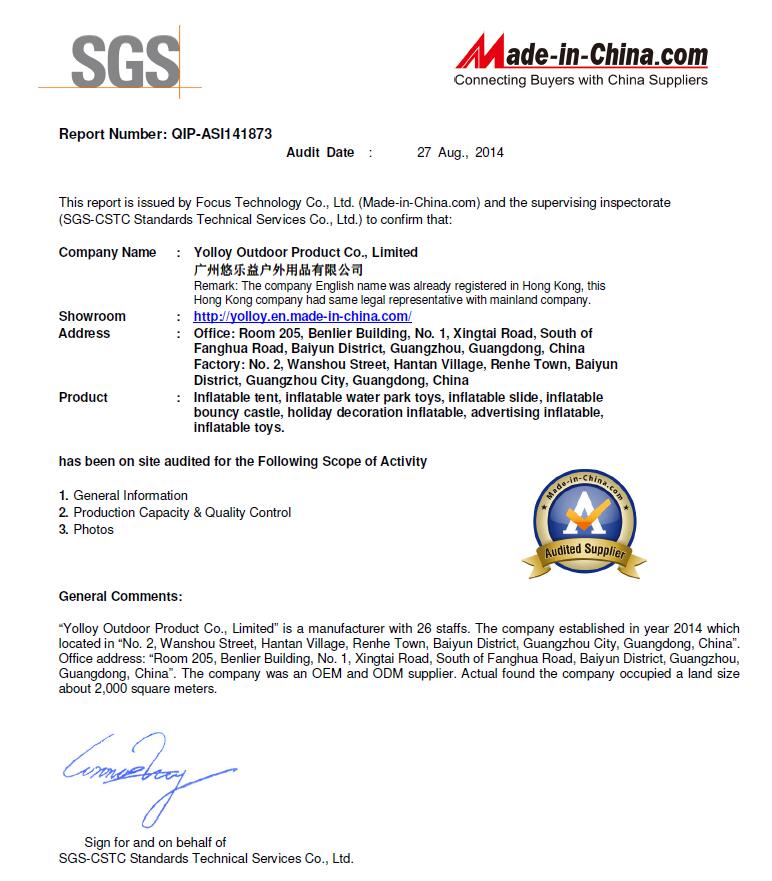
Certification

News

• New Order Successfully Finished for Long-Time Cooperated Japanese Client | YOLLOY Wins Full Client Recognition

• YOLLOY Custom Inflatable Pool Tent for Danish Client: Professional Pool Repair Shelter & Debris Protection

• Trusted Once Again! Greek Captain Re-orders Our Products After 4 Years

• Revolutionize Your Outdoors: The All-Terrain Inflatable Floating Tent for Land & Water

• Elevate Your Summer Fun: The Ultimate Inflatable Water Floating Volleyball Court Trampoline

• Innovative Inflatable Nightclub Tents & Pop-Up Bars: The Ultimate Solution for Portable Party Venues

Contact Us

Name: Sunny Yang
Tel: +86-20-8370 0771
Fax: +86-20-8370 0771
Mobile: 13570587575
E-mail: [email protected]
Add: No 5,Xiong wei Bo Nan Road,ZhongLuoTan Town,Baiyun district,Guangzhou,China
Friend me on Facebook Follow me on Twitter Add me to your circles Follow me on Pinterest Watch my channel on YouTube
News

Inflatable Canopy Tents: The Ultimate Solution for Outdoor Events, Brand Activations, and Commercial Spaces

Author:yolloy Date:2026/8/11 21:32:25
Picture this: you are standing in an open field at 8 a.m. on event day. The sun is climbing, the clock is ticking, and your crew is still wrestling with a tangle of aluminum poles, connectors, and canvas panels. By the time the structure is up, you have burned through hours of labor and half your energy — and the guests have not even arrived. Now imagine a different scenario: one person plugs in a blower, and within 15 minutes a fully formed, architecturally striking shelter rises from the ground. This is the reality of an inflatable canopy tent — a portable, durable, and visually commanding structure that is reshaping how businesses, event planners, and brand marketers think about temporary outdoor spaces.
What Exactly Is an Inflatable Canopy Tent?
An inflatable canopy tent is a tensioned air-beam structure that uses continuously powered blowers to maintain its shape. Unlike traditional pole or frame tents that rely on rigid metal or fiberglass skeletons, these tents use inflatable tubes — typically constructed from commercial-grade PVC tarpaulin, Oxford fabric, nylon, or TPU — as the structural backbone. The result is a shelter that combines the open, airy feel of a canopy with the speed and portability of inflatable technology. Canopy-style inflatable tents are particularly popular for trade show booths, outdoor market stalls, promotional pop-ups, wedding receptions, and corporate hospitality areas. They provide shade and weather protection while offering 360-degree visibility — an ideal combination for applications where you want to invite people in rather than wall them off.
Why Event Planners Are Switching to Inflatable Structures
The shift from traditional marquees to inflatable alternatives is not a passing trend — it is driven by measurable advantages in speed, cost, and versatility. A standard inflatable event tent deploys in 10 to 15 minutes with one or two people, compared to the 60 to 90 minutes and multi-person crews required for conventional frame tents. For rental businesses running multiple events per weekend, this time differential translates directly into higher margins and the ability to take on more bookings. Takedown is equally efficient. Deflating the tent takes only as long as switching off the blower and opening the air valves. The entire structure collapses into a compact bundle that fits into a standard transport vehicle — no disassembly of dozens of individual components. This compact storage footprint also reduces warehouse costs and simplifies logistics between event sites.
A Canvas for Your Brand: Customization That Works
One of the most compelling reasons to invest in a custom inflatable tent is the branding potential. The fabric surface of these structures serves as a blank canvas. Reputable manufacturers can print your company logo, sponsor graphics, brand colors, and custom artwork directly onto the tent material using high-resolution printing techniques. This transforms the tent from a simple shelter into a 360-degree marketing asset that works continuously throughout your event. The customization process at a professional factory typically follows a structured workflow: clients submit their concept — whether it is a rough sketch, a dimension requirement, a color palette, or a photograph of the venue — and the design team produces simulation renderings for approval. The design is refined through iteration until the client is satisfied, and only then does production begin. This ensures that the final product aligns precisely with the client's vision and functional requirements.
Applications That Span Industries
The versatility of inflatable canopy tents makes them suitable for a remarkably broad range of commercial and recreational applications. Here are some of the most common use cases:
  • Trade shows and exhibitions — Branded canopy tents create eye-catching booth structures that stand out in crowded exhibition halls and outdoor fairgrounds.
  • Product launches and pop-up retail — Rapid deployment enables temporary brand experiences in high-foot-traffic locations with minimal setup overhead.
  • Wedding receptions and ceremonies — Elegant dome and clear bubble canopy configurations provide weather-proof, photogenic settings for outdoor celebrations.
  • Corporate hospitality and VIP areas — Spacious, climate-controlled environments for guests at sports events, festivals, and corporate gatherings.
  • Sports and outdoor recreation — Inflatable sport tents, golf simulator enclosures, and equipment shelters for athletic facilities.
  • Emergency response and medical tents — Rapidly deployable shelters for field hospitals, command centers, and disaster relief operations.
Engineering and Materials: What Makes a Quality Inflatable Tent
Not all inflatable tents are built to the same standard. The difference between a product that lasts three seasons and one that fails after three events comes down to materials, construction methods, and quality control. Leading inflatable tent manufacturers use commercial-grade PVC tarpaulin as the primary material for most applications, with Oxford fabric, nylon, and TPU available for specialized requirements. Seam construction is particularly critical. High-quality tents feature reinforced seams produced through high-temperature fusion welding equipment, combined with precision sewing using waterproof nylon thread. Additional reinforcement is applied at high-load areas — connection points, anchor locations, and blower attachment zones. D-ring and round metal anchor systems are integrated into the design to ensure stability in windy conditions. Certifications provide an objective measure of a manufacturer's commitment to safety and quality. When evaluating suppliers, look for materials that have passed EN71, EN14960, and RoHS testing. For water-related applications, EN 15649 compliance is relevant. Blowers should meet CE or UL requirements and be available in 110V, 220V, and 380V configurations to match the electrical infrastructure in your region.
The Business Case: Total Cost of Ownership
When comparing an inflatable canopy tent to a traditional frame tent, the purchase price tells only part of the story. Labor savings represent the most immediate financial benefit. A tent that deploys in 15 minutes rather than 90 minutes saves over an hour of crew time per setup. Across a season of 40 events, that is a full work week of labor recovered — time that can be redirected toward additional bookings or higher-value tasks. Transportation and storage costs also favor inflatable solutions. A deflated tent packs down to a fraction of its deployed size, reducing the number of vehicles needed for event logistics and shrinking warehouse requirements. For businesses that pay by the square foot for storage, this difference is material. Furthermore, commercial-grade inflatable tents are engineered for a service life of approximately three years under proper use and maintenance — and each order from a quality supplier includes a repair kit, extending the usable lifespan well beyond that baseline.
Sourcing from the Right Manufacturer: What to Look For
Purchasing an inflatable tent wholesale requires careful supplier evaluation. The following criteria help distinguish a reliable manufacturing partner from a transactional vendor:
  • Minimum order quantity of one piece — This allows you to test product quality and market response before committing to a larger order.
  • Production timeline of 6 to 15 days for standard inflatable products, with transparent communication about lead times for complex or large custom orders.
  • Included repair kit with every product shipped — essential for ongoing maintenance and extending the product's service life.
  • Blower options across voltage standards — 110V, 220V, and 380V configurations to match the electrical infrastructure in your target market.
  • Proven international export experience — A track record of shipping to Europe, Asia, South America, Africa, the Middle East, and Latin America demonstrates logistics capability.
  • Responsive communication — Emails and inquiries answered within 24 hours, and a documented on-time delivery rate (95% is a strong benchmark).
  • Comprehensive packaging — Products should be packed with soft carpet protection, waterproof PVC bags, and outer PE film; large items may require steel pallets for safe transit.
Shipping and Delivery: What to Expect
Once production is complete, shipping options typically include air freight and sea freight. Air shipping generally takes 5 to 7 days in transit, while sea freight ranges from 15 to 30 days or more depending on the destination port and customs clearance. The choice between the two depends on your urgency and budget — air freight is faster but more expensive, while sea freight offers better economics for larger orders. A manufacturer with a proven 95% on-time delivery rate provides confidence that your event schedule will not be disrupted by logistics delays.
Ready to invest in a custom inflatable canopy tent for your next event or rental business? YOLLOY Outdoor Product Co., Limited designs and manufactures high-quality inflatable canopy tents, clear domes, event tents, sport enclosures, and custom structures from its production facility in Guangzhou, China. With a minimum order quantity of just one piece, a 95% on-time delivery rate, and products exported to markets worldwide, YOLLOY is the manufacturing partner that event professionals trust. Every order includes a repair kit, and blowers are configured to your local voltage requirements. To discuss your project, request a quote, or explore design options, contact us at [email protected] or call +86-20-8370 0771.

Inflatable Canopy Tents: The Ultimate Solution for Outdoor Events, Brand Activations, and Commercial Spaces

Author:yolloy Date:2026/8/11 21:32:25

Picture this: you are standing in an open field at 8 a.m. on event day. The sun is climbing, the clock is ticking, and your crew is still wrestling with a tangle of aluminum poles, connectors, and canvas panels. By the time the structure is up, you have burned through hours of labor and half your energy — and the guests have not even arrived. Now imagine a different scenario: one person plugs in a blower, and within 15 minutes a fully formed, architecturally striking shelter rises from the ground. This is the reality of an inflatable canopy tent — a portable, durable, and visually commanding structure that is reshaping how businesses, event planners, and brand marketers think about temporary outdoor spaces.
What Exactly Is an Inflatable Canopy Tent?
An inflatable canopy tent is a tensioned air-beam structure that uses continuously powered blowers to maintain its shape. Unlike traditional pole or frame tents that rely on rigid metal or fiberglass skeletons, these tents use inflatable tubes — typically constructed from commercial-grade PVC tarpaulin, Oxford fabric, nylon, or TPU — as the structural backbone. The result is a shelter that combines the open, airy feel of a canopy with the speed and portability of inflatable technology. Canopy-style inflatable tents are particularly popular for trade show booths, outdoor market stalls, promotional pop-ups, wedding receptions, and corporate hospitality areas. They provide shade and weather protection while offering 360-degree visibility — an ideal combination for applications where you want to invite people in rather than wall them off.
Why Event Planners Are Switching to Inflatable Structures
The shift from traditional marquees to inflatable alternatives is not a passing trend — it is driven by measurable advantages in speed, cost, and versatility. A standard inflatable event tent deploys in 10 to 15 minutes with one or two people, compared to the 60 to 90 minutes and multi-person crews required for conventional frame tents. For rental businesses running multiple events per weekend, this time differential translates directly into higher margins and the ability to take on more bookings. Takedown is equally efficient. Deflating the tent takes only as long as switching off the blower and opening the air valves. The entire structure collapses into a compact bundle that fits into a standard transport vehicle — no disassembly of dozens of individual components. This compact storage footprint also reduces warehouse costs and simplifies logistics between event sites.
A Canvas for Your Brand: Customization That Works
One of the most compelling reasons to invest in a custom inflatable tent is the branding potential. The fabric surface of these structures serves as a blank canvas. Reputable manufacturers can print your company logo, sponsor graphics, brand colors, and custom artwork directly onto the tent material using high-resolution printing techniques. This transforms the tent from a simple shelter into a 360-degree marketing asset that works continuously throughout your event. The customization process at a professional factory typically follows a structured workflow: clients submit their concept — whether it is a rough sketch, a dimension requirement, a color palette, or a photograph of the venue — and the design team produces simulation renderings for approval. The design is refined through iteration until the client is satisfied, and only then does production begin. This ensures that the final product aligns precisely with the client's vision and functional requirements.
Applications That Span Industries
The versatility of inflatable canopy tents makes them suitable for a remarkably broad range of commercial and recreational applications. Here are some of the most common use cases:
  • Trade shows and exhibitions — Branded canopy tents create eye-catching booth structures that stand out in crowded exhibition halls and outdoor fairgrounds.
  • Product launches and pop-up retail — Rapid deployment enables temporary brand experiences in high-foot-traffic locations with minimal setup overhead.
  • Wedding receptions and ceremonies — Elegant dome and clear bubble canopy configurations provide weather-proof, photogenic settings for outdoor celebrations.
  • Corporate hospitality and VIP areas — Spacious, climate-controlled environments for guests at sports events, festivals, and corporate gatherings.
  • Sports and outdoor recreation — Inflatable sport tents, golf simulator enclosures, and equipment shelters for athletic facilities.
  • Emergency response and medical tents — Rapidly deployable shelters for field hospitals, command centers, and disaster relief operations.
Engineering and Materials: What Makes a Quality Inflatable Tent
Not all inflatable tents are built to the same standard. The difference between a product that lasts three seasons and one that fails after three events comes down to materials, construction methods, and quality control. Leading inflatable tent manufacturers use commercial-grade PVC tarpaulin as the primary material for most applications, with Oxford fabric, nylon, and TPU available for specialized requirements. Seam construction is particularly critical. High-quality tents feature reinforced seams produced through high-temperature fusion welding equipment, combined with precision sewing using waterproof nylon thread. Additional reinforcement is applied at high-load areas — connection points, anchor locations, and blower attachment zones. D-ring and round metal anchor systems are integrated into the design to ensure stability in windy conditions. Certifications provide an objective measure of a manufacturer's commitment to safety and quality. When evaluating suppliers, look for materials that have passed EN71, EN14960, and RoHS testing. For water-related applications, EN 15649 compliance is relevant. Blowers should meet CE or UL requirements and be available in 110V, 220V, and 380V configurations to match the electrical infrastructure in your region.
The Business Case: Total Cost of Ownership
When comparing an inflatable canopy tent to a traditional frame tent, the purchase price tells only part of the story. Labor savings represent the most immediate financial benefit. A tent that deploys in 15 minutes rather than 90 minutes saves over an hour of crew time per setup. Across a season of 40 events, that is a full work week of labor recovered — time that can be redirected toward additional bookings or higher-value tasks. Transportation and storage costs also favor inflatable solutions. A deflated tent packs down to a fraction of its deployed size, reducing the number of vehicles needed for event logistics and shrinking warehouse requirements. For businesses that pay by the square foot for storage, this difference is material. Furthermore, commercial-grade inflatable tents are engineered for a service life of approximately three years under proper use and maintenance — and each order from a quality supplier includes a repair kit, extending the usable lifespan well beyond that baseline.
Sourcing from the Right Manufacturer: What to Look For
Purchasing an inflatable tent wholesale requires careful supplier evaluation. The following criteria help distinguish a reliable manufacturing partner from a transactional vendor:
  • Minimum order quantity of one piece — This allows you to test product quality and market response before committing to a larger order.
  • Production timeline of 6 to 15 days for standard inflatable products, with transparent communication about lead times for complex or large custom orders.
  • Included repair kit with every product shipped — essential for ongoing maintenance and extending the product's service life.
  • Blower options across voltage standards — 110V, 220V, and 380V configurations to match the electrical infrastructure in your target market.
  • Proven international export experience — A track record of shipping to Europe, Asia, South America, Africa, the Middle East, and Latin America demonstrates logistics capability.
  • Responsive communication — Emails and inquiries answered within 24 hours, and a documented on-time delivery rate (95% is a strong benchmark).
  • Comprehensive packaging — Products should be packed with soft carpet protection, waterproof PVC bags, and outer PE film; large items may require steel pallets for safe transit.
Shipping and Delivery: What to Expect
Once production is complete, shipping options typically include air freight and sea freight. Air shipping generally takes 5 to 7 days in transit, while sea freight ranges from 15 to 30 days or more depending on the destination port and customs clearance. The choice between the two depends on your urgency and budget — air freight is faster but more expensive, while sea freight offers better economics for larger orders. A manufacturer with a proven 95% on-time delivery rate provides confidence that your event schedule will not be disrupted by logistics delays.
Ready to invest in a custom inflatable canopy tent for your next event or rental business? YOLLOY Outdoor Product Co., Limited designs and manufactures high-quality inflatable canopy tents, clear domes, event tents, sport enclosures, and custom structures from its production facility in Guangzhou, China. With a minimum order quantity of just one piece, a 95% on-time delivery rate, and products exported to markets worldwide, YOLLOY is the manufacturing partner that event professionals trust. Every order includes a repair kit, and blowers are configured to your local voltage requirements. To discuss your project, request a quote, or explore design options, contact us at [email protected] or call +86-20-8370 0771.