An inflatable obstacle course is one of the most versatile and profitable attractions an event rental business can own. Whether you are expanding your existing inventory or launching a new venture, an obstacle course draws crowds at school carnivals, corporate team-building events, community festivals, birthday parties, and holiday celebrations. Unlike traditional bounce houses that appeal mainly to younger children, obstacle courses attract participants across a much wider age range — from energetic kids to competitive adults. This broad appeal translates directly into higher booking rates and stronger rental revenue throughout the year.
What Makes an Inflatable Obstacle Course a Smart Investment
The return on investment for an obstacle course often outpaces that of standard inflatables. A single weekend booking can cover a significant portion of the purchase cost, and because these units are larger and more elaborate, they command premium rental prices. Event organizers and party planners are willing to pay more for an attraction that keeps guests engaged for extended periods. A well-designed course can entertain dozens of participants simultaneously, which means fewer attractions are needed to serve a large event — a compelling selling point for your clients.
Another advantage is repeat business. Schools, churches, and corporate clients who book an obstacle course once tend to return year after year for their annual events. Once a course becomes a staple attraction at a community festival, it creates a reliable revenue stream for your rental business.
Key Factors to Consider When Choosing a Course
Before you invest in a commercial inflatable obstacle course, there are several important factors to evaluate. First, consider the target audience. A course designed for children will have lower climbing walls, shorter tunnels, and gentler slides, while an adult-oriented course may feature taller vertical climbs, longer runs, and more physically demanding challenges. Knowing your primary customer base will guide your selection.
Second, think about the available space at your typical event venues. Measure the footprint of any course you are considering and confirm that your clients can accommodate it. Modular designs that can be configured in different layouts offer flexibility when space is limited. A sectional course can be set up as a compact single-lane challenge or expanded into a full-scale dual-lane competition track.
Third, assess the setup and takedown requirements. Larger courses naturally require more time and labor to inflate, anchor, and deflate. If you run a small operation with limited staff, a mid-sized course that can be managed by one or two people may be a more practical choice than a massive multi-section unit.
Material Quality and Construction Standards
The durability of an inflatable obstacle course depends heavily on the materials and manufacturing processes used. Commercial-grade PVC tarpaulin is the industry standard for high-quality inflatables, offering excellent tear resistance and weather resilience. When evaluating products, ask about the thickness of the material — 0.55mm (18oz) PVC tarpaulin is widely regarded as a reliable commercial-grade option.
Seam construction is equally critical. Reinforced seams using high-strength nylon thread and precision sewing equipment prevent blowouts during heavy use. Additional reinforcement at stress points — such as climbing wall attachment areas, anchor points, and slide entries — extends the service life of the course. Look for products that incorporate D-ring or round metal anchor systems, which provide secure installation and wind resistance during outdoor events.
Safety certifications are another important consideration. Reputable inflatable obstacle course manufacturers will have their products tested to recognized standards. Blowers should carry CE or UL certification, and inflatable products should meet relevant safety benchmarks such as EN 14960. Always request documentation to verify that the course you are purchasing meets the safety requirements of your region.
Customization: Stand Out from the Competition
One of the most effective ways to differentiate your rental business is through customized obstacle courses. Instead of offering the same generic designs that every competitor has, you can work with a manufacturer to create a course that reflects your brand identity. Custom colors, printed logos, and themed artwork make your course instantly recognizable at any event.
Customization goes beyond aesthetics. You can specify the number and type of obstacles, the overall dimensions, and even the layout of the course to match your market's preferences. Some rental businesses commission courses with detachable sections, allowing them to offer multiple configurations from a single investment. A manufacturer that accepts custom orders with a minimum quantity of just one piece gives you the freedom to experiment without committing to bulk purchases.
Water-Ready vs. Dry-Only Courses
Many inflatable obstacle courses are designed to work either as dry challenges or with water added for summer events. A water-ready course with a splash pool at the finish line effectively gives you two products in one — a dry obstacle course for cooler months and a water attraction for the summer season. This dual-purpose capability maximizes your booking potential throughout the year.
When evaluating a water-ready course, check that the materials and construction are suitable for wet conditions. Non-slip surfaces on climbing areas and slide sections are essential for safety. The blower system should also be positioned to avoid water exposure, and the manufacturer should supply appropriately rated blowers for your local voltage requirements.
Working with a Manufacturer Directly
Buying directly from a manufacturer rather than through a distributor offers several advantages. You eliminate the middleman markup, which can significantly reduce your purchase cost. You also gain direct access to the design and production team, which makes customization faster and more accurate. If you have a specific idea — whether it is a rough sketch, a photograph of a competitor's course, or a detailed site plan — a manufacturer with in-house design capability can turn that concept into a finished product.
Communication is key when working with an overseas manufacturer. Look for a supplier that responds to inquiries within 24 hours, provides simulation renderings before production begins, and keeps you informed throughout the manufacturing process. A manufacturer that reports a high on-time delivery rate — such as 95% — demonstrates reliability that protects your seasonal business from costly delays.
Packaging, Shipping, and What to Expect
When you order an inflatable obstacle course from an overseas factory, the product is typically packed with protective materials — soft carpet layers, waterproof PVC bags, and an outer PE film wrap. Large units may be shipped on steel pallets for additional protection. A repair kit is usually included with each inflatable, which is essential for quick fixes on the job site.
Shipping times vary by method. Air freight can deliver your course in 5 to 7 days, while sea freight may take 15 to 30 days or more. Plan your orders well ahead of your peak season to avoid last-minute gaps in your inventory. Blowers can be supplied in 110V, 220V, or 380V configurations to match the electrical standards of your country, so confirm the voltage requirement when placing your order.
Maintenance and Longevity
With proper care, a commercial-grade inflatable obstacle course can serve your business reliably for three years or more. After each use, clean the surfaces with mild soap and water, and ensure the unit is completely dry before storage to prevent mold and mildew. Inspect seams, anchor points, and blower connections regularly for signs of wear. The included repair kit allows you to address minor tears and punctures immediately, preventing small issues from becoming major problems.
Store your inflatable in a cool, dry environment away from direct sunlight when not in use. Prolonged UV exposure can degrade PVC materials over time, so using a storage cover or keeping the unit indoors during the off-season will extend its lifespan. Invest in a quality blower and maintain it according to the manufacturer's instructions — a blower failure during an event is the last thing any rental operator wants to deal with.
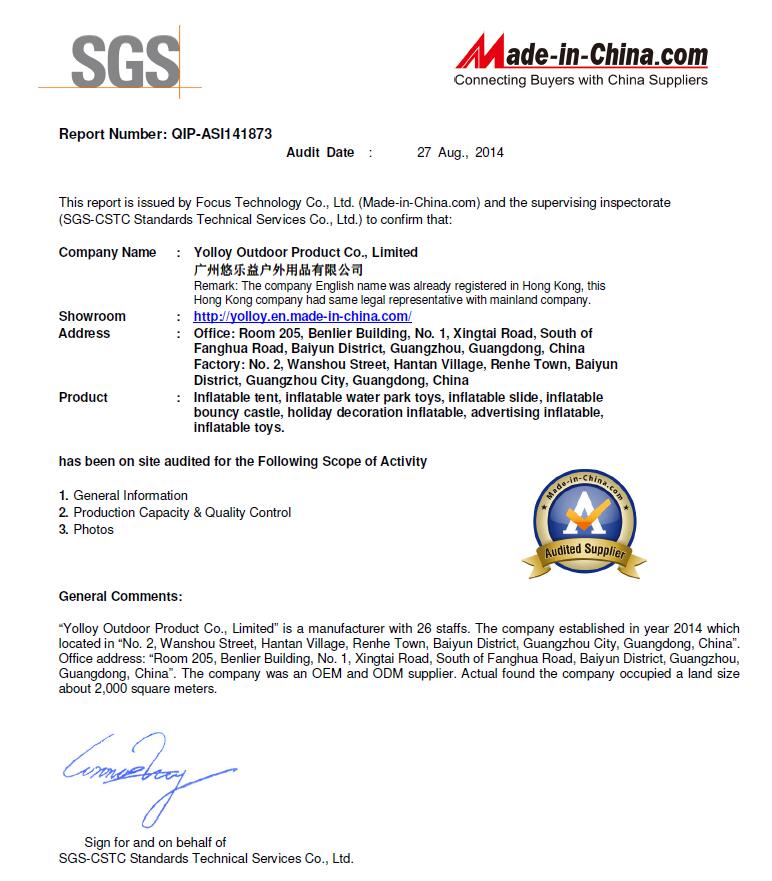
Ready to add an inflatable obstacle course to your rental inventory? As a specialized manufacturer based in Guangzhou, China, YOLLOY offers custom-designed obstacle courses built with commercial-grade PVC tarpaulin, reinforced seams, and certified blowers. Whether you need a compact single-lane course for backyard parties or a multi-section competition track for large events, the design team can create a solution tailored to your market. Custom sizes, colors, and branded artwork are available, and the minimum order quantity is just one piece. Contact YOLLOY today at [email protected] or call +86-20-8370 0771 to discuss your project. Visit www.yolloy.net to browse the full product range.