Sourcing inflatable air mattresses for your business — whether you run a rental company, a water park, a sports training facility, or a retail chain — is a decision that affects your product quality, customer satisfaction, and long-term profitability. A reliable
inflatable air mattress supplier does more than ship products; they become a partner who understands your market, your safety requirements, and your growth goals.
Unlike consumer-grade air beds sold in retail stores, commercial inflatable air mattresses are built for repeated use, often in demanding environments. They range from high-fall stunt air bags used in film production and parkour training to floating yoga mats, teak-finish air platform docks, and inflatable gymnastics mats. Choosing the right manufacturing partner makes the difference between a product that lasts three seasons and one that fails after three events.
1. Understand What Kind of Air Mattress You Need
Before you contact any
inflatable air mattress wholesaler, clarify the end-use scenario. Commercial inflatable air mattresses fall into several categories, each with different material and construction requirements:
High-fall stunt air bags for safety training, film production, and extreme sports — these require multi-chamber construction, high-strength seams, and certified load-bearing capacity.
Floating water platforms and leisure docks — made with marine-grade PVC, UV-resistant coatings, and anti-slip surfaces for lakes, pools, and yacht use.
Inflatable gymnastics mats and yoga mats — lightweight, portable, and quick-inflating for training centers, schools, and outdoor fitness programs.
Laser tag arenas and interactive sport inflatables — custom-shaped, branded, and designed for high-traffic entertainment venues.
A supplier that only produces one type may not have the engineering depth to handle your product category. Look for a manufacturer with a broad portfolio — one that has demonstrated experience across multiple inflatable product lines.
2. Evaluate Material Quality and Safety Certifications
Commercial-grade PVC tarpaulin is the standard material for most inflatable air mattresses. However, not all PVC is equal. Thickness, tensile strength, and coating quality directly affect durability and safety. Leading manufacturers use precision high-temperature fusion welding equipment for airtight seams and reinforced stitching with waterproof nylon thread at high-load areas.
When evaluating an
inflatable air mattress company, ask for material certifications. Reputable suppliers will have their materials tested against international standards. For inflatable toys and sport products, EN 14960 certification is relevant. For water park products, EN 15649 applies. Blower systems should carry CE or UL certification, and overall materials should comply with RoHS and EN71 standards where applicable. These certifications are not just paperwork — they are your assurance that the product meets safety requirements in your target market.
3. Customization Capabilities Matter
Off-the-shelf products rarely fit every business model. A capable
inflatable air mattress factory should offer full customization: custom sizes, colors, logo printing, and even design-from-scratch service based on your drawings, sketches, photographs, or site plans. This is especially important for businesses that need branded products — such as inflatable laser tag arenas with sponsor logos, or floating platforms with custom color schemes matching a resort's branding.
The best suppliers operate on a design-to-production workflow: designers prepare simulation renderings from your proposal, revise until you approve, and then release the design for factory production. This collaborative approach ensures the final product matches your expectations before any material is cut.
4. Production Lead Time and Minimum Order Quantity
For businesses testing a new product category, minimum order quantity (MOQ) is a critical factor. Some factories require large container-sized orders, which can be a barrier for small to medium businesses. Look for suppliers that offer flexible MOQs — ideally starting from one piece — so you can order samples, test the market, and scale gradually.
Typical production time for a regular inflatable product ranges from 6 to 15 days, excluding transit time. Complex or large custom products may take longer. Air shipping can deliver in 5 to 7 days, while sea freight typically takes 15 to 30 days or more. A supplier with a 95% on-time delivery rate and transparent communication about production schedules is worth prioritizing.
5. After-Sales Support and Warranty
Commercial inflatable products endure heavy use, and even the best-made items need maintenance. Quality suppliers include a repair kit with every product and provide guidance on patching and upkeep. A realistic warranty expectation for commercial inflatables is around three years when products are used and maintained correctly, though this varies by product type and usage intensity.
Additionally, confirm that the supplier responds to inquiries within 24 hours and provides ongoing support. A supplier that goes silent after the invoice is paid is not a long-term partner. Check whether they offer replacement parts, blower servicing advice, and technical support for installation.
6. Why China-Based Suppliers Lead the Market
The majority of the world's commercial inflatables are manufactured in China, and for good reason. Established factories in manufacturing hubs like Guangzhou have decades of specialized experience, access to high-grade raw materials, skilled labor, and efficient logistics networks serving Europe, Asia, the Americas, Africa, and the Middle East. Working directly with an
inflatable air mattress china supplier eliminates middlemen, reduces costs, and gives you direct input into the design and production process.
When sourcing from China, prioritize suppliers who communicate clearly in English, provide detailed product documentation, and have a track record of exporting to your region. A physical factory address, verifiable certifications, and willingness to share production photos or arrange video calls are all positive signals.
Packaging and Logistics Considerations
How a supplier packages your products matters more than you might think. Commercial inflatables are bulky and can be damaged during transit if not properly protected. Industry-standard packaging uses soft carpet protection for the product surface, waterproof PVC bags, and outer PE film wrapping. Large or heavy items may be shipped on steel pallets for added protection. Confirm packaging standards before placing an order — a product that arrives damaged is a cost you absorb, not the supplier.
Questions to Ask Before Signing a Supplier Agreement
Can you provide material certifications (EN71, EN14960, EN15649, RoHS, CE, UL)?
What is your minimum order quantity, and can I order a sample first?
Do you offer custom design services, and what is the design-to-approval workflow?
What blower voltage options do you supply (110V, 220V, 380V)?
What is included in your standard packaging, and do you offer reinforced export packaging?
Do you provide a repair kit with each product, and what is your warranty policy?
Can you share references or case studies from clients in my industry or region?
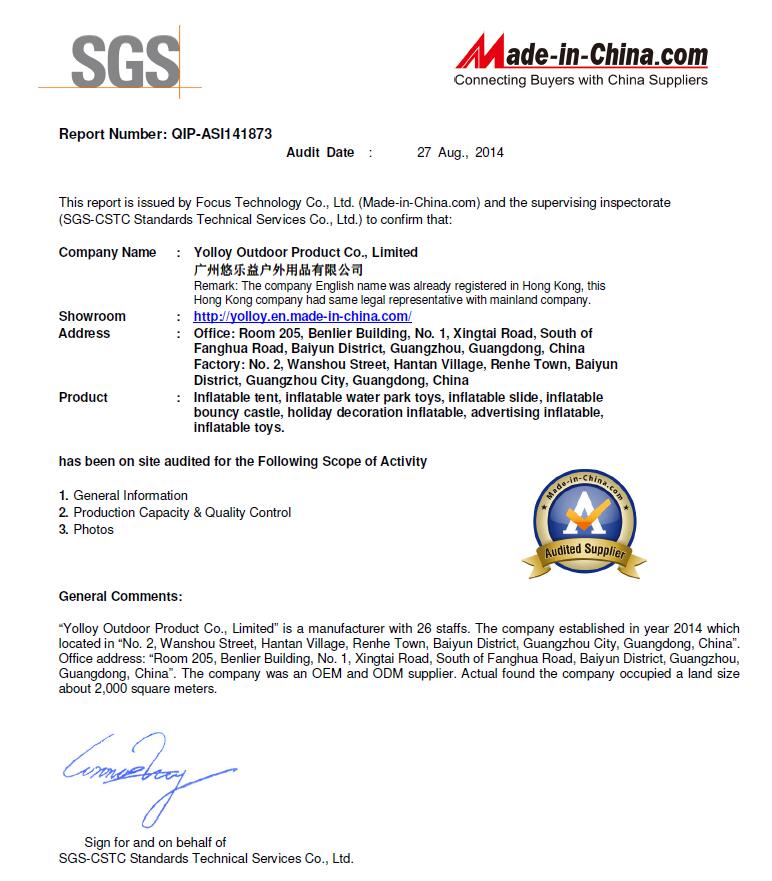
Looking for a trusted manufacturing partner? YOLLOY Outdoor Product Co., Limited, based in Guangzhou, China, designs and manufactures custom inflatable air mattresses, high-fall stunt air bags, floating platforms, interactive sports inflatables, and more. With EN-certified materials, precision welding and sewing, full customization from sketch to finished product, and a minimum order quantity of just one piece, YOLLOY supports businesses at every stage — from sampling to scaling. Contact the team at
[email protected] or visit
www.yolloy.net to discuss your requirements.