Products Category
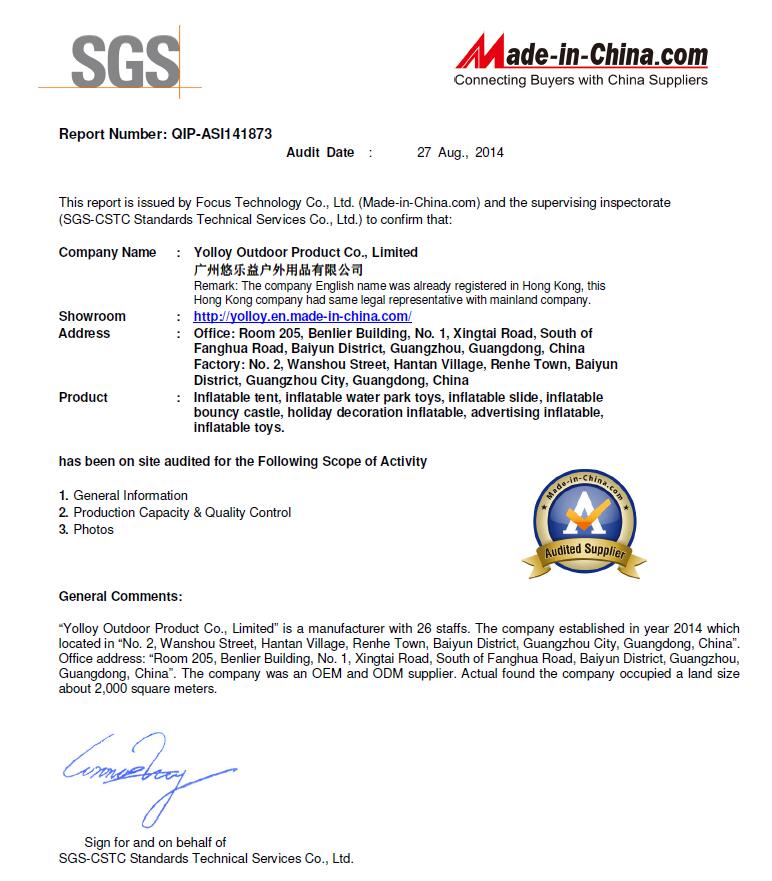
Certification

News

• New Order Successfully Finished for Long-Time Cooperated Japanese Client | YOLLOY Wins Full Client Recognition

• YOLLOY Custom Inflatable Pool Tent for Danish Client: Professional Pool Repair Shelter & Debris Protection

• Trusted Once Again! Greek Captain Re-orders Our Products After 4 Years

• Revolutionize Your Outdoors: The All-Terrain Inflatable Floating Tent for Land & Water

• Elevate Your Summer Fun: The Ultimate Inflatable Water Floating Volleyball Court Trampoline

• Innovative Inflatable Nightclub Tents & Pop-Up Bars: The Ultimate Solution for Portable Party Venues

Contact Us

Name: Sunny Yang
Tel: +86-20-8370 0771
Fax: +86-20-8370 0771
Mobile: 13570587575
E-mail: [email protected]
Add: No 5,Xiong wei Bo Nan Road,ZhongLuoTan Town,Baiyun district,Guangzhou,China
Friend me on Facebook Follow me on Twitter Add me to your circles Follow me on Pinterest Watch my channel on YouTube
News

How to choose inflatable bunkers for airsoft fields?

Author:yolloy Date:2026/8/18 7:13:31

How to Choose Inflatable Bunkers for Airsoft Fields

Setting up a new airsoft or paintball field can feel like a long list of decisions. Whether you run a small backyard arena, rent equipment for events, or manage a commercial venue, inflatable bunkers give you real advantages over fixed walls. They set up in minutes, fold down to almost nothing for storage, and can be rearranged between rounds to keep the game fresh. But not every inflatable bunker performs the same once players start hitting it. The material, the stitching, the anchoring, and the blower all decide how long it lasts and how safe it is in play. This guide walks through the points that actually matter when you compare options, so you can spend once and spend well.

Start with the material, because it does the heavy lifting

The surface a bunker is built from is the first thing to check, and it is usually the cheapest shortcut to a quick breakdown. Commercial-grade PVC tarpaulin is the standard for serious play because it absorbs repeated hits and holds its shape through a session. The thickness matters more than people expect. For casual games and light training, a thinner 0.4 mm build keeps the cost down and is perfectly fine. For inflatable airsoft bunkers meant for paintball impacts and rough play, a heavier 0.6 mm fabric resists stays and abrasion far better. Ask a supplier exactly what thickness they quote and what it is made from, not just the word "durable."

Construction matters just as much as the vinyl itself. Look for sewn panels with reinforced seams and waterproof nylon thread, with extra reinforcement added at the corners and other high-load points where players grab and lean. Airtight units should be joined with high-temperature fusion or welding equipment rather than ordinary stitching, which keeps the air in and the shape firm. If your bunkers will be outdoors all season, ask whether the material has passed relevant safety testing such as EN 14960, so you can stand behind the gear you put in front of players.

Match shapes and layout to your field size

A bunker is only useful if it fits how you actually play. Cylinders, blocks, towers, and barrel-shaped obstacles each create different sightlines and cover options, and a good mix makes a layout feel more interesting and more fair. Match the number of bunkers and their height to the size of your field and the number of players you expect. A compact arena needs fewer, lower units so it never feels crowded, while a large outdoor field can carry taller towers that force players to plan their angles. Sketch the layout before you order, and keep some flexibility to move pieces between games so the same field never plays exactly the same twice.

Check anchoring before you trust a windy day

The most over-looked part of choosing inflatable paintball bunkers is how they will stay put. On grass or uneven ground, a bunker that is not fixed down can shift mid-round or tip in a gust, which is both an annoyance and a safety concern. Good units come with D-ring or round metal anchor systems built into the fabric, and you should plan to use ground stakes, ropes, and sandbags where the wind is a factor. Ask the supplier for anchor points as standard so you are not improvising straps and zip ties on game day.

Think about inflation before you start pumping

Set-up speed comes down to the blower, not just the bunker. Confirm which voltage your site can supply, because a good supplier can provide blowers for 110 V, 220 V, or 380 V depending on your regional power. If your field has no reliable power supply, ask about battery-powered options or sealed-air units that can be inflated once and stay firm without a constant blower running. Nothing kills a rental morning faster than a bunker that needs ten minutes and a second pump to stand up, so match the inflation system to how often and where you set up.

Use customization to make the field your own

Unlike concrete walls, inflatable bunkers can be tailored to your venue. Most manufacturers offer custom sizes and colors, and many will print your logo or artwork directly on the unit, which turns cover into branding. The best suppliers can design a bunker from a simple drawing, sketch, photograph, site plan, or even just a budget you have in mind. A low minimum order matters too: a flexible manufacturer should let you start with a single piece and grow the set later as demand builds, rather than forcing you to buy a large batch up front and store it.

Budget beyond the purchase price

A cheap inflatable bunker stays cheap right up until it leaks mid-season, then it costs you twice. Factor in the running cost of maintenance when you compare products. Repairable seams, a supplied repair kit, and a fabric that survives sun and regular sliding will protect your investment over several seasons. Clean and dry the units after wet days, inspect the valves and stitching before each session, and store them dry between games. With correct use, a well-made unit should give you years of service, and a supplier that stands behind a realistic warranty and answers quickly when you have questions is worth more than a slightly lower price.

Sourcing and delivery timetables

Finally, factor in how a supplier operates before you order. A typical production run for a standard inflatable product is around 6 to 15 days, with complex or large custom bunkers taking longer, so plan around your season start date. For field owners, both air and sea freight are available, with air transit running roughly 5 to 7 days and sea taking 15 to 30 days or more. A responsive supplier answers within 24 hours and gives you a realistic delivery date, which matters far more than a small price difference when you are opening a venue on a deadline.

Choosing inflatable bunkers comes down to a handful of honest questions: what is it made of, how is it sewn, how does it stay anchored, how quickly does it inflate, and what happens when it needs repair. Answer those for your budget and your field, and you can build an arena that plays well now and holds up for years.


How to choose inflatable bunkers for airsoft fields?

Author:yolloy Date:2026/8/18 7:13:31

How to Choose Inflatable Bunkers for Airsoft Fields

Setting up a new airsoft or paintball field can feel like a long list of decisions. Whether you run a small backyard arena, rent equipment for events, or manage a commercial venue, inflatable bunkers give you real advantages over fixed walls. They set up in minutes, fold down to almost nothing for storage, and can be rearranged between rounds to keep the game fresh. But not every inflatable bunker performs the same once players start hitting it. The material, the stitching, the anchoring, and the blower all decide how long it lasts and how safe it is in play. This guide walks through the points that actually matter when you compare options, so you can spend once and spend well.

Start with the material, because it does the heavy lifting

The surface a bunker is built from is the first thing to check, and it is usually the cheapest shortcut to a quick breakdown. Commercial-grade PVC tarpaulin is the standard for serious play because it absorbs repeated hits and holds its shape through a session. The thickness matters more than people expect. For casual games and light training, a thinner 0.4 mm build keeps the cost down and is perfectly fine. For inflatable airsoft bunkers meant for paintball impacts and rough play, a heavier 0.6 mm fabric resists stays and abrasion far better. Ask a supplier exactly what thickness they quote and what it is made from, not just the word "durable."

Construction matters just as much as the vinyl itself. Look for sewn panels with reinforced seams and waterproof nylon thread, with extra reinforcement added at the corners and other high-load points where players grab and lean. Airtight units should be joined with high-temperature fusion or welding equipment rather than ordinary stitching, which keeps the air in and the shape firm. If your bunkers will be outdoors all season, ask whether the material has passed relevant safety testing such as EN 14960, so you can stand behind the gear you put in front of players.

Match shapes and layout to your field size

A bunker is only useful if it fits how you actually play. Cylinders, blocks, towers, and barrel-shaped obstacles each create different sightlines and cover options, and a good mix makes a layout feel more interesting and more fair. Match the number of bunkers and their height to the size of your field and the number of players you expect. A compact arena needs fewer, lower units so it never feels crowded, while a large outdoor field can carry taller towers that force players to plan their angles. Sketch the layout before you order, and keep some flexibility to move pieces between games so the same field never plays exactly the same twice.

Check anchoring before you trust a windy day

The most over-looked part of choosing inflatable paintball bunkers is how they will stay put. On grass or uneven ground, a bunker that is not fixed down can shift mid-round or tip in a gust, which is both an annoyance and a safety concern. Good units come with D-ring or round metal anchor systems built into the fabric, and you should plan to use ground stakes, ropes, and sandbags where the wind is a factor. Ask the supplier for anchor points as standard so you are not improvising straps and zip ties on game day.

Think about inflation before you start pumping

Set-up speed comes down to the blower, not just the bunker. Confirm which voltage your site can supply, because a good supplier can provide blowers for 110 V, 220 V, or 380 V depending on your regional power. If your field has no reliable power supply, ask about battery-powered options or sealed-air units that can be inflated once and stay firm without a constant blower running. Nothing kills a rental morning faster than a bunker that needs ten minutes and a second pump to stand up, so match the inflation system to how often and where you set up.

Use customization to make the field your own

Unlike concrete walls, inflatable bunkers can be tailored to your venue. Most manufacturers offer custom sizes and colors, and many will print your logo or artwork directly on the unit, which turns cover into branding. The best suppliers can design a bunker from a simple drawing, sketch, photograph, site plan, or even just a budget you have in mind. A low minimum order matters too: a flexible manufacturer should let you start with a single piece and grow the set later as demand builds, rather than forcing you to buy a large batch up front and store it.

Budget beyond the purchase price

A cheap inflatable bunker stays cheap right up until it leaks mid-season, then it costs you twice. Factor in the running cost of maintenance when you compare products. Repairable seams, a supplied repair kit, and a fabric that survives sun and regular sliding will protect your investment over several seasons. Clean and dry the units after wet days, inspect the valves and stitching before each session, and store them dry between games. With correct use, a well-made unit should give you years of service, and a supplier that stands behind a realistic warranty and answers quickly when you have questions is worth more than a slightly lower price.

Sourcing and delivery timetables

Finally, factor in how a supplier operates before you order. A typical production run for a standard inflatable product is around 6 to 15 days, with complex or large custom bunkers taking longer, so plan around your season start date. For field owners, both air and sea freight are available, with air transit running roughly 5 to 7 days and sea taking 15 to 30 days or more. A responsive supplier answers within 24 hours and gives you a realistic delivery date, which matters far more than a small price difference when you are opening a venue on a deadline.

Choosing inflatable bunkers comes down to a handful of honest questions: what is it made of, how is it sewn, how does it stay anchored, how quickly does it inflate, and what happens when it needs repair. Answer those for your budget and your field, and you can build an arena that plays well now and holds up for years.