Products Category
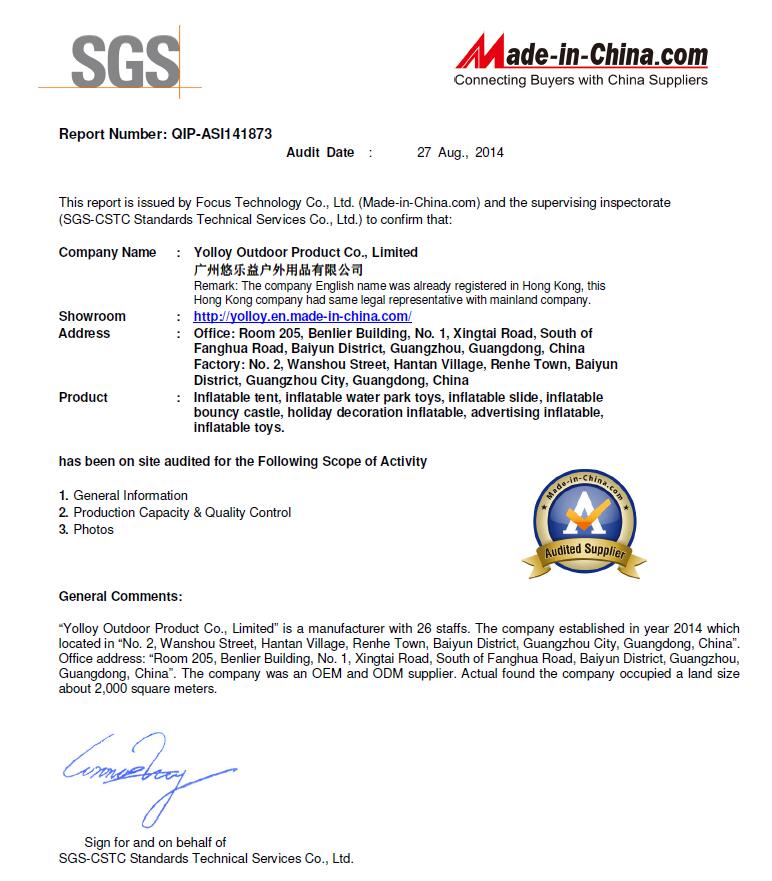
Certification

News

• New Order Successfully Finished for Long-Time Cooperated Japanese Client | YOLLOY Wins Full Client Recognition

• YOLLOY Custom Inflatable Pool Tent for Danish Client: Professional Pool Repair Shelter & Debris Protection

• Trusted Once Again! Greek Captain Re-orders Our Products After 4 Years

• Revolutionize Your Outdoors: The All-Terrain Inflatable Floating Tent for Land & Water

• Elevate Your Summer Fun: The Ultimate Inflatable Water Floating Volleyball Court Trampoline

• Innovative Inflatable Nightclub Tents & Pop-Up Bars: The Ultimate Solution for Portable Party Venues

Contact Us

Name: Sunny Yang
Tel: +86-20-8370 0771
Fax: +86-20-8370 0771
Mobile: 13570587575
E-mail: [email protected]
Add: No 5,Xiong wei Bo Nan Road,ZhongLuoTan Town,Baiyun district,Guangzhou,China
Friend me on Facebook Follow me on Twitter Add me to your circles Follow me on Pinterest Watch my channel on YouTube
News

How does an inflatable water park for adults differ from one for kids?

Author:yolloy Date:2026/8/19 5:14:24

Walk up to an inflatable water park at a summer event and the first thing you notice is who is lining up to ride. At a kids' birthday party the queue is full of small, excited swimmers. At a corporate picnic or a resort pool deck, the riders are taller, heavier, and looking for a bigger thrill. The two crowds are not interchangeable, and neither are the units built for them. An inflatable water park for adults is engineered differently from a children's model in almost every way that matters: dimensions, weight limits, materials, features, and the safety systems that hold it all together.

Bigger footprint, taller slides

The most obvious difference is scale. A unit designed for children typically keeps its slide deck at a height a small rider can climb to comfortably, and its footprint is sized for a backyard or a modest party venue. Adult-oriented parks push the slide deck higher and stretch the overall layout so that several full-grown riders can be on the structure at once without crowding. Taller slides mean a longer, faster descent, which is exactly what an adult audience expects from a water attraction.

This larger scale has a practical consequence for operators: a bigger park needs more air volume, more water, and more space to set up safely. It is not just a matter of ordering a larger model and hoping for the best. The blower, the anchoring plan, and the site itself all have to be sized to match the unit.

Higher weight capacity and reinforced structure

Weight is where the engineering really separates the two categories. A children's water park is rated for the weight of a child, and its bounce surfaces and slide beds are built accordingly. An adult-rated unit has to absorb the impact of riders who can be two or three times heavier, landing on the same slide bed and splash pool over and over again throughout a busy day.

That is why commercial-grade construction matters so much. A well-built adult park uses commercial-grade PVC tarpaulin rather than lightweight residential film, and its seams are heat-welded or precision-sewn with reinforced stitching at every high-stress point instead of relying on simple glued joints. Some premium platforms use drop-stitch technology, which creates a rigid, board-like surface that adults can stand and walk on without the unit sagging underfoot. When you compare a flimsy residential unit with a properly built commercial one, the difference in stiffness and stability is immediately obvious the moment you step onto it.

Wider lanes and different slide geometry

Slide lanes are another giveaway. A lane sized for a child is narrow, because a child's shoulders are narrow. An adult needs noticeably more width to slide safely and comfortably. If an adult rides a lane that is too tight, they can catch the walls of the slide, slow down mid-ride, or in the worst case get stuck. Adult-oriented parks use wider lanes and longer slide beds so that a full-grown rider can keep up speed and land clear of the slide mouth.

The same logic applies to climbing surfaces and entry platforms. Steps and handholds that suit a six-year-old are awkward and even unsafe for an adult, so adult units are laid out with larger steps, higher rails, and platforms that can take repeated heavy use.

Features adults actually want

The attractions themselves also differ. Kids' parks are built around bouncing, splashing, and simple slides. Adult-oriented installations lean toward social and lounge-style features: floating bars, above-ground pool bars, relaxation zones, floating leisure platforms, and spacious splash areas where groups can gather. A resort or a waterfront venue will often pair a large slide with a floating platform or a pool bar so that adult guests can move between active play and socializing without leaving the water.

This is also where a commercial inflatable water park earns its keep for operators. A unit that appeals to adults can be booked for corporate events, company picnics, adult birthday parties, and resort programming, which broadens the rental calendar well beyond the kids' party season.

Materials, certification, and safety standards

Safety standards are not optional for either category, but the relevant standards differ. Inflatable water parks are commonly referenced against EN 15649, while inflatable toys and bounce products are associated with EN 14960; materials are also tested against standards such as EN71 and RoHS for safety and non-toxicity. A serious manufacturer will state which standards its materials and products are built to meet, and a commercial buyer should ask for that documentation before ordering.

Anchoring is another point where adult units demand more. Because they are larger and catch more wind, they need a proper anchoring system, typically D-ring or round metal anchor points built into the structure, so the unit can be staked or weighted down securely. For an adult park in particular, underestimating wind load is not a minor mistake; it is a safety risk.

Blowers and power requirements

A larger, heavier park needs a blower that can keep it fully inflated under constant use. Commercial units are supplied with appropriately powered blowers, and reputable manufacturers offer blowers for 110V, 220V, or 380V supplies so the unit can run on the power available at the venue. Operators should confirm the blower rating matches the unit and the site, and plan for separate circuits when a park needs more than one blower.

Customization matters for commercial buyers

For businesses buying an adult water park, off-the-shelf rarely fits perfectly. A manufacturer that offers custom sizes, colors, and printed logos lets an operator brand the attraction or match it to a venue. YOLLOY, a Guangzhou-based inflatable manufacturer, builds custom inflatable water parks, floating platforms, pool bars, and inflatable water slides from a description, drawing, sketch, photograph, or site plan, with a minimum order quantity of just one piece. Typical production runs 6 to 15 days for a regular inflatable product, and every unit ships with a repair kit and a blower matched to the order.

Choosing the right park for your crowd

The short version is simple: buy for the riders you will actually host. If your events are mostly children's parties, a kid-rated unit is the right size and the right price. If your audience is adults, or a mix that includes adults, invest in a unit with taller slides, wider lanes, higher weight ratings, reinforced seams, and proper anchoring. The extra cost is repaid in safety, durability, and a much better experience for the people using it.

If you are planning an adult-oriented water attraction and want it built to your exact site and brand, talk to a manufacturer that can customize the design, certify the materials, and ship with the right blower. That is the difference between a toy and a commercial attraction that keeps guests coming back.


How does an inflatable water park for adults differ from one for kids?

Author:yolloy Date:2026/8/19 5:14:24

Walk up to an inflatable water park at a summer event and the first thing you notice is who is lining up to ride. At a kids' birthday party the queue is full of small, excited swimmers. At a corporate picnic or a resort pool deck, the riders are taller, heavier, and looking for a bigger thrill. The two crowds are not interchangeable, and neither are the units built for them. An inflatable water park for adults is engineered differently from a children's model in almost every way that matters: dimensions, weight limits, materials, features, and the safety systems that hold it all together.

Bigger footprint, taller slides

The most obvious difference is scale. A unit designed for children typically keeps its slide deck at a height a small rider can climb to comfortably, and its footprint is sized for a backyard or a modest party venue. Adult-oriented parks push the slide deck higher and stretch the overall layout so that several full-grown riders can be on the structure at once without crowding. Taller slides mean a longer, faster descent, which is exactly what an adult audience expects from a water attraction.

This larger scale has a practical consequence for operators: a bigger park needs more air volume, more water, and more space to set up safely. It is not just a matter of ordering a larger model and hoping for the best. The blower, the anchoring plan, and the site itself all have to be sized to match the unit.

Higher weight capacity and reinforced structure

Weight is where the engineering really separates the two categories. A children's water park is rated for the weight of a child, and its bounce surfaces and slide beds are built accordingly. An adult-rated unit has to absorb the impact of riders who can be two or three times heavier, landing on the same slide bed and splash pool over and over again throughout a busy day.

That is why commercial-grade construction matters so much. A well-built adult park uses commercial-grade PVC tarpaulin rather than lightweight residential film, and its seams are heat-welded or precision-sewn with reinforced stitching at every high-stress point instead of relying on simple glued joints. Some premium platforms use drop-stitch technology, which creates a rigid, board-like surface that adults can stand and walk on without the unit sagging underfoot. When you compare a flimsy residential unit with a properly built commercial one, the difference in stiffness and stability is immediately obvious the moment you step onto it.

Wider lanes and different slide geometry

Slide lanes are another giveaway. A lane sized for a child is narrow, because a child's shoulders are narrow. An adult needs noticeably more width to slide safely and comfortably. If an adult rides a lane that is too tight, they can catch the walls of the slide, slow down mid-ride, or in the worst case get stuck. Adult-oriented parks use wider lanes and longer slide beds so that a full-grown rider can keep up speed and land clear of the slide mouth.

The same logic applies to climbing surfaces and entry platforms. Steps and handholds that suit a six-year-old are awkward and even unsafe for an adult, so adult units are laid out with larger steps, higher rails, and platforms that can take repeated heavy use.

Features adults actually want

The attractions themselves also differ. Kids' parks are built around bouncing, splashing, and simple slides. Adult-oriented installations lean toward social and lounge-style features: floating bars, above-ground pool bars, relaxation zones, floating leisure platforms, and spacious splash areas where groups can gather. A resort or a waterfront venue will often pair a large slide with a floating platform or a pool bar so that adult guests can move between active play and socializing without leaving the water.

This is also where a commercial inflatable water park earns its keep for operators. A unit that appeals to adults can be booked for corporate events, company picnics, adult birthday parties, and resort programming, which broadens the rental calendar well beyond the kids' party season.

Materials, certification, and safety standards

Safety standards are not optional for either category, but the relevant standards differ. Inflatable water parks are commonly referenced against EN 15649, while inflatable toys and bounce products are associated with EN 14960; materials are also tested against standards such as EN71 and RoHS for safety and non-toxicity. A serious manufacturer will state which standards its materials and products are built to meet, and a commercial buyer should ask for that documentation before ordering.

Anchoring is another point where adult units demand more. Because they are larger and catch more wind, they need a proper anchoring system, typically D-ring or round metal anchor points built into the structure, so the unit can be staked or weighted down securely. For an adult park in particular, underestimating wind load is not a minor mistake; it is a safety risk.

Blowers and power requirements

A larger, heavier park needs a blower that can keep it fully inflated under constant use. Commercial units are supplied with appropriately powered blowers, and reputable manufacturers offer blowers for 110V, 220V, or 380V supplies so the unit can run on the power available at the venue. Operators should confirm the blower rating matches the unit and the site, and plan for separate circuits when a park needs more than one blower.

Customization matters for commercial buyers

For businesses buying an adult water park, off-the-shelf rarely fits perfectly. A manufacturer that offers custom sizes, colors, and printed logos lets an operator brand the attraction or match it to a venue. YOLLOY, a Guangzhou-based inflatable manufacturer, builds custom inflatable water parks, floating platforms, pool bars, and inflatable water slides from a description, drawing, sketch, photograph, or site plan, with a minimum order quantity of just one piece. Typical production runs 6 to 15 days for a regular inflatable product, and every unit ships with a repair kit and a blower matched to the order.

Choosing the right park for your crowd

The short version is simple: buy for the riders you will actually host. If your events are mostly children's parties, a kid-rated unit is the right size and the right price. If your audience is adults, or a mix that includes adults, invest in a unit with taller slides, wider lanes, higher weight ratings, reinforced seams, and proper anchoring. The extra cost is repaid in safety, durability, and a much better experience for the people using it.

If you are planning an adult-oriented water attraction and want it built to your exact site and brand, talk to a manufacturer that can customize the design, certify the materials, and ship with the right blower. That is the difference between a toy and a commercial attraction that keeps guests coming back.